Where did ideas about learning disabilities come from?

Where did ideas about learning disabilities come from?

Patrick McDonagh is the author of Idiocy: A Cultural History, which explores representations of ‘idiocy’ and how people’s ideas of what might constitute ‘idiocy’ – and later, learning disability – were shaped through literary and other works from the 16th to the start of the 20th centuries.


When I was growing up in Vancouver, Canada, I attended primary school in a cluster of portable trailers placed on an grassy lot. Our playground had a large metal fence, and on the other side of the fence other children played. One day I was playing with a group of kids near the fence, while a girl played on the other side, when one of the boys from my class yelled at her, “Hey, are you retarded?” She gave him a look of disdain – I can still see it – and said “No.” Then she moved further away.


This exchange – the taunting question and the affronted rebuttal – stand out for me because it was the first time I heard the word “retarded.” I recall not knowing what this term signified, although clearly it was not good and seemed as it must be somehow connected to why a fence separated these two playgrounds: those children were different. I discovered many years later that the Oakridge School for children with special needs lay on the other side of the fence.


Strange impressions

I now recall this incident as the first of several that led me to become a historian of learning disabilities. In the early 1980s, while an undergraduate, I worked in a program with autistic youth and, a few years later, while pursuing my masters degree in English literature, I co-founded with a couple of friends the Spectrum Society for Community Living, which still operates in Vancouver. We were supporting people who were moving into the community from a massive long-stay institution which was shutting down and I became intrigued by how some people in the community seemed to hold the strangest impressions of what people with learning disabilities were like. Where did these ideas come from, I wondered?


And that question has changed my life. It turned me into a historian. And as a historian, my focus has been directed primarily at earlier ideas that I call ‘precursor notions’ to learning disability: ideas like ‘idiocy’, whose meaning has shifted dramatically from its first medieval appearance in English to its 19th century meaning.  A term like ‘idiocy’ is not simply an earlier term for what we now consider to be learning or intellectual disability. But it – along with many other notions – forms part of the historical lineage that leads to our current ideas.


Shaping ideas

My interest has been in how these ideas – whether they be ‘idiocy’ or ‘mongolism’ ‘learning disability’ or ‘autism’ – have been shaped. This involves looking at plays, poetry, and novels that deal with these ideas, as well as legal documents, 19th century  medical and scientific writings, and a vast range of other historical evidence.


The ultimate goal is to point to the factors that go into creating a particular group of people, establishing the boundaries that contain that group, and then reinforcing those boundaries. In understanding how this process occurs, we can also imagine the opposite process: what might dissolve those boundaries and reshape our ideas of disability and difference. In this way, I hope my historical work can help transform ideas about disability, intelligence and authority, and open spaces to imagine better futures for people who currently bear the labels that set them apart.

Self injury and bereavement: the role of relationships in helping people deal with difficult feelings

Self injury and bereavement: the role of relationships in helping people deal with difficult feelings

David O’Driscoll reviews two books exploring these complex and disturbing subjects


Understanding and Working with People with Learning Disabilities who Self Injure

Edited by Pauline Heslop and Andrew Lovall

Jessica Kingsley, 2013


Supporting People with Intellectual Disabilities Experiencing Loss and Bereavement: Theory and Compassionate Practice

Edited by Sue Read

Jessica Kingsley, 2014


When I first started working as a psychodynamic psychotherapist in the National Health Service, one of my first patients was a woman with learning disabilities who was self-harming. She cut her hair with scissors, attacking it in an alarming manner, causing considerable unease and confusion to her support team. She had begun this behaviour after her father died.


After some discussion, it was established that she was not told about the death of her father until maybe only a week before the funeral. I also found out that her father was a hairdresser. Both aspects were key elements in her self-harm.


We were able, over the course of the psychotherapy, to think about the meaning of such an act and the dynamics behind it. It was also a lesson for me in how people in anguish use their body to communicate inner distress.  And also – and this is an important point – that they can be helped by a psychological intervention.


For many practitioners working in learning disabilities, self–harm and loss and bereavement are complex, disturbing, and often upsetting subjects.


Two books from Jessica Kingsley explore in detail these two topics. The layout is similar. Both are essentially a collection of essays from a diverse group of practitioners and academics. Heslop and Lovall’s book runs to 13 chapters while Read’s goes to 18.


Read’s book is split into three sections; theoretical perspectives, contemporary practice issues, and specialist contexts and considerations. Heslop and Lovall’s book is split into two sections; ‘different approaches to understanding self-injury’ followed by ‘different approaches with working with people who self-injure.’ Each chapter has handy implications for practice at the end. This is a feature of all Jessica Kingsley books which I value.


Self injury

The self-injury collection is a valuable group of essays. The opening chapter by the editors on ‘dimensions of self–injury’ was a highpoint for me, describing the complications and many functions in self-harming; for example, “one function of self-injury may be the reduction of pain”;  also, “self-injury might provide paradoxical respite from the distress experienced by being in physical pain” (p. 10). People with learning disabilities are particularly vulnerable to self-injury. Cutting is the most common form in up to 90 per cent of self injury cases according to one survey.


Historically, there have been only biological or behavioural approaches with a long history of the latter offered to this group; this includes some shocking examples used as a form of punishment. My clinical experience tells me there is often a link to loss, which is overlooked. Support workers often struggle to help or understand it; clearly, being told not to self-injure is unhelpful, nor are the various distraction techniques which are so common.


While this may be self-evident it does not, in my experience, stop professionals using these techniques. There is still a worrying emphasis on pharmaceutical interventions. The authors and writers in the Heslop and Lovall collection are focused on the need to find a way of understanding the behaviour as a communication. A number of the authors focus on the key being a link to developing relationship. I like Valerie Sinason’s ideas as self-harm as a form of ‘life-saving medication’ or ‘trauma re-enactment syndrome’.Several chapters explore the role of difference in self-harming; the chapter by Lovell on family voices was particularly moving.


Loss and bereavement

Loss is a subject many professionals in the learning disability community would claim they are familiar with. This means having an understanding of a model of grief highlighting denial, anger, sadness, guilt, and recovery. Sigmund Freud describes it as a job of work we need to pay attention to.  Many professionals from specialist services may state it is nothing to be frightened of. And yet somehow I am not convinced.


I think they would help themselves by reading this collection and others, like Dr Noelle Blackman’s book (2003). Read has assembled an impressive range of authors from across the globe but it has very much a Staffordshire flavour due to her connection with the University there. In her introduction, Read makes the important point that  “loss permeates throughout everyone’s lives but for some communities it may be harder to express feelings of loss in meaningful, socially acceptable ways and individuals may not be given the appropriate support they need at the time they need it the most.”


There is too much to discuss in this brief review but the highlights for me were the very practical approach by the advocacy group, ‘reach’, which many support services could benefit from reading. I also enjoyed reading about some new areas for me: supporting children and young people with a life limiting condition and spirituality and faith which often gets overlooked.


The chapter on complicated grief was also a highlight and its role in suffering for many people. “For people with learning disabilities, the impact of grief is poorly understood in general, and our understanding of the impact of complicated grief is developing slowly”. This chapter pointed to their vulnerability but also the importance of psychological intervention and training. “Professional carers are arguably not adequately prepared to identify a possible negative reaction to bereavement or to provide effective support”.


I would have liked some more examples of clinical work, as seen in the self-injury book, maybe including contributions from the creative therapists and their approach to loss.


Amateur listening

Although in both books there is some overlap in contributions, both are valuable contributions to the existing literature. Both emphasise the role of relationships in helping people deal with difficult feelings, even the role of amateur listening, often overlooked.


The National Health Service recently published its survey into staff attitudes about working. They were asked what areas they would like to see improved and the key one was training. There was a general view that the training offered was poor and that staff wanted more specialism training. I have written about this elsewhere, stressing my belief that loss and bereavement training should be compulsory (O’Driscoll, 2015).


Now, after reading this collection, I think the same should be said for understanding self-harm.


References

Blackman, N.  (2003). Loss and Learning Disability.  Wurth publishing

O’Driscoll, D. (2015)  Nothing to be frightened of?  Loss and learning disability.  Learning Disability Today.  January/February 2015


David O’Driscoll, Psychotherapist Loss and Bereavement, Specialist Learning Disability Services,

Hertfordshire Partnership University NHS Foundation Trust

Valley of the DoLS…

Belinda Schwehr, Community Living’s legal correspondent, analyses the interpretations of the Cheshire West case which continues to cause confusion among both legal and social work practitioners.

As reported in Community Care* Mr Justice Mostyn has drawn attention to the ongoing Cheshire West confusion and sparked further controversy. The Court of Appeal has also criticised Lord Justice Munby’s approach to resolving the confusion via Court of Protection procedural rules. Grappling with the fallout from the Cheshire West case (see Community Living, 28.4) in what was supposed to be an appeal, the Lord Justice cited two out of 25 individuals whose situations he used as examples to assist local authorities and the legal world.

Meanwhile, Mr Justice Mostyn’s judgment in a Rochdale case involving a lady who could hardly walk, has been appealed with his permission in an attempt to get the issue referred to more senior judges. But his judgment was overturned by consent, which only happens when both sides recognise that the judge is fundamentally wrong. The Court of Appeal has formally allowed that appeal but without indicating precisely how Mr Justice Mostyn’s approach was flawed.

In Bournemouth BC v PS and DS, he ruled that a man with autism and associated challenging behaviour – known as ‘Ben’ – was not deprived of his liberty in the bungalow in which he received round-the-clock care from staff.

The judge ruled that Ben was not under continuous supervision because his carers afforded him “appreciable privacy” and he was free to leave because, if he did go, his carers would seek to persuade him to return rather than coerce him. If he refused, a Mental Health Act assessment would be considered and if this proved unsuccessful the police would be asked to exercise their powers under section 136 of the Mental Health Act to remove him to a place of safety. Mr Justice Mostyn said that unless and until this happened, “Ben is a free man”.

That might not seem like a distinction that matters but it is real in legal terms. Mr Justice Mostyn was not making an indefensible judgment – all he was trying to do was say, “Whoa there! Professionals may need to think more rigorously before coming to the Court of Protection for approval of a state of affairs regarded as deprivation of liberty, rather than as proportionate restriction. This man is not free to leave.”

In Rochdale MBC v KW   Mr Justice Mostyn had ruled that a 52-year-old severely mentally incapacitated and physically disabled woman living in rented accommodation was not deprived of her liberty. He said her freedom to leave her home – in terms of going to live elsewhere – was not constrained because the extent of her disabilities meant that she could not exercise her rights. “She is not in any realistic way being constrained from exercising the freedom to leave, in the required sense, for the essential reason that she does not have the physical or mental ability to exercise that freedom. Soon she may not have the motor skills to walk even with her frame. If she becomes house-bound or bed-ridden it must follow that her deprivation of liberty just dissolves.

This would mean that anyone who was physically incapable of getting to the door, and mentally incapable of asking for help to get there and into a cab, was not deprived of their liberty.

It must be seen at once that this is wholly inconsistent with the case law as it has been developing. It harked back to the ‘relative normality’ test, which has been comprehensively rejected by the Supreme Court because it collapsed the distinction between the existence of a deprivation of liberty, and its justification.

The Court of Appeal accepted the position of counsel that this was an incorrect approach, but Mr Justice Mostyn has defended his position by saying that this was not the basis of the case; instead, he maintained, the principle was that the care being received in her own home, which was her right, based on her care assessment and care plan, as opposed to an imposed regime, should not be regarded as a deprivation of liberty.

The Court of Appeal’s decision to  allow the appeal without a hearing was strongly criticised by Mr Justice Mostyn in a second judgment on the Rochdale case issued in March. He said that the woman’s status was now ‘in limbo’ as the Court of Appeal had not declared that she was deprived of her liberty; only that if she were, that deprivation was now authorised.

Much as the Court of Appeal has said that their views about the need for the person always to be a party in the case, the non-appeal case mentioned above cannot be regarded as an appellate judgment because there was no jurisdiction to hear an appeal against an exercise on which Lord Justice Munby had no  jurisdiction to embark. Mr Justice Mostyn has said the same about the Rochdale case referring to the Rules of Court on allowing appeals by consent:

“There has to be a judgment explaining why my decision was wrong (no-one has suggested that it was procedurally unjust). But there is no judgment. Mr Fullwood agrees that the annex to the order is not a judgment. So I do not know why my jurisprudential analysis in this case as augmented in the Tower Hamlets case is said to be wrong. The narrative in the annex does not say anything other than that I was wrong, aside from a mere assertion that I made a material error as to K’s downward path in terms of her mobility, which, as I have explained above, was immaterial to my decision.”

Had he augmented his decision, in the Tower Hamlets case? That case involved a woman called TB, who had a moderate to severe learning disability. SA was her husband, and in fact, her first cousin. SSB was also TB’s first cousin and TB’s husband had taken her as a polygamous second wife. That marriage was valid under the laws of Islam but was completely invalid under UK law. Four children born to TB and SA in the past had been removed permanently from the parents and placed for adoption. Two daughters had been born through the second marriage.

Mr Justice Mostyn had found it would not be in TB’s best interests to return to live in her home with SA, SSB and any child, determining that she should instead live in supported accommodation provided by the applicant local authority, which either had to be improved, in terms of the long hours of downtime and lack of stimulation she was experiencing, or provided elsewhere.

On the question of whether the 24-hour care she needed would amount to a deprivation of liberty, he noted that TB would not be cared for at a place understood to be her home, and she had motor functions to achieve a departure in a meaningful sense. In that case, he said, since she will be monitored round the clock and were she to leave to try to go ‘home’ she would be brought back, her situation is therefore very different to the lady in the Rochdale case.  “Although I personally cannot see that her situation amounts to state detention in any sense other than by reference to the term of art devised by the majority in the Supreme Court, I must loyally follow that decision. I therefore declare that TB’s care regime does involve detention under Article 5 {of the Human Rights Act}.”

I do not think the learned judge has augmented his reasoning. He simply distinguished the case on the grounds that this lady would be monitored round the clock and would be able to leave and reasserted his own opinion that it should not be regarded as deprivation but then he reluctantly accepted that the acid test, of not being free to leave, was met. To my mind, this underlines why the Court of Appeal was correct to allow the appeal by consent.

Whatever I think about the breakdown of judicial politeness and increasing strains beginning to emerge, I have to agree with Mr Justice Mostyn that: “All this will cost huge sums, sums which I would respectfully suggest are better spent on the front line rather than on lawyers.”

So what next? The consultation proposals came out on 7 July and will take one year, and not two.  (Belinda will examine these in the autumn issue of Community Living).

Meanwhile, the ‘Baby Bournewood’ case of Re D, perhaps indicates a way forwards, for young people and people being cared for by their own relatives. In that case, involving a 15 year old, the factual regime clearly amounted to deprivation of liberty: the child was not free to leave, and the State was managing the regime. However, the decision was that it did not have to be authorised under the inherent jurisdiction of the High Court’s Family Division, because the parents had conscientiously and carefully authorised it, and the regime was benign.

This approach looks at first to conjure precisely the same legal dilemma as has arisen in the adult world: does the different situation of the disabled child – different from that of a normal child – mean that the regime is not a deprivation of liberty at all, after best interests consideration and consent from those with authority (which would mean that welfare deputies and lasting power of attorneys for welfare would also have that power, regarding adults) or does it mean that it is a deprivation of liberty but that it does not infringe Article 5 rights because it is consented to by someone with authority, ie here the parents?

To test this out, add a few months, and this boy becomes 16 – he may or may not lack capacity in terms of the Mental Capacity Act (at 15 he was regarded as not Gillick competent to consent for himself but had only a mild learning disability and some paranoid perceptions). Assuming he is MCA-incapacitated as well: would his regime have to be considered under the MCA welfare order route (DoLS not applying until he was 18, even though he was in a hospital)?

The legal answer depends on how you characterise the situation: not deprivation, because authorised by his parents – in which case, that route to avoiding having to go to court would still work for over 16 year olds, (excluding, of course, a case of Munchausen’s concerns or out-of-the-ordinary invasiveness by other-than-benign parents) – and the Court does not have to run a 24-hour service to allow for hearings for all those children.

An alternative approach is, ‘Yes, it is a deprivation, because of the objective confinement, and yes, it is authorised by dint of parental rights, until someone is 18 – but the more actively it offends the wishes and feelings of the young person (who will invariably be lacking in capacity for the MCA to be relevant at all) – the more important it is to get the matter to Court for Article 5.4 purposes. That is, there will need to be a judicial process in some, but not all cases – unless or until DoL Safeguards are formally extended.

With an over 18-year old, there would be nobody to consent other than the State, and that is why it is different, and DoLS was the best we could do. But an LPA or deputy for welfare could be given this power, subject to clear legal constraints, and the European Convention countries would no doubt breath a huge collective sigh of relief.

A judge might therefore say, “This does not engage Article 5 rights” or, if it still does, then “The nation’s economic wellbeing concerns when looking at parents’ Article 8 rights, have to be balanced against the Article 5 rights”, or that the deprivation does not ‘sound’ in European Convention or UK Human Rights terms because once authorised by the parent/attorney/deputy it is not imputable to the State.

* Judge makes second call for Supreme Court to reconsider Cheshire West due to “serious confusion” in law. Community Care, 12 June 2015.

Getting the best from PIP assessments

Female researcher

Getting the best from PIP assessments

Assessments for Personal Independence Payments are geared towards health problems rather than difficulties in daily living. Liz Tilly and the Building Bridges Research Group carried out a project which showed the importance of having an advocate present during assessments.


The Building Bridges Research Group

is composed of people with learning disabilities based in Sandwell. They are part of Building Bridges Training and have been working together since 2010 doing inclusive research to understand the issues that affect the lives of people with learning disabilities. The group’s previous research had found that living with poverty had a major impact on the group’s social inclusion and their ability to have a full life in the community so increasing their income was a priority.


The PIP research project

Starting in the summer of 2014, three of the group members were supported to make a successful PIP claim and used the experience as a research project so others could learn from their journey. The three have a mild learning disability and live independently and had not previously made a successful claim for DLA or PIP. The aim was to explore how the PIP application process was experienced by the new claimants and how the assessment criteria for receiving the benefit related and compared to their experiences.  It also considered the type and level of support the claimants needed.


Personal Independence Payments

Personal Independence Payments (PIP) started to replace Disability Living Allowance (DLA) as the main UK disability welfare benefit in 2013.  PIP is awarded to help with some of the extra costs caused by long-term ill health or a disability for people aged 16 to 64.  It has two parts: the daily living component and the mobility component.  To get the standard rate claimants must score at least 8 points and to get the enhanced rate at least 12.  A claimant can receive different rates for each component. For more information see https://www.gov.uk/pip/overview. This means claimants can receive between £21.80 and £139.75 a week, a considerable increase in income for people on Job Seekers Allowance (JSA).


PIP has been controversial due to the long time it takes for a claim to be assessed; an average of 9 to 14 months (The Guardian 17.9.14), the need for claimants to emphasise their impairments and the controversy over the efficiency of the private sector organisations undertaking the assessment.  The assessment is considered by many to have a focus on the impact of physical impairment and less on the impact of having a learning disability on coping with independent living.


The assessment

I attended appointments with each person at each step of their claim, i.e. the initial appointment with the Welfare Rights Unit to start the claim and then later at their assessment which took place at the claimant’s home. The assessors were all from a health background rather than a social care background. After the interviews the claimants said they found the assessors’ language level too complex, although one of the assessors had been able to simplify their language during the course of interview.

It was also difficult for the group to recall and accurately give various facts such as names and purpose of medication, partner’s date of birth  and length of time living at previous addresses.  Ironically, ability to remember these facts related to having a mild learning disability but without this information the claim could not be processed.

Another aspect identified as challenging was being able to give in-depth verbal responses to open questions, such as ‘how does your condition affect your daily life?’  One claimant in particular gave mainly yes or no responses yet it was the in-depth explanation of difficulties in daily life and with mobility that enabled the assessor to attribute vital points.


Scoring points

Many aspects of the assessment related to health issues and physical impairment which weren’t issues for the claimants. The daily living component allocates points for difficulties with specific aspects of daily living. Some of these, such as washing, dressing and eating, did not present difficulties to the claimants.  However, they did score points for difficulties in preparing and cooking a hot meal, managing dosage of medication and needing help with budgeting. For the mobility component, points were scored for inability to travel to an unknown place. Our reflections following the assessments were that the rigid assessment questions seemed to simplify daily living and didn’t take into account the broader issues that make life challenging for people with a mild learning disability living independently. For example, all have top-up meters for gas and electric but to keep these topped up needs a range of organisational skills to plan and budget for when this is needed. The assessment doesn’t cover aspects of personal, home and community safety, coping in unfamiliar situations, functional numeracy, coping in a crisis, motivation to implement the skills they have and, increasingly important, digital skills.

Moreover the assessment doesn’t take into consideration the broader independent living skills requiring executive functioning skills: the ability to plan ahead, to think strategically, to self-organise and to prioritise what is urgent and important.


Outcomes of the application

We understood the process could take nine months; however, it only took approximately six months for each person to hear the positive news that they had been successful. Each received back pay from the date they started their claim journey, a considerable one-off back payment. This enabled them to be able to replace larger home items, purchase winter coats and even more luxury items such as a TV and a tablet. They all received the enhanced rate for daily living and the standard rate for mobility, making a substantial increase in their monthly income.


Conclusions

During their assessments the claimants found difficulty in communicating their experiences and challenges of independent living as these were broader than the narrow criteria used. Their difficulties in independent living were also exacerbated by poverty, their motivation for claiming the benefit. They were not claiming for the additional costs of having a disability, or because it was their right, but out of a need to increase their income to pay for essentials and for the costs of social and community activities. These had previously been unaffordable which had increased their social exclusion.  The claimants all said that having the appointment in their own homes was important to them as going to a strange place, even with someone supporting them, was stressful.


We hope that, despite the rhetoric that PIP is harder to claim than DLA especially for people with a mild learning disability, more will now apply to claim this benefit and, hopefully, be successful. However, we think that having someone present at the assessments who can be an advocate but also someone who knows the person well and can contribute to explaining the things that makes life challenging is imperative. This also has implications for people with learning disabilities who don’t have access to support or social capital outside their immediate networks, as is the case for many people with a mild learning disability.


Whilst there is a good easy read fact sheet available about PIP on the gov.uk website https://www.gov.uk/government/publications/about-pip-what-it-is-and-how-to-claim-it-easy-read-guide  we also think it would be helpful for people to have an accompanying easy read form for people to gather the key information they need in advance of the first stage of the claim, particularly if the person has difficulty remembering personal information, such as previous addresses and dates living at them.


Finally, whilst we recognise that the length of time from first registering to outcome of the claim has become much shorter, all the members of the group feel this should still be significantly reduced.


Justice for LB – the fight continues

Justice for LB – the fight continues

Rosemary Trustam attended an unforgettable exhibition of artwork to retain the momentum of the campaign for justice for Laughing Boy.


To keep alive the campaign for justice for Connor Sparrowhawk an artwork exhibition was held at Lancaster University’s Peter Scott Gallery. The exhibition was opened by Connor’s mother Dr Sarah Ryan on 18 May.


It’s now over two years since Connor (known as Laughing Boy) was admitted to the unit where he died 107 days later. On a second round of #107days focusing on themed weeks, the campaign continues to aim for justice and accountability for those responsible. This was well illustrated by the wealth of artwork on display.


The launch was attended by one of the staunchest campaign supporters social care consultant George Julian. Also present were Professor Chris Hatton, Co-Director of Improving Health and Lives and of the Centre for Disability Research at Lancaster University, who sponsored the exhibition and whose current research appropriately focuses on the health inequalities experienced by people with learning disabilities, and his colleague Hannah Morgan, lecturer in adult social care.


A political space

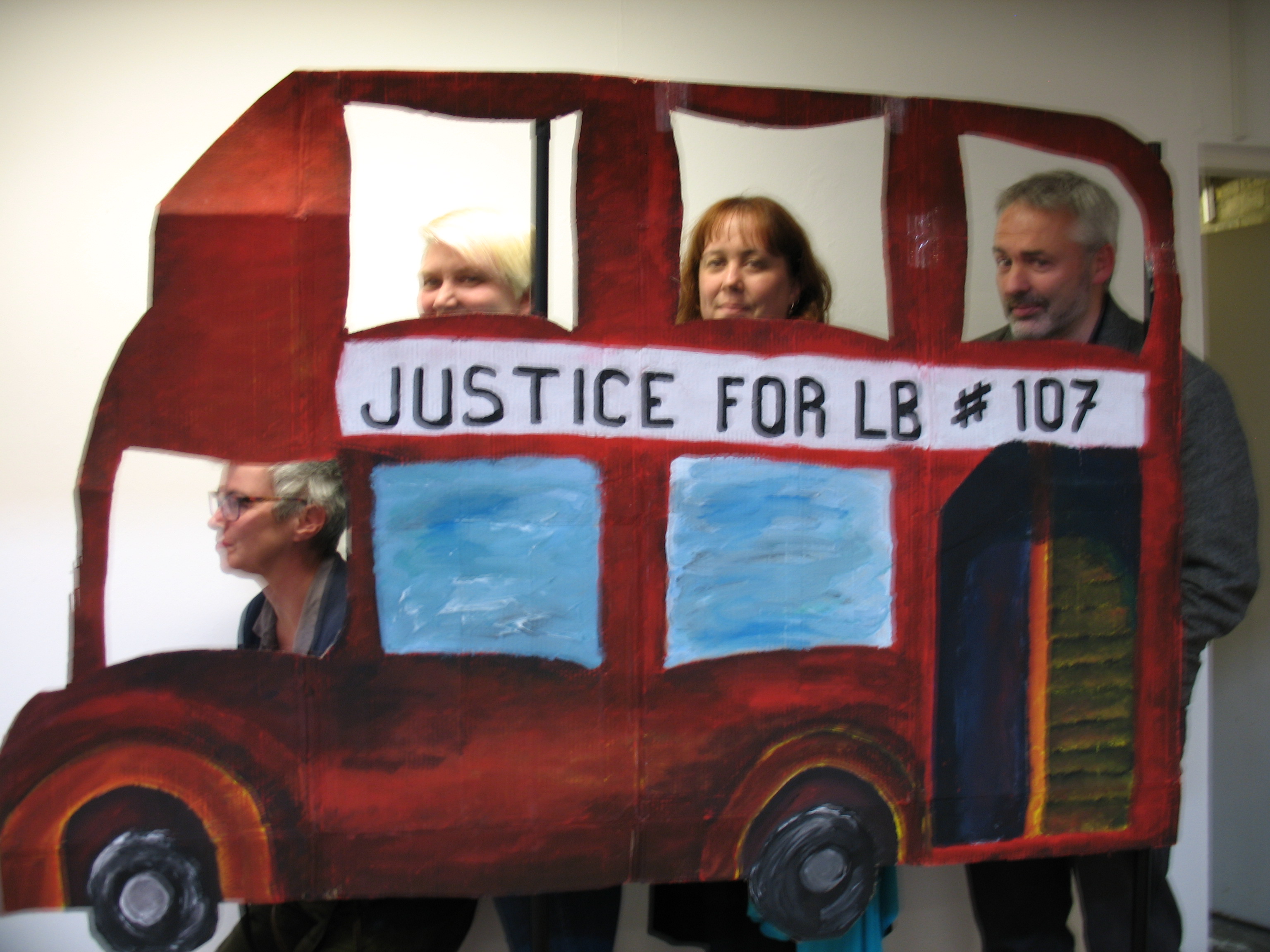
The passion felt by all the exhibitors was evident in the work on display, including a wonderful landscape picture by quilter Janet Read. The artwork, commentary and photographic record of activity inspired by Connor’s preventable death was erected around and by those attending, creating a political space. The people helping to erect it reflected on the way that the art has been developed – out of a solidarity and drive for justice that brought together so many people with contributions from numerous disparate sources. The quilt on its own is a wonderful expression of the support for Laughing Boy with plenty of squares devoted to the red bus! (One of LB’s favourite places was the Oxford Bus Museum in Long Hanborough). The quilters –Janet Read, Janis Firminger, Margaret Taylor and Jean Draper – are stitching legends. Their production of this unforgettably beautiful artwork, captured the random ‘stitched in the moment’ social movement response to LB’s death.


Later in the morning the Guardian gallery was shared, again illustrating how far the spontaneous creativity has spread http://www.theguardian.com/social-care-network/gallery/2015/may/18/justiceforlb-campaign-to-improve-care-for-people-with-learning-disabilities-in-pictures?CMP=share_btn_tw


In the afternoon a panel chaired by Chris Hatton with Graham Shellard (My Life My Choice), George Julian (#JusticeforLB), Janet Read (Chief Quilter), Dominic Slowie (NHS England) by video link and Imogen Tyler (University of Lancaster) shared experiences.


The Sparrowhawk Artwork surrounding the panel illustrated Dominic’s observations about how the campaign has turned people’s pain, anger and frustration into a movement which has captured hearts and minds. Graham shared the experience of having a learning disability: “I know what it’s like to have something happen to you”.


Janet described how the quilt not only represented the terrible things which had happened to LB but also illustrated his life and personality. Imogen talked movingly and powerfully about her cousin Rachel and of an Inclusion Scotland event where George Lamb announced ,“We are the revolting subjects and we are here to revolt”. There were also powerful stories from ‘just two mums’, founders of Unique Kidz and Co.


The permanence of the artwork and artefacts will help keep the movement alive. The second round of #107 days will include a film about LB, produced by My Life My Choice with Oxford Digital Media, funded by Oxford City Council and filmed in the Jam Factory.


The two main aims for the #107days activity are:

  • To raise awareness, share learning, experience and progress towards #JusticeforLB and improving life for ‘all dudes’, and
  • To raise core funding for the Justice Shed to sustain campaign activity.


Momentum for change

With the change in government and minister, there are real risks the momentum for the changes in the law the campaign is fighting for will be lost (see http://justiceforlb.org/what-is-justiceforlb/. The consultation on the Green Paper No Voice Unheard, No Right Ignored  closed on 29 May. We all need to make our MPs accountable for implementing a law that will better protect people’s rights to be supported in their communities appropriately and with skill.


In the meantime, Sir Stephen Bubb is not letting go and has announced a review of the progress since his November 2014 report called for the urgent closure of inappropriate in-patient care facilities and for a Charter of Rights for people with learning disabilities and/or autism and their families. https://www.acevo.org.uk/news/winterbourne-6-month-review-announced

Are demands on providers putting people’s rights at risk?

Are demands on providers putting people’s rights at risk?

Will providers stand up for the rights of people with learning disabilities or will we see them eroded as they struggle to survive austerity? asks Rosemary Trustam


In the wake of huge cuts in government funding (46 per cent by 2018), one North West local authority has developed a learning disability framework with criteria which providers must meet or their business will be transferred to the few top scorers. It’s designed to reduce the number of providers to save contract monitoring time. It makes significantly increased demands on providers, irrespective of size and service user needs, and requires them to work towards the living wage within a given period. No account is taken of agencies’ increased costs from the new pension requirements or the new ruling defining sleep-overs as working time making them subject to the minimum wage and annual leave entitlement. Providers must manage all this within an hourly rate reduced from £13.38 to £13 per hour*.


Apart from the costs of their model not allowing for these additional employer costs or adequate management and administrative support, a group of providers has discovered some fundamental mistakes. In law, the fact that the authority may not have sufficient funds cannot be accepted as a defence to passing on the cuts to providers. The consequences and impact on people with learning disabilities would be to deny them the service or quality of life they should expect and, indeed, are legally entitled to, as well as denying their voices in their provider of choice.


Some providers appear to be proceeding as if the requirements can be met for a lower cost. However, unless the services needed are very basic, it would be impossible to meet the range of need and would result in a poor quality service including even trimming people’s contracted service.


With reductions in the authority’s ability to adequately monitor their services and the lack of social work input, the danger is they would not become aware of deficits in service delivery until some tragedy or appalling abuse is exposed. Sadly, it is also likely that the weakened voice of people with learning disabilities would go unheard. With advocacy and self advocacy services commissioned by authorities, which close their ears to anything likely to increase costs, and agencies worried about winning re-tenders if they challenge too hard, whose voices will be heard?


If standards are to be maintained and improved providers must stand firm as the bastions of good practice and confront impossible demands and pricing. Worries about the loss of business can tempt providers to go in at the price. This can only lead to catastrophe. If good providers of integrity are lost and only the ‘shapers to fit’ are left, the market will become fragile and the local authority over-dependent on the few who can survive.


Charities are not supposed to prop up statutory services from their funds and would not last for long, while private providers who have to ensure profits for their investors will not continue.


David Brindle, writing in the Guardian on 10 March (Who will foot the bill to raise pay for care workers?), reports a leading homecare provider saying it will have no compunction about walking away from unprofitable contracts. Local authorities should take more notice of those in whose hands they are putting some of our most vulnerable citizens and look closely at their business motivation. Can it be a coincidence that hedge-fund driven Care UK has sold on its learning disability services to Lifeways, another Canadian hedge fund-owned business? Will we see more of this as large investors take what they can from specialist care services and then sell them? Lcal authorities should take note of the recent news that Allied Health Care, the biggest provider in the market, was up for sale and that the Saga group has since recorded a loss of £220m on its ‘discontinued’ Allied Healthcare business, largely through writing down its balance-sheet value to nil.


David Brindle suggests that the fundamental problem is the level of fees paid by local councils for people eligible for state funding. He noted that, according to the UK Homecare Association (UKHCA) which represents providers, only one in seven councils is paying at least the hourly rate of £15.74 the association reckons is necessary to cover costs and make a profit of 47p an hour.


Providers might take some heart from those who refused to take such unreasonable cuts lying down. In July last year, we saw the High Court judgment in favour of the Abbeyfield Society whose Newcastle branch took Newcastle City Council to court for not paying a fair rate for the care provided to older people at two of their care homes in the city. In this judgment the Court unusually was prepared to fix reasonable rates for care rather than tell a local authority to do so.


In December 2014, an association of independent care home operators took Torbay to judicial review over the price set by the Authority as the price they were prepared to pay for care (Torbay Quality Care Forum Ltd, R (On the Application Of) v Torbay Council [2014] EWHC 4321 admin) on the basis that their mathematical model was flawed and that taking account of top-up fees was done unlawfully and against government guidance. In the final judgment the judge said: “The normal setting of fees is a matter involving economic and financial assessment and a degree of expertise in how the sector operate”. Accordingly, he found the contention that the fee was worked out using a flawed model was correct and that “if the local authority chooses to adopt a mathematical model then some scrutiny of this is available on general law principles”. He saw their decision to use this model as falling within the scope of judicial review as a decision that “no reasonable decision-taker properly directing themselves on the facts could take”. He also found there was no good reason given to depart from the government guidance. During the judgment the judge took account of a number of other cases which may have a bearing on similar issues.


Another concern, as authorities begin to squeeze still further the price for care, is about getting sufficient calibre of support staff and professional management. Recruitment is growing more difficult across the country and where authorities want the living wage paid but don’t have the resources to meet the costs, it is likely that fewer well-motivated people will choose learning disability social care as a career. There will be fewer opportunities for progress as agencies reduce the number of senior posts. Support work demands a wide range of skills.


When we are striving to re-develop highly skilled services in the community and prevent people with complex needs being palmed off in expensive and mainly ineffective assessment and treatment centres, we need better discrimination by local authority commissioning. Providers must recognise that all the support services needed cannot be purchased for the same price and resist reducing their skills base.


Local authority cuts have bitten so deep already, particularly in those hardest hit, that they will soon be unable to meet their statutory duties. In this context, we must not allow our learning disability services to be pushed back into the dark ages by false economies. We see an increasing clustering of large numbers of people with learning disabilities into blocks of flats, sometimes with other vulnerable groups. As we hear of one development of 80 flats in the North West, we should fear the development of new institutions in the community in the drive to reduce costs. Large-scale developments separate and isolate people from their communities and keep the community out. Providers who really care about the quality of services for people with learning disabilities, must resist the erosion of standards and ‘new models’ which just replicate ‘old wisdoms’.


One of the North West’s long-stay hospitals started life as a ‘reformatory for inebriate women’ and ended up at its height as a hospital for over 2,000 people with learning disabilities. Providers take heed. Individuals in flats or sharing ordinary housing being moved into blocks of flats could be the start of the ‘warehousing’ of people seen in the 1900s.


That’s why we must give service users and their carers a strong voice as this is the best way to monitor services effectively.


* As we go to press we learn that the NW Local Authority has withdrawn their framework tender in the face of the challenge by a group of providers under the Care Act requirements. Providers can stand firm!

Changing the relationship between providers and commissioners

Changing the relationship between providers and commissioners


Have you heard the story about the support provider that helped the people they supported become so much more independent that they supported them less and gave the extra money back to the commissioner to invest in other local services?


Or the one about the commissioner who trusted the group of providers he worked with so much that they met together every month to plan local services and work out together who was best to provide them and what they would cost?


I am sure that most would agree that these are the kind of relationships commissioners and providers should have but we rarely hear this kind of thing happening. Both of these stories are true so it does happen and is possible. So why are we not seeing this kind of collaboration between commissioners and providers more often?


Adult conversations

I think the major reasons for this are that first, many commissioners use procurement processes that do not allow for this kind of collaboration and local problem solving. Procurement processes are essentially based on distrust and a need to control what providers do and what ultimately people receive, through a systems-based approach. Systems-based approaches rarely allow for adult conversations and the trust required to figure things out together. Often, the things we figure out together get better results and can even save money. Procurement processes reduce the process down to money and an inflexible criteria that forces providers to play a game that they often don’t want to play.


Second, the business models of many providers are focussed on increasing income and reach rather than enabling the people they support to be less reliant on services where possible and making best use of public money.  This naturally builds a distrustful relationship with commissioners who see providers as out for themselves rather than the people they support. Providers and commissioners are rarely able to explore ways that can give providers financial stability whilst giving people with learning disabilities the right outcomes and finding ways that local money can be better used.


Sharing the learning

At H&SA we are exploring and starting to work out ‘consortium’ and ‘alliance’ models that enable local providers and commissioners to come together in this way. It is early days but we will be sharing the learning as we go along. If you are interested, please get in touch.


If some of this feels too hard to contemplate when you work within inflexible and bureaucratic organisations, just remember that things rarely change just because of a system. Things change because of our relationships with each other and a shared passion and commitment for getting things right. But this always needs to be based on trust, so thinking about how you could build trust with a commissioner or provider is the starting point. Trusting relationships are open, honest and vulnerable. Don’t just ‘sell’ yourself, but expose yourself as a human being and organisation and this will give you the foundations you need to build a strong relationship.


I’d love to hear from you about stories of commissioners and providers that you have this kind of trusting relationship with and we’ll share them in coming editions.


Alicia Wood, Chief Executive, Housing & Support Alliance.


The Housing & Support Alliance (H&SA) helps housing & support providers, commissioners and advice and advocacy organisations make good housing and support happen for people with learning disabilities. For more information about H&SA membership call 0300 201 0455 or email kate.newrick@housingandsupport.org.uk

#Justicefor LB – a film to remind us there is still much to do

2015-05-18 12.41.52The summer Community Living issue will report on Lancaster University’s launch of the exhibition of the art work inspired by Connor’s death and the Justice for LB campaign. Thanks to My Life My Choice and Oxford Digital Media, with funding from Oxford City Council this is the film about his life Film about Connor’s life & Justicefor LB campaign. It’s now 2 years since the end of the 2nd series of activities across 107 days  – how long Connor was in that unit before his preventable death. We hope for some ultimate legislation inspired by the LBBill which was written in response to this tragedy and also by the fate of so many others who’ve died ir are stuck miles away in such units. The change of government means that lobbying must continue and we also saw yesterday (3rd July) the progress report on the Transformation of Services Progress Report on Transforming Care. Slow progress continues but the main issue remains that almost as fast as people are discharged new people are admitted so local relevant services remain a dream. The consultation on the Green Paper No Voice Unheard No Right Ignored has finished but will we see action?

Schwehr on Care

Schwehr on Care

With the start of the new Care Act Belinda Schwehr’s contribution to making it work as is intended is to start a regular two-weekly blog Schwehr on Care  As subscribers know, Belinda Schwehr LLM is a foremost community care law expert. She writes a regular article for Community Living magazine on legal issues arising in adult social care and has delivered a number of seminars across the last few years for the magazine.

Schwehr on CARE is Belinda Schwehr’s contribution to supporting people who are interested in adults’ social care to use the Care Act, together with public law principles. The idea is that the Act might then really make the kind of difference that it was intended to bring about.

The blog will do this by encouraging the airing of stories from people in the sector, or affected by it, about what’s actually happening in practice, now the new law is in force.

In response, Belinda will happily give a steer, using her 15 years of expertise and experience. She will look at what the Act says should be happening, about a given part of the customer journey, for instance, or what commissioners should be doing, or the line between health and social care.

Belinda will blog at least once a fortnight, on different bits of the Act, and more often if something juicy comes up in the meantime, through others’ contributions, tweets or comments. DON’T MISS THE OPPORTUNITY TO LEARN MORE AND/OR CONTRIBUTE TO THE LEARNING

Are providers becoming agents for social change? By Alicia Wood, Chief Executive of the Housing & Support Alliance

As I was writing this article, a young man with learning disabilities, Thomas Rawnsley, died whilst his family were battling to return him to his home and community. Thomas had been sent to an Assessment and Treatment Unit, where he was abused, and then to a care home, where he did not want to be. They have been fighting to find an alternative with the support of some of the most knowledgeable professionals in the country. These professionals have supported the family in meetings and advocated on their behalf when they needed it.


The striking thing about this is that they were all professionals working for housing or care providers. None of these organisations were doing it to get business –  they were doing it because they have seen injustice and have the knowledge, resources and skills to offer support.


Just over a year ago, Gary Bourlet made a plea to providers at the Housing & Support Alliance’s conference to support him to set up People First England. Offers of money and support came in rapidly. People First England is now working with 20 chief executives of provider organisations to talk about how People First England can be strengthened and sustained with the support of providers but operate completely independently.


Learning disability providers are starting national and local initiatives to support people with learning disabilities they are not contracted or paid to support; EasyRead Newspapers, making cinemas more accessible for people with autism, women’s sexual health projects, running local Timebanks and Small Sparks schemes, voting campaigns… the list goes on. What I think we are seeing is a shift from providers as just contractors of services towards providers as agents for social change.


This contrasts with the stories about incompetent, neglectful and abusive care and support providers that we see and hear about almost daily. We live in a society where there are people and organisations that see disabled and older people as cash cows, call themselves care providers and do the least amount of caring possible for the maximum income. Too often they are providing poor care with devastating impacts on people’s lives.


I suspect the majority of housing and care providers are somewhere in between. They care about supporting people well but do so within the restraints of institutional structures and financial resources – a compromise that benefits providers and commissioners rather than the people they support. Sadly, most providers do not think beyond the boundaries of the work they are contracted to do – but why should they?


We have never before seen people with learning disabilities and other vulnerable people left without the support they need to live like everyone else. Most organisations feel a moral responsibility to people with learning disabilities more widely but need to develop a culture to bring this about. Some opt to keep their heads down and not challenge local or national injustice because of threats to their funding. Few have felt comfortable publicly challenging the abuses that are going on for people post Winterbourne View or the loss of funding for self advocacy groups.


We need to question what we are in this work for if we aren’t going to shout  about better lives and rights for people with learning disabilities, challenge the wrongs, or do everything we can to make a difference more widely to the lives of people with learning disabilities.


Raising our Game Post Election

David Towell The Centre for Inclusive Futures brought together a number of people in the learning disability field just after the election to discuss the issues and share ideas. People were understandably concerned given the ‘damage done by the Coalition to the social fabric of our country and the lives of people at risk of disadvantage’ in the previous 5 years. However they were nevertheless influenced by Sally Warren’s blog “Let’s be Fierce not furious”, Philippa Russell reminding us of the tremendous contribution made by the Disability Discrimination Act (in its 20th Anniversary) and Sarah Ryall’s recent publication to look at what might be done despite this environment. From the discussion, David suggests 8 principles which might Raise our Game

Raising Our Game post election

Raise Awareness in Learning Disability week from 15th June

Mencap’s Learning Disability week starting 15th June is following up on their pre-election Hear My Voice campaign. It led to people with learning disabilities being more informed with local hustings with potential candidates (Preston’s example http://www.disability-equality.org.uk/news/preston-learning-disability—election-hustings/n144 ). Their idea is to get people ask their new MP to meet constituents with learning disabilities and hear of their concerns so they represent them. It is also to raise awareness amongst the general public of the strengths and achievements of people with learning disabilities, as well as the injustices and concerns. Mencap also have a questionnaire they want people to use to see if people understand what a learning disability is Survey Tool (Final)

#JusticeforLB Sparrowhawk Arts works exhibition at the Peter Scott gallery University of Lancaster

2015-05-18 12.41.52

See the report in our July magazine on the Artworks exhibition at the Peter Scott Gallery Lancaster university on from the 18th May and launched by Sarah Ryan (Connor(LB)’s mother) and George Julian and hosted by Chris Hatton. Don’t miss hearing about this unique illustration of the support to their drive for Justice which has led to the Green Paper & lobby your MP to get their support with a private members bill on #LBBill
https://www.liveatlica.org/whats-on/open-15-sparrowhawk-art-exhibition

Join the Learning Disability Alliance and United Response and get people’s vote out

Voting Series – United Response: Our Spring magazine is now out and has a pin-up guide to the General Election. (Click on election guide below to get it). This is the last of the series by United Response on getting people with learning disabilities to exercise their vote. Subscribe and you get access to the whole series on line. See UR’s website link for information www.everyvotecounts.org.uk

Voting information: 

Election guide 2 pdf

Learning Disability Alliance is working hard to call Parties to account on behalf of people with learning disabilities, families and their allies.They have gathered together useful information and links http://learningdisabilityalliance.org/category/election-resources/

Their Questionnaire results are in about how the government is rated on the 12 areas of importance to people – see http://learningdisabilityalliance.org/news/quality-checking-government-results/

Their national hustings results are also out – all the national Parties sent a suitable health/disability rep. EXCEPT the Conservatives who didn’t even answer the invitation!! http://learningdisabilityalliance.org This doesn’t bode well for their support for people with learning disabilities.

The LDA have pointed out that people with learning disabilities and their families and allies have a significant vote – so look at what was said and their easy read Manifestos and USE YOUR VOTE!

A graphic showing the number of people with a learning disability plus their friends and families making up 10% of the UK voters.


Election Watch

This Community Living magazine now out has United Response’s pull-out election guide

LDA England held a Citizen Jury on April 2nd in London

All the main Political Parties except the Conservative Party who did not even reply came & were interviewed by 7 people with learning disabilities and 5 family member reps about what they will do for People with Learning Disabilities and Families.

It’s hard to understand why the Conservatives ignored these voters…. on the day Sue Livett used their election material to stand in and answer their questions but understandably the Conservatives ended up placed last in standing up for people’s needs.


Results were:

Greens 81%    Labour 71%    LibDems 58%   Ukip 36%   Conservatives 18%

See http://learningdisabilityalliance.org/for more information and some film clips. Also see their election resources and for links to easy read Manifestos which are out

Dimensions have made an easyread report on what the 2 main Party leaders said to Channel 4

http://learningdisabilityalliance.org/news/party-leaders-interviewed-on-tv/

If you’re asking your local candidates questions why not check out these ones?

http://learningdisabilityalliance.org/election-resources/accessible-questions-for-parliamentary-candidates/

Our thanks to Andrew

Andrew Holman has been contributing his pithy and trenchant articles for more years than I can remember. This is his last regular article. His contributions will be greatly missed. I hope we shall still get the occasional offering when his frustration with our less than perfect services forces him to put pen to paper.  We wish him well in his ‘writing retirement’.

Elinor Harbridge, Editor


Policy

Review of the year

2014: a year of ups and downs but mainly downs

In his last article for Community Living, Andrew Holman reflects on the events of 2014 and expresses his sadness at how some services seem to be going backwards

After 25 years I’ve decided it is time to retire from writing and thought a roundup of the happenings of 2014, from what people I know have told me, would be as good a way to bow out as any. Unfortunately it makes for mostly dismal reading sprinkled with some good news.

The year 2014 was always going to be another difficult one for many – after some eight years of cuts imposed on and by local authorities things were never going to be easy. It is extremely sad to see many services going backwards, although I’ve seen less of the hypocrisy of everyone saying how they are going to provide ‘world class services’ despite the daily evidence otherwise!

Several people I know – among thousands of others – have had their services cut. They got some token ‘signposting’ to other organisations that might help but in practice it didn’t meet people’s needs. I’ve seen a rise in IQ testing to ‘ascertain’ if someone has a learning disability or not – if they have they then go forward to the next stage of being ‘considered’ for a service against another set of criteria, or barriers as I prefer to call them. That is a pity when I thought we had developed a more sophisticated assessment system based on what people needed, as opposed to a score.

Other people have had more stringent assessments of what they need. A sneaky way of saving money is to have the assessment strung out over many weeks, to see how you’re failing over the long term whilst still not providing any support. Unfortunately, the quality of some of those assessments left a little to be desired; usually being carried out by minimally trained non-professional staff. I questioned one who had decided to cut short an assessment to make extremely worrying allegations about him ‘ogling her cleavage’. The assessor seemed to have forgotten her client was almost totally blind and would have had trouble seeing any detail of her bust at any distance with or without squinting! It also raised a question about what is or isn’t appropriate clothing to wear to work (discuss!). It left the couple in a quandary as to whether to complain or not, fearing they would lose their service, but also worried about the damage such an action might have and what would be put on his file.

The cuts to support have caused people problems but it appears many of those affected have gone on to use other services, primarily GPs and mental health services.


The other area where people end up is the justice system. No one I know has experience of this but the figures tell us it is happening. On a positive note, there are plans to have 13 trial schemes with mental health teams based at police stations and courts. The blurb states they ‘aim to ensure people who come into the criminal justice system with mental health conditions, learning disabilities and other vulnerabilities are recognised and are promptly referred into health and other services to get the treatment or support they need’. We have also seen a rise in the amount of EasyRead information for people in the justice system, most of which has been of really good quality, not just ours at Inspired!


On that brighter note, the people with learning disabilities we employ here still have jobs. I can’t pretend is hasn’t been tough and, given the choice, many of our customers would opt for a cheaper service than pay for co-production, but we muddle through and continue to produce a stream of EasyRead information, last year producing over 250 pieces for over 50 organisations.


Others are doing admirable work; for example, the continued progress of the Stay Up Late campaign and their offshoot Gig buddies. It focuses on friendships and fun, the stuff of life denied to many, and I thoroughly enjoy catching up every time I meet these wonderfully positive people.

But to return to problem issues, it remains a great pity that the death certificate system has still not been overhauled since the Shipman investigation all those years ago. The changes, if implemented, could offer a far better picture of the early and sometimes unwarranted deaths of people with learning disabilities that we still saw happening in 2014.

Another still neglected area is the commissioning of services like Winterbourne View. This scandal continued to spread shock waves throughout the year with promises to close such institutions – with the result that more people were sent to them than left! To say this remains an absolute (insert your favourite swear word here) blot on our abilities to serve people with higher support needs should not need to be stated. I’m sure lots of good work is being done with some people to get them a more appropriate person-centred service but without sorting the fundamental issues of changing the people who buy these services and developing appropriate local support systems, it is doomed to failure. And every year we have a new report produced at great cost saying the same thing…

Many people think pushing an issue up to government level will bring about change but it can also end up stagnating in a bureaucratic quagmire with official reports on the matter seemingly written to obfuscate rather than progress matters.

On the brighter side, one of the very last long stay institutions, Calderstones in Lancashire (motto ‘changing lives through excellence’) is being closed following disastrous inspection reports during the year. Well, they say it is!

Another piece of good news that surprised me is that health checks for people with learning disabilities have continued. I hadn’t heard people talking about them much but when I checked they were being done and seem to have become routine.

It’s also been good to see the rise in preventative health information. Inspired have done a lot, including a whole series of EasyRead cancer leaflets, the blood in pee or poo ones as well as out-of-breath, heartburn, and so on. What worries me is their availability – they don’t seem to be everywhere despite the national campaigns in which they featured.

What remains a pity is the lack of a national perspective on EasyRead. We see lots of money spent on local information that doesn’t get much further, resulting in several different versions of a leaflet, all to different standards, while other subjects go uncovered. This happened when we were commissioned to do something on cervical smears. We found several copies already out there. We changed tack, went out and asked women what would be useful and are now producing something that we hope helps people get over some of the difficulties they face in having a smear, addressing professional, parent and carer attitudes as well as fears of their own. We hope this may help to increase the pitifully low number of women with learning disabilities – only 20 per cent – having a smear.

All this information is of course a major part of prevention, encouraging and supporting us all to do what we can to keep well. This is the way of the future, yet EasyRead reports we have done for some areas of the country clearly show problems; for example, figures for obesity in people with learning disabilities are rising more than the general population. Unfortunately, this is certainly true for lots of people I see and, one suspects, lower levels of support are contributing to this increase. It is a complex issue with many factors that, if left unaddressed, can have tragic consequences.


Inspired produced a series of booklets and short animated videos for the Department of Health on people’s rights and responsibilities to health services, based on the updated NHS constitution. These included things people should try to do more about. The group of people with learning disabilities working on them had high hopes of seeing the results shown in waiting rooms everywhere – no such luck yet but fingers are still crossed!

It was good to hear people still talking positively about local learning disability nurses. The future of the profession is always muttered about, and indeed I was one of those mutterers in the past, but with the demise of other support they are still in great demand and kept there with various registration requirements. I also continue to see community workers known by service users to be reliable and available – that is, in the areas that have them.

During the year, I heard from many people I’ve met through work over the past 25 years. A few have been using direct payments since we managed to get people with learning disabilities included in the original law. Many readers will remember that the government was going to exclude people with learning disabilities but we ran a strong campaign based on my first Funding Freedom book in 1996 and managed to convince them that exclusion wasn’t a good idea.

One of the issues I warned about with direct payments was the possibility of financial abuse. Without proper support to help manage them I knew many would be vulnerable. Unfortunately, this has proved to be true with several people reporting abuse. It has also meant managing with a much reduced service for ages until it is sorted out.

Similar issues were identified in a recent study by the National Institute of Health Research, School for Social Care Research*. It reported that “there was a statistically significant higher proportion of (safeguarding) referrals for financial abuse and abuse by home care workers”. They also found users “reported a lack of information about managing risk and funding options, plus insufficient support for being an employer”. So, sadly, no surprises there then.

On a lighter note, based on that early direct payments work, one man moved out of a long stay hospital up north into his own flat. He still has the same support worker he employed 16 years ago! I remember talking to him at the time about the benefit of having a shared interest with your support. They both love plane spotting and quickly ended up sharing social time together. Now, as a long-time friend, it was especially heartening to hear from him at Christmas about them sharing Boxing Day together once again.

Someone else on the move was the daughter of a good friend who moved into her own shared bungalow at the end of the year – I wish her the very best for the future. However, it needed exceptionally strong and determined advocacy from a knowledgeable mother to get her there and, even with that, her daughter still didn’t have a choice in where she lived, who she lived with, or who provided the support.


What about 2015? We have an election approaching with the parties trying to outdo each other over how much they can cut from public services. It does not bode well. There is an attention on retaining the level of  older people’s benefits and that, despite my age and paucity of pension, I believe unwarranted. There has to be more means-testing to help pay for services to the people who need them most, whatever their age.

I hope that good sense will prevail and it will be seen that cutting services does not save anything in the long term – but I doubt it. Costs will pop up elsewhere causing immeasurable damage to the people concerned along the way.

In the meantime, we are starting to see the rise of stronger campaigning – a neglected activity following the demise of Values Into Action. I strongly support the values and activities of the Learning Disability Alliance England and wish them every success in the run up to the election.

  • Risk, Safeguarding and Personal Budgets: exploring relationships and identifying good practice Stevens, M., Aspinal, F., Woolham, J., Manthorpe, J., Hussein, S., Samsi, K., Baxter, K., Ismail, M. 2014, Research Findings, RF41, NIHR School For Social Care Research, London.

NB. This summer I will be posting articles and other bits and bobs I’ve written over those years on a website www.andrewholman.me.uk.

Dorothy Atkinson How people’s own stories led her to a career in learning disability history

Dorothy Atkinson

How people’s own stories led her to a career in learning disability history

Dorothy Atkinson, Emeritus Professor of Learning Disability at the Open University and a crucial early pioneer of the history of learning disability, reveals what led her into this field of study.

My route into the history of learning disability was through my work as a social worker in Somerset in the mid-1970s/80s. Initially my interest was triggered by my appointment as a hospital social worker to two long-stay institutions, both apparently ex-workhouses. I was curious to know by what turn of events these former workhouses had become hospitals for people with learning disabilities. Subsequent visits to the Somerset Record Office in Taunton to consult relevant documents, revealed the changes in policy and practice that had led to the changed use of the old institutions.

Important stories

At the same time, my day job was to help people living in the two hospitals to move out and live, with support, in the community. It was during these major transitions in people’s lives that I began to hear their stories – about what had happened in their lives that had led to their incarceration in hospital and about their day-to-day experiences of living there. It became apparent that people with learning disabilities had important and revealing stories to tell, accounts that could – and often did – challenge the official versions of events.

This early interest in oral and documentary histories of people and places was given scope to develop when I joined the staff of the Open University in Milton Keynes in the mid-1980s. A collection of around 200 stories (as part of an OU course) in an anthology, entitled Know Me As I Am (1990) demonstrated the importance of people’s stories in the telling of history and confirmed their capacity to tell them. The subsequent founding of the Social History of Learning Disability (SHLD) group with Jan Walmsley in 1995 led to 20 years of inclusive conferences and publications which have drawn together life stories and documentary evidence.

Inspirational

My interest in people’s stories has continued over the years and includes my work with Mabel Cooper on researching and telling her life story and helping her promote it. Mabel’s life history encompassed early loss and separation from family, years spent in children’s homes and St Lawrence’s Hospital and her later life as a self-advocate, conference speaker and published author. Her story has proved inspirational to many people in this country and beyond. Sadly Mabel died in 2013 but her account of her life lives on in her book I’d like to know why.

I am now Emeritus Professor of Learning Disability, having retired from the OU. However, the work of enabling people to tell their stories continues. Since retiring to Somerset, I have had the opportunity to work with a local organisation, Open Story Tellers, on an oral history project to reveal the history of the two hospitals where I was based all those years ago – a real coming-together of two strands of my life. Meanwhile, the SHLD group, with colleagues from Leeds University and the University of East London, have received a grant to develop a digital archive of people’s stories – so that Mabel’s story, and the many other stories already told as well as those still to come, can be archived for the future.

Dorothy Atkinson is the co-author of many publications on the history of learning disability including Forgotten Lives – exploring the history of learning disability’ (1997), Good times, bad 

The legacy of Winterbourne View

Les Bonner is the father of a young man who was a patient at Winterbourne View. Here, he tells how his son’s experience left him traumatised and subject to constant crises.


Leslie was diagnosed with autism at three years old. He seemed to thrive at our village school in North Devon, where he was supported by a classroom assistant, and later at a special unit for autistic children. But on reaching adolescence his behavior became more challenging and, at the age of 18, aware of how his condition denied him the same opportunities as other young people, he tried to take his own life. On a life skills course at a local college he broke a window and tried to jump from the building.


Our local authority considered provision in North Devon inadequate for his needs so as Winterbourne View was the nearest place equipped to look after him, the decision was made to send him there. After speaking to both the psychiatrist and manager from Winterbourne View, my wife and I felt relief and gratitude that, in this crisis, the authorities had pulled all the stops out to find good quality care.


We could not have been more wrong.


Frightened

Vulnerable patients filmed by the BBC’s Panorama programme were being pinned down, hit and verbally abused. Although we don’t think Leslie suffered the same experience, he was unhappy from the start. We phoned him each evening. He was frightened and wanted to come home so I arranged to take him out for the day on the first weekend. However, when I got to the reception I was told he could not go out because no staff member was free to accompany us.  I insisted on seeing him and stayed there from around 11am to 3pm while phone calls were made with me arguing that he was a voluntary patient and should be allowed out with me.


During this time several patients came and talked to me and it was clear they had little to do with their time other than eat sweets and smoke cigarettes. Finally, the hospital agreed to let me take Leslie out on condition he was back before 5pm, leaving us less than two hours, just enough time to go for coffee at a nearby supermarket. After the visit I sat in the car park, trying to pull myself together.


This experience did not prepare us for the alarming events that followed. Our evening calls to Leslie were often interrupted and when asked about it he said it was because “somebody was kicking off”. By this he meant someone was being restrained. We were horrified. Leslie became fixated and talked continually about restraints.


Despite its outward appearance it became clear to us this was a terrible place. Leslie was being held there but nobody was doing anything to help his state of mind. I spoke to a psychiatric nurse assigned to work with him who said she was unable to start any useful programme because of the high number of restraints taking place. She believed Leslie would be better off elsewhere. She also said she was unhappy about the health care of all the patients, particularly their diet, lack of exercise and a reward system of giving out sweets. I witnessed the reward system in operation but never imagined the punishments that also took place.


Leslie was 18, confused and frightened and needed a therapeutic environment. Instead, he got Winterbourne View. While we were trying to get him out we arranged for weekends and breaks at home but it was always dreadful taking him back, knowing they had the power to section him. Because he was 18 we did not have the legal power to speak for him and as he was not able at this time to speak for himself the authorities were the dominant decision makers. Yet the authorities did not have enough information about Leslie and we had to struggle to get our voice heard. We were desperate to get him out of there but were told that if he did not return after a home visit, he would be sectioned.


We set about convincing our local authorities to move him. After some badgering they listened and finally, after 14 weeks, it was agreed Leslie could leave as long as he went straight to a residential college.


At the college Leslie was assigned a psychologist who reported that he was suffering from posttraumatic stress disorder as a result of what he had witnessed and experienced at Winterbourne View. Leslie was unhappy at the college, wanted to come home and woke up at nights screaming with fear and anxiety. The college was well resourced in many ways but lacked staff properly qualified for work with autism. Although mostly kindly and well intentioned, many were untrained and on low wages and said and did things which just confused Leslie and added to his anxieties.


Misgivings

Although he was coming home for weekends and holidays it was decided he should live at home and a programme of support put in place. An agency was appointed and an ‘enabler’ came to take Leslie out on activities. After a while we began to have misgivings and discovered the enabler had cancelled regular meetings with a psychologist without consulting us because “he didn’t believe they were doing any good”. We were disturbed by some of the sexist and racist expressions Leslie was repeating. For example, he asked us, “What’s a Pakki?” and told us how, on one occasion, his enabler had asked him what marks out of ten he would give a woman walking by. The enabler was untrained and on low wages so we ended the arrangement with the agency.


Looking online I found an agency specialising in work with autism. The Devon Autism Centre had just opened and the husband and wife who managed it were well qualified from Sheffield University which I knew to be one of the best in the country for its study in autism. I talked to them about our son and they agreed to help him. A manager from our local authority looked into it and agreed to the funding. The managers are committed to their work and co-ordinate a carefully selected and supervised team. The wife, a psychologist, comes to our house and helps us, as a family, develop strategies to help Leslie. She is constantly in touch with us and Leslie through emails and the enablers are all very capable so Leslie is now involved in a programme of learning and development.  However, the process of learning and engaging in the world around him heightens his anxieties so we are still at our wits end dealing with one crisis after another.


One of our main fears is that during a crisis something will happen that puts our son’s well-being into the hands of people who know little about him. We were shocked to discover that when he turned 18 the state had much more power over him when it came to mental health. Psychiatrists have had very little contact with Leslie, are not well informed about him and have not communicated with the people who work regularly with him. They are at the top of a decision-making hierarchy and exert a lot of power although Leslie has now been appointed a psychiatrist who, we are assured, has a warm manner and consultative style.


Missing

One morning shopping with his mum Leslie went missing and was found in the early hours of the following morning by the police 25 miles away in a bus shelter. He had expressed the wish to explore so it was agreed he could go out as long as he kept in contact via his mobile phone.


On another occasion the police answered a call and found Leslie on a high bridge. They talked to him and he told them he was not there to kill himself. Something that was said made him panic and run off and he ended up on the wrong side of the railings. The police pulled him over the railings and took him to North Devon Hospital. When he got there he struggled and was restrained and handcuffed.  His brother James arrived first to find him handcuffed on the floor. James talked to him on a subject that interests him, the policemen took his lead and he calmed down and was allowed to sit up. At 5pm he was interviewed, given a blood test and taken to a cell at the police station where none of his family were allowed to see him. We were told he had to stay there until a doctor came to make a psychiatric evaluation. We were advised to go home and wait for a phone call. We were afraid he would be taken to a psychiatric hospital so we contacted the Devon Autism Centre who prepared a room at one of their residential homes and contacted the police telling them they were prepared to take responsibility for looking after Leslie during this crisis. We left the mobile number of Leslie’s clinical psychologist who was waiting to give information but nobody phoned her. At 12pm the psychiatrist rang to tell us she intended to keep Leslie in the cell until next day when a team would arrive to assess him.


You can imagine how we felt. None of the people dealing with him knew about Leslie’s needs. People who did were ready and waiting to look after him in a safe place with alarms and 24-hour care and with plans to take him on a bus trip next day to a show. Instead, he was in a police cell, had done nothing wrong and the police didn’t want to keep him. He had told a staff member at the hospital that he did not intend to harm himself and only said he wished he had when he was handcuffed on the floor. I told the doctor I had taken advice and didn’t believe Leslie was section-able and that being kept in the cell any longer would make things worse. I told her that I had taken legal action against Winterbourne View and would take legal advice if they held him any longer because he was not threatening to take his own life. The psychiatrist agreed to make some calls and get back to me. Finally, after a call from social services, it was agreed to release Leslie to the care home. At 1.30am I took some of his things to the police station where I found Leslie pale and frightened.


The police were just doing their job, were as kind as possible and wanted to hand Leslie over quickly into proper care. Poor communication between psychiatric health authorities put Leslie through this ordeal. If we had not threatened legal action he would have been even longer in a cell. Instead he spent a fun day with people he knows.


Parents should not have to fight for their children like this – there should be a proper mechanism in place. Recently, Leslie has become involved in a pilot scheme initiated to create a ‘Police Passport’, a database aimed at informing police, on the spot, about vulnerable people and reducing the risk of this kind of tragedy.


Drain

Leslie is now living at home but as I am 67 and my wife approaching 60, his programme is aimed at enabling him to gain the skills necessary to have a place of his own with supported living. Leslie’s autism means he lives in the moment and finds it difficult to visualise a time when things will be better for him. At times he gets despondent and his anxiety levels reach crisis level. His brother James, the person Leslie relates best to, lives at home and is dedicated to his well-being but it is a terrific drain on him as we go from one crisis to another.

Only people who constantly live with this sort of fatigue and worry can understand what it’s like. Professionals who help us are sympathetic but they can go home in the evenings and get away for holidays. Media attention around Winterbourne View enabled local authorities to justify the release of funding to help our son but there is still no effective mechanism in place to help us cope in a crisis. The crisis support team’s role is only to come and assess whether a person should be admitted to hospital, which is frightening, or the police can come, which is just as bad. There is no trained or qualified person to come to our home and help us get through the crisis.


Mental health provision for vulnerable people needs to move away from relying on unskilled, untrained and low paid workers towards attracting people who wish to work where there is an ethos, training opportunities and upward mobility. It should not be a job that is just more attractive than working at a fast food outlet. There are many who share our fears and frustration when, after all the promises from the government, we see no real change in the help available.

The scandal of benefit sanctions

Recent figures show that disabled people claiming ESA are much more likely to be sanctioned than in the past. People will be looking to professionals to help them avoid and challenge the imposition of sanctions, says Charlie Callanan

Statistics from the Department for Work and Pensions have revealed that people with learning disabilities who claim employment and support allowance (ESA) are more likely to have their benefits cut through a sanction than people claiming the benefit due to other conditions.

Data shows that during March 2014* a sanction was applied to approximately 4,500 people claiming ESA (the benefit for people who are deemed ‘unfit for work’) because of a learning disability or long-term mental health problem. More than 60 per cent of the sanctions during the month were applied to claimants getting ESA for ‘mental and behavioural disorders’, the medical classification under which claimants with learning disabilities are recorded.

There was a more than six-fold increase in the number of ESA sanctions applied in March 2014 compared to December 2012, when a new system of sanctions was introduced, across all claimants with various disabling conditions. The following describes that system.

A sanction can be applied to the ESA award of a claimant in the ‘work-related activity group’ for failing to meet one of the following ‘compliance conditions’:

  • attending and taking part in a work-focused interview; or
  • undertaking work-related activity agreed with their personal adviser; or
  • agreeing to do either of the above at a later date.

If a sanction is applied the claimant’s ESA is reduced for a period by £73.10 (the weekly personal allowance of ESA for a single person from April 2015). But the ‘work-related activity component’, and any other elements of ESA in payment, such as premiums, are not affected.

There are two sanction periods. An open-ended period applies until the claimant meets the relevant compliance condition. This is followed by a fixed-period. The length of this depends on whether the claimant has had any other sanctions applied within the last year (but not including any within the previous two weeks).

Sanction periods are:

  • first sanction: one week
  • second sanction: two weeks
  • any further sanctions: four weeks.

Before the claimant can be sanctioned, they should get notification from Jobcentre Plus that they have committed a sanctionable failure. They then have the opportunity to show ‘good cause’ for the failure within five working days. Acceptance of good cause will depend on whether or not it was reasonable for the claimant to act in the way that they did. If the failure was due to their disability they should try to get medical evidence to support this assertion.

If a sanction is still applied to their benefit, the claimant can challenge the decision, first by asking for a reconsideration within one calendar month and, if this is unsuccessful, by lodging an appeal.

Claimants who are having difficulty managing following the imposition of a sanction may be able to get a hardship payment. The claimant must make an application for this and be able to show that unless the hardship payment is made they and/or their family will suffer hardship.

Jobcentre Plus should consider the following in determining if the claimant will suffer hardship:

  • whether a disability premium is included in the ESA award, or a disabled/severely disabled child premium in any child tax credit award;
  • what resources are available to the household
  • the difference between the resources available and the amount of any hardship payment that might be awarded
  • whether there is a ‘substantial risk’ that the household will not have access to essential items (eg food, clothing, heating, accommodation) or will have access to them at ‘considerably reduced levels’ without a hardship payment.
  • for how long the circumstances that require a hardship payment may last.

The amount of the hardship payment is 60 per cent of the personal allowance10 – £43.85 a week.


There are potentially a number of ways clients may either avoid, or reduce the risk of, a sanction.

  1. Get into the ESA ‘support group’ as claimants in the support group are not expected to meet work-related conditions. Medical evidence may be required to convince the decision-maker to place the claimant in this group.
  2. Ask for a reconsideration of the sanction decision, and if this is unsuccessful, submit an appeal to an independent appeal tribunal.
  3. Where the claimant cannot attend any interviews arranged by Jobcentre Plus or by a work programme provider, they should contact them as soon as possible and give their reasons for non-attendance.
  4. If the claimant is sent on an employment or skills conditionality programme that it is not suitable they should ask the provider if they can alter the programme. If they are unable to continue on the course or programme due to their condition, they should get a letter from their GP or other appropriate professional to confirm this.

It is of great concern that people claiming ESA, and therefore experiencing disability and ill-health, are now much more likely to be sanctioned than in the past. But is even more alarming that a vulnerable group of claimants – those with a learning disability or long-term mental health problem – are most likely to be penalised. As with so many negative changes happening within the welfare benefits system our clients will be looking to professionals to help them avoid and challenge the imposition of sanctions.

* The most recent data available at the time of writing.

Links:

methodist.org.uk/news-and-events/rethink-sanctions

A life transformed – Kathy’s story

Between 2010 and 2014 Choice Support and Southwark Adult Services reconfigured learning disabilities services by breaking up a long-standing block contract worth £6.5 million. Changes included deregistering 18 care homes, replacing them with supported living services and creating 83 Individual Service Funds (ISFs).  By focusing on providing support to individuals Choice Support transformed their services making them much more effective. Independent research verified that this work not only led to better quality, more personalised services, but also reduced costs by £1.79 million (29.75%).  Juli Carson and Sian Hoolahan explain how it worked for Kathy.

Kathy, a 53-year old lady with a moderate to severe learning disability and autism, is just one of the people whose support was transformed by this initiative.  She had been living in a registered care home in Southwark and now lives in her own supported living flat.

Kathy’s early years


Kathy was born with no complications but at around three years of age started to present behaviours that challenge. As she grew older she would physically attack her brother and sister. Kathy was diagnosed with autism and had very limited speech but her siblings found it difficult to forgive her and became estranged.


In 1974 Kathy was admitted to Darenth Park hospital when she was aged 13. Autism was not understood as a condition at that time and she was described as being mentally subnormal and maladjusted. Unfortunately, Kathy’s mother had mental health problems and found it difficult to be consistent and keep to any planned visits or arrangements. She found Kathy’s autism difficult to accept and understand. Interactions with her mother were always encouraged but had to be carefully managed so that Kathy wouldn’t become too distressed if plans changed or her mother refused to see her at the last minute.


Adult years


By the time Darenth Park hospital closed in the late 1980s Kathy had been living in conditions which were widely reported as being harsh and difficult with up to 40 people in each ward.


She was ‘resettled’ in a group registered care home for four people in 1988.  Her problems began immediately as she had to live with three other people who were all incompatible. Kathy responded negatively which reinforced a growing reputation that she was challenging. Staff became afraid to support her and the neighbours complained about noise and property damage.


Kathy’s behaviour ranged from hair pulling, grabbing and pulling down her staff until they were on the floor, tearing clothing, pinching, throwing objects, screaming and attacking children. She could also threaten staff with knives and self-harm with sharp objects. None of the female staff were able to support her at this point. She only responded to males which influenced her behaviour; for example, she dressed in a masculine way and wouldn’t wear a bra.


Kathy’s behaviour had an impact on every area of her life. She could challenge when out in the community – shopping trips were high risk as were visits to the bank or to general leisure facilities. She was terrified of medical practitioners which meant visits to the GP were not possible.


After Kathy attacked a neighbour’s child she was moved to a single person registered service on a campus site.  Here, the risks around Kathy’s support intensified and her service remained ‘on the edge’ for many years. Only a few males could or were willing to support her. Those who could were intensely loyal to her and kept the service going by working many hours and additional back-to-back shifts.


A positive change


A positive change began in 2008 when Mary, a female support worker who worked in another service on the campus site, asked if she could try and support Kathy. The first shift went as expected with Mary being attacked but she didn’t give up.


This coincided with a new female area manager, Juli, taking over the service in 2009. The personalisation agenda was a new concept at this time and both Mary and Juli firmly believed in putting Kathy at the centre of her support and involving her in every decision.


Juli wanted to build trust and create an equal positive relationship with Kathy. Every week she would visit Kathy and ask if she could talk to her. “Talk no” was always Kathy’s response. Mary also persevered and gradually built up trust with Kathy. She was able to get a positive response from her and incidents became less frequent.


Mary became the manager of Kathy’s service and after about six months she finally said,“talk yes” and Juli was able to come in and have a cup of tea. Kathy instigated a process where she would talk and Juli would write down a record of what she said. At the end both would sign this record. This seemed to de-escalate Kathy’s anxiety as it gave her the opportunity to get concerns off her chest.


A turning point was when Kathy was involved in recruiting and interviewing a new staff team. All the male staff members were replaced by females she had chosen. It wasn’t completely ‘plain sailing’ with some new staff unable to handle the challenges that Kathy still presented but there was progress. The core staff team understood autism, the need to limit change and maintain a routine. They also understood personalisation, the need to base everything around Kathy and what she wanted.


During this time Choice Support had been working closely with the London Borough of Southwark to divide up the Southwark block contract into Individual Service Funds (ISFs). This was ground-breaking work which had never been attempted before. Kathy’s service was one of the first to be piloted. Under the block contract her service cost £122,000 per year to run.  It was calculated that Kathy needed 14 hours support per day and sleep-in night support which meant her ISF at £98,000 was one of the highest.  Each hour of her day was discussed with Kathy and her Circle of Support to see what she wanted to do.


It was discovered at this time that Kathy had problems with sequencing and transition from one activity to the next. This seemed to be the main cause of her anxiety which in turn led to behaviours. To address this two activity boards were created, one for the morning and one for the afternoon. The planned activities were put on the board in picture form in the sequence they would occur. Her supporters knew they had to adhere to the sequences put on the board. This innovation significantly reduced Kathy’s anxiety. In addition, Juli would still meet with Kathy every Friday and write up her concerns and frustrations, de-escalating any remaining anxiety.


Around 2011 the staff team were able to re-introduce Kathy to her family. The new calmer Kathy won them over and they started to visit regularly, becoming part of her Circle of Support. Kathy’s mother recently passed away but before she did Kathy was able to reunite and rekindle their relationship and it became the most positive it had ever been.


Kathy was supported with de-sensitisation around medical practitioners and for the first time she was able to attend the GP surgery and the dentist. She got a small job delivering newspapers. She needed to be supported to do this but it was a great way for her to be out in the community meeting her neighbours.


Kathy’s ISF created a saving for Southwark Council of £24,000 per annum.


Up to the present day


There were plans to re-develop the campus site where Kathy was living so she needed to move. She was calmer than she had ever been so when a beautiful flat with a large garden became available it was felt that she would be able to cope with such a huge change. The staff team wanted to move with her. The new service was set up as supported living so Kathy now had rights with her tenancy agreement and access to several benefit entitlements. This gave her a significantly increased income and the opportunity to go on holiday.


The move was successful but afterwards Kathy was unfortunately diagnosed with rheumatoid arthritis which impaired her mobility.  However, she has been able to undergo invasive medical procedures which she wouldn’t previously have agreed to.


The last time Kathy had an incident where she challenged was 17t July 2011. Since then she has lived happily in her own flat.  She gets out regularly, has a job, visits friends and pursues interests.  She enjoys picking fruit from her garden in the summer and gets on well with her neighbours.


Kathy is no longer living on the fringes of her community.  Her story demonstrates how, when someone is able to make their own decisions, their lives can be transformed.


Authors

Juli Carson, Positive Behaviour Support Development Manager

Sian Hoolahan, Communication Manager

Listen up and let your people lead

Connecting innovation culture and ethical survival

Jo Clare shares selected findings and reflections on the research she did as part of an MA in ‘Leading Innovation and Change’ at York St John University

The question

The literature says that today’s innovators are at risk of a ‘trap of success’ (1) bound to become tomorrow’s stick-in-the-muds, apt to roast old chestnuts over cold coals.  No matter how cool and cutting edge we think we are now, all organisations need amulets against stasis and stuckness.  Making innovation a matter of culture rather than personality, embedding it in values and behaviour, making sure it is practised by many not few, should empower people to challenge that old-innovation-become-status-quo. Hence my research question: how does leadership create an innovation culture?

The context

The answer was principally intended to help the Three Cs’ team move from a climateof innovation which is top-down and temporary (2) to a culture of innovation which is bottom-up, adaptive and more enduring (3).

The context begged urgency. Deficit-reduction policies have been driving health and social services commissioners to demand more for less, and now even more for even less. Many leaders face an ethical dilemma about how our organisations survive. Should we compete on price, the prime casualties of which are often the lowest paid and quality and safety of services? Should we compete on quality, risking survival?  Should we compete at all?

However unwelcome the dilemma, no leader can escape the ethical and political ramifications of their strategic choices, including the basis on which they elect to compete (4,5,6) or, indeed, the decision to walk away. Whilst we might usefully mount the barricades to protest that markets are not the best way to distribute health and social care resources in the long term, the mantra of ‘no cuts’ does not resolve a dilemma which impacts on people’s lives now. Handing services back or not competing leaves the spoils (which roughly translates as ‘the lives of vulnerable people commoditised by commissioning’) to those providers who are winning the race to the bottom.

In this context, innovation offers an opportunity to increase people’s freedom, independence and inclusion and stay in business ethically.

The conclusion

Based on in-depth interviews of Three Cs employees and grounded theory, my research found that leadership is more likely to create an innovation culture if:

  • staff feel intrinsically motivated by authentic shared values
  • leadership itself is dispersed and distributed
  • the innovations in question fit shared values
  • bottom-up creativity and innovation is invited and nurtured

But here’s the rub: creating these conditions will count for nothing if our employees are under-remunerated and devalued. Extrinsic reward, including pay, may not be a prime motivator in a values-led not-for-profit sector, but it is a powerful and prevalent de-motivator.

Innovation-values fit

My findings highlighted a critical connection between authentic shared values and intrinsic motivation and suggested it has the power to make change-makers of all of us.  Like personal values, organisational values must be credible and cannot be faked; they are read and must be aligned in all aspects of organisational culture, including systems and structures not just behaviour. Take iPlanit for example – these web-based accounts for recording and monitoring person-centred outcomes proved spookily popular for what is essentially a personalised accounting system. According to one informant it is “a central place where you’re not just talking the talk but walking the walk”. Properly implemented, iPlanit is acceptable to staff because it resonates with our group values and has what Klein and Sorra call ‘innovation-values fit’ (7).

Likewise, anything which is dissonant undermines. So, talking equality and shared leadership whilst playing guru, oracle or standing on ceremony will not wash; if you believe we are all equal, flatten your hierarchy, eschew the red carpet, listen up and let your people lead. This is not to be confused with being indecisive, absenting yourself from leadership or being laissez-faire; ‘jackets on chairs’ are as demotivating to work for as autocrats.

Cherish challenge

New people are a precious source of new ideas and challenge to the status quo and should be treated as an asset.  If you say you are inclusive, as Three Cs does, make sure that the burgeoning band of staff who have transferred under TUPE understand and own your core values. The little things matter – even using an old form with a previous service name or company logo devalues people and makes them feel they do not belong.

To leverage the great boon of cultural diversity in a multi-cultural workforce, it is not enough to value difference.  Aired and reconciled, the conflict of cultural difference is a rich source of challenge to orthodoxy and fertile soil for innovation but not if it remains the scary, silent elephant in the room.  Where managers have understood and worked openly with cultural mores and perspectives in their teams – especially when it comes to issues of trust and risk – Three Cs has had its most evidential success.

And on this subject, those of us who like to ‘play nicely’ might want to consider a career change.   In-group harmony and accord, if cosy, can lead to groupthink, even gang mentality, where only conformist thought prevails – or else! Conversely, nurturing troublemakers, dissenters and ‘contrarians’ might be a proverbial pain in the neck but it can guarantee continuous challenge to the status quo.

Person centred innovation

The most promising finding was that genuine person centred-ness is a source of bottom-up innovation in its own right and has the potential to pull staff out of over-done care routines and into ‘small c creativity’ and problem-solving (8). Under the right conditions, and with those they support at the absolute centre, support workers can be true leaders themselves, wielding “the power to change the way people think about what is desirable and possible” (9), laying waste the disabling tendency of care and support.

The idea of an army of powerful person-centred innovators is quite a long way from the current stereotypes of the social care workforce as routine-bound, institutionalised change-resistors. To fully realise workforce potential, the culture and climate in the social care operating environment would have to change radically.  Exacerbated by cost pressures and rampant professional panic, the current environment is still essentially punitive and risk-averse, demanding a level of standardisation and back-covering which is anathema to thinking outside the box and risk-taking, key ingredients of creativity and innovation.

Formal Western education has a strong bias for logic, right answers and thinking inside the box, whereas the creativity which feeds innovation needs the fertile soil of divergence, high risk and no box (10).  Imagine a freer risk-tolerant operating environment, not so much no box as minimal box, with a well-trained but formally under-educated workforce proving a richer source of imagination and far better value than formally educated graduates, professionals and executives…

The rub

Here’s the rub again.  Creativity must also be nurtured and rewarded. Many private and not-for-profits alike pay their front-line staff the minimum wage, which does not provide a minimum income standard (Davis et al 2012).  With no policy on the Living Wage or the London Living Wage, more and more commissioners are inviting poverty wages. Whilst the right conditions are not just about remuneration, working a tired 50 hour minimum every week at £6.50 per hour just to earn the same as somebody working 36 hours at London Living Wage, is not  conducive to safety, let alone creativity.

If you need those additional hours to stay above the breadline your own family’s economy is served not by innovation for greater freedom and inclusion but by the continued or increased dependence of those you support. When commissioners invite a race to the bottom predicated on poverty wages, they do not just hazard an attack on quality and safety but perpetuate ‘doing for’ and doom any chance of converting the increased well-being and independence of those we support into longer term savings.

Bottom-up person-centred innovation has huge potential but will not be delivered by making casualties of the lowest paid in social care. In a payroll-intensive business it is only bottom-up innovation that will yield both ethical outcomes and the efficiencies necessary to remain competitive for the long term.

REFERENCES


  1. Shaw, R. B., A. E. Walton, et al. (1995). Discontinuous change : leading organizational transformation. San Francisco, Calif., Jossey-Bass.
  2. Holbeche, L. (2006). Understanding change : theory, implementation and success. Oxford, Butterworth-Heinemann.
  3. Beerel, A. C. (2009). Leadership and change management. Los Angeles, Calif. ; London, SAGE.
  4. Kohlberg, L. (1969). The relations between moral judgement and moral action : a developmental view. [S.l.], [s.n.].
  5. Thoms, P. and J. F. Fairbank (2008). The daily art of management : a hands-on guide to effective leadership and communication. Westpoint, Conn. ; London, Praeger.
  6. Yukl, G. A. (2010). Leadership in organizations. Upper Saddle River, N.J. ; London, Pearson.
  7. Greenhalgh, T., Robert, G., Bate,P., Kyriakidou, O., Macfarlane, F., and Peacock, R. (2004) ‘How to Spread Good Ideas A systematic review of the literature on diffusion, dissemination and sustainability of innovations in health service delivery and organisation’ NCCSDO
  8. Chen, K. K. (2012) Organizing Creativity: Enabling Creative Output, Process and Organizing Practices
  9. Zaleznik, A. (1977) Managers and Leaders: Are they different? Harvard Business Review 55
  10. Robinson, K. (2007) Do Schools Kill Creativity? TED TALKS: You Tube.
  11. Davis, A. Hirsch, D. Smith, N. Beckhelling, J. and Padley. M, (2012) A minimum income standard for the uK in 2012: keeping up in hard times Joseph Rowntree Foundation

Quids In: promoting financial resilience and well-being for adults with learning disabilities

Lemos&Crane, The Camden Society and Quaker Social Action are working together to develop a course promoting financial confidence, independence and resilience for adults with learning disabilities. Sarah Frankenburg a researcher at Lemos&Crane, describes what is emcompasses.


Quids In is being developed by the Camden Society and QSA based on the latter’s award winning Made of Money programme for low income families. The course focuses as much on the emotional and social aspects of financial resilience as knowledge and skills, incorporating topics such as assertiveness and getting help, ways to save, how changing behaviour can save money and planning for the future.

Cruelty and financial resilience

Research by Lemos&Crane and the Foundation for People with Learning Disabilities (Loneliness and Cruelty: people with learning disabilities and their experience of harassment, abuse and related crime in the community, 2012) highlighted the disturbing prevalence of targeted harassment and cruelty towards people with learning disabilities. Ours and others’ research identified finances as one area in which people with learning disabilities are often victim to exploitation. Cruelty of this kind not only has immediate financial and practical consequences but can have a devastating long-term impact on well-being, independence and an individual’s sense of personal safety and autonomy.

Guarding against financial abuse is just a part of the motivation for supporting adults with learning disabilities to improve their financial capability and resilience. Financial capability often brings with it a sense of independence and personal security. Being in a position to choose when to spend or save money is a meaningful aspect of adult life from which many vulnerable people can be excluded. With increased emphasis on personalisation in adult social care and more people now receiving personal budgets, building financial confidence, capability and independence for adults with learning disabilities is extremely timely.

Partnership

The Camden Society has many years’ experience of supporting adults with learning disabilities living independently in the community. The findings of the Loneliness and Cruelty research resonated with their day-to-day experience; in particular the vulnerability of people with moderate needs who receive little or no formal support. They report seeing a number of service users who need support in unraveling unsuitable phone contracts, for example, or who find it hard to budget on more than a weekly basis.

Quaker Social Action’s award-winning Made of Money programme has been a leader of good practice in the financial capability and inclusion field. Made of Money supports families on low incomes to take control and prevent financial problems becoming unmanageable. As well as practical advice the workshops recognise the other factors that influence financial behaviour.

People with learning disabilities and their experience of money

Developing a deeper understanding of the experiences that adults with learning disabilities have with finances is fundamental to developing a relevant and valuable course. During the research phase we found hugely varied experiences, attitudes and exposure to money. Despite this, a number of continuities emerged. One was a sense of clarity about what constitutes ‘the good life’. We invited adults with learning disabilities to make a ‘wish tree’ – a tree onto which people fixed drawings and paintings of their wish or dream – what they would do or buy if money were no object. The most common response was a home.

We found that relationships – with friends, family and supporters – are fundamental to people’s experiences of and attitudes towards money. This manifested in various ways but consistently had considerable impact on whether people found money to be a source of unease or empowerment. On the whole there was a general lack of clarity about price and value; people had little idea of what things cost. It is unclear whether this was due to the nature of people’s disability, education or a lack of exposure to financial matters. From the research phase it therefore became apparent that Quids In will have to focus on the emotional and social aspects of money management as well as practical skills, knowledge and awareness.

For many we spoke to, money was a source of considerable anxiety, and this served as a barrier to people developing a greater sense of self control. One of the central aims of Quids In is to address these barriers and support adults with learning disabilities to develop financial resilience, to protect themselves against financial exploitation and to experience the positive long-term effects of financial capability – a strengthened personal sense of independence, security and well-being.

The development of Quids In is now well underway, with one test group having already graduated from the pilot course. Over the course of 2015 more support workers will be trained to deliver and co-deliver the course, and Lemos&Crane will continue the embedded evaluation of its development. For more information visit www.lemosandcrane.co.uk.

Lemos&Crane are conducting embedded research and evaluation throughout the project which is supported by Pears Foundation.

Let’s be Frank – Commissioning for vulnerable people is now all signposts with no destinations

Whilst the rest of us are busy being polite, it’s Frank’s job to find out what’s going on and say it like it is. In his new column, Frank catches up with World Class Commissioning.

Somebody up north thinks it’s a good idea to get residents to vote on a cuts hit list which includes older people, disabled people and people with learning disabilities.


Let’s face it, commissioning is just buying stuff for other people with other people’s money.  I knew we were in ego-bother when somebody added ‘World Class’ to it.


One world class cocktail of hubris and austerity with an unmeasured dash of ‘stimulating the market’ later (did it even reach the glass?) has well nigh done us in. Here we are, margins squeezed drier than a commissioner’s eye, core contracts and grants in tatters, still waiting for that rare bird, the Personal Budget, to lay its golden eggs.


If you get any of the fabled eggs, don’t be tempted to put them all in the health and well-being basket. The Chief Medical Officer says there is no evidence base for well-being. Mark her words. Well-being is a decoy to lure the real McCoy of mental health into the mainstream, never to clutch at the purse strings of a commissioner again.


Social care is not faring much better either. Somewhere up north, somebody thinks it’s a good idea to get residents to vote on a cuts hit list which includes older people, disabled people and people with learning disabilities. Presumably, this ingenious ad hoc democracy is replacing both FACS eligibility and commissioning, so we can safely put social services and commissioners on the hit list too, preferably with pre-marked crosses.


My favourite piece of World Class Commissioning has to be that relating to the inexorably growing business of signposting. Aided and abetted by the Care Act, signposting is going to delay the need for care.  Signposting is going to reduce hospital admissions. Its intellectually superior sister, intelligent signposting, might even send people to useful destinations. Meanwhile, the money for useful destinations is disappearing, some of it into the pot for signposting.


When World Class Commissioning finally understands that voluntary and community sector destinations are the source of the prevention which they, like Columbus, have lately discovered, it will be too late. The world for the vulnerable will be all signposts and no destinations. At which point, there will be no need for signposts either. That’s world class that.


Frank


Frank will have more blunt observations in future issues. Watch this space.