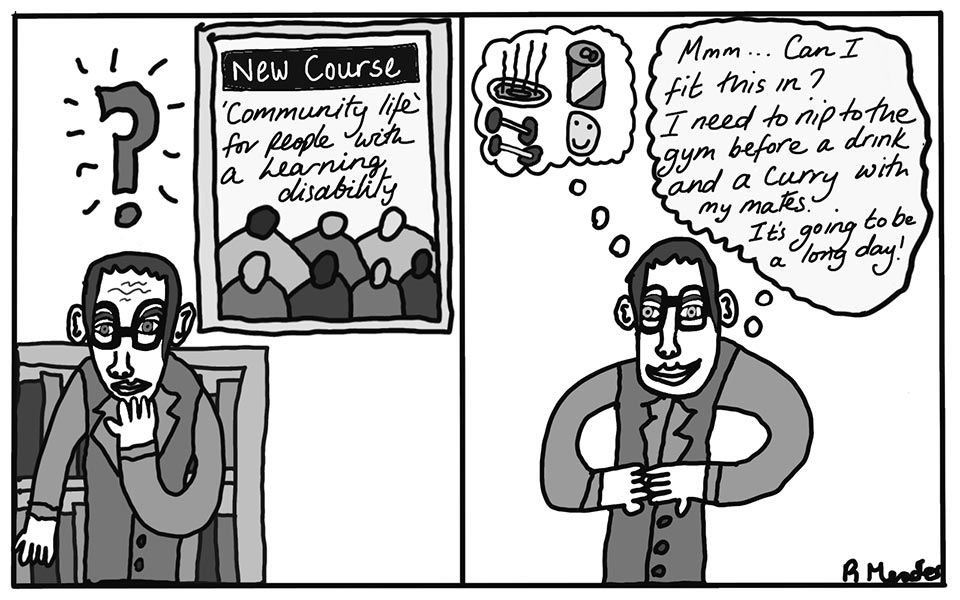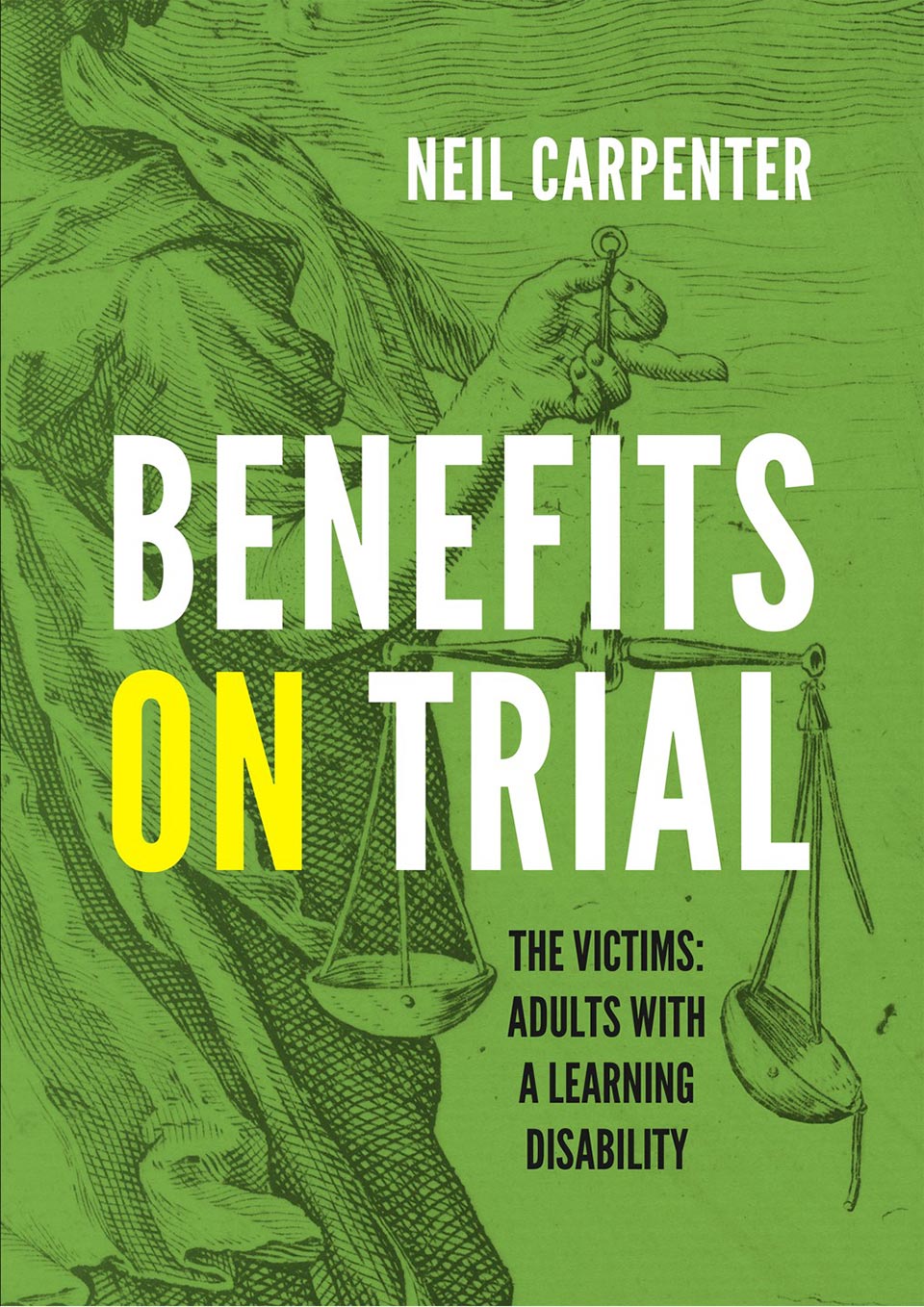

Dated language, families being wary of change for the better, the audience reaction at a dance performance, a sharp speaker and a candid model all catch Simon Jarrett’s eye.
Many parents opposed plans to close long-stay hospitals. Why?
Writing an article recently, I needed to read through the very first issues of the British Journal of Learning Disabilities, an academic journal launched almost 50 years ago in 1973.
It was then known as Apex, the Journal of the Institute of Mental Subnormality. There was talk of “mongols” and abnormality. The language, while not intended to be disparaging in these articles, is always a shock, even if we go back only a few years.
Be assured that the language we use so confidently today will be a shock to others in not many years’ time.
Reactionary or legitimate?
Even more of a wake-up call in these journals than the language were the many articles and letters written by worried parents.
Many were deeply opposed at the time to all the talk going on about closing long-stay “subnormality” hospitals and returning people to the community.
At first, their language and their concerns seemed very alien to me. But then I realised there was a thread that linked them to familiar themes of today.
Families often have a real distrust of any new government policy or initiative, feeling that somehow it will be they who will be left alone to bear the brunt of any negative consequences of change, while professionals move smoothly on to their next project.
I think it is important to remember that when family members appear to be acting in a very conservative or even reactionary way, they often have very legitimate concerns, arising from bitter experience, at the root of their anxieties.
Dance ovations
I have the privilege of being the chair of a dance company in London called Corali, where we train and develop the careers of talented dancers who happen to have learning disabilities.
The other week, they appeared in a show at the Barbican Centre in London, where they performed with a company called Thick and Tight.
The show played to sell-out audiences for six nights in a row and they received huge ovations each night. The audience reaction was nothing to do with the fact that the dancers have learning disabilities and everything to do with their talent.
I could never compete
I was asked to speak in an online seminar for history teachers about putting the history of learning disability on the curriculum in mainstream schools.
A fellow speaker was Shaun Webster MBE, an equality campaigner, activist and self-advocate. He tells his life story in Saba Salman’s book Made Possible.
If you ever get the chance to hear him speak, do take it. He is so mesmerising that at times I forgot I was a fellow speaker, as I listened to what he had to say.
He began life, as he openly acknowledges, with an incredibly difficult father, and was told things that would have destroyed most people’s self-esteem for ever.
But he went on to be a father himself, a generous and highly effective campaigner, and the proud possessor of an MBE (which he made sure he went and showed to his dad after he got it).
Someone asked a question to both of us at the end and I hastily said: “Please let me go first. There’s no way I can follow him.”
Model behaviour
I saw the ever more successful fashion model Ellie Goldstein on morning television recently.
They showed a clip of her modelling for Gucci or Vogue or suchlike, and one of the presenters commented: “You look like you were born to do this.”
“I was,” she replied.
As we leave behind the social distancing rules imposed by the pandemic, Helen Guest notes a definite feeling of screen fatigue as people are eager to meet up in real life again.
All together now: Pro-Active Community members enjoy meeting up in person again.
I work for the award-winning Pro-Active Community (PAC), a charity for vulnerable adults. While it was registered in 2020, it was established before then with the support of Active Prospects, another award-winning charity, which provides support and housing for vulnerable adults and is based in Surrey.
While social media and of course Zoom have played such a major part in enabling people to remain connected over the past two years, the challenge is now on to ensure the “screen fatigue” that is setting in doesn’t hijack that important link.
For adults with a physical or learning disability, autism, acquired brain injury or mental health needs, remaining connected during the pandemic was more critical than ever before. The fear of isolation and, for many, the difficulty of overcoming loneliness, have been very real.
The necessity to provide social interaction in a safe and supported space has always been a priority for the PAC – a lively and determined group of supported people who want to make a difference, but for them, by them – not what others think is needed but what they truly want.
Phyllis said she has never played bowling before and she has thoroughly enjoyed herself and even won the first game // Service manager – Woodview, Caterham
From campaigning at local and government levels about disability rights to hosting fundraising Bake Off events and highlighting climate change, everyone has in common a drive for equity while enjoying the accessible and inclusive nature in which it is organised.
I am co-chair of the Pro-Active Community, I manage the Facebook page and I miss being face to face, I like seeing people I haven’t seen for ages, and all your friends. It’s nice to all get together to be part of a group again since the last lockdown in 2020. It is fantastic, means a very lot to me, I can say my voice and we can work in a team to organise some activities and things what we do all together. It makes me feel positive and I feel proud actually that I am the co-chair. // Matthew Leadbeater
The opportunity to be back together in person is ever closer. The PAC has a subgroup, the Surrey People’s Group, made up of people across the county who meet once a month; this is facilitated in partnership with Surrey County Council.
The groups where we meet up mean I’m not lonely, which I am if I can’t be in the groups. // Leah Hickson
The group have maintained their meetings via Zoom, continuing the connection through the pandemic, and have included guest speakers on subjects such as adult safeguarding, online/cybersecurity, safe banking and money management through to mental health and wellbeing.
Meeting at the hall every month, it was really good to see everyone and talk about things, and have coffee and biscuits. I liked hearing new people talk to us about different things like the environment and climate change. I miss being together but Zoom meetings mean I still see people and don’t feel so alone. // Michael McLachlan
The PAC had arranged for a 100-guest gathering to celebrate Christmas which, sadly, had to be postponed due to Covid. The disappointment proved how much everyone was looking forward to being together and to seeing people they had not been able to for most of the year.
However, trips to the bowling alley in smaller groups were possible. The level of enjoyment and the feedback from the people who took part demonstrated very clearly the benefits of meeting face to face.
I like being part of the Pro-Active Community, I was the chair last two years, I like the friends and seeing everyone, I miss seeing everyone together. It’s alright on Zoom, support staff can help me, or I can do it, it’s better face to face, I like together. I was down and depressed in lockdown and wanted to see people, so the groups were good to do activities, making things, going to the theatre and Wakehurst Gardens. It gave me confidence talking in front of people and on stage sometimes in big audiences, I like public speaking as well. At the Learning Disability England Conference I signed and talked to everyone on Zoom. // Elizabeth Wheeler
Everyone is welcome to join Pro-Active Community meetings at https://www.facebook.com/ProActiveComm / www.proactivecommunity.org.uk / https://activeprospects.org.uk
Helen Guest is the active living manager at Active Prospects and Pro-Active Community facilitator.
Self-advocate Richard Keagan-Bull writes about his research at a London university.
I started my job as a research assistant at Kingston and St George’s University in London in January 2021. A few years ago, I did a course there for people
with learning disabilities about how to do research.
One of the teachers was Professor Irene Tuffrey-Wijne, who said that she was hoping to get some funding to employ a person with a learning disability to help her do some research.
She asked if I would like to apply for the job, but I think she asked all the other students and everyone with a learning disability in her network also, not just me.
So, in December 2020, I saw the job application and so I applied. I was lucky enough to get an interview. So I had the interview – I was all dressed up smart.
The interview was on Zoom – it was a bit strange, it was. After the interview, Irene said: “Thank you very much, Richard. We will let you know by the end of the week, but it might be by the end of the day.”
In the afternoon the telephone rang. Irene had called me to say: “Congratulations, Richard! You got the job on the Growing Older project.” I said: “Thank you very much, Irene.”
I felt quite excited. It was nice to get a proper job where I would get paid at the end of the month. It’s a big thing for me. I now have a proper ID card to get into the university, I have. It’s quite exciting. It makes you feel important to have an ID card to get into the research offices where I work. I can even go into the staff canteen.
So I started my job working with Irene. For the first months it was all done on computer because of Covid, so it was all a bit weird. The team is Irene the professor, Becky the doctor who I’ve been working with mostly on the research, and me the research assistant.
Irene said: “The first thing we’ve got to do is to employ someone who can support you, Richard, in doing your job.”
We ended up doing the interview to find someone to help me. We found a nice woman called Jo. We have given ourselves a name now – we’re the A-Team we are!
Practical research
I’ve been working there since January 2021. I work on the Growing Older, Planning Ahead project. I do that on a Wednesday. It is about people with a learning disabilities who are still living with their families in their 40s. It’s about finding them help a way to plan for the future, when their mum and dad are sadly no longer around.
I’ve been busy doing interviews with people with learning disabilities, and now we are running a group with families.
On a Tuesday morning, we have started doing work with the LeDeR programme. This is about finding out why people with learning disabilities die sooner than they should. We have a group of six people with learning disabilities who meet together and talk about it. Jonny comes in to lead the project, and Tasha helps to support me in my work on a Tuesday. So we have quite a team of people here now.
We didn’t really like the name LeDeR, so we’ve renamed it Staying Alive and Well. That was my idea.
We also have a new study starting in April. It is about end-of-life planning for people with learning disabilities. It will probably be on a Thursday.
Richard Keagan-Bill with (l-r): Irene Tuffrey-Wijne, Dr Becky Anderson, Jo Giles and Colin the Caterpillar
So now we are joking that I am Staying Alive on a Tuesday, I’m Growing Older on a Wednesday, and I’ll be Planning My Funeral on a Thursday!
So there has been lots going on this year. Lots of people asking me to do things, like give talks. The highlight of my year was being put on the Disability Power 100 list. So that’s me, being one of the 100 most influential disabled people in the UK. I’ve asked the team now to start putting the red carpet out for me!
The first time I went in to do my job in the office at the hospital after lockdown, Becky and Irene were away. Jo and me went into the office on our own and did a bit of investigating around the place so we could get our bearings and all that.
When we got to Irene’s office, there was a nice card in her office for me saying, “Welcome Richard!” and two boxes of chocolates, one for me and one for Jo, to say, “You made it!” and then I looked at the door. It had “Professor Irene Tuffrey-Wijne” on it and, underneath it, “Richard Keagan-Bull: Research Assistant.”
So I thought, “I’ve really made it. My name on the door!”
This is an edited extract from Richard Keagan-Bull’s Life Story, which he hopes will be published soon.
Richard Keagan-Bull is a self-advocate and research assistant, and sits on Community Living’s editorial board
At the moment he felt most alone, Simon Duffy discovered the power generated when people come together as equals to support each other.
Circle of strength: women are there for each other at WomenCentre – Image Women at the Centre
The early part of my working life was spent focused on trying to solve the problem of how to shift power and money into the hands of disabled people and families.
I tried to do this in London in the early 1990s, with limited success, then more effectively later on with Inclusion Glasgow, where we used individual service funds to help design personalised support to get people with complex needs out of Lennox Castle Hospital in Glasgow.
Later on, I applied this kind of thinking at local government level and I was very involved in the development of what we called personal budgets.
However, from 2009, my working life changed radically. I was thought to be too critical of the government-led implementation of personal budgets and, suddenly and unexpectedly, found myself having to fend for myself. I went from having a team of people around me to being alone.
I began to suspect my focus on a shift in financial power was far too limited. There is also the power we make when we come together as equals
As many have found, in times like those you quickly find out who your friends are. Few of my more recent friends wanted to be associated with me; mostly, it was my old friends, people I’d worked with when things were tough, who stuck by me and tried to help.
One amazing exception to that pattern was Clare Hyde. She was a new friend who was leading work on personalisation in mental health and had been one of the developers of WomenCentre in Halifax.
Together, we went on to write the book Women at the Centre (2011) and I learned so much from her and all the other women she worked with.
Critically for me, I learned the power of peer support. WomenCentre did not have the money to create personal budgets. Although the women they supported were often going through hell, experiencing a whole array of connected problems, there was no money to really help them.
Instead, WomenCentre used the power of peer support – women helping women. This was found in the relationship of equality between the women who were paid and those who were struggling; it was also found in the way women who had come through on the other side of their torments came back as volunteers, mentors and supporters in WomenCentre.
I began to suspect that my focus on a shift in financial power was far too limited. There is also the power we make when we come together as equals. This is what WomenCentre created.
About the same time, I was also lucky to meet Kelly Hicks. Hicks had left her secure job as a social worker and set herself up independently in Doncaster to try to help people.
Outside the system
From the very beginning, she recognised that the most disempowering thing the system does is fail to recognise the gifts and talents of people with disabilities and mental health problems.
She also saw the key to unlocking those gifts was not in changing the system but in helping people work together outside the system – through peer support.
Over the past 10 years, I’ve been able to carry on working with Hicks and the group she founded, PFG (People Focused Group) Doncaster.
It remains the most inspiring thing I am involved in, always bringing joy, even when often they have to deal with the most significant human problems.
Last year, I was able to carry out some research on behalf of the group and we published Growing Peer Support (2021), which outlines the power of how PFG Doncaster works.
I can only touch on a few of their achievements but, to give you some idea, we estimated that if the state had tried to do what PFG Doncaster had done it would have cost £3.2 million. However, it received only £65,000 of income during that period.
We also studied an amazing service they had just started providing – an emergency service for people in crisis. This work has prevented suicide and kept people out of institutional care.
Looking back on my earlier work, I am afraid that I had underestimated the importance of peer support. Sadly, I think that means I also underestimated people.
Today, most of my time is focused on how we continue to build Citizen Network as a system of peer support.
At Citizen Network, we are trying to create systems of peer support to help solve some of the gravest problems facing the world today.
For example, we helped set up the UBI Lab Network, an anti-poverty campaign with 45 labs around the world, working to advance the case for universal basic income to provide economic security for everyone.
We also founded the Neighbourhood Democracy Movement, which is working to help neighbourhoods reclaim their power and create welcoming communities for everyone.
I am still involved in work to advance personal budgets globally through the Self-Directed Support Network, which is part of Citizen Network.
It is not always easy to change your life – or the world – but it’s a lot easier if you have peer support.
Further reading – Duffy S. Growing peer support. Peer-led crisis support in mental health. Sheffield: Centre for Welfare Reform; 2021
Duffy S, Hyde C. Women at the centre. Sheffield: Centre for Welfare Reform; 2011. https://citizen-network.org/library/women-at-the-centre.html
A film that explores the sexuality of a teenager with Down syndrome reflects wider positive developments in the film industry, says Tracey Harding.
Making contact and breaking taboos: George Webster and Sam Retford in S.A.M
A critically acclaimed short film challenging perceptions about love, sexuality and learning disability has finally begun to receive recognition after Covid halted its wider distribution and viewing opportunities.
S.A.M, filmed in 2020, is set in a park playground where Sam, played by George Webster, an actor with Down syndrome, is hanging out with some friends.
The group discuss a boy on the swings who they obviously know from school, and talk about his scruffy clothes and their general dislike of him.
They don’t notice at all when Sam says he has a crush on the boy, perhaps illustrating how easily his sexuality can be ignored because he has a learning disability.
Sam goes over to talk to the boy, also called Sam, played by Sam Retford. This develops into a relationship that highlights the stereotypes regarding sexuality that people with learning disabilities can face.
S.A.M also portrays the dysfunctional lives of the two boys. One is desperate to escape a family who do not care, while the other yearns to explore independence, which his overprotective parents are trying to shield him from.
The film features dynamic performances from the two central characters and deserves to be seen by a wider audience.
S.A.M was directed by Lloyd Eyre-Morgan and Neil Ely, who are based in Manchester, where the film was shot. The duo included people with disabilities behind the camera and as part of the production team to ensure inclusivity.
They hope to expand the film into a full-length version in the future.
Initially scheduled to debut at BFI Flare, it has been entered in film festivals around the country and was featured in Best British Short 2: Smile on Channel 4. It was shown at the Oska Bright film festival, which took place in Brighton in March.
In an interview with Enable magazine in October 2020, Ely noted that “people with disability are part of the LGBTQ+ community” but their stories tended not to be visible.
“We want to change this and get visibility on these stories and, most important, getting people to have conversations they probably have been nervous to talk about,” he said.
Webster is an ambassador for Mencap and has been vocal about challenging prejudice over disability, especially Down syndrome.
In September last year, he became the first presenter with Down syndrome on BBC CBeebies. He presented a BBC Bitesize video, 5 Myths of Down’s Syndrome, where he challenged some of society’s preconceived ideas.
Behind and in front of the camera
Webster was also featured in an article in The Guardian by Hayley Maitland in November 2021 which highlighted a shift in the visibility of Down syndrome on screen over the past few years.
Recently, Netflix and the BBC set up a five-year partnership to get talented people with disabilities in front of and behind the camera.
This positive shift in writing and performance is also demonstrated in HBO’s Mare of Easttown, a critically acclaimed series starring Kate Winslet as a detective investigating a murder in a small town in Pennsylvania.
Teenager Kassie Mundhenk, an actress with Down syndrome, was cast as the daughter of Detective Mare’s closest friend.
Writer Brad Ingelsby told The Guardian that children with Down syndrome were “always part of my life growing up”.
He said: “If you’re creating a ‘portrait’ of a community, it just makes sense to have someone with Down’s syndrome as part of the ecosystem.”
The Guardian article mentions Los Angeles-based agent Gail Williamson, who is head of a Hollywood talent agency’s division for diversity. She started out with 25 clients and now looks after more than 200 individuals with disabilities.
She now has high-profile production clients including Glee’s Lauren Potter and American Horror Story’s Jamie Brewer, who became the first actor with Down Syndrome to play a lead on Broadway, with a production of Orphans by playwright Lindsey Ferrentino.
Ferrentino’s note to directors was: “Finding a talented actor with Down’s syndrome isn’t difficult. So please do it.”
It seems that some catching up is happening, and representation is beginning to reflect the world around us in a more equitable way.
Jamie Brewer of American Horror Story is represented by talent agent Gail Williamson, who has more than 200 clients with disabilities – Photo S.A.M; EnigmaArts/Flickr CC BY-NC-ND 2.0
Young people discovered the value of history through the story of Grace Eyre, who set up a society that organised homes in the community, report Nathaniel Lawford and Jackie Reeve.
Grace Eyre in the 1890s: she said her work proved “children can become self-supporting” - Image Grace Eyre Foundation
The Grace Eyre Foundation, founded in 1913 as the Guardianship Society, was unique for its time.
In response to widespread institutionalisation following the 1913 Mental Deficiency Act, its founder, Grace Eyre Woodhead (1864-1936) pioneered a model of community based “guardianship”, providing homes for adults and children with learning disabilities in Brighton and rural Sussex.
This gradually evolved into a shared lives service – the oldest and longest running in the country. Shared lives involves paid carers sharing their homes and lives with people who need support to enable them to lead an independent life.
The foundation received funding from the Heritage Lottery Fund in 2019 to enable people with learning disabilities to explore their own history, share their life stories, learn heritage skills and help to create a digital oral history collection.
The Sharing Our Voices project was very much affected by the two years of Covid restrictions. Nevertheless, with flexibility, good will and reliable internet access, we were able to continue and involve an energetic group of young people in the Grace Eyre friendship group.
History and reflection on change
During the project, we learned not only more about our history but also how many issues still resonate today.
We saw how historical learning can be a stimulus to people reflecting on their own lives. What has changed – and, crucially, what has not changed enough?
Our online training with the friendship group involved learning about Grace Eyre and her ideas and from the life stories of people with learning disabilities in the past.
For example Albert (not his real name), born in 1932, was categorised as “feeble-minded” and spent his childhood in institutions and children’s homes.
is abilities were often underestimated but living in the community with a carer changed his life. With support, he was able to stay in touch with his family and hold down a job.
The past puts the present in context, says Jackie Reeve
As a project worker, it was exciting to watch as younger people learnt about the past and used that learning to put their own experiences in context. Sharing people’s life stories during training sessions provoked discussion about what has changed and what feels familiar – particularly regarding how people are treated and dismissed. One young woman said: “My best friend is really bright and really clever but people can make her feel really little sometimes. “Even nowadays, people still aren’t given a chance to be who they want to be. They still label you as somebody with a disability, which is wrong.”
The young people identified with the lack of control and respect people such as Albert experienced and shared their own experiences, demonstrating that many of these issues persist today.
Supporting people to explore their own history prompted some to name and campaign for rights. Learning how earlier generations lacked control over their lives, including choice of how and where they lived, showed how much had changed – and that more change was needed.
One participant said the project materials “will be such a great resource to support people’s understanding about where people with learning disabilities came from and where we’re heading in the future and what we can do to change that”.
Talking about Grace Eyre’s life was a prompt for these discussions, particularly where her own words were used to reflect on her work and the times she lived in.
When talking about past limits on opportunities, many participants related these directly to their own experience.
From several life stories we recorded, it became clear that a priority had been to find people work to help them to be useful and economically productive. The Guardianship Society would negotiate jobs with local employers and people would be sent there to work – with very little choice over this.
In the early years, that might have meant young women going into service and young men being placed on Guardianship-owned farms to learn agricultural skills. Later work included cleaning and jobs with laundries, local biscuit factories and bakeries.
Project participants were particularly struck by descriptions of the farms run by the Guardianship in the 1920s-1950s.
Eyre was proud of the two farms, believing they demonstrated that people could be self-supporting and productive: “It is now four years since the purchase of the first farm, and I think the proposition that… children can become self-supporting is proven beyond contention” (correspondence, circa 1927).
However, we know from a woman who grew up on one of those farms in the 1930s that life was far from joyful for those lads. She says they worked hard, had little fun and ate separately from the family. She remembered her grandfather shouting at them to work harder (https://sharingourvoices.org/story/gillians-story).
Grace Eyre was proud of the foundation’s farms but life on them could be difficult
The struggle to find not just employment but work people enjoy and find fulfilling is still very much an issue, and people chose to focus on this theme when making a history film towards the end of the project. The film replaced the original plan to perform a play, which was not possible during lockdown.
The film, Alex (view it at https://vimeo.com/595512042), explores issues around employment and the struggle to make your own choices. Directed by Justin Spray, it was launched in December 2021 as part of Grace Eyre’s ReThink Disability Campaign and is now being shown at various film festivals in the UK and overseas.
A key issue the project highlighted was the extent to which people are still experiencing some historical limitations in shared lives arrangements.
We found some carers were gatekeeping and preventing people from volunteering with the project. They would not take up the offer of IT help if that was a barrier.
This was complicated by the pandemic. People vulnerable for health reasons had their options limited even more. Project workers talked with people who wanted to join the project as things eased, but some were prevented because of caution on the part of carers or as others in their shared home were vulnerable.
There is a clear challenge to Grace Eyre Foundation here to ensure that carers understand their role clearly – to support people to be more independent, try new things, meet friends, develop relationships and express themselves freely.
We have found this has been a theme through the history of the Guardianship Society and the Grace Eyre Foundation, as the organisation has to constantly reinvigorate the shared lives model to ensure carers are supporting people towards greater independence.
Does training make clear to people what one is committing to when one becomes a carer? When one no longer needs a gatekeeper or a gatekeeper only in some things, is support present in that change for both those with learning disabilities and carers?
The struggles and questions around acknowledging independence are, in short, an experience and discussion that is still ongoing with Grace Eyre and, indeed, within society.
We are glad we continued the Sharing Our Voices activities during the pandemic and were able to engage people with learning disabilities to explore their histories, both personal and more generally.
The project has inspired us to reflect on our own practice and values and to look at how we use life story work to improve the quality of care by enabling people to tell their stories and thereby articulate their needs.
For oral history interviews, Grace Eyre’s story, participants’ blog posts and more, see https://sharingourvoices.org/
Nathaniel Lawford is the inclusion and project director at the Grace Eyre Foundation and was a participant in the Sharing Our Voices project
Jackie Reeve was director of the Sharing Our Voices Project and works for the Grace Eyre Foundation
Nathaniel Lawford reflects on self-reliance, a fulfilling life and Grace Eyre’s history
As a young disabled person myself, it seems that many people lack understanding that a person with learning disabilities is still a person and thus has the right, and may well have the capacity, for growing in independence and self-reliance within their lives.
From my understanding in my new role at Grace Eyre, Grace Eyre herself seemed to have struggled to appreciate the growth of maturity given the loss of the sometimes-parental role and bond that is especially possible between those living with/supporting 24 hours a day and those receiving the support.
So Grace Eyre (while celebrating the rights of persons with learning disabilities to be valued and a have a fulfilling life) seemingly envisaged a strict limit to where and in what respects they could be fulfilled with their lives.
For example, people were often sent to farms involving a very set pattern of activities with little opportunity for growth beyond the assigned tasks.
Grace Eyre said:“I tell you, if you give a boy a man-sized job, he performs it manfully. At Tubwell Farm, they have grown shoulders, all of them. But I now realise more than ever that commitment to these children must be lifelong.”
This comment could mean that Grace Eyre would never value those coming into the organisation, which at this time was often at a young age, or it could be seen as suggesting that in Grace Eyre’s view, persons with learning disabilities would ever remain children, and thus in her eyes lack significant capacity of independence of agency over their own lives and how they were fulfilled.
How much harder then must it be for those who have not just had significant contact with those they support but also live with those they support in cases where, at least to some extent, a change in the support needs of the person occurs.
Susan Street, who has lived in Shared Lives arrangements since 1957, views the history exhibition at the project launch.
Escaping from hospital was dismissed by the authorities as the behaviour of ‘vicious’ or ‘discontented’ individuals but it was a feat of defiance, explains Susanna Shapland.
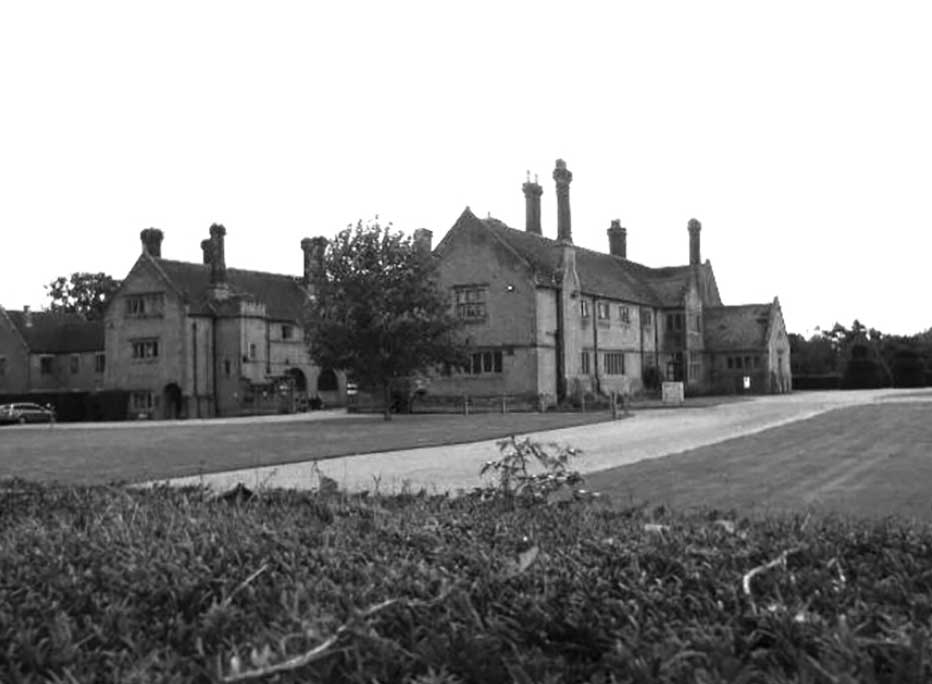
Bronham House: rules were strict, and a resident was not allowed to go outside to visit her aunt – Image: Nick Kingsley/Charles Hind Postcard Collection/Flicrk/CC BY 2.0
The “unauthorised absence of a patient from a hospital”, known as absconding, has long been a regular feature in the annual reports of long-stay institutions.
Historically, official records tended to downplay absconding as very rare and the act of only the most troublesome and difficult patients.
At the same time, escape attempts were portrayed by the authorities as genuine causes for concern. Absconding patients were said to be at significant risk of harm, and were also considered potential sources of harm to others.
Official records also emphasised the damage, both emotional and practical, caused to hospital staff, in terms of the work this created and the professional fallout in the wake of escape attempts.
Historians of learning disability David O’Driscoll and Jan Walmsley sought to reframe the official narrative on absconding from long-stay institutions by examining it from the patients’ point of view instead.
Using official documents balanced by oral testimony from patients who had absconded from the Cell Barnes and Bromham House colonies in south-east England, they examined how big a problem absconding really was for the authorities, and why patients felt driven to escape.
Restrictive rules
O’Driscoll and Walmsley found that all attempts even to go outside a long-stay institution were rigidly controlled. Even official leave involved a long series of correspondence between the hospital and whoever the patient intended to visit before it was granted. Often, it was not given at all.
For example, in 1944, Mary Bellamy was refused leave to visit her aunt, as Bromham Hospital authorities believed she was incapable of controlling her sexual instincts.
Like official leave, absconding demanded significant amounts of paperwork. The 1913 Mental Deficiency Act had created a byzantine web of bureaucracy around the control of people with learning disabilities, and those who escaped were no exception.
Penalties for absconding were severe, and extended to punishment not just of the patients themselves but also of anyone assisting in their escape. Staff members who failed to stop their charges getting out could face dismissal.
This tight control over the whereabouts of patients was in part because these institutions relied on them for labour.
Certain trusted patients would help organise and care for other patients, especially when staffing levels decreased after the Second World War. Moreover, patient labour helped to provide institutions with an income.
There were also fears that the institution would be held responsible for any criminal acts committed by their patients while absent.
Showing up the system
More significantly, absconding challenged the very existence of these long-stay institutions.
The official claims that they existed to protect both the patients and the community, and that inmates were infinitely happier and safer in a long-stay hospital than they would be out in the community, were fatally undermined by absconding.
The official response was to dismiss absconding as a failing of a “discontented” or “vicious” individual for whom absconding was just another “challenging behaviour” – an argument that stripped perpetrators of any agency and refused to accept that absconding could be inspired by any genuine grievance.
In reality, absconding was an act of wilful resistance by individual patients for whom life in the institution – whether temporarily or on a more permanent basis – was intolerable.
In the 1981 documentary film Silent Minority, patients at Borocourt Hospital in Reading, kept unstimulated in a bare outside compound for hours on end, attempted to dig their way out. The narrator acknowledged the act by drily noting “one or two still fight the system”.
O’Driscoll and Walmsley found similar examples of attempted escape as a means of “fighting the system”.
“Patient 247”, who spent 44 years at Cell Barnes, absconded because he resented being denied the experiences of “an ordinary life”, such as work and sexual relationships.
Another patient, described as a “professional escaper”, absconded using many and varied methods simply because he wanted to leave and was not allowed.
Margaret Day absconded just the once, when she was moved from Cell Barnes to Bromam House and felt ill-treated and disliked by the ward sister.
These acts of reasonable resistance all ended in failure and punishment.
The only way to successfully abscond was to have a supportive family waiting outside. Although patient “AJD” was forced to return to Bromham House after fleeing in June 1940, his family, who firmly believed AJD was kept at the hospital purely because he was a useful worker, unleashed such a battery of irate correspondence that he was eventually discharged at the chairman’s discretion.
As we reported in Community Living, Alexis Quinn’s successful 2016 escape while under section from both her mental health facility and the UK thanks to the help of her friends suggests that, in some cases, this situation has still not changed.
Further reading and a film: Kelly S, Quinn A. “I escaped from hospital”. Community Living. 2021;34(2): 16-17. www.cl-initiatives.co.uk/i-escaped-from-hospital/ O’Driscoll D, Walmsley J. Absconding from hospitals: a means of resistance? British Journal of Learning Disability. 2010;38(2): 97-102
Rosemary Trustam was the founding CEO of Integrate (Preston & Chorley) Ltd. Also the late publisher of Community Living magazine, a relentless, unstoppable campaigner, an indomitable and determined fighter for the rights of people with Learning Disabilities, a force to be reckoned with and a real hero of the Learning Disability Community, who saw the magazine as an important part of the mission to achieve equality and inclusion. She was irresistible, and utterly focused on the cause. Incredibly kind, and, one of the most selfless people you could meet. She always had time for individuals or families who came to her for advice, or help or support, or just encouragement. She was a great leader and mentor for many within the sector, ensuring with the sharing of her tremendous knowledge, her links to the University and her Practice Educator role, that her personal values and the values of Social Work were passed down, instilled in many and live on. She retained all the best traditions of the involved, concerned social worker, a type now sadly in short supply.
Rose Trustam was also a valued director of CASCAIDr Trading Ltd, the trading arm of CASCAIDr, the specialist social care legal advice charity, with its profits. Her input helped the charity to build a firm basis for growth, before Covid entered our consciousness. The pandemic meant that the charity had to reshape its advice offer, even to survive, and focus merely on Triage – a free steer for people with legal issues, rather than full-on casework, whether for free, or for a low-cost charge.
Rose’s untimely and sad death meant that we cannot share our exciting news with her that CASCAIDr will be re-opening to chargeable work once again with an operations manager in charge, in February 2022.
But in celebration of that news, and her own life and work, Belinda Schwehr, CASCAIDr’s CEO, will present a training event on people’s rights to adult social care, in Rose’s memory, including a session on what the liberty protection safeguards and the promised ‘cap’ on care costs may mean for people with learning disabilities and other life-long conditions.
Electricity and gas prices are rising just after universal credit was cut back, but there are schemes to help people afford their fuel bills. Charlie Callanan sets out what is available.
Cold weather payments are made when the temperature falls to freezing or below for a week.
Concerns about fuel becoming unaffordable come against a background of rises in consumer inflation, and the removal in autumn of the temporary £20 a week increase to universal credit.
However, various payments and financial and practical schemes are available to help clients deal with fuel bills and to improve household energy efficiency.
The winter fuel payment is a one-off payment from the Department for Work and Pensions (DWP) to help people of pension age with their fuel bills.
It is not means tested and not taxable, and clients can get it regardless of whether they get any other welfare benefits or not. It is paid directly to the claimant, so they can spend the money how they wish. People who were born on or before 26 September 1955 qualify for the payment this winter.
The payment will be £100, £150, £200 or £300. The amount depends on whether the claimant is aged over or under 80 years, and whether they live with another person who is also entitled to the winter fuel payment.
The household support fund is to help people who are struggling and is not restricted to those getting benefits
Claimants who have previously received the payment and people getting state pension or certain other benefits (such as pension credit) do not need to apply: they will get the payment automatically. Other people must make a claim to the DWP by 31 March 2021.
Under a new scheme in Wales, households receiving working-age, means-tested benefits can claim a one-off £100 payment for winter fuel. Payments are administered by local authorities.
Cold weather payments are made by the DWP to people claiming certain means-tested benefits. It is paid only when the average temperature in an area falls to freezing point or below over seven consecutive days. The payment is £25 for each qualifying week and should be made automatically into the account into which the claimant’s usual benefits are paid.
Grounds for eligibility Include where the claimant gets income-related employment and support allowance or income support, and the award includes a disability premium or a severe or enhanced disability premium or a disabled child premium; or if they get universal credit and have been assessed as having “limited capability for work”.
People who claim certain means-tested benefits and have a disabled child should also qualify for a cold weather payment, as should those who get pension credit.
The Household Support Fund is a new government financial support scheme. The government said it was set up to “provide a lifeline for those at risk of struggling to keep up with their bills over the winter”, following the financial consequences of the Covid-19 pandemic. It will be available until the end of March 2022.
Guidance from DWP to English local authorities states that the fund:
Should be used to meet immediate needs, and help those who are struggling to afford food, energy and water bills, and other essentials
Is not restricted to households getting welfare benefits
Is ringfenced so at least 50% goes to vulnerable households with children.
The fund has been distributed to English local authorities and to the devolved administrations in Wales, Scotland and Northern Ireland.
The Scottish Government has committed to spending £10 million of its allocation to help people struggling with their fuel bills. Clients should contact their local authority to find out how to apply.
Child winter heating assistance is available in Scotland. This is a payment of £202 to families who have a disabled child or young person (aged under 19) and receive a qualifying disability benefit, and is to help them meet their heating costs over winter.
The Warm Home Discount Scheme in England, Scotland and Wales provides a £120 rebate on electricity bills. People qualify if: they get guarantee pension credit and their energy supplier is participating in the scheme; or if they get a qualifying means-tested benefit and their energy supplier is providing a discretionary discount to customers who are on a low income. Clients will need to check with their electricity supplier if they qualify.
Another area of assistance is the grant funding to help improve fuel efficiency and heating. These may cover items such as loft insulation, draughtproofing, cavity wall insulation and a new or replacement boiler.
The qualifying criteria vary between schemes but people who are entitled to a means-tested benefit or a disability benefit as well as those of pension age may qualify.
Clients who are in arrears with their payments for gas or electricity and live in England, Wales or Scotland may be able to get financial help from their fuel supplier. Some larger suppliers run independent charitable trusts that give grants to some customers to help them pay off fuel arrears, as well as potentially towards other household debts.
The links below give more information about the payments and schemes described here.
Whether carers can arrange to buy sex for someone they look after and protecting people in exploitative relationships were the subject of recent court cases. Belinda Schwehr reports.
Two interesting decisions have emerged from the courts. One is of significance to anyone with less than full cognitive functional ability who is in a situation where others may be trying to intervene to prevent risk or harm to them, despite their wishes and feelings.
This will be of interest to those caring for people in the coercive clutches of charismatic charmers and suchlike, even if they are not necessarily after their money.
The other concerns whether carers can help people to use a prostitute.
Arranging commercial sex
In Re C, the court of appeal overturned a decision that it was lawful for carers of a man with a mental impairment to help him to engage the services of a prostitute.
It was a hypothetical question to be dealt with by exploring whether in so doing carers would be guilty under section 39 of the Sexual Offences Act 2003, which makes it a crime for a carer to “cause or incite” a person with a “mental disorder” to engage in sexual activity (regardless of their capacity).
The man, C, had capacity to engage in sex, but insufficient capacity to organise it. He told his advocate that he wanted to have sex and wished to know whether he could have contact with a prostitute.
The advocate raised the matter with his social worker and the council launched proceedings to address the lawfulness of such contact.
The practical arrangements envisaged would involve care workers booking the sex worker, making the necessary arrangements for C to visit her, then paying her. This would involve a charity specialising in the provision of sexual services.
A care worker could safely make these arrangements for someone who does not have a mental disorder. Equally, if the arranger was outside the definition of a care worker for someone with a mental disorder, that would not be an offence. It is not clear how far the definition extends under the Sexual Offences Act.
The concept defined in section 42 is that of a care worker and unlikely to include an informal carer; however, that is arguable. This section refers to person A, who is involved in the care of person B.
42(4) This subsection applies if A — (a) is, whether or not in the course of employment, a provider of care, assistance or services to B in connection with B’s mental disorder, and (b) as such, has had or is likely to have regular face to face contact with B.
The lower court had said it would not be unlawful. The court of appeal disagreed, finding the steps proposed amounted to “causation”.
Although section 39 arguably created a state of affairs in which C was treated differently from people without a mental disorder, this was justified in the circumstances and can only have been parliament’s explicit intention.
Under the 2003 act, the motive of the care worker, no matter how laudable, and the consent of the person with a mental disorder who wishes to engage in sexual activity are irrelevant.
Creation of circumstances for that activity rather than causing it in a legal sense is where the court felt the line should be drawn. The Sexual Offences Act requires the conduct of the defendant to be an operative cause of the prohibited activity.
The judge could not see how the extensive arrangements necessary for this man to engage in sexual relations with a prostitute, and without which sexual activity with a third party would be impossible for him, could be held to be outside the terms of the relevant section.
The court did not mean to stymie all thought of aiding people with “help” to start or continue sexual relationships, because each would turn on its own facts.
Examples on the other side of the line were suggested to be a worker taking a person to visit her partner for “private time” together, where sexual activity might or might not happen, or carers assisting a young person who wishes to go out and meet people in social situations.
One might ask whether providing the means, as a paid appointee or a deputy, to buy sex is “causing” sexual activity. Could carers take practical steps to help C into a position, when visiting his clearly chosen sexual partner, without that being “causing”?
The court envisaged that it might be appropriate in future cases for the court of protection to endorse a care plan under which care workers facilitated or supported such contact and to make an order under section 15 of the Mental Capacity Act 2005 that the care plan was both lawful and in C’s best interests.
Any declaration in future cases would not be binding on the prosecuting authorities, although no doubt it would be taken into consideration in the event of any subsequent criminal investigation.
Potentially exploitative relationships
In a separate case, Re BU, a wealthy woman in her 70s (BU) had been in a long relationship with a man in his 40s (NC). He had a history of unsavoury convictions and alleged offences, including fraud, blackmail, dishonesty, sexual assault and rape.
She was stopped from having further contact with him and given the extra safety of a forced marriage protection order, despite her strong and heartfelt wishes to share her life with him.
The reason was that her condition-related incapacity and possibly lifelong loneliness since the breakdown of her first marriage were found to prevent her from considering the strength of the evidence of his history and motives based on his actions.
She was given the extra safety of a forced marriage protection order, despite her strong and heartfelt wishes to share her life with him.
The woman’s daughters became concerned when it emerged that NC had attempted to acquire a fund owned by their mother worth £700,000. Some of her investment assets had disappeared, and other assets had been realised to fund the cost of acquiring a boat, a caravan, a pick-up truck and a van, all purchased in her name but seemingly used by the man in his business.
He had received various sums in cash from BU’s accounts, estimated by the police to be approximately £80,000. She had apparently been persuaded to underwrite the entire wages bill and paid for materials, equipment and the hire costs related to this business as well. He maintained she now had a 35% interest in a business but could provide no written evidence of this.
NC claimed that BU’s daughters were financially motivated to alienate her from him. He saw his relationship with BU as a romantic albeit platonic bond, which he hoped would be given legal status in due course through a civil partnership.
The daughters feared being isolated from their mother, and that she might become isolated from family and friends. The loss of their inheritance if a marriage was concluded was accepted as not being the main point of their intervention.
The judge videolinked with BU and accepted NC was a central and crucially important part of her life, pivotal to her emotional wellbeing and happiness. She could not countenance an existence without him, although she had been unable to have any contact with him for a year.
Her diagnosis of vascular dementia made her vulnerable to alleged control in that she could not recognise it was an aspect of her relationship with NC. If the court were to deprive her of his company, she saw her future as empty, bleak and devoid of all that she presently craved to salve her long-term loneliness.
Her rights to a family life under article 8 and her rights to marry a person of her choosing under article 12 were fully engaged.
Dementia may make a person vulnerable to financial abuse and coercive control in a relationship.
The court said that, where personal autonomy and life choices are a central aspect of the human right that the court is bound to uphold and respect, it should intervene only in limited circumstances.
NC believed the court should have no role to play in relation to her decision-making, and maintained she was capacitous in her own right.
The council took a neutral position in respect of future contact but made it clear it had neither the professional expertise nor the financial resources to supervise any contact the court may order. This illustrates the limits of safeguarding – however much effort might be put into it.
The council’s assessment in 2020 concluded that BU’s care needs were being met although it identified risks of financial abuse and coercion and control in the relationship between NC and BU; it would do no more, given the formal appointment of a financial deputy to look after BU’s financial affairs and the restrictions placed by the court on contact between them.
The court found the man had “engaged in a deliberate and calculated attempt to subvert any independent decision-making”.
He was described in evidence as a narcissist and a fantasist, and could not satisfy the judge as to benign motivation with regard to what he had done or attempted with BU’s money.
The judge attached a penal notice to the forced marriage protection order to ensure the man knew clearly that any attempted breach of the order could have severe consequences, including imprisonment, were he found to be in contempt of court.
The court held that in any future considerations of contact, the factors that were “relevant information” for the purposes of section 3 of the Mental Capacity Act 2005 include:
With whom will that person be having contact?
The nature of the relationship between them;
What will be the nature of the contact? Will such contact take place in a public or private setting? Will overnight stays be involved? Will contact involve the presence of a carer or support worker?
What are the positive and negative aspects of that contact? In this context, unless demonstrably false, any assessment should include not only an individual’s current experiences but also any negative or unpleasant aspects of past experiences during contact with that individual.
The assessment needs to include consideration of what constitutes a family relationship and that such relationships are different from other categories of contact. n
Small providers are offering early, highly tailored support at neighbourhood level, helping people to realise aspirations and belong in their community. Amanda Topps reports.
When I talk to leaders in adult social care, they openly admit “we can do better for people” with regards to community support and getting a good life.
So how can we do better? One nationwide project is providing some answers about supporting people and commissioning services differently.
Small Supports developed after an informal group of small support organisations in adult social care quietly evolved.
While each of the organisations is unique, they have several overlapping characteristics, one being that they remain small, often supporting no more than 15-30 people. Another is that they are deliberately local, embedded in their communities.
Research into small supports organisations has shown that compromising on control and aspirations starts to make things go wrong.
NHS England and the Local Government Association formed a partnership with the National Development Team for Inclusion (NDTi) to establish the Small Supports project.
How it works
Personalisation and being person centred are at the heart of this approach, with 12 sites in England supporting the growth of small providers.
The aim is to develop small providers that are able to design focused, tailored support with people who have learning disabilities and/or autism. These include those who have experienced difficult or traumatic events and need a different approach to support them to leave secure hospitals or assessment and treatment units, and people for whom professionals in the community have experienced difficulty in providing and sustaining timely, appropriate support.
Small supports are started by passionate, dynamic, entrepreneurial local people who want to make a difference to people’s lives. Fundamentally, their values and focus are on the person, their human rights, citizenship and individuality.
Relationships are at the heart of small supports, which engage clearly and honestly with people and their families, commissioners and professionals from local authorities, health and integrated care systems and communities.
Taking time to get to know individuals, hearing their hopes and dreams for the future and getting involved earlier – long before discharge – are also intentions.
The nine characteristics of Small Supports
Control by the person and their family
Life aspirations of the person are key
Supporters (staff) recruited by and around the individual
People choose where they live and who, if anyone, they live with
Sustainable funding designed and used based on the individual
Do not withdraw support or sell services on
Rooted in their local communities
Stay relatively small and financially sustainable
Develop around these practices – they are not aspirations within large, segregated services
Being local means the small supports’ leaders and supporters are rooted in neighbourhoods. They will build links with the person to their community based on the individual’s strengths and assets.
They understand the importance of supporting people to lead rich lives, contribute to society and belong by building relationships outside their family and paid support.
By focusing on individual aspirations, assets and building networks, they know that anything becomes possible, including friendships, love, getting a job, being a good neighbour and regaining health and happiness.
In Lancashire, we have developed plans in partnership with experts by experience and stakeholders, thinking about the qualities and values we want our small supports providers to hold alongside the nine characteristics the NDTi advocate.
We have been talking to people and organisations who want to become small supports. We have asked our team to develop excellent questions to ask each organisation to help us understand their values. We are working with Self Directed Futures (www.selfdirectedfutures.co.uk) to develop individual service funds and personal health budgets.
Once small supports providers are approved, individuals and their families will get a chance to meet them to see if they would like their support.
The provider will then design the support with the person, helping them to find their own home and the people they employ using a personal budget. Providers will be supported in their development through opportunities including networking, accessing training and mentoring.
The belief is that staying small enables quality, flexibility and quicker decision making when changes to support are needed. Leaders of the organisation can keep in touch with everyone – the people being supported, their families and staff. Building strong trusting relationships with the individuals they support, their families, commissioners and community teams is vital to ensuring quality continuous support.
All small supports sites are actively looking for brave, values-driven people who want to explore how to set up their own dynamic, citizen-focused great small supports organisation. They will need to be strong leaders, tenacious, proactive, flexible, good at problem solving and passionate about making a difference and supporting people to live great lives. They need to be able to go the extra mile and stick with the person.
Those who have successfully established small supports usually have a background in providing or commissioning services, have some form of lived experience of autism and learning disability or are learning disability or mental health nurses or social workers.
Suzanne Gale visits a home with beautiful gardens that the residents can rarely use, finds that advice from care homes and councils is based on what suits them and gets a spring in her step about Strictly Come Dancing.
I recently visited a low-secure unit for teenage girls, most of whom have autism. It is surrounded by grounds bigger than my local park.
However, the girls often cannot go out in it because they may need to be accompanied and there aren’t enough staff.
The organisation claims that it doesn’t have enough money to provide a sensory room. It also says staff turnover is so high that the girls have only a shred of the specialist support that has been identified as vital to their recovery.
Of course, being able to walk in a tree-lined, manicured garden is good for mental health but surely, without decent staffing, it’s pretty worthless?
If the people who need the support are spending most of their time indoors because there are not enough trained staff to keep them safe outside, or there are not enough specialist skills available among employees to put a decent behaviour management plan in place, it’s hardly worth it.
With such limited financial resources, isn’t it time for everyone to realise that the public purse needs to focus on upskilling and paying for good-quality staffing within the sector rather than keeping local landscapers in business?
Mistake or ploy?
I have power of attorney for a relative and can, therefore, sign legal agreements on their behalf.
I’ve had to argue, sometimes at length, with so-called professionals who have been putting pressure on me into signing things that just aren’t correct.
At one point, after repeatedly explaining the difference between an attorney and representative to a care home manager, she told me that “we’ve filled this in the way we always do it and no one else has made such a fuss”.
When I escalated the situation, her manager told me that it’s sometimes difficult for people to understand the complexity of a power of attorney so there was always going to be the odd mistake.
The impact of this “mistake” would have made me personally responsible for picking up care home fees if the relative’s money ran out. It makes me wonder whether it was a mistake at all.
Hidden horrors in legal advice
Over the past year, I’ve spent many an evening studying with Belinda Schwehr from CASCAIDr on her professionals’ course, primarily concentrating on the Care Act and how we can best support people with disabilities to ensure that their legal rights are observed.
The complexities of the Care Act are brilliantly unpicked and explained by her and at least I now know what I don’t know.
What’s shocked me most, however, is realising what poor legal advice I have been given.
I now believe that much of the advice I have received from in-house solicitors in both local authorities and providers has been based on a risk assessment of how little the service user and their family will know and therefore how much the provider and/or the council can get away with. It’s frightening stuff.
Strictly for all
Reality competition shows have taken valuable steps to challenge the public perception of ability.
Age and race have not been significant barriers to winning in the reality TV world. It’s been more than 10 years since we first saw Heather Mills, who is an amputee, on Dancing on Ice and, since then, many people with visible and invisible disabilities have been given opportunities to work with committed and creative professionals in such competitions.
All of these contestants have raved about how excited they have been to step up to the plate.
Last year, it was proven that same-sex couples can, in fact, dance and skate together without the world stopping on its axis and, this year, we have seen the amazing Rose Ayling-Ellis on Strictly Come Dancing, who has shown us that deaf people can dance.
Will the producers ever be brave enough to consider one of the many successful people with a learning disability a big enough celebrity to offer them a spot?
Studies often assume that a person with a learning disability is a tragedy and unable to take part in studies. Where is the happiness, and how can we improve research? asks Sara Ryan.
Dino time: research often ignores the fun, love and brilliance that characterises much of family life
I was thinking about this article a few months before an exemplary “What is wrong with research?” news story was splashed across national channels in August this year.
It concerned Spectrum 10K, a project to investigate “genetic and environmental factors that contribute to autism and related physical and mental health conditions to better understand wellbeing in autistic people and their families”.
The Wellcome Trust-funded project was paused in September by its lead, Simon Baron Cohen, after concerns were raised by autistic people, their families and allies.
These included fuzziness around what it was trying to achieve, and a lack of detail about the use and the storage and sharing of collected DNA samples.
There were also fears the project may incorporate eugenic thinking given the longstanding interests of investigators and the lack of involvement of autistic people in its design.
The Health Research Authority is looking into the issues raised and the project team have commissioned a stakeholder engagement company to conduct a retrospective co-design.
Varied ethical stringency
That such a project gained approval from ethics committees in England and Scotland highlights how subjective and variable committee responses can be.
As researchers, we are required to jump through stringent hoops to get the necessary signing off to begin our work.
This includes providing micro detail to satisfy committee members that requests of potential participants are appropriate, that we will act in a responsible and respectful manner, and that data will be anonymised and securely stored for a specified length of time with potential data sharing clearly stated.
Ethics committee members are, of course, people with their own assumptions, thoughts, experiences, biases and viewpoints.
Prestigious project partners – Spectrum 10k involves the universities of Cambridge and California and the Wellcome Sanger Institute – may lead to lighter consideration of applications.
While we cannot know if this was the case here, freedom of information requests reveal inconsistencies in the committee’s considerations (O’Dell, 2021).
Centred on deficit
A further problem with research is the use of poorly framed questions, aims and objectives, which arise from incomplete understandings of the research topic.
Learning disability and autism research, including the Spectrum 10k project, is replete with examples of this.
Despite the influence of a social model of disability, which sees the difficulties people experience as an outcomes of external factors such as physical obstacles, prejudices and assumptions, research is too often underpinned by a pathologising, medical model that emphasises deficit, burden and cure.
A review of studies about research priorities (Roche et al, 2021) found members of the autistic community want research that will make a difference in their everyday lives.
In practice, autism funding is focused on basic science with animal research accounting for 44% of the total UK autism research funding in 2016 (Autistica, 2017).
American philosopher Eva Kittay (1999: 169) wrote about how parents of disabled children and professionals had different types of knowledge:
“There are, on the one hand, the imposing (often impressive and sometimes worthless) professional knowledges that are being applied to your child. On the other hand, there is one’s deep and intimate knowledge of this child, a knowledge that is, however, curtailed by one’s limitations in training and expertise.”
Researchers, funders and ethics committees add to impressive and sometimes worthless knowledge.
I remember an intensely earnest and well-meaning postgraduate student sitting in our living room asking a set of deficit-laden questions about our son, Connor, 20-odd years ago.
Each question made me feel my skin was being carefully sliced with a scalpel and yet I answered them. I was on the medical model page – in part because of the deficit-laden research evidence base – and could not see beyond trying to squidge Connor into a mainstream space he would never (brilliantly) fit.
Research that takes a deficit-focused approach erases consideration of the joy, love, fun and brilliance that characterises much of family life. In turn, the research findings replicate and add to a bleak and partial evidence base.
When I was writing Love, Learning Disabilities and Pockets of Brilliance, I was struck by the deficit focus in research around siblings of autistic children. Google Scholar threw up pages of studies about the negative impact of having an autistic sister or brother.
Pavlopoulou et al (2019) took a more enlightened approach, arguing it was not helpful to focus on a binary of positive and negative outcomes in terms of siblings’ wellbeing.
We need to approach our research within different frameworks that allow engagement with the interests and joys children shared.
The Pavlopoulou study found siblings were resourceful, empathetic, tolerant and loving, and viewed their family tasks as “helping out” rather than negatively framing them as “caring responsibilities”.
This underlines how important it is that research design, framing and focus are not set up to reinforce stereotypes, preconceived ideas and deficit models.
A final layer to this brief exploration of the wrongness of research is exclusion, in the form of being excluded at the beginning, middle or end of studies. I will begin with a personal example.
When Connor was around four years old, he was enrolled in a university sleep study. This involved wearing a monitor to record his night-time sleep patterns for a week.
We were asked to repeat the week as the monitor showed a level of wakefulness that suggested the device was faulty. When the second week produced a similar pattern of wakefulness, Connor was excluded from the study because his data could skew the findings.
It is grimly fascinating to witness how apparently scientifically robust research can have its edges smoothed to avoid unruly findings.
On wider scale, a review of projects funded by the National Institute of Health Research (NIHR) was conducted to determine the inclusion of people with learning disabilities in its portfolio (Spaul et al, 2020).
It found that: 60.3% of the studies had “learning disability” as an exclusion criterion; none investigating pneumonia or sepsis included people with learning disabilities, even though they can be susceptible to these conditions; and only 1.4% specifically related to people with learning disabilities.
The authors suggested “a review of ethical barriers and a more active involvement of research funding organisations to scrutinise the justifications behind this exclusion might be warranted”.
This removes people’s right to participate in research and the enjoyment, pride or satisfaction this may generate
This review revealed so much that is wrong it demands further unpacking. Learning disability as a blank exclusion criterion in research – what does this mean?
It feeds into the consistent homogenisation of people with learning disabilities, erasing the variety of skills, abilities and ways of communicating.
Treating everyone as the same makes it easier to remove people who come under this heading from research
It removes people’s right to participate in research and the enjoyment, pride or satisfaction that this may generate
It erases any consideration of (fluctuating) mental capacity and discussion around consultee consent that could enable people to participate
It weakens the evidence base as research findings are less robust.
The last point has profound consequences given the enduring health inequalities and the rates of premature mortality for people with learning disabilities and autism.
Doing things better
How do we do things better and refuse to be comfortably numb?
I am working on two NIHR-funded projects involving people with learning disabilities and family carers: Flourishing Lives; and Growing Older, Planning Ahead.
These projects are, through a combination of bumpy and evolving involvement, co-design and a strong and cheerful commitment by everyone involved, helping us to understand how to do research better.
A commitment to doing things differently has involved the research process itself affecting team members in diverse ways, not least in the development of confidence.
Some of the things we have learned during this work around how to do research better include:
Working with funders and ethics committees so they know the importance of meaningful involvement of people in research whether as participants or partners. This may involve careful explanation of why we need to support people to take part rather than deny them the opportunity
Acknowledge we have learned a lot from past experiences of trying to involve people in research and continue to improve our knowledge, skills and ways of engaging
Recognise that research participation can be beneficial and enjoyable, and the potential for harm is low
Be upfront and clear about the additional resources needed to pay people for their work and the time and flexibility required for effective engagement. This includes developing and sustaining relationships with third-sector organisations and people that continue after the project ends.
Kittay (1999: 178) wrote “those who plow the fields of social justice know an oppression that has laid so heavy on the shoulders of its victims that it has numbed the response to the burden is the most unjust of all.”
We all have a responsibility to act on these injustices. The effective and swift response to Spectrum 10k by the autistic community and allies is a refreshing example of a refusal to be comfortably numb.
Doing research better is essential to achieving effective and meaningful change and redressing longstanding inequalities throughout life. This is a conversation we as a research community need to continue and embrace, as uncomfortable as it can be.
Sara Ryan is a professor of social care at Manchester Metropolitan University and author of Justice for Laughing Boy: Connor Sparrowhawk – a Death by Indifference.
O’Dell L (2021) Spectrum 10K: health official slammed “messy” ethics application from controversial autism DNA study. https://tinyurl.com/567dmnhv Roche L, Adams D, Clark M (2021) Research priorities of the autism community: a systematic review of key stakeholder perspectives. Autism. 25(2):336-348 Autistica (2017) A review of the autism research funding landscape in the United Kingdom. https://tinyurl.com/he8dtnhc Kittay E (1999) Love’s Labour: Essays on Women, Equality and Dependency. New York (NY): Routledge: 169 Pavlopoulou G, Dimitriou D. “I don’t live with autism; I live with my sister”. Sisters’ accounts on growing up with their preverbal autistic siblings. Res Dev Disabil. 2019;88:1-15 Spaul S, Hudson R, Harvey C et al (2020) Exclusion criterion: learning disability. Letter. Lancet. https://tinyurl.com/3xcpkrcn
Songs, books, plays – Bobby Latheron has written them all, including an account of his life with autism. He tells Sean Kelly about a future film and podcast, and his next, darker book.
Bobby Latheron with Carl Pemberton
Bobby Latheron is a young man with autism. He is also an explosion of creativity.
Latheron has written a book that has been published. He has released songs that are available to buy. He has written plays. Currently, he is working on his second book and filming a documentary about his life – which may include part of our interview.
I was able to speak to Latheron along with his support worker Charlotte Rix and I asked him to tell me more about his life.
“I would say it’s been a struggle. I didn’t get diagnosed till I was 15. Secondary school was very hard for me. Because I couldn’t do up a school tie, I used to get detentions.
“The work was too hard. And they would put me in front of like a million students to do an exam and I would just break down. And they wouldn’t understand what it was.”
Latheron found himself labelled a “naughty child” and tells me he was bullied by other children and by some staff too.
Then, at 15, he went to a specialist school for children with autism. This was a bit of an improvement but the drawback was that his educational needs were neglected.
“The autistic school was very laid back. You would go on trips more than work if you know what I mean. I think there needs to be something in the middle. I wanted a little push but not too much of a push,” he laughs.
After school, Latheron went to Stockton College to study performing arts, which he loved, but he could not stay because he did not have the maths and English grades required. So he moved to a specialist ESPA (Education and Services for People with Autism) college in Sunderland.
That was fine except that he was the only student there for two years. “It was very lonely,” he says. During his final year, however, other students began to arrive.
Nowadays, Latheron’s day job is as a carer for disabled people, working for a company called MAIN. He continues to have his own support worker “for my own stuff like my book and my documentary”.
He is also part of a social group in Stockton called Autism Matters. “The staff there are very…” – he searches for the right word – “nice!”
The group has obviously been very important to him: “Yeah, I think coming to Autism Matters, you do make friendships. And those friendships are forever.”
Story, song, script
The decision to write a book came after a discussion with one of his teachers at the ESPA college: “He said your life has been such a journey you should write a book.”
The book, My World in My Words, published by New Generation Publishing in September 2019, is a unique take on his own life. The cover features a (psychedelic) image of Latheron inside a cloud of words including honest, unique, bubbly, dramatic, inspired, autism, struggles, songwriter, script and funny. It’s the most accurate cover I have seen in years.
The book itself starts with more than 20 mini-interviews in which Latheron asks other people to define autism and to give their opinions about him as a person living with autism. Contrasting and comparing different answers to the same questions is fascinating.
The book also features a diary section about a trip to America and a selection of Latheron’s song lyrics (printed in different colours) as well as photos of him with many friends and associates.
Latheron is a gay man and the book ends with a lengthy fictional script for a play featuring him and some fairly complicated relationships and developments, including a dramatised version of his coming out. Without giving too much away, I can say it involves murder as well as convincingly faked deaths. I found myself reading some parts out loud in character because the writing is so irresistibly dramatic.
Out with friends: Latheron includes friends and associates in his book – Steven McDonald Photography; Bobby Latheron
Dark fairy tale
Latheron says his second book will be edgier. Part fiction, this “dark fairy tale” as he calls it will tell of a future in which he has a record deal and is living in America, and describe some more of his relationships. Sounds gripping.
As if that is not enough, he has been writing and releasing his own songs. It started when his sister bought him singing lessons. Latheron discovered his teacher was going to be Carl Pemberton of Journey South, a pop group who had become famous through the X Factor.
When they first met, Latheron refused to sing in front of Pemberton. Pemberton asked him why and Latheron said: “Because I can’t sing!” Latheron asked if he could write songs instead: “I said, well, I kind of keep everything inside of me – do you know what I mean? – like my emotions, or everything.”
He felt writing songs might help him to express some of those emotions. And that is exactly what happened. Pemberton helped him record the songs and sang on some of them, along with other professional singers.
The result is that Latheron has joined an illustrious line of songwriters who write songs for others. About 10 of the songs have been released and can be bought as downloads or listened to on streaming services and YouTube.
Latheron explains that he likes to have a story element in his songs. His most well-known song is called Run. Like many of his songs, it has an autobiographical element and is based on a difficult relationship in his past.
He wants his songs to help people who have been in bad relationships: “I want people to know that there is a way out. You don’t have to stay in a relationship when it’s not working out.” You can run? “Yeah,” he says, laughing, “that’s what the song is about, yeah, like RUN!” He wants the songs to help people “build their mental health and strength in their relationships” and in life. Writing the songs has helped him.
Asked about inspirations, Latheron says he particularly admires the singer Adele “because all her songs are basically about her past relationships and stuff. She inspires me to write.” He also likes Peter Andre, but not all of his songs.
Latheron mentions Katie Price, who was once married to Andre and he has read my interview with her (summer, pages 14-15).
“I really like her as a person,” he says. “I have seen the documentary Harvey and Me. I think every parent fights for their kids but, when you’ve got kids with autism, you’ve got to fight a bit more.”
The start of a musical odyssey with Carl Pemberton of Journey South; holding copies of his book outside a store that stocks it.
Mission for understanding
Helping people in the wider world understand about autism has become a mission for him.
“I am hoping to go into schools after the pandemic and talk about autism, how it’s good to be kind to one another. Don’t ever judge people,” he says.
He has experience of being judged and abused. For example, a few years ago he was at an airport with the Autism Matters group. “You could hear other people saying ‘Look at them spakkas’. And I just want to tell people that we are normal and we do have feelings. Even the people who can’t speak, they can hear, and they do have feelings.”
Latheron says he finds close relationships hard to make. “Because I am out as gay and I have had really bad experiences in relationships, it’s really hard to trust someone. And sometimes I just want to give up on love. Do you know what I mean? People say: ‘Oh don’t give up – there is always someone there for someone’.”
I remind him that his book also gives the same message. “Yeah, but it is very hard to believe in myself after going from being bullied at school or college. When I hear my music on the radio, it’s very hard to believe that I can achieve stuff, you know. Even now, it’s very hard to believe I’ve got a book out and that I have got a second book coming out very soon as well.”
He adds that, for an autistic person, life can sometimes seem like a big battle and he worries a lot about life.
Like whether people may not like me because of the way I speak, or my tone or you know. I think about everything. I am always a worried person. I think that’s to do with my autism. I am scared of flying. I think ‘Oh my God, I could get on a plane and it could crash and I could die’. It is a very hard life.”
At the same time, he feels the difficulties he has experienced have helped to shape him. “If I didn’t have this life now, I wouldn’t be who I am now. If I had never had the ups and downs with relationships, I wouldn’t be a songwriter.
“When I brought my book out, it was so hard. I was thinking: am I doing the right thing? Am I pushing myself out there you know for people to think ‘well, he’s got autism’. Well, I might have autism but I live a normal life. Do you know what I mean? Like we all do.” He laughs.
He plans to launch a podcast: “I want to talk about autism and bring people in to talk about their autism as well, and play my songs on there about living with autism.”
Horrified at the prospect of a segregated future devoid of opportunities for his son, Les Scaife steered him to a life free from special schools, day centres and the grip of social services.
Our first child Jean did not experience any problems at birth. She attended a girls’ school then university, progressing to be very experienced in IT and the study of wine (which I appreciate a great deal today).
Our second child Brian was born with a learning disability due to a lack of oxygen during a difficult delivery in 1972. Having no experience of disabilities, several arms of “expertise” were thrust upon me in the form of a psychologist and a social worker when Brian became of school age.
It transpired that what they had planned for my son was a system that would segregate him from the community and place him in a system where he had no peers. This would deny him the opportunity to improve his social skills and his social behaviour, and to learn how to engage with people who did not have a disability.
Moving home for mainstream school
I fought against this system as I wanted to give Brian the opportunity to develop his strong points and to learn from others in the community.
To this end, I decided to move from Surrey where we lived and we went to Cornwall, where Brian did not have to go to a special school but could attend the comprehensive with support (which is what we wanted in Surrey).
Life went well for Brian and he progressed to the Duchy College, a working farm where agriculture was taught.
We have responsibilities to help our sons and daughters have a better experience of life than the establishment has planned for them
Brian showed an interest in things mechanical and was given access to the mechanical workshop where he learned basic car maintenance and how to drive a tractor with support.
As time went by in Cornwall, I taught Brian to drive a quad bike that he used to drive around our large garden. We then went into vintage engines that we bought as basket cases and restored them for display at vintage shows around the country.
All this was achieved without the help of social services who kept offering their assistance.
I could see the progress Brian was making in terms of engaging with other people, building his confidence and achieving more than we all thought he was capable of.
At the end of his schooling, I found there was no suitable further education in Cornwall, so we called the removal van again and moved to Lancashire, where there were better opportunities for him.
Money before people
It was in Lancashire that I got more involved with the system of social services in terms of putting money before people, so I read up on legislation and educated myself on what should be and what was being delivered.
For this we had to go through the process of an assessment that insisted we stuck to the needs not wants. There were some disagreements along the way but, eventually, I got a package of care that was good for Brian.
Having got the package of care, I waved social services goodbye, and Brian went to a college doing basic mechanics and car maintenance.
Then along came direct payments. I looked at how they were intended to work and talked to a woman in the direct payments office in Westminster.
I decided that this would give Brian more choice and control over his care, and that he could use it to his advantage. So I applied – and hit the brick wall of social services as, in the beginning, direct payments were a concession, not an entitlement.
However, this soon changed and I was banging on the door of social services again. This time, they had to give way as it seemed I knew more about the payments that they did.
Having got the direct payments, I again waved the social worker goodbye and we set out to decide what Brian wanted to do with this money, which
he could use to employ personal assistants (PAs).
He opted to further his love of music so he employed two PAs, both of whom played guitar. One of them teaches guitar so Brian was in his element. Brian’s PAs have now formed a band called Brian & The White Lightning to raise money for a local food bank and a football team for disabled people.
In 2002, I formed a charity, West Lancashire Peer Support, to help others manage direct payments, as you become an employer when you get them.
The responsibility of tax, national insurance, contracts of employment, keeping financial records for audit and so on can be too much for family carers.
We now manage around 120 packages of care for direct payments and personal health budgets, and we are also corporate appointees with the Department of Work and Pensions.
I am fortunate to be working with people who are so committed to choice and control. In 2007, we assisted with setting up direct payments in Australia. We toured Australia every year until 2016, speaking to state officials and families on the benefits to both sides of direct payments and peer support.
At 90, I have now had to think of what will happen to Brian when I am no longer here. My daughter lives in Surrey and Brian wants to stay in Lancashire with his mates.
So I looked at supported living and did not like what I saw. It seems that social services place people like Brian in a house with other people and a carer. They then take all their benefits, giving them back £25 a week for pocket money.
Because there is a carer in the house, he would also lose his direct payments and his carers, and it would also deny him his social life that he so enjoys.
After doing some sums, it looks to me as if local authorities make a fortune out of vulnerable people In supported living.
So I have opted to place Brian with a family that I know and trust. His benefits will pay for his keep and still give him the same amount in his pocket money as he had before. This way, they cannot take his direct payments away from him as they are not providing any additional care.
There is a plan B if something happens to the mother of the family where Brian will be. The daughter is a nurse and will have Brian with her family should it be necessary.
Opportunities at the outset
When I look back over the years since 1977, I see that people with disabilities are not given opportunities in the same way the rest of society are; we are all where we are because we had the opportunity to get there. Unfortunately, people with disabilities do not get those opportunities.
It is surprising what can be achieved when people are given such opportunities. We all have a gift but some get the chance to develop their gift while others do not.
Brian has got to where he is mainly without the “help” of social services. I shudder to think where he would have been now if we had not taken the stand we did against the segregation of people with disabilities.
Day centres and special schools are a form of segregation as far as I am concerned. Others will disagree but, when I look at Brian, I am pleased at what he has achieved when given opportunities.
To sum it all up, we do need support for vulnerable people but that support must be flexible and restrictions on what direct payments can be used for must not hinder the opportunities for people to develop their hopes and dreams in the same way the rest of society does.
We have to remember that we also have responsibilities as parents to help our sons and daughters to have a better experience of life than the establishment has planned for them.
Brian is now living with his new family. I visit him twice a week and was there last night to celebrate his 49th birthday.
I am happy that I can rest in peace when the time comes, knowing that Brian is happy and safe with his new family, and all achieved without the help of social services.
Playing the guitar with Brian & The White Lightning; Brian working with Les Scaife, using tools that improved his hand-eye coordination.
An engine restored by Brian at Duchy College, which is based at a working farm.
An allotment project that provides social and therapeutic activities and brings peace and nature to a built-up city area is under threat. Its members are objecting, says Deborah Williams.
Tony Wisby: “If it closes, it will cause suffering to members’ health, nature and the wildlife habitat”.
Although some people may not want to get their hands covered in soil nor relish the company of slugs and snails, there seems to be an innate pleasure in the life-affirming beauty of a garden or allotment.
Simply being in an open green space can have a profound effect, invigorating us with the work involved in its care while calming us too. Gardening can mean many different things for all of us.
Sprout There! is a horticultural project and part of Uniting Friends, a charity for people with learning disabilities in Redbridge, London. It provides practical, social and therapeutic activities in all aspects of gardening at Redbridge Lane West Allotments and supports healthier eating, using our organically grown produce. It also helps people gain skills for future employment.
People with learning disabilities have been disproportionately affected by Covid-19, and lockdown has resulted in increased isolation, as well as physical and mental health issues.
During lockdown, the project had never been more relevant and enjoyed by so many. All charity members had access to a safe, beautiful environment and, although the plot is situated beside the A12, a major route, it provides a green breathing space.
We now face the threat of a radical change to our project, as a large gas company has asked to use our area while it carries out maintenance work for its adjacent site, which could potentially result in much of the plot being covered in concrete.
Our work would be compromised and the biodiversity that the site supports would be devastated.
A study by scientists at London’s Natural History Museum has found that the UK is one of the world’s most nature-depleted countries – in the bottom 10% globally and last among the G7 group of nations.
Taking action
Faced with the potential closure of our site coupled with the realities of our ravaged environment and climate change, many of our members have voiced their concerns and anxieties and a few have decided to become active in protesting against the proposals.
Peter Fowke has been part of the project for more than two years. He loves watching nature programmes and is incredibly knowledgeable about both plants and wildlife.
“Sprout is enjoyable for me because I have met new people and I enjoyed coming back after being inside during lockdown,” he says.
“Lots of groups go regularly to the allotment site. The jobs to do are growing plants and vegetables. I have learned how to take plant cuttings and pot them. The allotment is an important place for wildlife and the environment.”
All of this could change if the proposals go ahead.
“I think if the gas company build a car park, the willow trees in line with the fence will be gone and it would damage the site, and the allotment may take
years to get back as it was in the past,” says Fowke.
He has contacted his MP about the lack of support for his own mental health issues in the past and is worried that, if the plot were closed, “for people with learning disabilities there could be problems in late life”.
Tony Wisby has a wealth of knowledge and experience and is a great asset to the project. He has worked as a gardener professionally in the past and supported other people with learning disabilities.
“I am a member of Uniting Friends and a gardener with a City and Guilds in horticulture. I love the allotment as it’s great to meet friends and socialise,” he says.
I get a lot of happiness putting into the allotment and what I get out of it, also working with plants and nature and to help the environment.
“I share my knowledge to others, in plants, veg and nature, conservation and to teach people. It’s good for the environment. This site is a very important place to me, it affects my health and during lockdown this played an important role. It’s very good for my health and wellbeing.”
Wisby is worried about the project’s future. “If it closes, it will damage the environment and wildlife, and cause suffering to members’ health, to nature and to the wildlife habitat. We use the site to better our health – otherwise, we would have nothing.”
The plot holders on the site came together and a petition was started to save the site. Local papers and radio became involved.
The importance of this small green oasis surrounded by concrete is not to be ignored and Fowke and Wisby joined others to present a petition against the proposals to the council. Fowke was impressed by the proceedings.
“I have been to a council meeting about the gas works on the allotment. I felt very important but also enjoyed listening to different points of view. After I left the meeting I felt good, and saw others outside the town hall,” he says.
He feels that the takeover of green spaces is “a government problem not just a local one”.
Wisby was also inspired by the petition and has since voiced his thoughts on the issue on the Uniting Friends radio station.
Both of the men will continue to protest. Wisby sums up: “The allotment is a place of peace and rest and a place of good.”
The full story and link to petitions is at: wnstd.com/rlw
Deborah Williams is project coordinator at Sprout There!
Top: Peter Fowke: “The allotment is an important place for wildlife and the environment”; below: Tony Wisby is a qualified gardener
Digging for victory: gardeners present a petition and speak out at a council meeting
A former resident gives the definitive retort when asked if he wants to go back to an institution, plus what it means to be human is quite straightforward, says Simon Jarrett.
When the long-stay hospitals were closing in the 1980s and 1990s, I was working for an organisation in London setting up supported housing for people who were returning to their communities.
Many had been taken away as children, and were now returning to places they hardly knew after decades inside.
We were constantly warned by hospital staff that the moves would not work. People, we were told, would fall downstairs, fall out of windows, walk into roads and be run over, electrocute themselves or die from an unfamiliar diet.
None of these things ever happened.
As a precaution, everyone who moved could decide to move back to the hospital at a six-month review.
One older man, who since moving had gone abroad for the first time on a camping holiday to France and made a regular daily trip to the bookies to place his horseracing bets, was asked at his review if he’d like his bed back.
“You can burn your ******* bed,” he replied.
I still think that is the most succinct comment on an institution I have ever heard.
Being human
I’ve just been reading a book about human nature and I have realised we do things the wrong way around.
People are always puzzling over what it is that makes us human and distinguishes us from other animals. They come up with all sorts of explanations – the ability to be social, to make things, to have a sense of the future or the past, to laugh or to cry, to be able to think abstractly and so on.
The problem is that once we start making these rules, they never apply to all humans.
Many people don’t make things, some don’t wish to be social, others might care little about the future or the past. We therefore start to create categories of exclusion – if you don’t do this or that, you are not fully human.
The answer surely is that to be human means you were born to two human parents.
The job of human societies is to ensure there is a place for all those born human. If we start from there, there is no place for exclusion or institutions.
Below the radar, on the edge
I am continually surprised by people whose faces go blank when the words “learning disability” are mentioned.
I have spoken to distinguished academics who have no idea what a learning disability is, and who then send me a link to an interesting article on “madness” because they think that is what I am talking about.
It’s not just academics. I’ve experienced this with local and national politicians, teachers, employers – just about any group I can think of.
It is no wonder that when a group of people fall so far below the radar of so many, they find themselves on the edges of society.
Trailblazers in tough times
People with learning disabilities as a group have come through the intense challenges of the pandemic with great credit.
Despite the greater medical susceptibility of some, and the high exposure of many as a result of economic and social circumstances, people with learning disabilities have been real trailblazers in the resilience, creativity and sheer determination they have shown.
Self-advocacy groups have flourished, setting up mutual help plans to protect against isolation and danger. Thousands have embraced online connection, even if they were wary of it before.
Artists have created, performers have performed and activists have beaten a path to the heart of government over vital issues such as vaccine prioritisation.
This is a group that many members of the public, employers, politicians and others think struggle to learn and do things.
As a group who always have to face adversity, they have shown a resilience that puts many of us to shame.
Lockdown meant that Respond, which supports people with learning disabilities who have experienced abuse or trauma, had to change how it worked. This had some surprising results, say Lynne Tooze and Sonia Antoniazzi, including bringing advocacy and therapy closer.
There was an overwhelming desire at Respond to ensure that as much support as possible – whether by continuing therapy, emotional support or advocacy – could be offered when the country went into lockdown.
Respond supports people with learning disabilities who have experienced violence abuse or trauma. What difficulties were they facing in their lives because of the pandemic?
Of course, there were concerns around providing support. How would clients feel about going online and not meeting in person? What issues would they face in the transition to more digital ways of supporting and communicating?
What new skills were needed by therapists and advocates? What new software could be used or would be required?
For most of us working at Respond, it felt overwhelming – so it was certainly the same for the clients.
We found ourselves learning how to make the most of Zoom, Teams and WhatsApp and feeling very out of our comfort zone. We certainly felt concern for our clients, thinking they too would find it all very difficult.
And then something quite amazing happened. People adapted and carried on, found they could learn new skills and learned to communicate in different ways.
We feel a little nostalgic in a strange way when we think about it, as it sort of brought people together, levelling the playing field. One autistic client, who is usually very isolated, said she felt part of life more than ever as everyone was isolating.
More funding became available for short-term support and work for victims of domestic and sexual violence. Respond was fortunate enough to be able to then offer online therapy sessions for individuals and in groups.

One autistic client, who is usually very isolated, said she felt part of life more than ever as everyone was isolating
The advocacy team, especially through lockdown, supported people across the UK. This centred around many issues – trafficking, family courts, domestic violence and sexual exploitation as well as recent and past harms.
The number of people who rang Respond about problems with hate crime, issues with neighbours and concerns for family members was notable.
Support includes managing expectations, for example when a client sees an abuser receiving an inadequate prison sentence.
Therapy at Respond allows people to express their deepest fears without being judged.
Standard problems, worse outcomes
It remains clear to the staff team at Respond that people with autism or a learning disability experience all of the harms that others do but seemingly more frequently.
They are targeted by unscrupulous and abusive people as they are less likely to report, less likely to be believed, more likely to be ignored or the crime underplayed and are less likely to have access to justice.
The belief that autistic people and people with learning disabilities do not make credible witnesses is all too pervasive.
What is left for them to experience? Healing and a journey away from the harm and injury they have endured. How can this occur successfully?
Respond’s advocacy team advises and supports and acts as independent advocates: this can mean acting as an advocate around capacity, human and equality rights and justice while also focusing on solutions to practical issues.
It is essential to be clear about what can be done and what the work will involve, which may include advising when a different advocate or a solicitor from outside is required, as well as being open about what is not possible.
A lot of the work is around containing expectations and being with a person through a journey that is unfortunately likely to be a disappointment – particularly where justice is concerned.
Support and advocacy
There are similarities between emotional support/therapy and advocacy in terms of containment (making someone feel safe and not out of control) but those similarities end with the content and direction (helping people to focus and think about what they want to do safely in therapy) of the support offered.
Containment and safety for clients who access advocacy is based around expectations of results and the concept that positive results will mean justice.
A perfect example of this is a client seeing the person who hurt her receiving an inadequate prison sentence – although most cases do not even go to court.
Given this, it is essential to do some work on expectations, what could happen and how the person will manage this.
Therapy provides an opportunity to acknowledge and name the emotions the client is feeling in ways that make sense to her, and about the expectations that are being reached. This includes naming disappointment and injustice, and having those feelings recognised and validated – and perhaps experiencing for the first time that they are believed.
The therapeutic space gives the client the opportunity to build a trusting, meaningful relationship, where they are in the presence of an unerring ally. Here, the unspeakable truth about how they are feeling, especially in the face of constant injustice, can be named with no fear of judgement or spiteful retribution.
Adding therapy to advocacy
The recent opportunities for Respond advocacy clients to receive therapy as a parallel service with advocacy have been positively received and well used.
The therapeutic space gives the client the opportunity to process her feelings and have them validated and, in so doing, she can clear the processing space that she needs for the advocacy work.
Having a therapeutic space to process feelings stirred up by the legal processes she might be involved in or is considering means the client can express her deepest fears or process her understanding, knowing she will not be judged.
In addition, therapy has invariably given clients the space and time to think about previous traumas in their life, and to somehow find a way of being able to understand them and give them their rightful space.
To be seen, heard and believed is something these clients have rarely experienced. To be able to process some feelings and situations that could feel overwhelming at times has supported their journey through the judicial system’s processes.
As perpetrators and abusers in these cases are seldom brought to justice, it is not unusual for the victims to carry the shame of a crime that is not their own but is left with them as a result of this broken system.
By facing this shame in therapy, the client can recognise her own worth by putting down those feelings that she is carrying for others and move with greater self-worth and own her identity as a survivor.
Sounds easy, no? It’s not. And it might be worth trying to imagine what this might be like if the life you have experienced thus far has reinforced that you are of no value, and certainly are not worth having the resources spent on you to try to get the justice you rightly deserve.
Collaborative work between advocacy and counselling/therapy services is not a new concept. Its success has been seen before but perhaps not as frequently as people might imagine.
When we were forced into lockdown and were required to think creatively to ensure services could be delivered, suddenly everything was to play for, and this proved to be significant for autistic clients and those with learning disabilities.
Due to the extraordinary situation, there was now a smooth transition with a pathway that gave fair access to individual or group therapy
Reaching more people
Due to the extraordinary situation and the funding Respond was able to access because of Covid-19, there was now a smooth transition, with an efficient internal referral pathway that gave fair access to short-term individual or group therapy.
The funding was offered in response to the call to support people’s mental health and wellbeing as difficulties were being exacerbated by lockdown.
It had been clear for a long time that the need for this joined-up provision was needed, The clients felt more “held” and better contained, as they had access to support via a one-stop shop.
As services were online, the reach grew, so clients from across the country could access services that have historically been delivered in London and, more recently, Birmingham.
The therapy spaces gave people the opportunity to talk about how their past and unprocessed traumas were coming back to the foreground of their lives. For some, the issues lay with the pressure of being in confined spaces with violent partners or family members who were unable to understand or manage the difficulties of lockdown themselves.
It is said that “necessity is the mother of invention” – and, because of the needs that were highlighted by the pandemic, it became evident that the commissioning of joined-up services must hold the needs of the client at their very heart.
Perhaps the big message is that therapeutically held services (which consider motivations, responses and other traumas that may affect a person and their networks) are needed to support the process of ensuring justice is available to everyone, not just the privileged few.
After the death of her son Danny, Rosemary Tozer had to deal with not only grief but also agencies that were keen to avoid taking blame. Her battle against such attitudes will continue.
Danny Tozer “was not given a chance to survive when out of sight or sound”
Our son Danny was just 36 when he died unexpectedly in September 2015 following an epileptic seizure at a supported living house run by Mencap. He could not ask for help when he felt unwell that morning and did not want to get up.
Sad indeed, but why is this still of interest after all this time? Have his parents not yet come to terms with his death and found “closure”?
I have wondered how to put into words here what happened, when we have already written thousands for ourselves, lawyers, coroners, ombudsmen and others, to process and describe horrific events and find some justice. Reliving our experiences revives the trauma we and those who loved Danny still live with. Our family is incomplete without him.
Some readers may be familiar with at least part of Danny’s story or followed his inquest in 2018 (live tweeted by George Julian @TozerInquest). A profile of Danny and a careful, extensive article by Katharine Quarmby about his death and its aftermath can be found on the Dying to Matter website, which was launched on the sixth anniversary of his death (see box and end of the article). What follows is a relatively brief summary.
Having been a cheery toddler, Danny was diagnosed with autism when he was three and his learning disabilities became more apparent; he was losing speech by the time he started school.
In adulthood, Danny was full of life and fun and a people person, enjoying pubs, clubs and cafes, playing his piano, outdoor activities and drinking lots of tea.
The phone call
When we had a phone call one morning saying “you’d better get here quick – he’s in cardiac arrest”, we were shocked but not surprised.
Our lack of surprise followed two years of concern for Danny’s wellbeing in his placement. Common problems we raised included staff shortages and inconsistent approaches, low expectations and understanding of individual support, and communication and other guidance not being followed.
Consequently, Danny could become confused and anxious. His partial health funding related to his epilepsy, communication and behaviour.
Motivated staff work well with Danny but were often criticised by others. (We began to wonder if some staff might find a way to create a situation where we would have to move Danny if things did not improve.)
He was as fit as a fiddle apart from his epilepsy and had run a 10K race six weeks previously. That morning, we assumed he had had a seizure.
His tonic seizures had started 12 years previously and occurred about once a month, lasting around two minutes. One was due and his epilepsy support plan told staff to be extra vigilant at that time and to call an ambulance if he was still having a seizure after five minutes. The month before, in a minuted meeting, we had emphasised that, when behind a closed door, he should be checked constantly in case he fell.
We arrived at the hospital to be told by the house manager that he had been left for 30 minutes in his bedroom then found unresponsive. The paramedics restarted his heart but the house had no defibrillator. “What for?” was the response.
Later, we found out that Danny had been sent to hospital by ambulance unaccompanied. The consultant reported that Mencap staff did not believe he had had a seizure. His seizure mat had not alarmed – we had seen it unplugged or not working on visits. The house manager tested it on arriving at the house as Danny was leaving and it had failed to function.
The next day Danny deteriorated and, by the evening, he was declared brain dead. Three intensive care unit consultants concluded he had had a seizure and that, had he been found sooner and put in the recovery position, he would have been OK.
Families want to see changes to prevent further deaths but are largely powerless to achieve this as authorities are likely to close ranks
As we hoped Danny could donate his organs, one of the consultants spoke to the coroner for permission. The coroner asked him if we thought there had been foul play.
Driving home, devastated, we said that we did not think he had been murdered but neglected.
Red flags
Many will recognise the red flags apparent in this account.
Indeed, after Danny died, we felt sure that at last our previous concerns of what we had experienced at the house would now be believed and action taken. We had not anticipated the inertia, lack of responsibility and ignorance of their roles by professionals in the agencies involved.
Within a week, a safeguarding review had been opened and closed without our knowledge. We have never had an explanation why a safeguarding review was not undertaken by the York Safeguarding Adults Board in line with the Care Act 2014.
After Danny’s death, we sought legal advice and it took two years to get an inquest opened. If Danny’s case had fallen under the deprivation of liberty safeguards – it was confirmed he would have qualified – this would have happened automatically.
We were refused legal aid although all public bodies have their costs met by public funds. The Care Quality Commission (CQC) soon inspected some Mencap houses including Danny’s and found “requires improvement in all areas” for Mencap’s entire domiciliary care service in the area.
Having taken over the Health and Safety Executive role, the CQC investigated over nine months whether Mencap should be charged with manslaughter, without contacting us or City of York Council.
It concluded that, as it was not known when Danny had a seizure, he might not have survived anyway. This seemed illogical to us and, crucially in our opinion, Danny was not given a chance to survive when out of sight or sound.
After nine months, the council commissioned a management review, which found failings by the council and Mencap and that Danny “should not have been left as long as he was” – although the reviewer never visited the house.
Following this, the council apologised and said it could have done things better, agreed that the placement was unsuitable and wrote a “DT action plan” – reducing his identity to initials.
Mencap did not undertake an internal inquiry until two years after Danny’s death; the family was unaware of this and it was not presented at the inquest six months later. It suggested that the family’s expectations of the placement were unrealistic and staff did not engage with us for fear of confrontation.
An article 2 (right to life) inquest was held in April 2018. The City of York Council and Mencap staff who gave evidence seemed to have little recollection of much of what had happened and portrayed their practice as entirely acceptable.
The coroner concluded in one sentence that Danny had died from natural causes and said that it would have been too difficult to keep him safe.
He did comment that communication between the council, Mencap and the family was not satisfactory.
To our surprise – and to the surprise of other parties involved and legal and social care commentators – neither neglect nor any other failings were mentioned.
Chance lost for a positive legacy
So why is it important that the deaths of Danny and others with learning disabilities in similar circumstances are known about?
We know that people with learning disabilities die, on average, 20 years younger than their peers and these figures have not improved in recent years (LeDeR, 2020). Only half of those with autism, learning disabilities and epilepsy reach their 40th birthday (Autistica, 2016).
Bereaved families often want to see positive changes in services that could prevent further deaths – a legacy from a senseless event. But they are largely powerless to achieve this as authorities are likely to close ranks to preserve their reputations and the status quo, so positive change is not achieved.
Families are frequently isolated and unsupported at this time, confused about what should happen after their relative’s death, which authorities can prefer to present as a one-off – a blip in the system rather than the ultimate consequence of a closed culture.
Sadly, families are often perceived as an irritant before and after a premature death, and discouraged from demanding answers to why it has occurred. Once we were offered a patronising hug instead of answers to our questions.
By chance, we did find support and advice from people associated with the Justice for LB campaign. Initiatives such as Dying to Matter could provide a supportive network between families and evidence of similar issues that arise from care-related deaths to bolster campaigning.
Sadly, families are often perceived as an irritant before and after a premature death, and discouraged from demanding answers
For us, the lack of change in local services has been hugely disappointing. The coronial verdict meant that any impetus to improve among agencies was lost.
There is no evidence that people in York with Danny’s profile now have robust epilepsy plans monitored and reviewed. Mencap has never initiated any contact with us since Danny’s death or inquest and the current chief executive has said that she cannot comment on anything that happened before she was in post.
We are all aware of the discriminatory attitudes to the lives of disabled people that pervade our society and even the structures designed to support them to reach their potential.
If independent advocacy is not available, then frequently only the diligence of families can ensure the safety and wellbeing of their relative, and often filling in gaps in provision. This has become sharply apparent in recent times with cuts to services and Covid restrictions.
But we must not forget the deaths that preceded or have happened alongside the pandemic. Aside from financial resources, inclusive attitudes and caring, constructive approaches are paramount while we await and campaign for societal and legal change.
In the next issue, Alicia Wood and Katharine Quarmby, who launched Dying to Matter, will discuss the ongoing implications of Danny Tozer’s death, and how preventable deaths can become a thing of the past
References Autistica (2016) Personal Tragedies, Public Crisis. The Urgent Need for a National Response to Early Death in Autism. https://tinyurl.com/2p8b5erk Learning Disabilities Mortality Review (LeDer) Programme (2020) Annual Report 2020. https://tinyurl.com/yvvspcur
When carrying out research on mental health support for people with learning disabilities, Emma Dalrymple found a stark absence of studies from the patient perspective.
Over the course of my three years of study, it has become apparent to me that the experiences of people who have both learning disabilities and mental health problems are significantly under researched.
In addition, much of the limited literature that I was able to find was from the perspective of health professionals and carers rather than of people with learning disabilities themselves.
For my MSc in mental health recovery and social inclusion, I had to design a research project on an area in mental health services that needed improving, and I chose mental health support for people with learning disabilities.
Initially, I had intended to focus on the mental health recovery experiences of people with learning disabilities, as recovery-based approaches have been promoted across services since the 2000s.
The concept of mental health recovery originated in the 1990s, pioneered by Dr William Anthony, an American psychologist. He described recovery as an individual journey, where a person is able to live a satisfying and hopeful life, with or without continuing symptoms of mental illness. An important aspect of personal recovery is that it differs from traditional and clinical concepts of recovery, particularly the idea of being cured.
Policymakers in the UK quickly adopted the concept and mental health services were encouraged to employ key recovery principles, which focus on human rights and the highly individual and personal nature of what it means to live a full life with a mental illness.
The ethos of mental health recovery principles is that they apply universally – and my starting point was that they would apply equally to people living with mental illness who also have a learning disability.
To give the evidence a thorough appraisal and identify gaps that would merit further exploration, my early searches were to find any published literature from the firsthand perspective of people with learning disabilities and mental illness that discussed their experiences of recovery within mental health services.
However, I quickly found there was so little evidence in the area of recovery that I would need to take a broader approach to include experiences of mental health services in general to better understand and address service and practice gaps.
They are twice as likely to have mental health problems as others, which makes the absence of their perspectives from the literature stark
Although specialist databases contain hundreds of thousands of articles and my initial search returned several hundred documents, after screening these for relevancy, I was left with a total of just 12 published papers investigating the lived experiences of people with learning disabilities and mental health difficulties – research specifically into recovery principles within this community was limited to a meagre two papers.
As I researched further, I found evidence to show that people with a learning disability are almost twice as likely to experience mental health problems as those from the general population, which makes the absence of learning-disabled people’s perspectives from the literature even more stark.
Logically, there should be much more representative research into the experiences of a group of people who are statistically very likely to need mental health support in their lifetime.
Ethical exclusion
I also found that researchers frequently state learning disability as a factor that prevents people from participating in research (see page 12).
The origins of ensuring people have the capacity to consent to research were intended to put a stop to inhumane experimentation on people with learning disabilities – a practice that had been considered ethically acceptable until the 1960s. However, the introduction of more stringent ethical safeguards has resulted in people with learning disabilities being excluded from research participation.
Although the Mental Capacity Act 2005 favours inclusive approaches to capacity and presuming competence, it still seems that it is acceptable practice in many research fields to rely on capacity and perceived deficits as exclusion factors, particularly for people with more severe, complex and profound learning disabilities.
In the 12 articles I did find from the perspective of people with both learning disabilities and mental illness, strong patterns emerged across their experiences of mental health services.
This is significant as the studies were conducted over a 20-year period, in a variety of settings from secure inpatient services to community settings, and involved participants with a range of mental health needs and levels of impairment. The information gathered covered a very broad range.
“Being listened to” was a main theme and, in services viewed as good, professionals paid attention. Photo: Seán Kelly
Ignored and stigmatised
The most common theme that arose was “being listened to” – or, in several cases, not being listened to – which came up in almost every article. Where this was mentioned, participants were unanimous in reporting that professionals who listened were essential to good service delivery whereas not being listened to was a significant factor in negative experiences.
Another prominent theme was the level of stigma and discrimination people encountered. Stigma took many forms, ranging from being treated differently by staff and by members of society more generally to being ignored or singled out.
A wide range of discrimination was experienced by the people with learning disabilities who took part in these studies. They reported having poorer life outcomes and quality of life, difficulty in accessing support to ensure adequate housing, healthcare, employment and education, and few opportunities
for meaningful or contributing roles in society. It was notable that social exclusion had a significant negative effect on quality of life.
Many people reported that their mental health difficulties were diminished or ignored by a range of professionals, even in specialist settings.
Within mental health services, especially mainstream services, attitudes were often poor, with a sense among mainstream staff that people with learning disabilities belonged elsewhere. One article referenced a member of staff in a general inpatient unit telephoning a consultant of a learning disabilities unit saying, “We’ve got one of yours” (Donner et al, 2010: 8), despite the patient not being known to the specialist service.
When living in the community, the same sense of being ostracised is reported. One research participant describes being treated as if they were invisible: “We ask a question… they just ignore you… just walk by… without saying a word” (Sutton and Gates, 2020: 6).
People with learning disabilities and mental illness also face the double jeopardy of being stigmatised and discriminated against twice over because these two populations are highly stigmatised by society.
In addition, there is some evidence to show that people with learning disabilities are further stigmatised by those who live with mental illness but who do not have a learning disability – which then places them on the furthest edges of an already marginalised population.
For people with learning disabilities who end up in inpatient settings, the sobering Out of Sight – Who Cares? report from the Care Quality Commission, published in 2020, details the ongoing stigma, discrimination, segregation and abuse that an unacceptable number of people with learning disabilities and mental illness suffer at the hands of service providers.
The first published inquiry into the abuse of people with learning disabilities happened more than 50 years ago, as a result of a horrified nurse blowing the whistle about the inhumane treatment of patients he witnessed at the Ely Hospital in Cardiff (see page 30).
The inquiry called for widespread reform and lasting change and, in the passing decades, we have seen the introduction of human rights legislation and a repeated series of almost identical inquiries, reports and recommendations. Yet it seems that very little has changed for people with learning disabilities whose mental health needs are left to escalate.
Another common theme was how frequently people experienced problems accessing services, particularly because mainstream professionals lacked understanding, including reports that this made people with learning disabilities feel unsafe in general settings.
There was a lack of accessible information and many services were incredibly difficult to navigate. This meant people often had to depend on those involved in their care instead of being able to rely on reasonable adjustments being made despite these being a legal requirement under the Equality Act 2010.
Even among the few articles that were from a lived experience perspective, only one of the 12 had an easy-read version. This means that, for the most part, people involved in the research, who had agreed to share their experiences, will have been unable to access the findings.
Respect and autonomy
Even with the small amount of research available, there were several common themes around positive experiences of mental health services.
The most frequently mentioned theme was importance of relationships and being respected, followed by having control, choice and autonomy when working with professionals. This included being allowed to take risks or make decisions that others might not agree with, rather than having those decisions made on their behalf.
The final theme was being able to have meaningful opportunities in life, whether related to work, learning or relationships.
These positive experiences seem to sit within the aims of mental health recovery and the policy intentions of the past 20 years yet, given this evidence, the gap between intentions and practice does not appear to be narrowing for people with learning disabilities and mental health problems.
It seems that ambivalence continues among professionals and across society to accommodate and include people with learning disabilities, which reflects a long history of viewing people within this group as “other” and excluding them from mainstream services intended for all.
It is clear from the small amount of literature that exists that there needs to be more, better-quality and fully inclusive research into the experiences of people with learning disabilities and co-occurring mental illness.
Such research is important not only to ensure that the voices of a significantly marginalised population form part of the evidence base but also to stimulate discussion around enduring policy and practice gaps by using flexible research approaches and reframing inclusion as an imperative.
For a copy of Emma Dalrymple’s dissertation, Another Point of View: an Evaluation of Mental Health Services from the Perspective of People with Learning Disabilities and Co-occurring Mental Illness, email her on e.dalrymple@ucl.ac.uk
Emma Dalrymple is carer and educator for her daughter, who has a range of disabilities, and patient and public involvement lead for a number of research projects at UCL Great Ormond Street Institute of Child Health
References Donner B, Mutter R, Scior K (2010) Mainstream in-patient mental health care for people with intellectual disabilities: service user, carer and provider experiences. Journal of Applied Research in Intellectual Disabilities. 23: 214–25 Sutton P, Gates B (2020). Narrating personal experience of living with learning disabilities and mental health issues in institutional and community settings: a case study. British Journal of Learning Disabilities. https://doi.org/10.1111/bld.12338.
While self-advocacy groups often struggle financially, many secure good funding. Jan Walmsley looks at why this has arisen and at getting funding from charities and commissioners.
The funding of self-advocacy has been a preoccupation for the movement for as long as I can remember. Ask anyone involved, and they will talk about the loss of local and national government funding, the closure of groups and the limits on what they can do.
Given this, the Open University-Learning Disability England (OU-LDE) partnership decided to look into the funding of self-advocacy in England.
The research was supported by an advisory group convened by LDE, comprising LDE, leaders of well-established self-advocacy groups, a knowledgeable local authority commissioner and the chief executive of All Wales People First. Funding came from the OU’s knowledge transfer initiative.
Checking Charity Commission and Companies House data, to our surprise we found several groups had an income in the £300,000-£500,000 range. This went against received wisdom.
Clearly, some groups are managing, despite austerity and the withdrawal of central government funding since 2017. So there is an interesting story somewhere.
Where the money comes from
Next, we undertook some interviews, focusing on why self-advocacy is commissioned in some areas but not others, how groups are funded when they lack local authority support and how self-advocacy groups perceive the pros and cons of different types of funding.
We talked to members and staff from self-advocacy groups of varying sizes and funding models, people whose jobs include commissioning self-advocacy and our advisory group.
The findings reveal a mixed picture. Certainly, local authority funding, once the mainstay, is declining and unreliable.
One group said: “It’s always been enough to keep us alive, not enough to allow us to thrive.”
However, it is not an entirely gloomy picture. There are many different ways to fund self-advocacy.
One group is funded as a day service, which members pay to attend out of their direct payments – secure, but hard to expand. Several had local authority project funding but, to get this, needed to know the right language, referring to their work as engagement and consultation.
Some actively avoided local authority funding, saying it would prevent them from criticising the council when they needed to. Others acknowledged a need to tread carefully when confronting.
Most groups sell services such as easy-read translations, accessible guides, inspections and reviews, lockdown support, training and consultancy. There are markets for all of these.
Lottery and charitable foundation funding is a mainstay, with the Lottery praised for its accessible application process. Other funders make it far less easy to co-produce applications and reports. These sources are, however, short term, and funders are resistant to funding core office costs.
In some cases, self-advocacy is funded under the radar, with people giving time for free, piggybacking on their day jobs, for example as advocates.
There are important messages here. Self-advocacy groups need to be flexible and creative to survive. Their leaders need to know how to frame funding applications or have the money to pay a professional fundraiser. The good news is that this can be done. Some groups are doing very well.
What commissioners need to know
The term self-advocacy itself is an issue. It is understood within the learning disability tent as referring to people speaking up for themselves, individually or collectively.
Elsewhere, however, it is far from clear; many local authority commissioners have limited knowledge of the sector, what self-advocacy means, why it matters and its potential value to them.
There are no kite marks, no national website where a commissioner can find their local group and no agreed definition. There is an urgent need to close these gaps.
Self-advocacy also becomes confused with advocacy. Local authorities have to fund advocacy under the Care Act 2014.
It takes a sophisticated commissioner to both understand the difference and have the skills to persuade their politicians, who may not know much about learning disability, to fund both.
One commissioner noted that their authority’s high level of spending on advocacy all went on work that was required specifically under the Care Act.
All the commissioners we interviewed recognised the value that self-advocacy brought them. All but one paid for it – he could not find a suitable group locally.
Self-advocacy helped by getting services right first time and making it possible to consult and engage meaningfully. It even saved lives by drawing attention to the need for Covid-19 vaccine prioritisation.
There is good news here. Some groups are good at getting funding, skilful at wording bids to fit local authorities’ current priorities and brilliant at selling their services. And some commissioners really get why they should be funding self-advocacy, even if they struggle to do so.
But things could be a lot better. There are areas with no active groups. An information campaign on self-advocacy, why it matters and how it helps local authorities meet their obligations to consult and engage is urgent.
Leaders of self-advocacy organisations need opportunities to learn about selling themselves and about fundraising. And funders could think hard about application processes that can be co-produced, and imaginative ways to monitor provision.
Self-advocates, when asked what they would do if funding was unlimited suggested a kitchen where people could learn to cook healthy food, a drop-in for care homes so more people could learn about self-advocacy, formal certification for self-advocates’ job skills and help to learn to use technology.
What a wonderful world that would be.
People with autism are often seen as uncommunicative but a global event shows many are engaging and highly talented performers. As Autism’s Got Talent celebrates a decade of shows, Anna Kennedy and Lisa Robins look at what the events achieve.


Scott Edgar, a mimic from the US, flanked by compere Phil Barnett and founder Anna Kennedy
Curtain call: performers included singers, musicians dancers and a poet
Our 10-year birthday celebration of Autism’s Got Talent with outstanding performers surpassed all my expectations, writes Anna Kennedy.
We are still on a high and we have received so many messages of hope from the performers and their families, as well as messages from the audience.
Autism’s Got Talent will always hold a special place in my heart, and I cannot wait to see the talent that 2022 will bring from across the UK and overseas.
Our legendary Autism’s Got Talent event, at the Mermaid Theatre in London, showcased amazingly talented performances by autistic adults and children from across the world.
Each of the performers flies the flag for autism and shows what people with autism can do and then some.
We aim as a charity to continue to build Autism’s Got Talent year by year and we want all those involved to have fun, do what they love, make friends and be themselves, and have one night that is all about them.
This was a great opportunity for 16 autistic individuals who stepped up on stage and showed the audience what they could do.
These included wonderfully talented singers Jessi Kay, Joseph Pass, Holly Allison, Samuel Turner, T’mya Fyffe, Sky Boswell, Louisa Futcher, Ben Maille and Kieron Lee.
There were also amazing drummer Joshua Scott-Crowley, guitarists Daniel Carson and Tom Wakely, a band from Essex Caged Arts, expressive and passionate dancer Aston Avery, powerful poet James Scullion, and Scott Edgar, a mimic who came all the way from the US.
So often society can view these people as difficult and uncommunicative, but this event once again totally blew that out of the water.
This whole show is a concept based solely on inclusion and there needs to be more events like this.
Autism’s Got Talent now has a roadshow and has travelled to St Ives, Essex, the North East and Liverpool. This year, it will be going to Cheshire.
Show off your talent in 2022
Applications for Autism’s Got Talent 2022 are now open. Please send in your auditions and demonstrate your talent. Shortlisted entries will take part in the live show.
Global event offers springboard to creative opportunities
Autism’s Got Talent is a worldwide event that creates a platform to showcase the variety of talent within the autism community, writes Lisa Robins.
Its aim was simple – to break preconceptions in society and replace negative ideas with hope, fun, laughter, and inclusion.
Autism’s Got Talent, which started in 2012, is growing in popularity and has firmly cemented its status as a leading charity and autism event. Every year, this star-studded event showcases talented performances by adults and children with autism.
The event has formed a springboard into new opportunities for many of the acts. It also gives the audience a rare emotion of hope and belonging
as they become part of a unique network and understand that anything is possible.
Recognising the uniqueness of autistic individuals, Anna Kennedy OBE, who has two sons on the autism spectrum, has used the event, with a team of volunteers, to find ways of recognising their ability and creating platforms for them to excel.
Covid-19 has highlighted how important communication is to a good quality of life. Alix Lewer describes how an inclusive communication charity kept people in touch.
I truly believe that communication skills are vital when supporting someone with a learning disability in any setting. A skilled communication partner and inclusive communication environment can transform their lives from existence to fulfilment. Sounds radical but I’ve seen it happen.
OK – I’ll admit something first. As a speech and language therapist, I’m totally biased. As founder of an inclusive communication charity, even more so.
But don’t judge me. There is substantial academic research to back me up and – more importantly – an awful lot of people with learning disabilities and their families say the same.
Nothing I’ve seen during the pandemic has changed my mind. On the contrary, everything has strengthened my conviction that there is simply not enough awareness of the value of communication or investment in embedding inclusive communication skills training across health and social care.
Strike a chord: Rosie Mumford takes part in Include.org’s online choir from home
Crazy Covid changes
Covid-19 has been a crazy time for communication for all of us. Every normal interaction has been affected in one way or another.
This runs from being forbidden to hug or hold hands with the people we love to covering our faces, and from struggling to work out our choices from reams of impenetrable government guidance to relying on digital interaction to meet.
Covid-19 has highlighted how integral all forms of good communication are to daily life and the quality of that life.
Suddenly, in March 2020, the world was Zooming. Despite limited resources, Include.org did too. Training went on hold, but the Include Choir (an inclusive communication and awareness-raising choir for people with and without learning disabilities or autism) went online, offering free Facebook Live sessions to all, and quadrupling our Facebook membership.
The weekly Virtual Tea Break was started as we noticed how the absence of social interaction affected our members. This facilitated news-sharing session and accessible newsletter proved hugely popular. People craved contact and genuinely needed the chance to connect and share those little triumphs which made the lockdown day worth living.
We all need to tell our story – even when words and speech are tricky.
By the end of the second lockdown, we were running four weekly inclusive communication sessions. This included a Sing Sign and Smile Session, which allowed members and staff to practise Makaton and raised people’s mood.
We also held a Chat & Chill session, which developed as we watched people’s anxiety grow while struggling to process complex issues such as lockdown and vaccination.
We used visual resources such as Talking Mats and accessible information to assist understanding, followed by mindful body percussion, which involves making musical sounds with the body to help regulate mood.
To meet the needs of people who had nothing else in their week thanks to service closures and care package cuts, we provided more activities online and through the post – and the need kept growing.
From two staff and 15 volunteers, we now have 50 volunteers and eight (very) part-time staff. We reach members from across the UK and train volunteers from across the world.
We received a Surrey Lieutenancy Award and were finalists in the Breaking Down Barriers category in the Learning Disabilities and Autism Awards. Sounds like a fairy tale, right? And yet…
We lost touch with many of our pre-Covid members because, despite phone calls, pleas from parents and offers of volunteer support, people in care were and are not supported to get online.
There are many reasons, such as a lack of staff confidence, reduced staffing levels and no management support, or simply no understanding of the value of inclusion, interaction and maintaining skills.
Assumptions and choice
People were assumed to be unable to interact online although we found, with skilled family or staff support, even those with significant levels of learning disability could engage in sessions.
That old chestnut choice was regularly wielded as an argument by staff: “She chooses not to join the sessions.”
How can someone make an informed choice to join something they have never experienced and do not understand? It’s not just in healthcare that we’ve seen the principles of the Mental Capacity Act take a battering, with subsequent loss of autonomy, skills and quality of life.
As we have restarted face-to-face alongside digital services, we are delighted to slowly reconnect with old friends but I do wonder what effects we will see from their enforced exclusion over time.
Inclusive communication and Mental Capacity Act training are needed more than ever and, whatever the difficulties of the funding landscape, we will deliver it.
We are working with our members to rebuild our training content and will be rolling out a range of innovative training programmes in 2022 and beyond.
Two talented poets who have learning disabilities, Phillip Rackham and Sharon Russell, reflect on freedom – in both day-to-day life and during the pandemic – and what it means to be without it. Illustrations by Robin Meader.
Freedom
Freedom is going to wrestling with my friends
Freedom is having a bath on my own
Freedom is going out on my own
Freedom is doing cooking for myself
Freedom is to go to Sainsbury’s by myself
Freedom is to choose what I want to wear
Freedom is to decide what I want to eat
Freedom is to decide by myself when I want to go to bed
Freedom is to play my music when I want to
Freedom is to have a girlfriend
Freedom is to use the telephone when I want to
Freedom is to get my money from the post office
Freedom is to get a present by myself
And freedom is to get a newspaper by myself
My name is Phillip Rackham. I live in north London and I love my independence. I love being creative and attend creative writing classes at Community Focus arts centre every week. This is my opportunity to express myself and socialise. I am also big fan of Formula 1 but my big love is Arsenal – I am a lifelong fan.
Lockdown
We all have to stay in because we don’t want to break that milk jug and we all don’t want to get that bug
We all want to go and see what there is but we all have to stay in and do our share, but we all want to go out, we all have to wear a mask because we don’t want to get germs
We all want to go out and have a coffee, but we all have to sit in and eat toffee
We all want to go out and buy toys in a shop or even a pub lunch, we all want to go out but it’s plain to see that you are stuck in with me
We all want to go out and do something better, but I do think that we have to wait until the weather is better
We all want to go out for a day but you are all worried that we might go astray, we all have to expect that there is nowhere to go, not even in the snow
We all have to stay calm and try to wait even if we all think it has come a bit late
We all have to stay clear of other people otherwise we all have to spend all day sitting in the steeple
We all want to go out and do things in time, but all haven’t got a dime
We all want to go out, but the pubs are closed, and we all want to go out and have a jolly but we all have to stay in you big wally
We all have to stay in and do as we’re told so by the time we can get out we will be 100 years old, so we all have to stay in and have a good cry but we all have to say why, why, why
We all have to stay in touch but its not much fun so why can’t we all go out and catch some sun
At the end of the day we have all had enough, but I am sorry to tell you all it’s tough!!
Sharon Russell just lives to write poems and wants to share them. Writing poetry has got her through lockdown. She lives in Cheshire