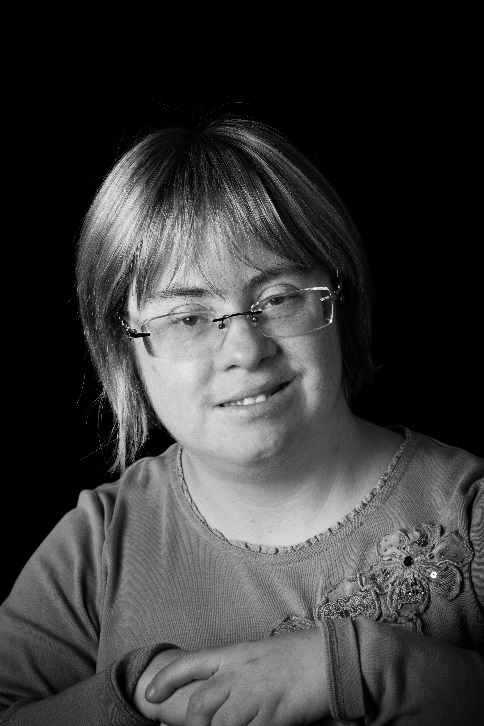
Tracey Harding looks back on an autumn of abundant treats, with some wonderful acting from Sarah Gordy in the BBC’s Strike and an interesting cinema documentary featuring adults with Down’s syndrome in the BFI London Film Festival.
Strike – ‘The Silkworm’, BBC1, Sunday 10 September 2017
The Grown-ups, Director Maite Aberadi, 2016
The talented Sarah Gordy featured in the second instalment of the BBC’s Strike mysteries by J.K Rowling – The Cuckoo’s Calling. Sarah is blazing a trail for actors with learning disabilities, having previously been seen in episodes of Call the Midwife and Doctors, as well as starring in Upstairs, Downstairs. She gave a heart-wrenching performance as Orlando Quinn, daughter of Owen, who has been brutally murdered. He leaves behind his wife Leonora who is struggling to take care of their daughter who was brain damaged at birth. Frankly, the intensity of Sarah’s performance made for some difficult viewing at times, but in a cast of talented actors, including Monica Dolan as her mother, she was mesmerising to watch. I look forward to her future projects and continued development as a screen actor, role model and champion for people with learning disabilities.
A tale of four adults
October has seen the 61st BFI London Film Festival take place in cinemas around the capital. It is an annual opportunity for more than 300 films to be shown from approximately 500 countries. This year saw the inclusion of a film from Chile The Grown-ups, directed by Maite Aberadi. The documentary follows adults with Downs Syndrome at a training centre where they work in the catering department. The film offers an observational and empathetic study of the students who are middle-aged and mature enough to seek independent living, but do not possess the finances or emotional stability to pursue these on their own. Reflecting issues for people with learning disabilities internationally, most of the time spent training and working in the centre’s catering department is not rewarded financially or recognised. The film’s four central subjects are strong and charismatic. Anita wants to escape the boredom of the training centre and marry Andres, a fellow classmate. Rita is frustrated by her emotions and how to deal with them, and Ricardo is trying to work and save money for his future:
“I want to be someone, like a homeowner. I want to make enough to keep my home. I want to build a family with someone who makes me feel special. That’s what I’m saving for.”
The Grown-ups ultimately highlights the need for expanded job and life opportunities for people with learning disabilities, and their repeated mantra ‘Who are we? conscious adults’, needs to be heard and recognised by a wider audience.
More Sanctuary
The love between two people with learning disabilities and their attempts to forge a relationship together in The Grown-ups shares a theme with Sanctuary, which I wrote about in the last issue. I promised to update you on further developments, and I am delighted to report that the film had its UK premiere at the Oska Bright Film Festival in Brighton on Wednesday 15th November. This was the eighth annual festival of films made by, or featuring, adults with learning disabilities and runs over three days showing more than a hundred films from around the world, including short films and animation.
There will be a report in a later issue of Community Living. The film has also been shown in Hawaii, and will be screened at the International Film Festival in Poland. Another UK film festival screening took place at Manchester Home on the 29th December, with more to follow in 2018.
Can social work practice based on the social model of disability
successfully challenge the oppressive practice and disabling barriers experienced by people with learning disabilities? Hannah Morgan and Elaine James report on a study to test their belief that social work is about human rights and its role is one of servant, not master.
STUDY TITLE: NAMED SOCIAL WORKERS – BETTER SOCIAL WORK FOR PEOPLE WITH LEARNING DISABILITIES,
AUTISM AND/OR MENTAL HEALTH CONDITIONS
Aims: To find out whether social work practice based on the social model of disability can successfully challenge the oppressive practice and disabling barriers experienced by people with learning disabilities.
Methods: We held workshops and focus groups with self-advocates to understand more about what they want in their lives and how they think social workers can help them achieve this. We supported the senior leadership team in a local authority to implement value-based practice and trial the role of a named social worker for people with learning difficulties. This included participating in the national pilot workshops, sharing academic resources and research and acting as a critical friend in discussions about the purpose and scope of the social work role. We shared our findings with self-advocates and practitioners from across our region to learn how we can support better social work in different agencies and locations.
This work was supported by the Department of Health, Calderdale Council and City of Bradford Metropolitan District Council as part of the Named Social Worker pilot. The views expressed represent those of the authors only and not those of the funding agencies.
BACKGROUND
In 2015 the government published its response to the consultation ‘No voice unheard, no right ignored’ (ref?). The consultation was issued in recognition that the response to the Winterbourne View scandal and attempts to transform care for people with learning disabilities, autism or mental health conditions had been too slow. One of the proposals for action was to: ‘pilot access to a named social worker who will provide professional advice and support, be the primary point of contact for the service user and their family/carers wherever the person is being supported, and provide a professional voice across the system’
The Centre for Disability Research (CeDR) at Lancaster University in partnership with Calderdale Adult Social Care applied to take part in the original pilot. We were strongly influenced by the stories we heard from families like those of Steven Neary and Connor Sparrowhawk and from the 7 Days of Action campaign about routine abuse and neglect. These stories demonstrated a health care system that is frequently restrictive and controlling in the lives of people with learning disabilities, and particularly young people at times of transition crises. The key themes from these experiences are:
People and families are not listened to and their views not taken into account when decisions are made about them
The most restrictive option (often hospital admission) is routinely being taken by professionals.
This is especially worrying given the Care Act (2014) and the Mental Capacity Act (2005) have choice, control and a legal obligation to select the least restrictive option at their heart. This is supported by Court of Protection judgments like that issued by Justice Hedly (2) which stated that people with learning disabilities should not be dressed up in ‘forensic cotton wool’ but allowed ‘as far as possible to make the same mistakes that all other human beings are at liberty to make and not infrequently do’. Restrictive practices frequently breach people’s human rights, especially to a family life, and are at odds with Article 19 of the United Nations Convention on the Rights of People with Disabilities, concerning the right to ‘Independent living and being included in the community’.
We wanted the opportunity to test our belief that social work that is ‘all about human rights’ (as Lyn Romeo, the Chief Social Worker for Adults in England described it), and that sees its role as one of servant, not master (3) can be the professional challenge that protects and upholds the rights of people with learning disabilities in the health and social care system.
FINDINGS
The key finding so far is that the named social worker pilot has provided social workers with the time and space to showcase what better social work looks like – social work that resonates with their values of social justice, upholding human rights and working cooperatively with the people social work is there to serve. It has less to do with creating a new role, that of ‘named social worker’. By working with people with learning disabilities as equal partners, social workers are better able to support people to live independent lives in the community.
The first three Statutory Principles of the Mental Capacity Act
Every adult has the right to make their own decisions unless it is proved otherwise.
All practicable help must be given to support people to make their own decisions.
People have the right to make decisions others may see as unwise. Everyone has their own values, beliefs and preferences which must be respected.
KEY MESSAGES
Health and social care is too often restrictive and risk averse when making decisions about people with learning disabilities
Social work should be based on the social model of disability and a commitment to uphold people’s human rights
Knowledge and shared understandings of better social work practice is most effectively co-produced by self-advocates and social workers working together in respectful and reciprocal partnerships.
WHAT’S NEXT?
The Department of Health are funding a second phase of the pilot over the next six months (until March 2018). CeDR are now working with Bradford Adult Social Care to implement the approach. We are also working with Bradford Talking Media, who presented at our Better Social Work Conference. In this phase, there will be workshops linked to the first three principles of the Mental Capacity Act where self-advocates and social workers will co-design the knowledge and skills social workers need to support people with learning disabilities. We will create learning materials and pilot a continuing professional development (CPD) module for social workers. We are planning another Better Social Work Conference next summer to share our learning and hear back from self-advocates and practitioners in our region about what difference social work is making.
References
Department of Health, Government response to ‘No voice unheard, no right ignored ’ – a consultation for people with learning disabilities, autism and mental health conditions’ (Cm 9142, 10/11/15)
An NHS Trust v P. & Anon 2013.
Munby, Lord Justice. 2011. Safeguarding and Dignity: When is Safeguarding Abuse: Keynote address by Lord Justice Munby to the Rotherham, Doncaster and South Humber Mental Health NHS Foundation Trust’s AMPH and Social Care Conference, Doncaster.
Further reading
James, E. Morgan, H and Mitchell, R. (2017) Named social workers – better social work for learning disabled people? Disability & Society 32 (10) pp 1650-1655 DOI: http://dx.doi.org/10.1080/09687599.2017.1340019 (open access)
Easy Read version produced by Rebecca Fish http://wp.lancs.ac.uk/cedr/2017/07/10/named-social-workers-better-social-work-for-learning-disabled-people/
National Named Social Worker Pilot website hosted by SCIE https://www.scie.org.uk/social-work/named-social-worker
Hannah Morgan is Senior Lecturer &
Elaine James is Honorary Researcher
Centre for Disability Research (CeDR), Lancaster University
Rosemary Trustam reports from a conference of commissioners entitled Successful pathways towards integration – building resilience in a changing world where a key message was that specifying outcomes is unlikely to lead to better commissioning.
When wolves were reintroduced into Yellowstone National Park regenerated forest areas were avoided by deer, rivers changed due to less erosion, and populations of birds and beavers increased. Conference chair Alex Crawford, from Aneurin Bevan University Health Board, said if these outcomes had been specified it is doubtful anyone would have suggested bringing in wolves to achieve them!
He was underlining a key message of this conference on integration, that specifying outcomes in such a complex world is unlikely to lead to better commissioning. Building on this, several conference speakers also emphasised the importance of building trust and relationships across services, between providers, commissioners, communities and, most importantly, by listening and handing influence to people and families.
The conference challenge was how to connect the different parts of health, social care and housing to be there when people most needed them. With mounting cost pressures for adults with disabilities, the importance of partnership was stressed. The key elements of partnership are building trust, relationships, common purpose, and mutual respect, modelled from the top. A coordinating lead is needed for integration – ‘a choirmaster so everyone sings the same tune’. It also requires organisations to get the relationship structures right, share risks and respond jointly when things go wrong. Proper resourcing and government understanding of the need for joint approaches to serve the same people are also vital.
Conference presentation highlights included:
Toby Lowe, Senior Research Assistant from Newcastle University: his research evidence challenges outcomes-based contracting approaches. He argues that these encourage people to produce good-looking data rather than meet client need, and therefore fail to produce good outcomes. Practices such as ‘creaming’ results where, for example, work programmes only concentrate on those most likely to get a job and ‘park’ those who present the biggest challenge. Commissioners need to develop healthy network systems based on trust and positive relationships with and among providers.
Mark Saunders of Greater Gwent’s Health Social Care and Wellbeing Transformation Support Programme described how a residential abuse scandal led them to review their monitoring to find more innovative ways to get feedback. Volunteers from an NHS retirement group have confidential discussions with people and relatives following My Home Life Cymru standards. Tanya Strange gave an inspiring presentation about Primary Care’s numerous community connecting activities aimed at tackling loneliness, including a website (www.ffrindimi.co.uk) to provide a single point of contact for self-referral, volunteers matched with lonely people according to their interests, and a staff volunteering scheme. Other plans include community recruitment to train volunteers to look out for and protect people.
Advonet with Leeds City’s ‘Good Lives Leaders’ (GLL’s) project developed a contract monitoring system using people with learning disabilities and family carers as quality checkers. Built through a consultative design process the project involves experts by experience going in to supported housing, residential and nursing homes to check three key areas:
1.Is it a good place to live in?
Do people feel valued in the community or at work?
Are people supported to have a full range of relationships and a social life?
It was reported that numerous positive changes for individuals have resulted from their feedback reports. Advonet plan to extend the scheme to other client groups and share their practice widely.
Angela Catley from Community Catalysts made the case for the importance of doing things differently in an age of service and cost reductions. Community Catalysts aim to find ways to get more for less by unlocking local assets and resources and finding creative ways to deliver people’s support (1). A partnership project called Enterprising Minds with the charity Hansel and North Ayrshire Council supports people with learning disabilities or autism to develop their community involvement. Successes included a young woman with a severe learning disability who combined her love of baking and dogs to set up a dog biscuit business (2). Community Catalysts worked with Oldham commissioners in 2010 to support 18 people to start their own enterprises. One of these was DanceSyndrome, recently featured in Community Living (3). Angela ended with the inspiring words of Eddie Bartnik, the pioneer of ‘Local Area Coordination’: “People … are not just passive recipients of social and health care but have expertise, gifts, strengths that can help them achieve their vision for a good life, contribute to their local communities and maximise the impact of resources” (4).
References
What can be achieved when people are seen as active citizens, Community Living, 31 (1), 2017.
See ‘Enterprising Minds’, 2015 http://www.hansel.org.uk/Uploads/users/wmcgill/99da720cf95d405a21f7d6b49baf7c4f/1432741231_jxUz0a7E_hanselenterprisingmindsmay2015.pdf
It’s lift-off time for DanceSyndrome as Jen’s dream comes true. Community Living. 30 (4), 2017.
Bartnik, E. (2008) Active citizenship and community engagement – Getting serious about more positive pathways to relationships and contribution. Intellectual Disability Australia 29 (2), 3-7.
To access the presentations from the day go to http://www.ncctc.co.uk/presentations/oct-2017/
For a full report from this conference go to Community Living: www.cl-initiatives.co.uk
In a recent issue of Community Living (1) Robin Jackson asked whether we wanted to go in the direction of ‘Robocare’ and advised readers to wake up to its harmful potential. Sally Warren acknowledges that there could be a dark side to technological care but argues that Assistive Technology can also be liberating.
While we need to be careful about possible threats to people’s dignity and well-being, we should be wary also about spreading an ‘anti’ message about Assistive Technology.
My everyday experience with three of my friends with learning disabilities shows that technology can be liberating but only if a person is supported by people who love and care for them and think about what would really benefit their life. One of these, Cathy, is happy to share her story.
Assistive Technology – or to use the popular term ‘Robocare’ – is the use of technology rather than human labour to provide personal care and support. Examples are personal pendants, sensors to report that people have fallen, epilepsy sensors rather than night-time checks, telephone and computer prompts, and so on. Fears have been expressed that such technology will lead to increased loneliness and isolation, online privacy invasion and cyber bullying.
Cathy is undoubtedly lonely but over the years has shown massive strength in saying very clearly, and sometimes very loudly, what she wants in her life. She now has a ‘community circle’ which truly listens, discusses ideas and supports change to happen.
Proud
Cathy has recently had her funding for support increased. There is no doubt that some paid support, human contact each day alongside natural help from church and other friends, ensures she has the support she needs. But Cathy is proud; she wants to do things for herself and doesn’t want to ask people all the time.
This is hard for her. She has always enjoyed going out on her own and would walk locally or get the one bus she knows. The challenge was when she got lost. This would cause her to panic. She would phone her friend, screaming and crying. Her friend would talk to her, help her calm down and then ask her to walk into a local shop. Cathy would then be asked to hand her phone to the shopkeeper. Her friend would then talk to the shopkeeper, find out where the shop was, say he was on the way and ask the shopkeeper to chat to her and let her sit down until he arrived. To be honest, most shopkeepers were very helpful when this happened but Cathy would feel embarrassed and ashamed for days and would stop going out.
So where does technology come in? Four months ago Cathy had her annual review. She agreed to see the Telecare team. They arrived within three days of the review meeting and within a week Cathy had technology which increases her independence and freedom. She loves it! She now has a few ‘tech’ things but her favourite is the iHelp device. It took some getting used to but now, if Cathy gets lost, she can press a button. The device is connected to her friend’s mobile. The minute Cathy presses it her friend gets an alert that tells him exactly where she is – he can then phone her and make sure someone goes to meet her. The device also sends a message if the battery is running low – again the friend can let Cathy know it’s time to charge the device.
Cathy is really angry that she can’t read. A letter coming through her letter box addressed to her (she can recognise her name) is likely to make her extremely distressed. It may be that a supporter or friend is turning up later but in that moment Cathy’s distress can lead to her smashing up her flat and hours of distress. Now she is learning how to use the scanning pen. She drags the pen along the lines of the letter and the words are read out. Not perfect, especially if the language is complicated, but Cathy is so proud of being able to understand some of her letters and proudly demonstrates the pen to others.
Simple eh? Gadgets will never replace human contact but what a difference a couple of gadgets, along with friends and good support, have made to Cathy’s life.
Reference
Back to Bedlam or forward to Robocare? Robin Jackson, Community Living, 30 (4), 2017. For his full discussion of technology in care see Robin Jackson’s Back to Bedlam: what kind of a future faces people with learning disability?, Centre for Welfare Reform, 24 July 2017.
Sally Warren is CEO of Paradigm and a Community Living adviser.
Are funding cuts recreating institutions in our communities? Does outsourcing to large private companies and profit-seeking lead directly to warehousing? Robin Jackson sees trouble looming
We are witnessing the operation of two pernicious trends in the provision of care in the community for people with learning disabilities.
The first is the process of micro-institutionalisation where to remain cost-effective care services are under pressure to employ as few staff as possible and then to pay them as little as possible. There are obvious consequences for residents. Opportunities to participate in a range of recreational, social and educational activities in the community are restricted as there are not enough staff on duty at any one time to accompany individual residents into the local community. In the past many residents would have gone out to a day centre, adult training centre or sheltered workshop but nearly all these facilities are now closed because they were regarded as ‘segregated’ settings.
When excursions for residents are scheduled they usually take place during the day and involve visits to a narrow range of venues – shopping malls, garden centres and local parks. What is concerning about this practice is that people with learning disabilities are not seen by the public as individuals but rather members of an undifferentiated group. This would not matter were it not for the fact that since the Brexit referendum a toxic climate has developed in Britain in which the level of tolerance for people who exhibit differences – whether intellectual, racial, ethnic, religious or sexual orientation – is declining.
Confinement
Staff shortages – often acute – can lead to the confinement of residents in their ‘home in the community’ – a practice not conducive to the creation of a congenial, relaxed and normal environment. Thus what we have is segregated, not person-centred, provision. This is the antithesis of what those arguing for community inclusion are seeking.
In addition to this process of micro-institutionalisation there is a further worrying trend. Increasingly, a wide range of services is being outsourced to monolithic, profit-seeking and democratically unaccountable organisations possessing an abysmal record for the quality of the services they provide (consider, for example, the recent poor performance in delivering public services by such companies as ATOS, Capita, G4S and Serco). We are witnessing here the phenomenon of warehousing where a significant number of people with care needs are located under one roof to reduce costs. If the economic argument lying behind the ‘warehousing’ model is accepted then there is nothing to prevent the creation of larger and larger ‘warehouses’.
What cannot be disputed is the poor quality of services offered to people with learning disabilities. This is clearly illustrated by the findings of a Care Quality Commission review of learning disability services conducted in 2017. Unannounced inspections were made at 145 settings, where two national standards were examined: care and welfare and safeguarding (ie. protecting people’s health and wellbeing, and enabling them to live free from harm):
35 met both standards (24%)
41 met both standards with minor
concerns (28%)
69 failed to meet one or both
standards (48%)
Commenting on these findings, the CQC reported that many of the failings were a direct result of care not being centred on the individual or tailored to their needs – a feature of the ‘total institution’ described by Goffman over 50 years ago (1).
Dispiriting
What is dispiriting is the way in which such concepts as ‘community care’ and ‘inclusion’ have been deployed so casually and uncritically by politicians, academics and social commentators. The twin processes of micro-institutionalisation and warehousing will render opportunities of offering personalised care virtually impossible. But who cares? Certainly not the government, which sees this particular population as numerically too insignificant to merit serious attention (2).
A troubling sign of things to come may be discerned in the decision by Scope, one of UK’s largest disability charities, to cease providing day and residential services. Will other charities follow suit? If so, the temptation for care services then to be outsourced to the kind of companies identified earlier may prove irresistible with disastrous consequences for people with learning disabilities.
References
(1) Goffman, E. (1961) Asylums. London: Penguin Books.
(2) Greig, R. (2016) ‘Clock turned back on rights for people with learning disabilities.’ The Guardian, 14 October.
Robin Jackson is an author and commentator on social care and learning disability and a visiting research fellow at the University of Hertfordshire.
When Rex encounters trouble, Frank has reason to consider the instinct defence, its uses and misuses.
“Off to work Rex”? I asked. “I am Frank” he replied, beaming. “I passed my probation last week,” he continued, excitedly. “Well done,” I said, heartfelt. “I saved 1200 quid already” he said. “Brilliant” I said.
One rent deposit, a home of his own, three dating sites, and a honeymoon in Florida later, Rex’s dreams for leaving home sounded like mine at his age. Admittedly, his plans did not include ‘lozzucking around waiting for the unlikely rise of a Socialist Republic’ but still …
Rex prodded me with his rolled up newspaper. “Read it. Back page. Anthony Joshua. Body achieves what the mind believes. That’s what he says”.
Rex loves boxing. So do I. Joshua is his hero.
Just about to settle down for a cup of tea and a read when wife arrives home, pale and perplexed. ”You’ll never guess the outcome of that fit to practise hearing for the learning disability nurse”. I put the milk back in the fridge and picked up Rex’s newspaper. “You mean the nurse who punched a teenager so hard in the face he broke his teeth and his jaw. That nurse who, trained in restraint, showed none. Him? Banned for life I hope”.
Free to punch again
Wife shook her head. “The entry in the Nursing and Midwifery Council’s register for Maxwell Nyamukapa1 has a big green tick of approval against it, followed by ‘Registered – no restrictions on practice’. He is free to practise and to punch again”.
I could not compute wife’s explanation. It contained all the wrong words: no case to answer, act of self-defence, instinctive. “Instinctive you say”? I asked as it dawned, my anger uncoiling like a spring. “Instinct? Against a vulnerable teenager with learning disabilities and autism?”
Wife joined me in apoplexy. Yet more legitimised violence in health and social care? Wife and I were globally vexed. Men with huge power over others re-branding their heinous crimes ‘instinct’, like they cannot help themselves, like it’s natural, like they have no choice. Weinstein and his vile rape instinct, faking helplessness. Trump filmed boasting serial sexual assault, defended as locker-room talk. As if these are the unrestrainable instincts of men, bearing no resemblance to the men we know and respect. Instinct – a fashionable defence of the indefensible.
I calmed down, unrolled Rex’s newspaper, glanced at the back page, saw Anthony Joshua with his arms and fists up, gloved, defending himself legitimately. I rolled it back up again furiously and spent 20 minutes defending boxing, its discipline, its relative care of the human.
“Did you know that in boxing there are 21 fouls for which a boxer can be penalised or disqualified”? I said, fuming. “In a sport that is all about whacking people, nowhere does it say that the instinct of self-defence mitigates any of those 21 fouls,” I added, whacking the fridge door with my rolled-up newspaper so hard, an Eiffel Tower fridge magnet catapulted in wife’s direction, decapitating her cup cake.
I was just wiping vanilla cream and entrails of cherry off the floor tiles when the front door bell went. Wife answered it and ushered Rex into the kitchen. Gone was the buoyant dreamer and schemer of this morning; he looked crushed and crestfallen. “I am gonna lose my job,” he blurted out, near to tears. Turns out customer and his mate, sixth formers from a local school, were baiting Rex all the way up beers, wines and spirits. “They called me a mong,” he said. “They called me a spazz.”
“When I got to bread and started filling the shelves I …” Rex hesitated, “I whacked one of ’em round the head with a bag of burger buns when he called my Mum a retard,” he said, shamefaced . “Wife gave him a big, long hug.
I read his suspension letter. “I’ll accompany you to the hearing if you like,” I offered. “Do you think I’ll be sacked”? asked Rex, still desolate.
“What would Anthony Joshua say”? I asked, trying to comfort him. “The body achieves … no, in this case the mind achieves what the mind believes. Let’s believe that you won’t be sacked, and you won’t be sacked”.
It was a gloved hand
Rex went home to tell his Mum. “Well, technically, it was a gloved hand,” I said to wife and we smiled, wryly, about the burger buns. “What’s the line of defence going to be Frank? Wife asked. “Oh, that’s easy,” I said .“There are professional role models for that,” I declared. “Instinct. His defence will be instinct”.
Maxwell Nyamukapa was a nurse at Winterbourne View Hospital.
Venue: Life Community Church, 407 Lodge Road, Hockley, Birmingham B18 5QN
Don’t miss celebrating LDE’s first year!
The overriding theme of our conference this year is change. We will showcase great ideas, and latest thinking, and celebrate that innovation abounds during cash-strapped times, whilst not shying away from the reality that things can be difficult. We are asking all our speakers to be practical and solution focused so that our delegates leave feeling equipped and inspired for the year ahead. For more information click here
When he hears that Rex has got a job at Lidl, Frank is horrified to discover that he has an inner snob.
“Just come back from Lidl. Rex has landed a job there”, declared neighbour Henry, incredulous. “Collecting trolleys?” I sneered, parading my low expectations of supermarkets. “Actually, he’s a Customer Assistant” said Henry, dead shirty. “Wearing a badge that says so. Kept kissing it, same way footballers do when they’ve scored a goal” he continued proudly.
I hate it when Henry is in the know. “Bet he’s being paid £7 an hour for the privilege,” I said wisely, trying to best him. “Actually, he gets £8.45 an hour”. My turn to be incredulous. “Are you sure Henry? That’s more than most care and support workers get”. Henry laughed: “Me and every customer in aisles 14 and 15 – rice, pasta, tinned foods and canned fruit – know Rex’s wage is £8.45 an hour on account of the victory lap he did when he told me”.
I was visualising Rex getting sacked for behaviour unbecoming a Customer Assistant when Henry read my mind. “I apologised to a passing supervisor. Said it was my fault. She winked at me, handed Rex a price gun and steered him to the tinned tomatoes. He was as ’appy as Larry”.
Disgruntled, I told wife. I said Customer Assistant was better than collecting trolleys but a waste of Rex’s talent and potential. I said that he was bright enough for a career in computing. “How do you work that out, Frank”? she asked, disagreeably, stirring soup. I hit her, broadside, with a volley of my best shots and latest research: less than 7% of people with learning disabilities have jobs when 65% want them, skills and talents under-estimated, always at the end of the labour queue, the Catch 22 of being economically excluded then derided for dependency on benefits… “Frank,” she interrupted, her back still turned, stirring purposefully, “that’s an argument for celebrating Rex’s job at Lidl, not dismissing it.”
Her calm tone hinted at the storm to come. Finished stirring, she slatted the slotted spoon back into the steaming saucepan with a hiss and a flourish and swung round like a force 9 gale. “You are so Metropolitan Elite Dot Com”, she scathed. “You don’t know one end of the labour market from the other. You confuse potential with actual. You have been listening to too many of your job snob colleagues who, frankly Frank, are as big a barrier to employment as unenlightened employers”.
All jobs are good jobs, according to wife. They just have to be the right jobs, for the right people at the right time. Any job helps people to get a foot in the door of the labour market. There are more entry level jobs in retail, food distribution and catering than any other sectors. “Hundreds of thousands of young people kickstart their paid employment in shops. Why should Rex be any different?” she demanded. “Never had a job. No work experience. No proven skills yet. Nobody goes from potential to career with nothing inbetween. Not even you ruddy social workers. Think on, Frank”.
As I was backing out of the kitchen, storm-lashed, a memory of my first Saturday job on the frozen food counter at Kwik Save leapt to mind, and shut me right up.
I was still ‘thinking on’ shamefaced at the back door, when Henry appeared bearing homemade marmalade for wife. “Great news about Rex”, I relented, quietly. “He’ll be brilliant at that job. He loves ordering and organising. He’s charming and helpful so customers will like him”. Henry was in no mood. “Any way Frank,” he began loudly, breezing past me, “what’s wrong with collecting trolleys”? Wife looked on with a face like thunder as disgrace tapped me on the shoulder for a second time. I groaned involuntarily; I knew what was coming next, and what Henry’s first job was.
In six large London NHS hospitals a quiet but remarkable revolution is taking place in the perceptions and expectations of people with learning disabilities as employees. This revolution has arisen from the work of Project SEARCH, an organisation that has a very simple mission – to secure competitive employment for people with learning disabilities. Simon Jarrett visits supported employment providers Debbie Robinson and Steve Parr, who are partners in a Project SEARCH programme at the Royal London Hospital, to find out more.
Twenty years ago, at the Cincinnati Children’s Hospital Medical Centre in Ohio, Erin Riehle had a revolutionary thought. She was the director of the renowned Cincinnati Children’s Emergency Department, and wondered if it would be possible to train people with developmental disabilities to fill some of the high-turnover, entry-level positions in her department, many of which involved complex and systematic tasks such as stocking supply cabinets. She discussed her ideas with Susie Rutkowski, a special education expert, and so was born the partnership that became Project SEARCH.
Project SEARCH now operates in 45 states of the US and nine other countries across the world, including the UK, where it currently has 41 sites. In the NHS in London, Project Search programmes are in operation at six large hospitals – Charing Cross, The Royal London, Great Ormond Street, Whipps Cross, Northwick Park and Newham – supporting people with learning disabilities and those on the autistic spectrum into full-time employment.
Job rotation
At each of these sites, eight to twelve interns each year, aged between 16 and 24, go through a job rotation of three internships combined with a programme of tutoring, coaching and mentoring. The expectation is that by the end of the year, each student will have entered into long-term paid employment, at the prevailing wage, of 16 hours a week or more. There is no job segmentation (carving up jobs so that people just do part of them, as they are deemed incapable of doing the full job) – and all jobs are on the open labour market. The rate for successful transitions into employment in UK Project Search sites is 67%, and internationally is 75%. Currently in the London Hospital programmess it ranges between 73% and 83%. Most of the jobs are full time, and people stay in them long term. These success rates are all the more remarkable given the context within which they occur – a national employment rate for people with learning disabilities just below 6%.
The model is straightforward. Project SEARCH programmes work in partnership with large employers in both the public and private sectors. Employers must have a workforce of at least 250, so that job rotation across a range of departments is possible during the internship. The programmes must be business-led and are a partnership between the host business, the education provider, supported employment provider and Project SEARCH. The partners work together to deliver a series of core critical success factors defined by Project SEARCH (and known in America as Model Fidelity). They purchase a Project SEARCH license, which gives them access to programme infrastructure, resources and specialists. There is no hard sell, says supported employment provider Debbie Robinson, because the model will only work if it is a good fit and right for all partners, but especially the host business.
Once a programme gets off the ground, it is owned by the host business, and the tutor, and job coaches see themselves as its guests. On this basis, interns are treated exactly like any other employee – they have smart cards, computer access, access to all areas necessary for their work, and are expected to abide by all the employer’s codes and practices. While coaching, support, development and training are provided by the job coaches and education partner, management and mentoring come from within the host organization, as they would for any other employee.
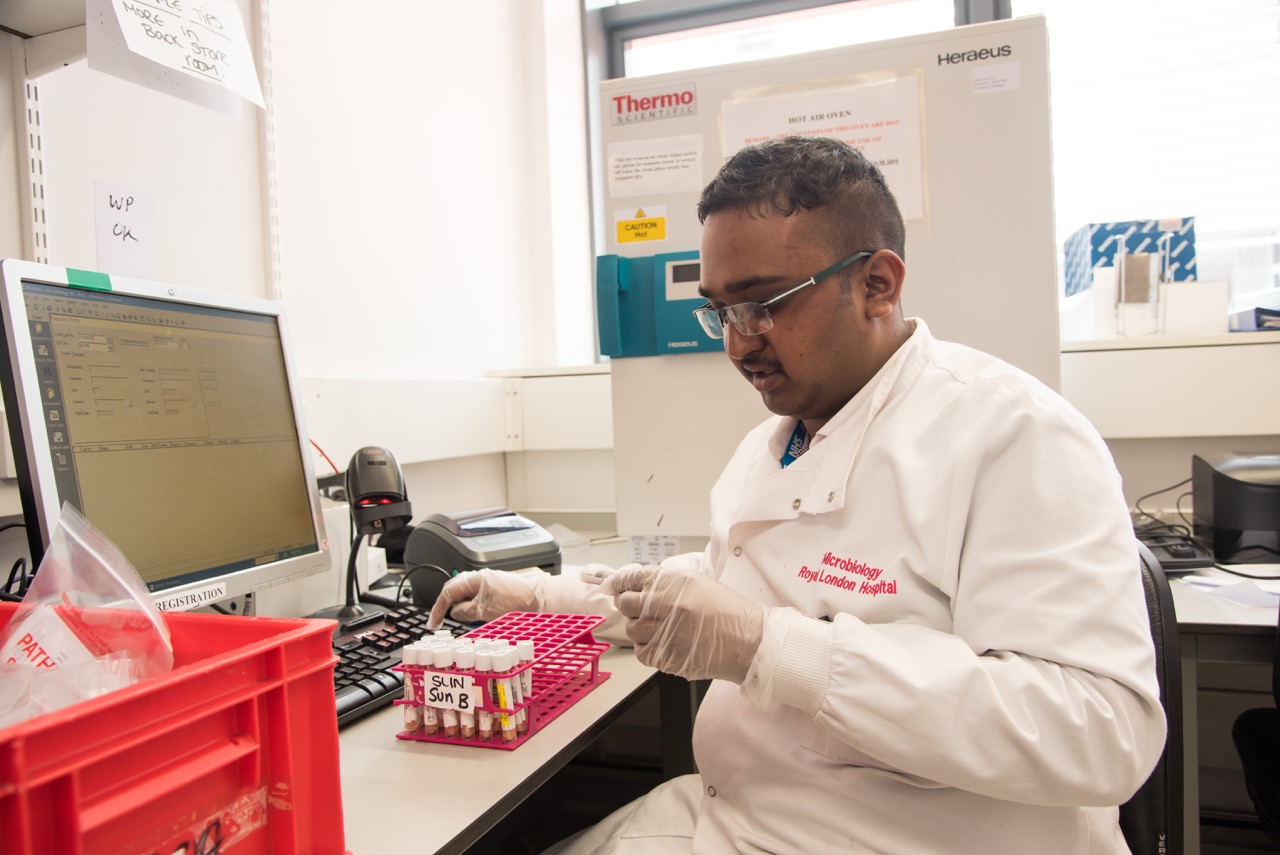
The jobs that people secure are often not what stereotypical assumptions might suggest. They work across all areas of the hospital, including contracted out services. One person is processing blood and fluid samples in a microbiology lab, highly critical work, at a level of accuracy and productivity that has astonished co-workers. Another was put forward to apply for a position as a ward host, only for the ward sister to intervene and appoint them to the higher position of health care support worker. People are working as receptionists in busy outpatient departments, or carrying out complex sterilization and maintenance work on high-level equipment. They are working in areas as diverse as oral surgery, endoscopy, catering, restaurants, maternity, estates, medical records, portering and medical engineering. Each of them has gained their job on merit, because they have the skills, ability and personality to do it.
What are the secrets of this success? There seem to be a number of factors. Underpinning it all appear to be the high expectations that Project SEARCH holds of its participants. They go through a process of total immersion in the work they do, and interact with the workforce and its management as employees, not as ‘special’ people. This can be tough, but Debbie Robinson and colleague Steve Parr describe the transformations which people undergo when they are placed in this sort of environment. Project SEARCH also works with the families of participants, to ensure that they understand that the expectation is full-time employment in a real job and escape from the benefits system. Families sometimes have to undergo a similar journey of transformation to change their own expectations. There is, of course, a need for adaptation, adjustment and learning, on both sides, as people integrate into the workforce. Here Project Search’s team of job coaches come in, liaising with employee, employer and co-workers to ensure that a person has the skills and self-confidence and benefit from the understanding of those around them. This ensures they can fit successfully into their team and do their job well. The approach is an unusual mix of high idealism and deep pragmatism. The idealism is that there is no compromise on the central premise – people must go into real jobs, with proper pay, on the open labour market. The pragmatism is in building a coalition of interests around the person to make this happen.
Franchise basis
It is not of course just about working in the NHS. Project Search operates on a franchise basis, overseen in the UK and Europe by employment specialists Anne O’Bryan and Carmel McKeogh. There are partnerships with hotel groups, universities, retail distribution, drug companies, local authorities and, in America, even a casino. It is not so much what employers do that matters, as their willingness to integrate people with learning disabilities into their workforce and build their skills and experience.
Project SEARCH overturns many of the assumptions that bedevil people with learning disabilities who wish to enter the labour market. For many years we have been told that people need endless training, literacy and maths skills, social skills instruction and guarantees of a ‘safe’ environment before they can even walk through the doors of an employer. We have heard that there must be job segmentation (such as doing the photocopying) rather than a full job role, as people only have limited skills. Their families won’t let them work because of the loss of benefits, they will find open work environments too stressful, they will be bullied, their behaviours will annoy and alarm their coworkers. Project SEARCH have politely consigned all of these assumptions to the rubbish bin, looked at the people with learning disabilities they support, and seen them as people who can work. So have the employers who have taken them on, much to the astonishment of some learning disability professionals.
On the day that I visited the Royal London Hospital, the lead BBC news story was that the NHS had over 30,000 full time job vacancies, and had advertised more than 86,000 vacancies in the first three months of 2017. This was described as an ‘unprecedented workforce crisis in the NHS’. In circumstances like this, it is an act of almost criminal negligence to consign a significant segment of the population to a lifetime on benefits because they are considered incapable of working. Project SEARCH are showing, very elegantly, one way out of this morass.
Website: http://projectsearch.us/Home.aspx
For queries about Project SEARCH in the UK: anne.o’bryan@projectsearchuk.com
Thanks to Project SEARCH job coaches Lee Bones and Lorraine Hall for their help with this article.
The Commitment of Individuals made Learning Disability Week a Success
Rosemary Trustam rounds up the reports from around the country on Learning Disability Week (19-25 June) which had employment as its main theme.
With only 6% of people with learning disabilities in employment, Mencap’s Learning Disability Week work theme seemed a priority area.
But the charity’s activity showed no evidence of involving Job Centres. Whilst there are useful resources and some individual stories on their website they no longer give direct support to localities.
The government green paper (1), whilst offering some potential for young people leaving schools, offers few prospects for people with learning disabilities unless the promised SE pilot with the British Association of Supported Employment (BASE) opens any doors (2).
The Government’s welfare benefits’ changes seem designed to encourage those needing more support and work preparation into the Employment Support Allowance (ESA) support group, as people joining the work activity group (WRAG) since April 2017 have been £30 per week worse off. Will people with learning disabilities in the WRAG benefit from their new job coach role? It feels doubtful when targets push advisers towards people more likely to get into work quickly.
Supported Employment (SE) is not a statutory service so many cash-strapped local authorities no longer fund it. Across the UK, employment activity seems to owe more to some individuals’ commitment than any government strategy.
Undaunted in Preston
Preston’s Learning Disability Forum (PLDF) led by people with learning disabilities was undaunted by a lack of resources, being full of enthusiasm and volunteering. Members continued their annual commitment to a full LD week programme of events, supported by Integrate’s Pat Afflick and REACT’s James Hughes. Their flag market launch was opened by Preston’s mayor, Councillor Brian Rollo, where stalls showed the work and support of some local learning disability charities representing people and carers and passers-by were encouraged to join in with DanceSyndrome’s flag market workshops.
The highlight was Preston City Council’s employee ‘Jack’ who spoke about his pathway to employment, initially through college, but then an internship with the council where he experienced different departments, resulting in his current full-time job. Apart from social events, a health day and a training day on safe dating, the week had employment-themed activities. These included a drop-in breakfast at Disability Equality North West (DENW) on employment with benefits advice support; drop-ins at Integrate’s social enterprises offering opportunities in packing, shop work, gardening and wood recycling; and ended with a free showing of Ken Loach’s film I Daniel Blake.
From Harrow to Newcastle
Harrow Mencap held an inspiring Learning Disability week fashion show with people with learning disabilities as models and supported by local businesses; Friends Action held Works for All events across Newcastle and the Twisting Ducks Theatre Company and Newcastle City Learning in Partnership with the Skills Funding Agency created a host of films and resources for employers and people interested in employment (see http://www.friendsaction.co.uk/news/works-all-learning-disability-week ).
Across England support for the week’s employment theme was often through postings on websites or through social media, which included NHS England’s ‘Message to employers’ https://vimeo.com/187842280, whilst areas like Kirklees and Leeds, led by Aspire, ran a more general programme of sports and fun events.
It takes a lot of effort, resource and connectivity to engage people in a position to change things, so perhaps the activities most likely to have had impact were reported by a University of Wolverhampton student Laura Creswell. She spent the week with Dudley Voices for Change. Their full programme included a very wide engagement relevant to employment – job centres, job coaches, tutors, psychologists, nurses on Day 1’s employment event.
The benefits of employing people with learning disabilities were illustrated there by a lunch of delicious food provided by Lunch on the Run. Their week saw a full range of workshops aimed at showcasing both the context and the achievements and talents of people with learning disabilities .
For the full report see https://www.wlv.ac.uk/current-students/news/july-2017/student-experience-learning-disability-awareness-week-.php
Meanwhile in Scotland…
Scotland’s Learning Disabillity week earlier in May had its theme as ‘looking back, thinking forward’. The aim was to learn lessons from the past and consider how to work for a better future. This year is the Scottish Year of History, Heritage and Archaeology giving the opportunity to reflect on how the lives of Scottish people with learning disabilities have changed since Scotland’s first 2001 learning disability strategy.
References
(1) Work, health and disability: improving lives, Department for Work and Pensions, Department of Health, 2016.
(2) Lives not services, Community Living, Vol. 30, No. 3.
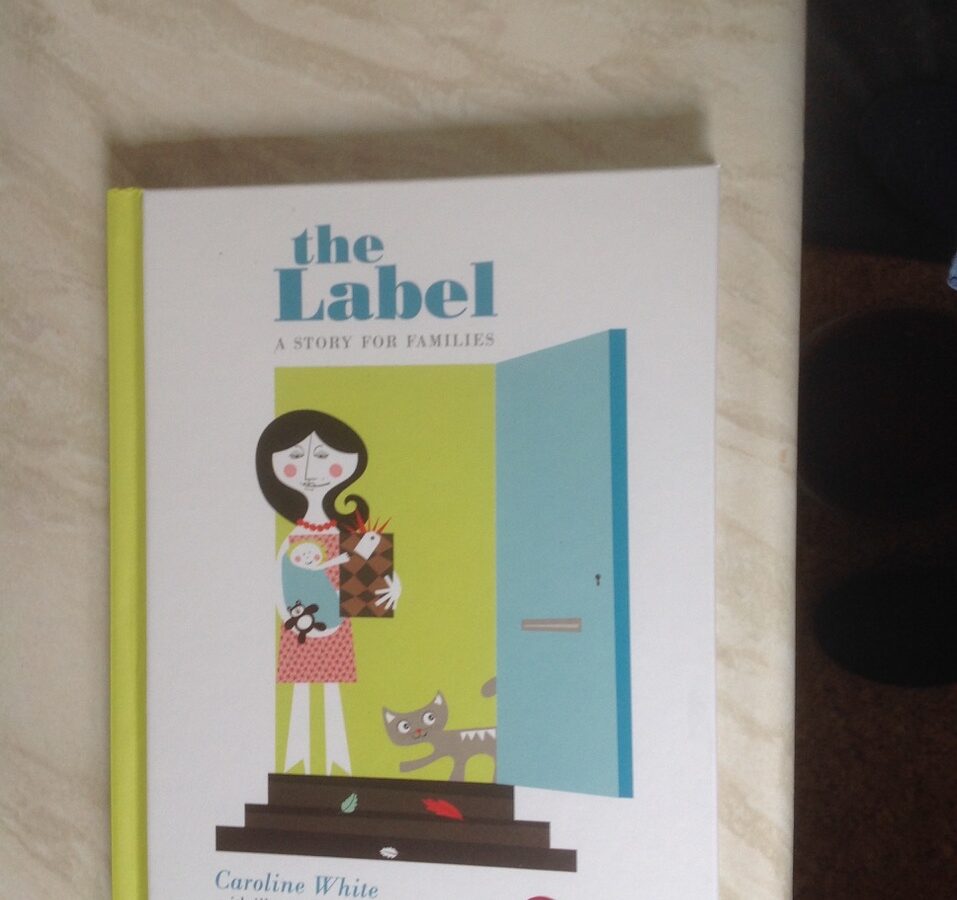
This beautifully illustrated and written little book captures in a few pages a mother’s journey – from despair to joy – of having a son with Down’s syndrome.
In the opening page the author writes: “Here you were, my brand new, longed-for baby – and I didn’t want you.”
But next she asks: “How was it possible to love something so deeply, with so much longing, but at the same time not want it?”
She struggles to come to terms with her feelings – that the child she had borne would never fulfil all her expectations. A doctor had pronounced and he had been labelled.
One day a parcel arrives and before she can open it its label flutters away in the breeze. The parcel contains a book and she feels that at last this would give her all the answers she needs. But all the book’s pages are blank. Confused and upset, she puts it away with all the others detailing the problems she will encounter as her son grows up.
Milestones
Years later when her son had become independent, had a job and a partner and was leaving home, she retrieves the book and dusts it down, but now it is dog-eared and full of cuttings. They tell a very different story: the first day her son walked, his first word, the day he started school, the day he learned to ride a bike… in fact, all the usual milestones in a child’s early life.
Reflecting on those early years she realises how he had filled her life with a richness she had never imagined possible. She addresses him in the book: “You taught me so much and changed the way I looked at everything, You were the son I had always dreamed of and instead of dreading the future I was now excited by it”.
Unique life
The book without a label – that was the one she had been looking for. It told of a unique life they had shaped together, not the path they had been told they would follow.
Her book describes the conflicting feelings mothers who give birth to a disabled child experience – that mixture of love, guilt and self-loathing – and gives them hope for the future.
Caroline White writes from her own experience. Her eldest son Seb was unexpectedly diagnosed with Down’s syndrome 24 hours after his birth. Iniitally devastated by the news she began to realise her view of Down’s syndrome was outdated and made it her mission to try to change attitudes that still surround the condition.
In 2012 Seb made history as the first child in the UK with Down’s syndrome to feature in a major high street retailer’s TV ad when he starred in Marks & Spencer’s Christmas TV campaign.
Research: Trained staff can help people overcome the barriers they face in intimate relationships
Research from the Tizard Centre at the University of Kent finds that supporting people with learning disabilities in intimate relationships can present a challenge to staff and a culture of risk-aversion can prevail. Training can help staff to engage with the dilemmas they often face. Dr Claire Bates reports
Summary
Aims:
This research review discusses some of the barriers to relationships people with learning disabilities face and how they can start to be addressed.
Methods:
11 adults with learning disabilities were interviewed to share their experiences of selecting and being in an intimate partner relationship.
Further information: http://www.emeraldinsight.com/doi/full/10.1108/TLDR-03-2016-0009
Background
Having someone to love who loves you back is highly valued. The importance of relationships is now recognised by the Care Act (2014), which identifies the development and maintenance of personal relationships as an eligible need. In 2001, Valuing People aimed for more people with learning disabilities to form intimate and sexual relationships. However, in 2009, Valuing People Now showed a lack of progress. Mencap highlighted that in 2016 little had changed as just 3% of people with learning disabilities lived with a partner.
Safeguarding processes are often accused of creating a climate of liability avoidance, with support providers being fearful of supporting relationships, particularly sexual ones, due to criticism if something ‘goes wrong’. However, people with learning disabilities are more vulnerable to abuse and support providers have a duty of care to protect. Research has shown that people with learning disabilities face restrictions, often put in place to ‘protect them’, but as a result their relationships are highly supervised. Restrictions such as not being allowed to share a bed, limited privacy and forbidding sexual relationships.
Findings
Accommodation: impact on choice and autonomy
Some people with learning disabilities explained how their living situation affected their relationship. One couple were unhappy due to the restrictions placed on them by staff and conflict with housemates, such as not being able to share a bed on weeknights or cuddle in communal areas as this upset their housemate. Staff had to balance the wishes of all members within the group home. However, some of the restrictions implied possible control by staff as opposed to support. It also appeared that some people still felt they required the staff’s permission to engage in normal adult activities such as sharing a bed. This was not an option for some as housing providers did not always provide double beds. This suggested that the person was not seen as an adult who might wish a partner to stay overnight.
Sexual relationships: capacity and consent
Not everyone needed support to initiate relationships. A woman with low support needs engaged in relationships with partners who could be considered ‘undesirable’. Staff have a duty of care to protect vulnerable adults in such relationships; however, if a person has the capacity to consent to a relationship, staff can only offer advice and support. The Mental Capacity Act (2005) states that capacity should always be assumed unless there is evidence to suggest otherwise. In an interview, one person’s responses suggested that she did not have the capacity to engage in a consensual sexual relationship at this time. What was unclear was whether the woman had received any support or education to help increase her capacity to understand a sexual relationship and consent. With this support, she may have been able to consent to this form of relationship in the future.
This example demonstrates again the balance staff need to achieve between enabling individuals to engage in relationships while still protecting them from harm, including considering their capacity to make decisions regarding sex and partner choice.
Risk avoidance
Possible indications of a culture of risk avoidance in organisations were identified such as the double use of contraception for one couple (pill and condoms), a woman with an implant who was not sexually active and another person’s insistence that she was unable to remove her clothing with her partner. The first couple could have been screened at a family planning centre to rule out any fear of STI’s. This suggests that staff may have been fearful of a pregnancy, despite all participants being adamant that they did not want children. However, not all organisations were risk averse in all areas and were, for example, actively supporting one woman to start a sexual relationship (in terms of providing emotional support and sexual health advice), despite her previous experience of sexual assault.
Conclusions
Risk aversion persists around sexual relationships. People with learning disabilities are not always treated as adults or as free as other people to make their own choices regarding their intimate relationships. People with learning disabilities need a clearer understanding of their rights to know when they are being unfairly restricted. It was clear that supporting intimate relationships was challenging for staff, and also that there was good practice. They often face difficult dilemmas, balancing providing support and protection to individuals in relationships without being overly protective. Staff training needs to be improved, which includes considering issues such as contraception, capacity regarding sex, and supporting individuals who have experienced abuse in starting new relationships.
Key messages
People should be treated as adults in regards to relationships and their rights respected. Unnecessary restrictions should not be placed upon relationships
Staff could benefit from better training around relationships to help them provide good support to people.
People with learning disabilities should be better informed of their rights in this area to know when they are being restricted and feel confident to raise concerns if they are not being supported correctly
Further reading
Bates, C., Terry, L. and Popple, K. (2017) Supporting people with learning disabilities to make and maintain intimate relationships, Tizard Learning Disability Review, Vol. 22, 1 pp. 16 – 23.
Bates, C., Terry, L. and Popple, K. (2016) Partner selection for people with intellectual disabilities, Journal of Applied Research in Intellectual Disabilities. (Early View).
Dr Claire Bates is an Honorary Research Associate at The Tizard Centre, University of Kent.
As the campaign to ensure people with learning disabilities gain fair access to the workplace steps up, Simon Duffy sounds a note of caution.
Dr Shigeaki Hinohara, who lived to be 105, said, “Don’t retire, and if you must, retire much later than age 65.” He believed human life is all about contribution and that we need to be doing things, for other people, if we want to thrive.
For people with learning disabilities, opportunities for such contribution are reduced by a combination of low expectations, a crazy benefit system and the attitude of employers. The employment rate for people with a learning disability is 6% but when Learning Disability Alliance asked people what was most important to them work was very high on the list.
In the days when normalisation was a powerful movement for change then helping people to get and keep work was one of the most straightforward routes to helping people develop a ‘socially valued role.’ What is more, supported employment, social enterprise, self-employment and apprenticeship schemes like Project Reach, all have great track records for supporting people, sometimes people with the most severe impairments, into work.
A balanced life
If someone wants a job they should be able to get one. However, as a philosopher, I am struck by some of the questions we don’t ask about work. For instance, Aristotle would have wondered why we did not value our free time more to contribute as citizens: help others, teach and get involved in the politics (literally, community life). Christian theologians would wonder why we think work for an employer is proper work, but the work of love – taking care of each other – seems less important. This doesn’t seem right or logical. It struck me recently that every week we live through an ancient pattern which tells us what a balanced life includes.
– Monday (lundi) is the day of the moon, for dreaming, thinking or talking.
– Tuesday (mardi) is the day of Tyr or Mars, a day of service and citizenship.
– Wednesday (mercredi) is the day of Woden or Mercury, a day of exchange or business.
– Thursday (jeudi) is the day of Thor or Jove, for making, growing and building.
– Friday (vendredi) is the day of Freya or Venus, a day for loving and caring.
– Saturday (samedi) is the day of Saturn, a day for relaxing.
– Sunday (dimanche) is the day of the sun or the day of the Lord a day for rest and thankfulness.
How do we get a life in which our contributions are balanced and include all the different aspects of a good, human life?
Narrow and shallow
The kind of society where doing what other people want – which is what employment means – is not the kind of society in which any of us, but particularly people with learning disabilities, will thrive. It is a narrow and shallow vision of the good life. We need to think differently and start to plan and organise differently.
The case for basic income (a secure and regular income for everyone) will continue to get stronger. More people will realise that they can contribute locally and bring about wider social change as active citizens. Support organisations will start to realise that they should be engines for building community – in all its richness – not containing people in social isolation.
We need to be more confident in redefining the meaning of work and ensure every one gets the chance to contribute in the way that makes most sense of our gifts.
Dr Simon Duffy is Director of the Centre for Welfare Reform and Secretary for Citizen Network
Nearly a decade ago a radical promise was made to close the employment gap between people with learning disabilities and other disabled people by 2025. Yet unemployment has remained stubbornly high. Julie Ridley asks how successful Supported Employment has been in increasing opportunities for real paid jobs.
In 2009 in Valuing Employment Now, the Labour Government stated that to deny people with learning disabilities the opportunity to work was a ‘waste of talent for individuals, employers, society, and the wider economy’ (DH, 2009), pronouncing a radical commitment to increase employment opportunities by 2025, particularly jobs of 16 hours or more, and to close the employment gap with other disabled people. The government’s vision for adult social care (DH, 2010) actively encouraged the use of personal budgets for employment, although this has been difficult to implement (Davies et al, 2012). Yet, statistical information for England from the Adult Social Care Outcomes Framework shows a major gap between such policy rhetoric and the reality of people’s experience. Rates of employment amongst people with learning disabilities remain persistently low, and have been dropping year on year. The same is true in Scotland.
In 2015-16, only 5.8% of adults with learning disabilities known to local authorities were in employment compared to 48% for disabled people, and 75% for the general population. The Learning Disabilities Observatory report fewer people in any paid or self-employment by 2014/15, with most of those employed (71%) working less than 16 hours per week, and a sharp drop in the number of people working something like a half time job of 16 hours or more per week to achieve the economic, social and other benefits. Research in Scotland finds similarly low employment rates, with the vast majority of people with learning disabilities in employment being employed for 10 hours or less per week (Ridley et al, 2005; McTier et al, 2016).
All this is a far cry from the presumption of employability for everyone that underpins supported employment. Traditionally, getting a job involved someone progressing through various stages and acquiring skills until reaching the point of readiness to take on a specific role or responsibility. In contrast, the Supported Employment (SE) model, evolving from progressive movements in the field of disability, sought to place people directly into jobs and provide the support they need for as long as needed, commonly referred to as ‘place, train and maintain’. SE was first developed during the 1980s in the US and was widely implemented throughout Europe, increasing from just five agencies in the UK in 1986 to over 200 SE services in 1995, supporting an estimated 5,000 people in paid jobs, predominantly people with learning disabilities (Beyer et al, 1996).
Largely inaccessible
Since then, many local authorities have struggled to fund SE services because it is not a statutory requirement for them to do so, and the numbers of agencies and people supported has dwindled. Austerity measures and local authority cut-backs have played a part, but the sector has always been fragile despite its innovations and success in improving thousands of people’s quality of life. It is also because of confusion about how SE should be defined, resulting in various versions, including a DWP scheme in the 1990s providing employer subsidies. Originally designed to support those with high support needs, it is ironic that SE has been largely inaccessible to people with profound or severe disabilities. In mental health, it is generally referred to as Individual Placement and Support or IPS and has been subject to greater research scrutiny.
Despite an increasing body of research dating back to the 1970s showing that people with significant learning disabilities can be taught complex tasks using effective task training techniques such as ‘training in systematic instruction’ or TSI, the implementation of SE has been disappointingly slow (Beyer & Robinson, 2009). In 2006, the European Union of Supported Employment put this down to a number of issues: lack of a rights-based approach to disability, absence of national frameworks, a lack of dedicated funding, complicated welfare benefits systems, and a lack of leadership or national strategies. A more fundamental issue lies in whether jobs for as little as one hour per week count as SE (Hunter & Ridley, 2007). An independent review in the UK in 2009 by the Commission for Social Care Inspection and others, concluded that employment opportunities were a ‘distant goal’ for most people with learning disabilities.
Reflecting upon the fragility of the sector almost 20 years ago, a Policy Consortium (O’Bryan et al, 2000) underlined the urgent need for SE to become ‘much more widely available, with services of consistent quality’. The sector responded with development of National Occupational Standards (NOS) for Supported Employment (updated and revised in July 2017), and a Level 3 Certificate for practitioners. The call for a national strategy and investment in SE, however, wasn’t heeded. What’s more, it appears ever more difficult for people with learning disabilities to access the employment opportunities they aspire to. Huw Davies, Chief Executive for the British Association for Supported Employment (BASE), suggests the downward trend in employment corresponds to a lack of investment in SE but this could potentially be improved by the Local Supported Employment proof of concept trials announced in the green paper Work, health and disability to be implemented later this year. The trials will ensure ESA and Universal Credit claimants with learning disabilities or autism and those in contact with secondary mental health services, have better access to employment opportunities.
The current investment of £2¾m aims to explore combining central and local budgets to enhance SE delivery. Initially the funding will take place across nine local authority areas – Brighton and Hove, Cheshire West and Chester, York, Croydon, Hertfordshire, Kent, Shropshire, Stockport and Telford and Wrekin – with a view to securing further funding for wider national expansion. BASE anticipates this will increase the evidence base for SE and potentially improve the poor employment rates for people with learning disabilities thus far. Coupled with the conclusion that disabled people, governments and taxpayers are likely to benefit financially in the long term from more inclusive employment (Beyer and Beyer, 2016), such investment through proof of concept trials should be a good thing. However, the extent to which this translates into the radical transformation by 2025 envisaged in Valuing Employment Now remains to be seen.
References
Beyer, S., Goodere, L. and Kilsby, M. (1996) The Costs and Benefits of Supported Employment Agencies, London: The Stationery Office.
Beyer, S. and Robinson C. (2009) A Review of the Research Literature on Supported Employment: A Report for the cross-government learning disability employment strategy team. DH London.
Beyer, S, and Beyer, A. (2016) Economic impact of the inclusion of disabled persons in the labour market. EASPD.
Commission for Social Care Inspection (CSCI), Healthcare Commission, Mental Health Act Commission, (2009), Commissioning Services and Support for People with Learning Disabilities and Complex Needs, National Report of a Joint Review, CSCI/Healthcare Commission/Mental Health Act Commission.
Davies, H., Melling, K., & Wilson, P. (2012) Personalisation and Supported Employment. BILD.
Department of Health, (2009) Valuing Employment Now. DH London.
Department of Health (2010) A Vision for Adult Social Care: Capable Communities and Active Citizens. DH London.
Hunter, S., and Ridley, J (2007) Supported Employment in Scotland: some issues from research and implications for development. Tizard Learning Disability Review, 12, 2, pp3-13.
McTier, A, Macdougall, L, McGregor, A, Hirst, A, & Rinne, S (2016) Mapping the employability landscape for people with learning disabilities. Glasgow: SCLD.
O’Bryan, A., Simons, K., Beyer, S., and Grove, B (2000) The Policy Consortium for Supported Employment: A Framework for Supported Employment. York: Joseph Rowntree Foundation.
Ridley, J., Hunter, S., and Infusion Co-operative. 2005. “Go for it!” Supporting People with Learning Disabilities and/or Autistic Spectrum Disorder in Employment. Edinburgh: Scottish Executive.
Julie Ridley is Reader in Social Policy & Practice at UCLan and a member of Community Living’s editorial board.
Getting a job might seem to be the hardest part – but once in employment, new and difficult challenges arise. Vicky Green describes the very public role she had to take on, including presenting at conferences, when she became a research associate in an inclusive history project.
Between 2014 and 2017 I worked as a Research Associate at the Open University as part of the Inclusive Archive of Learning Disability History project. (1) On the project I worked in a big team, which included two other researchers who do not have learning disabilities, Sue Ledger and Nigel Ingham. I also got support from my PA, Row Richards.
When I applied for the job I was told that attending and presenting at conferences was a big part of the role. At the time I wondered: why do I need to go to conferences? This article tells the story of my conference experience on the project – the good, the bad and the ugly.
Challenges of going to conferences
I went to a lot of conferences during the project. At the start I found it really hard. Sometimes I thought: if I’m not following the presentations and I’m fidgeting and not understanding, is there any point me being here? But I thought I might regret it if I didn’t go, and I might miss something interesting, even if it’s not very accessible. Also, it’s part of the job, and I couldn’t just present my bit and then leave. I think it’s important that I get a chance to present at that type of conference where some of the presentations are more academic or complicated. Staying over in new places was very hard for me at the beginning of the project, but I found this got better.
What has helped me at conferences
I noticed I started to feel more confident attending and presenting at conferences as the project went on. When I was talking to my colleague about this, we wrote down a few things that seemed to make a difference. A big thing was preparation. Being involved in co-writing the slides, especially the ones I would be reading, definitely helped. Also, I realised I needed to practise a lot. I did this in the office and at home. I did lots of reading through the slides and making changes until I was happy with the words. I did this with my PA and one of the other researchers.
Having a PA was a massive help – she helped to explain things I didn’t understand. Row supported me to write the slides, get my ideas down and practise them. I also found that having my PA with me helped when I was going to new places. I didn’t feel so nervous. Also, Row took notes which meant I could concentrate on listening. Things also got easier as I got to know the other researchers on the project. This helped me relax and meant I didn’t feel as lonely and unsure as I did at the first conference I attended.
The final thing that helped was just going to lots of conferences! The more I did, the less worried I felt. Also, I was involved in organising and presenting at ‘sandpit events’. These are a type of workshop where everyone can be involved. They are very inclusive and we used lots of different methods to make them accessible and fun. Such events helped me practise my presentation skills and build up my confidence and experience with people I know. Sometimes these events were hard and made me feel like I did at the beginning.
The good
At the end of the project I would say that the good things about conferences are: they give you a chance to tell people about your work; they help you meet new people (whether they’ve got a learning disability or not); and you get to hear about other exciting projects.
the bad …
The bad things are that conferences can be really tiring, especially when they are over two days or more. Also, there is a lot of work involved to prepare properly and sometimes you need to make last minute edits, which is frustrating.
… and the ugly
The ugly bits are that conferences could be a bit confusing, or even boring. They can leave you feeling unsure – especially when you can’t understand everything and can’t take it all in. A big help for me in that situation was building in lots of breaks and having some time out.
Although conferences can be tough, I do like taking part in them now. It’s important that people with learning disabilities get a chance to join in. Why should someone like me, with a mild learning disability, not be able to present at conferences, like anyone else?
(1) The Inclusive Archive of Learning Disability History Project was funded by the Arts and Humanities Research Council, 2014-2017
The Inclusive Archive of Learning Disability History: www.inclusivearchive.org
The Inclusive Archive Project Website: www.inclusivearchiveproject.org
It might not always be about getting into full-time paid employment. Sometimes it’s about following your passion with those who share it. Helen Allen of Community Catalysts and Mark Finch of Do Your Thing, explain.
Community Catalysts support people to explore their passions and think how to put these to good use – for themselves, for others and for their community. We enable people to forge links with others with the same interests or aspirations, to make connections and maximise local assets.
Do Your Thing in Kirklees is a Community Catalysts co-production project funded by Kirklees Council and Greater Huddersfield and North Kirklees Clinical Commissioning Groups (CCGs). The project is helping people with learning disabilities or those on the autistic spectrum to use what they are good at by setting up and running social activity groups.
Local connections
Coordinator of the Do Your Thing project, Mark Finch, first met Jamie last summer, having been introduced by Real Employment in Huddersfield. Jamie, who has learning disabilities, owns an allotment and loves the outdoors. Jamie wanted support to establish his own gardening group – inviting people to his allotment to share his considerable gardening knowledge and skills, whilst also making new friends. The group now has two members and for Jamie this is just right. Members, who both have learning disabilities or autism, really love the involvement and new friendships are being forged. One member has also joined other groups established under the Do Your Thing Project, widening his circle of friends and local connections.
Whilst supporting Jamie to develop his gardening group Mark also helped him connect with the folks at the local pub. Mark also put Jamie in touch with a local community café who needed help with their garden. Jamie is now developing a second gardening group at the café whilst also working there as a volunteer.
On behalf of Jamie and his gardeners Mark put a ‘shout out’ on Nextdoor (an online social network for neighbours and communities) to ask for some gardening tools. This has led to a great connection with a busy local self-employed gardener who would like some support to help him meet demand. Community Catalysts linked the gardener with Real Employment and they now have an ongoing working relationship, creating great employment or self-employment possibilities for Jamie and others in the future.
Real Employment also introduced Mark to Muzamil, who is 24 and has learning disabilities, to see if he could help him explore his passion for cars and gain work experience on the way to his long-term dream of finding a job. Mark chatted with Muzamil and his mother and realised he would like to set up a car cleaning group. From this came the idea of Dirt Busters and putting together a small team to offer car cleaning services to local people.
It’s worth mentioning the vital importance of allowing things to run their natural course. Rushing or imposing an external agenda has the potential to overload people and ironically lead people right back to where they started, feeling frustrated and disappointed.
Muzamil, his Mum and Mark agreed that the first step was to attract fellow Dirt Busters to work together to design and circulate a flyer. They also put a shout out on Nextdoor and within a couple of weeks, local residents had donated overalls and a local cleaning company donated buckets, sponges, cloths and cleaning materials.
All Muzamil needed now was some cars to clean, so they made a few phone calls, found several opportunities and decided to accept the kind offers of nearby Highfields and Mencap. Spring soon arrived and with it Harrison who had vehicle valeting experience and was keen to join Dirt Busters. Muzamil had the beginnings of a team!
And so, with the foundations solidly laid, Dirt Busters tackled their first car-washing session, precisely eight months after Muzamil and Mark first met, but not a day before they were ready. The day was a roaring success and, with the help of several people at Highfields, no less than 10 cars were thoroughly cleaned. The smile that lit up Muzamil’s face, as he finally got to bust some dirt, was that of a very proud young man indeed!
Looking back, there were times when it looked like Dirt Busters wouldn’t materialise, but with careful planning and dogged persistence, everything finally came together. It was moving to see so many people mucking in together, making things happen, and having fun in the process.
Community Catalysts believes that this type of approach has so much value, whether or not it leads to employment or self-employment. Highlighting people’s ability not disability and ensuring they are seen as active citizens leading change, rather than passive recipients of care services, has a huge impact on us all.
Helen Allen is Manager of Enterprise and Community Innovation at Community Catalysts and Mark Finch is Coordinator of the Do Your Thing project.
Sara Pickard explains why having a job is about more than money.
Isn’t it interesting that we are still hearing those constant news stories about the record highest levels of employment in our country BUT still only 6% of people with a learning disability in this country are in employment?
Why? Is it that people with learning disabilities don’t have the employment skills necessary or is it that employers just aren’t prepared to give these people a start in the world of employment?
Having the opportunity to get my voice heard on topics like this is really important to me, so when a small group of young people with Down’s Syndrome, including myself, were asked to feature on the Victoria Derbyshire Show on BBC back in May 2015, this was a great chance for us to be on a live TV news programme all about changing the perceptions of people about Down’s Syndrome in the employment sector.
Our group included people with jobs in acting, retail and charities. Some had featured in well-known TV shows such as Holby City and Call the Midwife. Being able to include people with a learning disability in more roles like this, can only help in making more people aware of what people with learning disabilities can do. A lot of really interesting points were made during our conversation, including what some of the barriers can be in seeking employment. We received some very positive feedback – but has the situation improved?
Challenging perceptions
There are some very successful schemes helping to connect people with learning disabilities to possible employers. An example of this is the Workfit Wales programme run by Simon James of Down’s Syndrome Association Wales. This has been in operation since 2014 from a grant from the Big Lottery Wales. Many young people are now in a range of permanent jobs and over 250 employees have received Down’s syndrome awareness training. Having more people with learning disabilities in public facing jobs is a really good way to help to challenge the public’s perceptions.
I have been very lucky to have been in steady employment for almost all of the 12 years since leaving college. My first experience was working as a school receptionist. After about a year I began working for Mencap Cymru, and in my ten years there I have worked on several projects where I have visited schools and colleges to make presentations, conducted interviews, helped in putting on exhibitions and, of course, a lot of admin work in the office. I have also made three visits to South Africa and Lesotho and one to Botswana as a volunteer to work with people with learning disabilities, which has been very interesting and eye opening in many ways for me.
In my other work role, I am also the council member for Europe for Inclusion International and this means that I have visited some amazing places like Rome, Madrid, Orlando and Prague in the space of the past year to make presentations, and I’m off to a conference in Brussels in December.
I feel that having a job is so important to anyone. Having a steady job, where I am getting paid, means I can feel good about myself. I am able to do the job I do well and enjoy it, just like anyone else would!
Bigger decisions
Having a job I feel able to make bigger decisions in my own life outside of work, including how I spend my money. I can appreciate what it must be like, when other people with learning disabilities don’t always get to have the same chances offered to them.
As the statistic that only 6% of people with a learning disability has a job shows, we just need to convince more people that those who have learning disabilities are as equal as anyone else in society, and can do valuable jobs, with the right support. So, why treat us any differently?
Simon Jarrett visits Bead Sew Crafty, a social enterprise that grew from the closure of day centres
Quote: To have a purpose, to produce, to do what you enjoy, to learn and to grow, is what Bead Sew Crafty offers to a group previously invisible to the world of employment.
There are beautiful, finely crafted things on display for sale at Bead Sew Crafty, a small craft workshop in surprisingly idyllic surroundings, considering that they are surrounded by industrial west London.
They work from a converted former visitor centre on top of Horsenden Hill, a remote (by London standards) countrified enclave, near to a canal, a herd of cows and country paths.
The workshop was started by Amrit Singh and Alsena Lawson, former day centre workers who set it up when, in their words, ‘we got kicked out of our jobs.’
Learning disability day centres in their borough were closing and alternatives were needed. Both skilled jewellery makers and adept at other crafts, they had run jewellery-making workshops in their centre. They had noticed that some people who were disengaged from the daily life of the centre, or deemed ‘challenging’, became interested and absorbed in the productive activities of the workshops. They rapidly developed quite sophisticated work skills.
Looking-glass logic
However, despite a supportive manager, the institutional bureaucracy and outlook of the day centre world continually hindered their work. They struggled to get small amounts of money to buy materials and stock; attendance and timings were erratic due to transport times and shift patterns; their room was in multiple use so work was constantly moved or lost. Worst of all, in the looking-glass logic of the world of learning disability services, the word came from above that either everybody should be able to participate in the workshops, or nobody. They were asked to include people who had no interest in the work, or no skills, or both. The results were predictable, and creativity was stifled.
When the chance came to set up independently they jumped at it, spurning the chance of redundancy or redeployment. Those who had benefited from the workshops previously, jumped at the chance also. Bead Sew Crafty has been going for four years now. The freedom from the straitjacket of the local authority, and the institution of the day centre, has been intoxicating.
The business is financed mostly through the personal budgets attached to the people who use the workshop. There is some trading income, but not sufficient in itself to fund the whole business. They have a contract to supply lavender pillows to a large, high-quality garden and craft centre in Hampshire. Their products are bought by the garden centre on quality, not sympathy. They sell also in markets and a small number of other outlets. The work ethic in Bead Sew Crafty is intense and professional. People are absorbed, and skill levels have rocketed. People deemed too ‘challenging’ to attend other projects without one-to-one support work in a focused way, independently, producing beautiful hand-crafted goods.
Yet this is not paid work. It is certainly meaningful occupation, and personal fulfilment levels are high. There is a sense that people feel they have something to get out of bed for in the morning, that they are involved in employment they value, and which is valued by others. They come from a generation for whom work was never even considered a possibility, for whom life was mapped out from birth as a procession from special school to residential home to day centre, where they would be trapped in a never-never land of aimless ‘day activity’.
The path to employment is multi-layered and there is not, as commissioners and planners always seem to imagine, a single one-size-fits-all solution for all those diverse individuals and groups we name as people with learning disabilities. To have a purpose, to produce, to do what you enjoy, to learn and to grow, is what Bead Sew Crafty offers to a group previously invisible to the world of employment.
Richard Lamplough, the founder of A Potential Diamond, makes it clear that getting the job-fit right is not about forms, notes and formal appointments. It’s about the simple things – neighbourliness, listening, coffee, cake and working through the grey areas. And first he has a question for the reader: Do you have a job title?
Perhaps you are a Social Worker, a Housing Manager or a Director of External Relations and Communities. (How on earth do you direct a community?) Perhaps, like me, you struggle to find a job title that describes your occupation and when people ask you what you do you string a few words together that make some sort of sense. I often used to say: “I work in the welfare-to-work sector,” or “I’m an employment-support professional.” I must have used those phrases quite a few times over the last 25 years or so.
But I don’t anymore.
For the purpose of this article I would like to suggest a new title: “Good Neighbour”. What do you think? It’s short and snappy, easy to understand, don’t you agree?
I would imagine you’re a good neighbour to many people; some might be close friends, others simply ‘friends’ and the rest … well, just neighbours I suppose. I’m imagining Cathy who is about 30 and lives a minute’s walk away from your house. You often bump into her and mum when you’re doing your weekly shop and the three of you have a chat. Cathy’s making great progress in her life and both she and her mum hope it won’t be too long before she moves into independent living. Cathy doesn’t have a paid job currently but she does a couple of volunteering jobs two mornings a week, which she enjoys very much.
Good neighbours
When I started A Potential Diamond in 2013 I didn’t want to be a good service. I wanted to be a good neighbour who could, perhaps, support any neighbours with learning disabilities or autism into paid employment.
I applied to West Sussex County Council for funding (through their autism small grant scheme) and with a matched contribution from my local further education college secured enough money to pay me for just under two days a week. The rest of my time I put in from my own resources. I ran the project this way for about a year and from September 2015, in partnership with Manor Green College (a fantastic special school in Crawley), I successfully re-applied to the autism small grant scheme, which was increased and extended for a further three years.
I have many principles that underpin my neighbourly approach but here are just a few. First, I don’t have waiting lists. If a young person, their parents or a social worker contact me I meet them within three working days. I’m imagining the day when Cathy and her mum knocked on your door, introduced themselves, saying that they had just moved into the area and could they borrow a cup of sugar? You didn’t say: “Yes, of course, but the earliest I can lend it to you is four weeks this Saturday.”
Secondly when I meet a young person for the first time I don’t write anything down. I just listen. Actually, I LISTEN. And then we chat, and then I listen some more, and then we chat some more, and then I listen some more. You get the picture. I’m imagining another thing you didn’t say to Cathy all those years ago: “Of course, you can borrow a cup of sugar. I just need to write down your full name, your date of birth, your address, your National Insurance number and whether or not any other neighbours are lending you sugar at the moment.”
Okay … I write one thing down. I write down when I’m next going to meet the young person. And over the forthcoming weeks, months or years I get to know them as best I can. I get to know the key people in their lives too and what job search guidance they get from these supporters. The young people I meet are usually at school or college and so, with their permission, I chat to their tutors. Sometimes I run ‘Let’s get a job’ sessions at Manor Green College and Crawley College. When I do this it helps me get to know them even more and, crucially, informs me of some of their skills and qualities.
At some of these sessions we talk about how we apply for jobs. I don’t dwell on this too long, just like I don’t dwell too long on things that many so-called employment support professionals think are uber-important, such as CVs and interview practice. As for the internet, in my opinion, for every good thing it’s done for people with learning disabilities or autism it’s done a bad thing, and one of the worst things concerns recruitment. Let me explain.
Networking
When I’m not getting to know the young people I support I’m networking with local employers. “So, if you have a basic-skilled job, how do you advertise it?” I ask the friendly employer I’m sharing coffee and cake with at a networking event. “We tend to use the Indeed job site,” comes the reply. “Umm … could I chat to you a little bit about a slightly different approach you might want to consider?”
I believe that the key to supporting people with learning disabilities or autism into sustainable paid employment can be summarised in one handy phrase: “Get the job fit right.” And you’ll get the job fit right if you look at two key drivers.
One, you understand the young person, their life within their local communities, their skills and qualities and their support needs. Two, you understand something about the employer, their role within the local community and the job role they have in mind. Then you simply connect the two together.
So perhaps my title should be Community Connector?
You’re probably thinking I’m simplifying things too much so let’s rephrase something: “Get the job fit 80% right.” Over the last six months I’ve supported ten young people into full or part-time paid employment. With all of them, there’s been a 20% grey area. Much as I wish it could be, it’s never black and white but it always requires close management on a range of issues from the big stuff to the tiniest detail. For the young person and their parents I’m still the community connector, but for everyone else I become an employment support professional again. My use of bold is deliberate. The government’s Access To Work provision can provide a lifeline to address some if not all of the 20%. I find the advisors very helpful but the system is incredibly clunky. Luckily, my two job coaches, Mel and Mark, never let the clunkiness get in the way of effective job coaching which, surprise surprise, embraces effective community connecting.
Grey areas
With the right approach, almost certainly the 20% grey area can be reduced, if not to zero then to 5%, within two months, sometimes even two weeks.
Some of you reading this are already excellent community connectors. Perhaps you’ve never used this talent to create a job for somebody with learning disabilities or autism but I’m sure you can do this.
Here’s a suggestion. Contact three close friends or relatives in your local community who work in the private sector. The more senior they are within their organisations, the better. See if you can arrange a ‘chat’ with them at their offices. Take their favourite cake with you. At your meeting explore what opportunities there might be to ‘create’ a basic skilled job at their organisation for somebody with learning disabilities or autism, even if this is for just one day a week. Don’t forget, some people on the autistic spectrum have some significantly advanced skills. This is particularly useful if, between mouthfuls of cake, your friend starts talking about cloud applications, database functionality and Microsoft SQL servers. Nod and smile at this point to make it look as if you understand.
If, out of your three meetings, there’s a possibility of creating just one part-time paid job for somebody with learning disabilities or autism you’ve had a fantastic result. It’s quite likely you might know somebody who fits the bill. How about Cathy? If you’re struggling to think of somebody you know personally, drop into your local supported employment agency where there will be a considerable talent pool. Make the connections and watch the good stuff happen.
If you get stuck with anything, or if the supported agency gets stuck, particularly with any Access To Work clunkiness, send me an email.
e-mail : richard@apotentialdiamond.org
Phone: 077389 41415
Website at www.apotentialdiamond.org
Richard Lamplough is creator of A Potential Diamond and managing director of Won’t Ever Be Ltd.
Talented artist and designer David Braunsberg, diagnosed as severely autistic aged four, describes the part that work has played in his life, his struggles and successes.
Quote: Volunteering is good for autistic people as it is flexible and non-pressurised. It provides a regular routine and a structure to my week.
I was born in London in 1959. From an early age it became evident that I was severely autistic, unable to talk until age four. At this early stage I made up words which, to everyone else, had no meaning. The earliest event I can remember is a picnic and being stung by a wasp. Unable to communicate I screamed for a very long time.
Noise, such as slamming car doors, or road works involving drilling, greatly disturbed me. I would be afraid and block my ears. I do not remember much about the strange behaviour my mother has told me about, except standing in the middle of a room and spinning round and round until I became giddy.
In 1963 I was diagnosed autistic. Anxiety and temper tantrums were a big problem. I began attending Sybil Elgar’s school in St. John’s Wood, the first in Britain to teach autistic children. Mrs Elgar always had her eyes on me and was caring and loving but she was strict and told me off when I behaved badly. When the school was adopted by the National Autistic Society it moved to Ealing and I still remember the building. I did not play with the other children but on my own.
Integration
By 1968 I could talk and was gradually integrated into a mainstream school ending up in a school ‘for delicate children’. I was unhappy there because I was bullied – usually in the boys’ toilets. In summer 1969 we moved to Edinburgh. I remained anxious and found it difficult to mix with other children. Early in 1972 we came back to London where I attended Hampstead Comprehensive School. There I had a fabulous headmistress who kept an eye on me to prevent teasing and bullying. Although I did encounter some teasing and bullying and was quite anxious in the beginning, as I settled down I was able to make friends and, as a whole, enjoyed school. I coped well in most of the subjects and especially enjoyed maths. In the fourth year my work in art was recognised as a gift by the teachers. I managed to obtain several O-level passes.
I left school in 1977 and took a three-year diploma course in Furnishing and Textiles at the London College of Furniture. The Head of Textiles was very caring and looked after me. The other students were mature and understanding and I got on well with them. During the last term of the third year the pressure of preparation for the Diploma presented difficulties and I had stress problems. Despite this I passed.
Studio
I enjoyed weaving the most so I set myself up as a freelance and took short courses with several well-known weavers. I felt I could not work full-time in paid employment and a pressured, competitive environment. I showed my tapestries in several group exhibitions. Eventually I rented a studio in East London which I shared with an embroiderer. I had an obsession about locking up when I was the last to leave, having to check several times before I went home. In 1987 I gave up the studio because weaving was not lucrative. My work was very labour intensive and not easy to sell at realistic prices.
To learn another craft I took a workshop with a well-known silk painting artist. I had already worked with batik at college and wanted to extend my skills. I enjoyed it but after completing it I began to have psychiatric problems. I felt I did not have a structure to my week and started getting anxieties, obsessions, phobias and depression. Following the Lockerbie bomb disaster in 1988 I cancelled a planned trip to New York to visit relatives and had further obsessions imagining people being after me with guns. When things eventually got better I continued with my silk painting, working from home, and I am still doing this. Being autistic presents problems for a freelance artist unable to ‘sell himself’ and convince shops or galleries to show his work. Not having a full weekly schedule or coping with too many tasks at once also upsets me.
In 1996 I registered with Prospects, an employment service run by the National Autistic Society to help autistic people find and keep jobs, hoping this would give a structure to my week which is especially important for autistic people. I had several placements, some more suitable than others. From 1997 to 1998 I worked at the Architectural Association School of Architecture as a technician. I also learned etching along with the students. I then worked from 1999 to 2000 as a technician once a week in a local Adult Education Institute. Every week I was asked to work in a different department and these changes in routine presented a problem. I became very depressed and left Prospects. Freelance work did not provide a regular routine and I returned to my earlier obsessional behaviour.
Commission
In 2003 I got a commission to design and paint a large silk hanging for Priors Court School for autistic pupils. I was also interviewed to take part in a documentary for the BBC, The Autism Puzzle. This included me as a small boy (from an earlier documentary) and as a very articulate artist as an adult.
In 2008 I had my worst bout of anxiety, obsessions and depression and had to seek help. Eventually I was encouraged by a social worker to work at a greeting card company which took on people with mental health problems, but had no experience with autistic people. The staff did not listen to my problems and I was very unhappy there, behaving in a difficult way and crying frequently. This made it even harder to be understood. I was patronised and felt like a round peg in a square hole and became very obsessive. Returning home after a day’s work I felt depressed and miserable. When the company moved I left.
My social worker suggested that I should try volunteering and at one of the meetings I heard about the Holy Cross Centre Trust which helps people who are socially excluded. I now run an art table at their drop-in centre in Kings Cross providing materials and advice where a small group can draw and colour and I use my own talents to encourage and facilitate their work. Everyone is friendly and caring and the atmosphere suits me very well. I am respected for the person I am and at no time have I felt upset or ill at ease. I have made some friends and my confidence has snowballed over the years there. Volunteering is good for autistic people as it is flexible and non-pressurised. It provides a regular routine and a structure to my week.
I have through my life experienced high degrees of stress and have not been able to suppress my anger when people have behaved rudely or with total disregard for my problems. Words may have failed me so I have felt I had to show my distress physically. Over the years such episodes have become infrequent and I now love life. I enjoy many fulfilling activities and meeting lovely people. I still attend art classes because I greatly enjoy working together with other people and being inspired by a brilliant teacher. In spite of all this I still encounter some problems.
Being autistic comes with some benefits. I am particularly thorough and tidy and careful not to hurt the feelings of those around me. I am keen to help autistic children to develop artistic gifts and their parents to give them hope for the future and to convince them that autism is not a disability but just being different. I have already given several talks to parents.
Social Care Law: The Liberty Protection Safeguards
What will be the effect of the Law Commission’s proposals, particularly for people in ATUs?
Belinda Schwehr explains and examines new legal proposals intended to protect individual liberty. What will be the implications for people in assessment and treatment units?
The Law Commission’s proposals to protect an individual’s liberty cover arrangements in supported living accommodation, shared lives schemes, respite care, children’s homes, residential special schools, foster care, and private and domestic settings. They will no longer be setting-based at all.
The Liberty Protection Safeguards (LPS) will replace Deprivation of Liberty Safeguards (DoLs) and will apply to arrangements proposed or in place to enable the care or treatment of a person, and which would give rise to a deprivation of that person’s liberty. They will apply when:
– a person is to reside in one or more particular places;
– a person is to receive care or treatment at one or more particular places;
– the means by and manner in which a person can be transported to a particular place or places.
Unfortunately it will still be necessary to decide whether a regime amounts to deprivation of liberty. Logically the decision-maker will have to be the local authority or Clinical Commissioning Group (CCG). But since the work will have to be done upfront, there would be no disincentive to deciding that the acid test was met.
To be covered, the person must be aged 16 or over, lack capacity to consent to the arrangements that are proposed or in place, and be of ‘unsound mind’ within the meaning of Article 5(1)(e) of the European Convention on Human Rights.
Arrangements can only be authorised if a medical assessment has confirmed that the person is of unsound mind. The medical assessment must in all cases have been prepared by someone who meets the requirements set out in regulations; for example, certain types of psychologists or doctors holding a licence to practise, could provide the assessment. The regulations could also be used to specify circumstances in which a ‘specialist’ medical assessment must be carried out; for example, requiring that people with autism should only be assessed by practitioners with qualifications or experience in the treatment of autism.
The draft Bill provides that an assessment must confirm that the arrangements are necessary and proportionate by having regard to either or both of the following matters:
(1) the likelihood of harm to the person if the [proposed] arrangements were not in place and the seriousness of that harm; and
(2) the likelihood of harm to other individuals if the [proposed] arrangements were not in place and the seriousness of that harm.
This must be verified by an independent reviewer and then in some cases an approved mental capacity practitioner. In my view the scope of those two officers’ roles is where controversies will be fought out.
If they think the conditions have been met, an authorisation will be issued.
The responsible body is required to produce a record specifying the detail of the arrangements authorised.
An authorisation would last for up to 12 months, to be renewed for a further period of 12 months and then for further periods of up to three years.
Once residence and care arrangements are authorised, the person deprived of their liberty would be entitled to ongoing rights to advocacy (including appointment of an Independent Mental Capacity Advocate [IMCA] to represent and support them if there is no appropriate person appointed), regular reviews and access to the courts.
There would be statutory authority to deprive someone of their liberty temporarily in emergencies but only to enable life-sustaining treatment or to prevent a serious deterioration in their condition.
Implications for people at risk of
episodes in Assessment and Treatment Units (ATUs)
Protection under the Liberty Protection Safeguards proposals will extend to people with learning disabilities and autism even if they do not present with abnormally aggressive or seriously irresponsible conduct.
To that extent, whether or not one thinks of one’s relative with a learning disability or autism as someone ‘of unsound mind’, the proposals do not change the law as to whether such a person can be sectioned under the Mental Health Act: they cannot be, which is a good thing.
But it is likely to be the more challenging clients who are managed in ATUs. These people are either sectioned under the Mental Health Act, into ATUs, which legally are hospitals and have the legal protections afforded to all compulsorily detained patients or to those who are there voluntarily, as described below. Formally sectioned patients must then be discharged unless an admission under Section 2 is converted to a Section 3 detention for treatment.
There are some, however, who enter voluntarily and can leave, but are often too challenging to be able to be cared for by any other practical arrangements, or are told that they will be sectioned if they try to leave. If, as noted above, they are not detained under the Mental Health Act framework of process and advocacy rights, it is these people who will need the safeguards and be entitled to them, and it will be a particularly tough test of the independence of the Approved Mental Capacity Professional (AMCP) in determining whether arrangements in such places are necessary and proportionate.
AMCPs, the report suggests, MUST approve the arrangements if he or she determines that the conditions for the authorisation of arrangements are met. The AMCP would be expected to consider matters using their own professional judgement rather than simply to consider whether those conducting the assessments could reasonably reach the conclusions that they did. If I was going to be an AMCP, and the impasse holding ‘escape’ up is refusal to increase a person’s budget, the question whether the arrangements are ‘necessary and proportionate’ is what would be worrying me.
The clear intention in the Commission’s report is that AMCPs will not be entitled to tell a council or CCG what to buy, or make a decision that the conditions of the Liberty Protection Safeguards are not met, but simply advise that the package being offered is irrationally or arbitrarily low, and thus indefensible in public law terms.
However, an AMCP will owe an obligation to ensure that their actions do not bring about a state of affairs that is ‘not in accordance with the law’, because an AMCP will be a human rights public body in their own right, and not entitled to bring about an unjustified interference with human rights, which themselves turn on the underlying measure being LAWFUL.
The report is clear that the AMCP can say No, the conditions are not met, but just as with a Best Interests Assessor (BIA) who says no, now, when they don’t think the package is lawful, there is no clarity as to what should then happen. And the fact that the report makes no final recommendation about whether challenges should be to the Court of Protection or a new Tribunal, means that we will all be in the dark a good while longer.
The next step will be for the Department of Health to respond to the Law Commission’s recommendations, which should happen within 12 months. Then a draft Bill of some sort will be scrutinised by both Houses of Parliament, as part of the usual legislative process.
How will the safeguards work?
To be covered the person must be aged 16 or over, lack capacity to consent to the proposed arrangements and be assessed to be of ‘unsound mind’ within the meaning of the European Convention on Human Rights.
The assessment can only be carried out by someone who meets the requirements in the regulations; for example, a certain type of psychologist or doctor but, for example, where someone has autism, these could be used to specify a specialist experienced or qualified in autism.
To be authorised, the arrangements must be verified by an independent reviewer or an AMCP as ‘necessary and proportionate’, taking into account whether the person could be harmed or could harm others.
Because it can’t be authorised until verified by the independent reviewer or AMCP, alternatives would have had to be considered.
LPS may now offer those incapacitated individuals entering ATUs on a voluntary basis not detained under the MHA, but who are assessed as too challenging for other care arrangements, some protections but it will be the task of the AMCP to determine whether arrangements are ‘necessary and proportionate’, to have considered alternatives and to ensure the advocacy support.
AMCPs will only be entitled to advise a council or CCG if they consider the package being offered is irrationally or arbitrarily low, and thus indefensible in public law terms.
Advocacy support should be ongoing and where a temporary emergency authorisation has been given the safeguards of the process should be followed for a longer term authorisation.
It is yet to be seen whether Universal Credit will make work pay for our client group, says Charlie Callanan
The government introduced Universal Credit in 2013 promising to reform and unify the welfare benefits system. An important attraction of the new benefit is supposed to be that it is a system designed to “make work pay”.
The work conditions within Universal Credit continue a theme introduced with employment and support allowance (ESA), that people with a disability or illness who have the potential to work in the future must be helped to move closer to the employment market.
All claimants of Universal Credit must accept a ‘claimant commitment’. This includes any work-related requirements applicable to the claimant they must meet. For people with a learning disability who have ‘limited capability for work’ the requirements are to take part both in work-focused interviews and in work preparation, eg. participating in training, an employment programme or work experience.
Work-related commitments
People with a disability who are found to have both limited capability for work and limited capability for work-related activity are allowed to get Universal Credit without meeting any work-related requirements. If a learning disabled claimant is working part-time, and their average weekly earnings are at least at their ‘individual earnings threshold’, no work-related requirements can be imposed on them to make them seek additional work and/or working hours.
The individual earnings threshold is the hourly national minimum wage multiplied by the claimant’s ‘relevant’ number of hours. This is 16 hours a week if the claimant would otherwise be someone who only has to meet a work-focused interview requirement and a work preparation requirement, ie. has limited capability for work. In contrast, a claimant without a disability, or any other restriction on her ability to work, is usually expected to seek work of 35 hours per week.
The ‘carrot’ of the work-related activity component top-up – available to existing disabled people who claimed ESA or Universal Credit before 3 April 2017 – has been removed for new claimants. Their basic rate of benefit will be the same as the rate for jobseekers. But the ‘stick’ of the threat of sanctions remains for those disabled people who fail to take part in work-related activity.
Universal Credit is quite different to the legacy benefits in how work and earnings are dealt with. There are no permitted work rules and there is no ‘cliff-edge’ where the claimant must come off the benefit once they start to work a certain number of hours, or earn a fixed wage. It should be more flexible in dealing with the fluctuations of people doing part-time, temporary or freelance work.
Put simply, within Universal Credit the amount of the award reduces as earnings rise. Fortunately, for certain claimants, some earnings are disregarded in the benefit calculation. This is called the work allowance and is the amount of money a claimant may earn before their Universal Credit payment is affected. However, the claimant is entitled to a work allowance only if they:
– have limited capability for work and/or
– are responsible for dependent children.
The claimant can earn up to the threshold of the work allowance applicable in their circumstances, and their Universal Credit payment will then go down by 63p for every £1 they earn above this threshold. This is called the ‘earnings taper’. Claimants who don’t qualify for the work allowance will see their payment go down by 63p for every £1 on all their earnings.
Reporting earnings should be straightforward, at least for claimants being employed and paid under PAYE. This is because the employer will use ‘real time information’ to regularly inform Revenue and Customs of the employee’s earnings, which is then passed to the Department for Work and Pensions.
Registered childcare
Helpfully, people in work who are responsible for children can get assistance with the costs of registered childcare. The level of help with childcare is 85 per cent of eligible costs, up to a maximum of £646.35 per month for one child and £1,108.04 for two or more children.
The government has been evangelical in proclaiming the benefits of Universal Credit for people who are able and willing to work. This includes disabled people who, it says, have frequently been excluded from job opportunities. It is yet to be seen, however, whether or not the combination of the Universal Credit and earnings will truly make work pay for our client group.
Tracey Harding is relieved to find a summer of good offerings
Quote: Sanctuary is like a breath of fresh air, as the cast are almost entirely made up of actors with learning disabilities. With the tag line ‘Never let love pass you by’, it is a delightful love story set in Galway, Ireland.
At the start of the summer, I was pessimistic about whether I would come across any examples of film and TV featuring actors with learning disabilities. Although the summer is renowned for being a slow period for new television or film, I began to bemoan the dire lack of opportunities them in film and TV.
Then, lo and behold, I found myself having too much to talk about, because an episode of Casualty caught my eye, and a friend mentioned a film called Sanctuary which turns out to be so fabulous, that I may have to carry on talking about it in the next issue!
Casualty, (BBC1, 25 June 2017, episode 39)
First, the current series of Casualty featured actor Sam Barnard as Darren Tailor whose brother Lee is admitted to Accident and Emergency. Sam has Down’s syndrome and has previously been seen in The Suspicions of Mr Whicher, and has appeared on the Channel 4 reality programme The Undateables.
In this episode, Lee has been involved in an accident in a factory, and it later transpires that the accident happens because they have been stripping cables to sell for food supplies.
Lee has been supporting his brother since the death of his mother but has not told Darren that their mother is dead but that she is ‘on holiday’. When Lee tells Darren the truth, Darren is distraught and goes home where he accidentally drinks anti-freeze and is admitted back into the hospital. The brothers are reunited and Lee accepts that he needs assistance to continue to care appropriately for his brother. Sam Barnard gave a great performance in an episode that focussed on the relationship between the brothers, and an optimistic future for them both. It was good that the writers placed the storyline as central to the episode rather than on the periphery. Film can be used as a tool for change – Sanctuary shows us how.
Sanctuary: 2016. Director: Len Collin. Writer: Christian O’Reilly. Stars: Stephen Marcus, Amy-Joyce Hastings
As I mentioned, it is often difficult to find film that features actors with learning disabilities and when they do it can often be tokenistic or ‘preachy’. The film Sanctuary is like a breath of fresh air, as the cast are almost entirely made up of actors with learning disabilities. With the tag line ‘Never let love pass you by’, it is a delightful love story set in Galway, Ireland. The story is an adaptation of an original play by Blue Teapot Theatre Company, an ensemble of adults with learning disabilities.
In essence the story is about Larry and Sophie who are in love, but Larry has Down’s syndrome and Sophie has epilepsy, and associated tremors. When Larry approaches his care worker Tom to book them into a hotel with the intent of consummating the relationship, Tom wrestles with the request, because he is assisting in an illegal act. Meanwhile, Larry’s friends from the training centre manage to get themselves involved in some really funny escapades which are sensitively filmed, and aided by a soundtrack as diverse as Bing Crosby and The Violent Femmes.
Sanctuary has assisted in altering legislation in Ireland; in February 2017 the Criminal Law (Sexual Offences) Act that made it illegal in Ireland for people with Intellectual Disabilities to have sex before marriage changed. The influence of lobbying and the poignant presentation of informed choice and equality in Sanctuary were in part responsible for this. That is an achievement that film makers often aspire to, but very seldom achieve, and the director Len Collin, and all the people involved, can be justifiably proud.
The film premiered in Galway in 2016 and has been receiving rave reviews in Ireland this summer but, frustratingly, the release in the UK has been put back to November. When I contacted the Director, Len Collin he explained that the problem with the film is that “nobody expects the film to be any good… they think it will be worthy or just plain terrible”.
As Len points out, because the opposite is true it creates the problem of how to market it. Whatever way that occurs, this is a film that needs to be seen by as many people as possible, to highlight that change can happen, and that people with learning disabilities are extremely talented.
I look forward to sharing more about the film in the next issue, when hopefully there will be news on the opportunity for all of us in the UK to see this remarkable film.
John O’Brien has been at the forefront of radical thought about how best to support and liberate people with learning disabilities since the 1970s. In 1987 he conceived the idea of the ‘five accomplishments’ – choice, competence, respect, community presence and community participation, vital to human experience, but often missing from the lives of people with learning disabilities. Yet even those who have known of John and his work for five decades might struggle to know exactly how to describe him. Is he a consultant or an advisor, a teacher or a guide, or perhaps even a guru? In our exclusive interview Seán Kelly finds out how John O’Brien describes himself, and why.
When we spoke recently John O’Brien described himself simply as “an itinerant curious person”. He finds places where something good is happening and then tells others about it so it can be replicated. He claims little or no credit for himself. In fact, to hear him tell it you would think he has just been having a good time with his friends.
After 50 years of work it seemed like a good time to take stock with him but it seems I am a just a little early… “Well, it’s 49 years actually, 50 in 2018”.
John says he first came to this work by accident. “The accident was the Vietnam War and my resistance to it”. John had refused the draft. The Federal Court then required him to work in an institution for 3,000 people. He says the ward he worked on had many of the same hallmarks as the ward in One Flew Over the Cuckoo’s Nest. The staff had lost sight of their connection to their fellow humans and were reduced to simply supervising and controlling people. Some of the inmates were violent and staff had developed the use of fear as a form of control. “So,” he says with typical understatement, “that seemed like a situation that would be worth some attention”. It was the start of his life’s work.
Sticky power
In the early seventies, inspired by therapeutic communities, John and his colleagues moved with people from the institution into a group home. However, he quickly found that the staff reproduced much of the institutional setting in the new home. “It was an opportunity to see how sticky that power over relationship is and how easy it is to recreate it”.
For about a dozen years John felt that maybe he could do some good by climbing up the bureaucratic ladder. “I did that with modest success and was part of the team of people that created a whole range of community supports for people”. What could go wrong? “Politics changed. We got fired by people who were enthusiastic about the construction of new facilities where we were not”.
So John became itinerant and curious. “What I’ve done ever since is try to discover people who are working to create better lives, and communities that work just a little bit better, and seeing if I can find ways to learn from them and be of some help to them”.
Over many years he has developed a wide range of relationships and it is these links which continue to draw him and his partner, Connie Lyle O’Brien, into the work. They have worked at every level, from individual people’s situations to involvement with state and national policies. “There’s nothing particularly organised, and certainly nothing commercial, about the way this works. People call up and say they have gotten themselves into something”. A mess? I suggest. He smiles. “Sometimes it’s under the banner of a great opportunity, sometimes it’s a mess. If we can be of some assistance we show up and see what we can learn”.
Mechanistic mind-set
Meanwhile, John is concerned that services are increasingly developing a mechanistic mind-set. He describes how the largest funder of services in the US has decreed that everyone will have a person-centred plan. In times of short funding this becomes: “Can’t you figure out how to do a person-centred plan in 45 minutes?”. It is seen as a technical problem to be solved with video and online courses.“Nobody thinks that that’s sufficient but some organisations have kind of got stuck on that”. John says it is essential that staff have time to develop real skills and, as he puts it, “get a chance to figure out what the hell I am doing here and what’s possible in this relationship that I have entered”.
He does accept that sometimes tough action has to be taken. As a ‘so-called manager’ (“because that was something I had no gift for whatsoever”) he says he dismissed a whole bunch of staff. “Some people are incapable of the kind of relationship that’s necessary, at least at this point in their lives”.
He has become increasingly interested in ‘social labs’ for staff development. He mentions a recent event where staff from 12 organisations came together in New York State to talk about individualised support “for people who scare us basically”. John and colleagues provided some support (“information and stuff”) but mostly it was an opportunity for people to work out what they were doing. John links this to the action-learning sets that David Towell and others have been leading in the UK for 30 year or more.
John is famous for telling people’s stories. I ask him how he got so good at it? “Probably the good fortune of growing up in an Irish-American family that valued … bullshit”. We both laugh. He says that narrative is really important as a means of understanding and that it can be used to reframe destructive storylines. “That is what person-centred planning is,” he says, “an occasion for people to notice what story they are in at the moment and see whether there’s some desire for a different story or for their story to develop in a particular direction.”
I ask John whether he thinks things are currently moving forwards or backwards? He says that in some ways we have moved incredibly far forward as the ingenuity and courage of people with disabilities and their families and allies has resulted in amazing things. He says a person with Down’s syndrome used to be seen as “the shop-floor prototype of a profoundly impaired person. In US institutions their life expectancy used to be 18-20 years. Now people with Down’s syndrome have turned into the example of the sunny side of our work. They’re on TV, they’re making movies … some guy in England has just graduated. That’s quite amazing. So obviously we are moving forward”.
But then he expresses the concern that many of us feel, that widespread pregnancy-screening and terminations mean that “somewhere between 60% and 90% of the possible people with Down’s syndrome don’t get to be whole people out in the world”.
Valued roles
He says he is astonished by the number of ways that people with intellectual and developmental disabilities have managed to create valued roles for themselves outside the mainstream world, and by the way that campaigners have managed to make intellectual disability a public issue. “The convention on the rights of persons with disabilities is largely the achievement of people with disabilities and their allies”.
John also pays tribute to the Special Olympics. He says it began as “a special thing with weird connotations” but that half a million people are now involved in sport with non-disabled people. Many of the people he meets say, “Special Olympics, that’s what got me started, that’s what gave me confidence”. Yet he feels that social movement is “sluggish” at present and he is not sure where the next openings for real progress will be. He is also very concerned that too often, in the US at least, people are “drugged into stupor, often in their own homes and on an individual basis”.
So it is a tremendously mixed situation, but the solution he says is not simply more money. In fact, he describes the relationship to money as “ambiguous” and mentions one US state where it is very difficult to innovate and yet that state “spends far and away the most money on people with developmental disabilities” but “every dollar now comes with a greater load of regulation and requirement and accountability and paperwork and so on”.
I ask John about any heroes he has met along the way or people who have influenced him. His first tribute is to the people who were incarcerated on the hospital wards all those years ago. He and his colleagues were just “minimally competent” at supporting people he says, “and what astonished me was their capacity for growth and their capacity for forgiveness.”
An early influence was Burton Blatt at Syracuse University. Blatt put his career on the line when he produced a powerful book called Christmas in Purgatory which John says “blew the lid off what was going on in the back wards of the institutions in the United States”. John says he was lucky enough to live near Blatt and through him he got to work with Wolf Wolfensberger in 1969 “which made a great deal of difference to my way of understanding things”. However, John is keen to stress that “family members and people with disabilities are my main heroes.”
He recently wrote a book with Beth Mount called People with Developmental Disabilities And Their Allies Building Communities That Work Better For Everybody. In the book John and Beth describe people with developmental disabilities who have become Pathfinders – “courageous and creative people with disabilities who have remade the world for others with developmental disabilities”. John does acknowledge that this is a fairly tall order when austerity funding is “putting your capacity to get your trousers on in the morning at risk” but it remains an inspirational vision.
As we draw to a close I ask John if there is anything else he wants to add? “No,” he says “… I’ve probably said too much already”. Finally I am able to disagree with him wholeheartedly!