Simon Jarrett discusses a disturbing 1970s film classic which peddles some very old ‘retardation’ myths.
Film Deliverance (1972) Director: John Boorman
The film Deliverance, by the English director John Boorman, and starring amongst others Burt Reynolds and John Voigt, is a 1970s Hollywood classic. It tells the disturbing story of four Atlanta businessmen who decide to make an adventurous and perilous canoeing trip down a river in the remote Georgia countryside of America’s Deep South. Soon they realise the river is not the only danger they have to face. They are chillingly pursued and attacked by white ‘rednecks’, the pejoratively named insular and inbred rural inhabitants of the area.
Disturbing
When the film ends only three of the men remain alive. Their experience has been so horrifyingly disturbing they vow to keep it a secret for the rest of their lives. The suspicious sheriff whom they meet at the end of their journey has no evidence of how their companion died, so eventually he simply tells them to leave the area for ever. This, they willingly do.
The scene contains two scenes which have become iconic in film history. The first is a horrifying male rape scene perpetrated against one of the men by two rednecks. The second is known as ‘Duelling Banjos’.
The four men encounter a strange family of rednecks. One of them, noting that a young boy has a banjo, tries to engage with him by bringing out his own banjo and starting to play. The boy responds, playing to an incredibly high level of skill. For many minutes, they duel, each outdoing the other with their playing, until the boy finally triumphs. It is a mesmerising scene.
The next day they encounter the boy again and he is hailed and invited to play the banjo once more. He gazes back at them, expressionless and motionless, showing no recollection of meeting the visitors at all.
Retarded territory
The implication is clear. The boy is, in the American usage, retarded. Many other hints of retardation appear. In the background of one scene, another child lolls helplessly, strapped in a makeshift wheelchair, itself strapped to a rickety pick-up truck.
Isolation
Redneck territory is retarded territory, caused by generations of in-breeding and isolation from the rest of the world. They are contrasted with the smart, middle-class interlopers from the urban sophistication of Atlanta, whose entry into the bizarre world of the redneck brings only humiliation and horror.
The belief that the poor white inhabitants of the Deep South are retarded runs deep in the American psyche. To this day ‘poor white trash’ is the label attached to them, from all sectors of United States society. It has its origins in the eugenic scares of the late 19th and early 20th centuries. Academic social scientists carried out lengthy surveys of particular Deep South families, producing graph- and chart-laden studies which ‘proved’ that criminality, retardation, chronic disease, alcoholism and mental illness were all caused by their feckless in-breeding. The families produced ever-growing armies of useless humans.
Discredited
These ostensibly scientific studies (since widely discredited) began with The Juke Family in 1877, which was then followed by The Hill Folk, The Nam Family and, most notoriously, The Kallikak Family in 1912.
Several years later, the mass call-up of World War 1 was used to carry out the world’s first mass IQ testing programme. It came to the alarming conclusion that 37 per cent of white Americans and 89 per cent of black Americans were feebleminded morons.
All of this was nonsense of course, with distortion of evidence to prove the researchers’ theories, and IQ tests designed simply to prove the pre-existing assumptions of the testers. But it was dangerous nonsense, and it lives on.
Deliverance proved that, even in the heart of liberal Hollywood, demeaning racialised theories about intelligence always bubble below the surface.
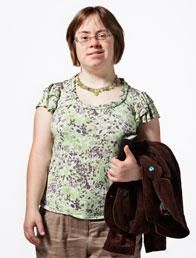
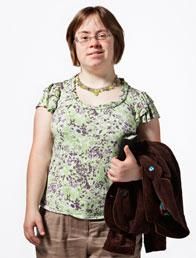
Hannah Sampson dreamed of being a full-time dancer from when she first started ballet classes aged five. Now 22, she’s made it. But it hasn’t always been that easy she told Simon Jarrett
It sounds like a pretty straightforward and untroubled career progression. Ballet classes from age five, a GCSE in dance at school, a diploma in dance and musical theatre from Kingston College, a part-time job with a dance company, and finally full-time work teaching dance and performing.
Life now involves working with internationally renowned choreographers such as Charlotte Vincent of the Vincent Dance Theatre, as well as national and international performance tours. Except there’s a lot more to the story than that.
Hannah’s progress to where she is today is one in which she has always had to fight against being characterised as a dancer with Down’s syndrome, rather than a dancer in her own right. This has involved an awful lot of determination and single-mindedness from her, and a track-record of making the right call at the right time when faced with critical career decisions. She studied ballet to grade 2 but realised early on that in a world where only a tiny minority make it, the chances for a dancer with Down’s syndrome were virtually non-existent.
Despite her love of ballet, she switched to contemporary dance. She attended mainstream school, rather than special school and it was this that gave her the GCSE in dance that took her to college and a dance diploma. And when the chance of work-experience came up at Surrey-based Stopgap Dance Company she took it, prepared to work her way up from the bottom. This led to the part-time work, then the full-time job, and the hard-won status of both teacher and performer.
Meeting Hannah at a Birmingham conference to promote participation by people with learning disabilities in the arts, that single-mindedness is clear to see. It has always been her love of dance that has driven her and it is clear that she is on a mission to get the whole population dancing.
“If you think you can’t dance, try it out”, is her advice to anyone sitting nervously on the side lines. Dance can be fun and a hobby as well as a profession. In her own case she has always been keen not to judge herself as a disabled person but as an artist. It is interesting that her starting point is her own judgement of herself, rather than other people’s. It is perhaps this self-belief that has challenged the perceptions of others and brought her to the point she has reached today.
It was always her dream to be a successful, mainstream dancer and she talks about her right to pursue her dream. Beneath the bubbly, warm generous personality lies an iron will that seems to propel her through whatever prejudices or setbacks she faces.
When she first taught a class of non-disabled dancers, she saw straightaway that it was difficult, in her words, “to get them on the same page”. She did it by simply engaging with them as a dance teacher, sharing her love of dance and her skills, until they saw the value of what she was giving them. She comments casually, “It’s something they learn”.
Her next ambition is to choreograph for both disabled and non-disabled dancers. She is in the right place for this. Stopgap Dance, who bring together exceptionally talented disabled and non-disabled dancers, have an excellent track record in producing stunning dance choreography. The learning disabled, internationally-performed choreographer Chris Pavia has also emerged from the Stopgap talent stable.
To watch Hannah Sampson dance in his Awakening is to see a fusion of dance and choreographic talent that resists any attempt to place a limit on people’s talents or abilities.
Hannah Sampson, renowned dance performer, teacher – where will she go next? Keep watching.
Stopgap dance company http://stopgapdance.com/
You can see clips from Chris Pavia’s Awakening, with Hannah Sampson dancing, on YouTube: https://www.youtube.com/watch?v=M9Y5gxZi6so
Ramy El-Bergamy’s job is to make Channel 4’s programmes reflect the true diversity of our society. In an exclusive interview with Community Living, he explains to Simon Jarrett what that means.
Ensconced in Channel 4’s futuristic London headquarters Channel 4’s On-screen Diversity Executive Ramy El-Bergamy has a big job on his hands. He has to ensure that the Channel’s ‘360° Diversity Charter’ will translate into a real change on-screen.
In every aspect of the Channel’s output – drama, documentaries, reality programmes and game shows – we should be able to see a range of people who reflect the society we live in, rather than just one part of it. This means that not only should we be seeing the whole spectrum of ethnic and gender diversity, but also the full range of disability and impairment, that we know is out there. There should be no excuses – why on earth should a television channel not reflect the audiences it’s broadcasting to?
Making the Charter a reality
El-Bergamy came to Channel 4 in 2015 with a ten-year broadcasting background, having worked on programmes such as Big Brother, The Voice and Geordie Shore. With his colleague Nina Bhagwat, the Off-Screen Diversity Executive, the brief is to make the Charter a reality. For El-Bergamy this is about ensuring that what we see on-screen changes. For Bhagwat it involves working closely with independent and in-house producers to improve their organisational diversity. For example,10 per cent of the approximate 300 production team for the Rio Paralympics will be people with disabilities – a specific commissioning demand by Channel 4.
What chances of success for El- Bergamy, and what about the minority that often gets missed out even by other minorities – people with learning disabilities? He points to recent successes such as Paul Abbot’s No Offence and Undatables. Both risked controversy, Undatables through its title and No Offence through its plotline, which involved a serial-killer who was stalking women with Down’s syndrome. Its cast of actors with Down’s syndrome took on roles that challenged stereo-types, including male prostitutes and characters who drank and swore just as much as, if not more than, the police they became involved with. Both largely won over their critics, drawing huge audiences. No Offence is now showing in France to audiences of over five million.
This isn’t worthy television, it’s highly successful commercial television, and that is a point El- Bergamy is keen to make. Those who damn all of this as tokenism or political correctness, he points out, are often those middle-class white males who have most to lose from increased diversity on-screen and elsewhere. The audiences, he insists, never have a problem. The viewing figures show that whenever diversity becomes a feature of a programme, so long as it’s good viewing in its own right, audiences respond by watching in their millions.
Threats to diversity
El-Bergamy sees two threats to diversity that have to be tackled. The first is structural. TV production is a small, demanding world with quick turnarounds. Independent production companies will get a call asking them if they can deliver something in six weeks. In such circumstances, they turn to those they already know which perpetuates existing imbalances of representation. Those on the outside are unable to get in, leading to a mistaken perception that there are few talented disabled people out there.
To counter this, the diversity team are trying to build relations and connections between producers and disabled actors during the quieter times, rather than having to undertake desperate and often futile searches when a commissioner is screaming down the phone for a deadline to be met. It was in this way that Richard Hayhow of Open Theatre Company was able to identify the acting talent for No Offence and then work with them on-set to ensure a successful production.
The second threat, as El-Bergamy sees it, is simple prejudice or, to put it more kindly, unconscious pre-judgement. Disabled actors are seen as representatives of all disabled actors. If a programme featuring them flops, it is seen as a sign that programmes involving disabled actors don’t work. It is not considered that the programme itself, or the actor, may not have been very good. No Offence was a risk but then a success – what would have happened to the perception of learning disabled actors, El-Bergamy ponders, if the programme had flopped? Disabled actors have to work twice as hard to be considered half as good and carry the weight of thousands of hopefuls on their shoulders.
Simple insight
El-Bergamy offers a simple insight. If you are a learning-disabled person on television, you shouldn’t have to be an ‘issue’. You can be in a story, just like you can be in real life, simply because you are there – you don’t have to symbolise something, or be a plot device to show how wonderful or terrible other people are. You shouldn’t be expected to add something weighty to the narrative. You can be on the television just being who you are.
Channel 4 should be commended for its bold initiative, and Ramy El-Bergamy for the energy and drive with which he is tackling it. It will be a great day when a learning disabled actor wanders on to our screens, and none of us feels the need to comment.
Josiah Wedgwood fought a one man battle against the Act that still influences thinking today. Simon Jarrett looks at the beliefs behind it.
The pseudo- science of eugenics, in vogue from the late 19th to the mid-20th century, was influential in many Western countries. But Britain was the only country in the world to enact national eugenics-based legislation, the Mental Deficiency Act of 1913.
The Act set up a system of unprecedented social and medical control for those deemed to be ‘mentally deficient’. Under the Act, the deficient would either be committed to a rural ‘colony’ where they would live out their days under medical supervision, or would be closely supervised in the community, to ensure they did not have children, become involved in crime or engage in ‘immoral’ activities. The Act was not repealed until the Mental Health Act of 1959 and has therefore always loomed large in both public and professional thinking. It remains influential in discussions about people with learning disabilities even today.
Eugenics was based on the belief that criminality, immorality, alcoholism, anti-social behaviour, physical defect and low intelligence were all linked, and stemmed from ‘defective breeding’ amongst the lower classes. Only control and restriction of lower class breeding, and the encouragement of breeding amongst the finer specimens of the middle and upper classes, could prevent Britain from spiralling into a nightmare society populated by the brute-like, deformed offspring of the immoral lower classes. While this may appear absurd today, it was believed to be ‘scientific’ and was widely accepted across the political spectrum. Both left and right wing politicians believed that the ‘respectable’ working class should be supported over the ‘disreputable’ poor.
Unanimous support
When the Act was introduced to parliament in 1913 it enjoyed almost unanimous support. For the Liberal government and the 42 Labour MPs (the party was only 13 years old at this time) it represented another step in an advancing programme of welfare reform which placed in the hands of the state that which had previously been left to charitable groups. For the Conservative opposition, eugenic anxiety trumped any concerns about state interference. All three parties were united in their belief that the degenerate population had to be ‘dealt with’ in some way.
One man opposition
It was left to one man to lead the isolated opposition to this major, and deeply transformative, piece of legislation. He was Josiah Wedgwood, a Liberal MP and self-styled ‘last of the radicals’. Wedgwood was a direct descendant of his namesake, the18th century founder of the famous pottery manufacturers in Staffordshire, that bears the Wedgwood name to this day.
Wedgwood’s opposition was based not on a specific commitment to, or even interest in, those labelled mentally deficient, but on his fierce commitment to the ideas of liberty and democratic accountability. All citizens had rights, whoever they were and whatever label was attached to them. They could not just be summarily dismissed from society or closely controlled within it simply because they did not meet with approval. He saw the Act as a tool for giving power to illiberal groups such as the Eugenics Society, and as a threat to democracy.
In parliament, as the Act was debated, Wedgwood led the opposition to it virtually single-handed. Sustaining himself with sweet drinks and chocolate, he sat through two late-night parliamentary sittings, tabled 120 amendments and made 150 speeches. He accepted that some of those deemed deficient might need specialist institutional care, but if this Act was, as the government claimed, about their protection, then why could that care not be voluntary rather than compulsory?
His opposition was doomed – such was the consensus that the Act was a good thing that one person’s objections were never going to prevail. However, he was able to highlight the controversies that the Act brought to treatment of the ‘defective’ population, and he made life extremely uncomfortable for the government, who had expected an easy passage.
Human rights, not disability rights
It was interesting that Wedgwood had no apparent experience of, or even interest in, deficiency himself. For him this was a matter of individual liberty. In our modern terminology he was not a disability activist, or advocate, but a human rights campaigner.
Sources
Mark Thompson, The problem of mental deficiency: Eugenics, democracy and social policy in Britain, c. 1870-1959, Clarendon press, Oxford, 1998
V. Wedgwood, ‘Wedgwood, Josiah Clement, first Baron Wedgwood (1872–1943)’, rev. Mark Pottle, Oxford Dictionary of National Biography, Oxford University Press, 2004; online edn, May 2009 [http://www.oxforddnb.com/view/article/36812]
Paul Richards has already started and run several successful projects, notably the Stay Up Late Campaign. Now he has another project, Gig Buddies, which has really taken off, as he told Seán Kelly
“We are calling this our vision for the Gig Society! I know it’s a terrible pun, but we are doing it in spite of the Big Society because it is how communities should behave”. Paul Richards is speaking about Gig Buddies. You may know Paul as the bass player of Punk Legends’ ‘Heavy Load’, or as the Director of the Stay Up Late Campaign and Charity, or most recently you may know him from promoting Gig Buddies, a Stay Up Late project.
I met Paul in Brighton and it turns out to be an interesting time for him and the project. On the one hand some of Gig Buddies’ core funding has been cut by East Sussex. Only recently this would have meant the end of the project but there are now plans to work with partners to develop up to 20 new Gig Buddies projects on a social franchise basis. Paul seems to have a calm and even philosophical approach to the whole thing. It occurs to me that he is a rather Zen Punk!
Rock ’n roll
How did it all start? The answer as you might expect has everything to do with rock ‘n roll. Paul was originally a support worker for Southdown Housing in Brighton. Jim, a guy with learning disabilities, had started a band. The first bass guitarist left and Paul, who didn’t play bass but, just like Noel Redding with the Jimi Hendrix Experience, or Kim Deal with the Pixies, took it up because he wanted to join the band.
Three members of the band had learning disabilities and two did not. Paul says, “There weren’t any other bands around like us at the time”. The band soon got a residency at the Blue Camel, an ‘inclusive club’. Paul says that at first he was unsure. “I was in another band and rehearsing three times a week. Heavy Load was just this out-pouring of sheer joy and bedlam! It took me a little while to adjust. We realised we were just having such great fun. I suppose that’s the moment you just embrace that chaos and think this is great”.
The band played at the Beautiful Octopus Club and other disability and inclusive clubs. Then Jerry Rothwell made a movie about them. “He followed us around for two and a half years. I didn’t believe it was ever going to happen and still, looking back on it, I can’t quite believe it did”.
From low-key beginnings Heavy Load went on to play in Berlin, New York, Denmark, a squat in Copenhagen and twice at the Glastonbury Festival.
They were commissioned to write the theme tune for a Channel 4 programme called Cast-Offs. Paul met the producers in a hipster café who told him, “We want noise, anarchy, chaos. Music like you don’t hear on TV normally’. I said, “Yes, we can do that”. One of the producers said, “I love your can-do attitude”. I said, “Well, you’ve just sort of described what we can do. If you’d asked for anything else…”. Heavy Load found themselves with a day in the studio to record just 19 seconds of music. “So it was, right lads, let’s knock this out as quickly as possible because then we’ll record our next album during the rest of the day”. Which is just what they did.
The band dissolved in 2012. “Michael the drummer said I’m 50. I want to retire”. It seemed to be a good time for everyone to call it a day and they ended with a gig in Trafalgar Square as part of the Olympics celebrations.
Taken root
Meanwhile, Stay Up Late had already taken root. Paul says the band had always realised that by the time they went on stage many members of the audience had gone home. They knew that people had to go home with their staff because shifts were coming to an end and it was time for ‘handover’. Paul jokes that they were pleased to know that it wasn’t the quality of the music that was sending people home. Heavy Load briefly took to asking if the band could go onstage and play earlier in the evening. “But we soon stuck to our guns and went on later, even if we were playing to no-one. We were a punk band!”
A crystallising moment came after Heavy Load did a mainstream gig in a regular music pub with two other mainstream bands. The band was concerned about how they would be received and to start with the audience were like, “What the …??”. But by the end everyone was converted, singing along and linking arms. For the band it was a great achievement. “Afterwards we were all having a drink and a chat, a post-gig post-mortem. Michael had half a pint of beer left and his support worker came up and said, ‘Come on, drink up, it’s time to go home’. That was the moment that Stay Up Late started”.
Paul emphasises that people don’t have to stay up late. “I always say we don’t care what time people go to bed but we do if they have no choice”.
Is it working? Are people staying up late? “At the moment if I am honest I would say it is probably not working. We are facing the biggest challenge yet with the cuts”. But he points out that the problem of people going home at 8.30pm existed when the movie was made in 2006, two years before the global crisis. He says there has been a failure of people, including commissioners, to deconstruct the current system and replace it with something better.
It has also been hard to get through to staff. “There is a hard core of people who get it but a majority of support workers are just going along with the system”. Radical change is the solution he would like see: “They say that making cultural change is like trying to stop a super tanker. Well, you can do that if you use torpedoes!”
What has changed, Paul thinks, is that the campaign has increased discontent with the current state of affairs. He quotes a recent survey in Hertfordshire. “They did this surprise audit at 8.30 in the evening. Social workers went round to see what was going on and 61 per cent of people were ready for bed. Calderdale did the same thing and got the same results”. Stay Up Late did their own survey of nearly 200 people which shows better results, not so surprising perhaps since many respondents might well be supporters of the campaign. Nearly three quarters of people with learning disabilities who responded said that they could stay out after 10pm (48 per cent with support and 24 per cent who didn’t need support). Depressingly, however, the great majority of respondents said they knew other people who could not stay out after 10pm. Paul says he hopes that Stay Up Late is making this nasty boil bigger. “With all this discontent maybe it will burst!”.
Positive focus
Paul is keen to keep a positive focus and for the campaign to shine a light on where people have got it right. He cites Gettalife, a small organisation which will provide 24-hour cover with three people doing long shifts which means they can support the person doing whatever they want to do, whether it’s sleeping or going out.
The Stay Up Late campaign led almost inevitably to Gig Buddies. How could people stay up late? By having a friend with the same interests who would go out with them. Paul developed the idea at a Brighton conference looking at ideas to make the city better for its residents. Several hundred people attended and assisted in the development of 27 different ideas. Each one was given three minutes to make a pitch for funding. Paul gave the pitch about Gig Buddies – and won! After three days of hard work he says he went home absolutely shattered and his partner asked, “So how much did you win?” The answer was just £2,000, but it was a start. Southdown’s director Aideen Jones persuaded the Board of Trustees to award £5,000 so suddenly £2K had become £7K! Paul then managed to get some additional funding from East and West Sussex Councils and soon had enough to employ a member of staff part-time. Madeline started on two days a week. Now she is the full time manager and has an assistant and admin support. Stay Up Late has just passed its third birthday and there are now 70 successful matchings across Sussex.
Pauls says the matching is really important. It’s based on getting to know people and it’s not something you can do online with an app. People need to really share an interest. “It’s not just a dating agency without the sex”.
The new Gig Buddies projects will be developed through social franchising. This means that they will be run and funded independently and the current staff will provide the know-how. This should mean that the results will look quite different in different places, with different solutions based on local knowledge.
Meanwhile the whole project is being researched by RIPFA (Research in Practice for Adults). Paul feels the need for academic evidence to back his view that while the project looks like great fun it can also deliver some ‘meaty’ outcomes in terms of mental and physical well-being.
What’s your gig?
The project has also been widening its remit so it is not just about rock ‘n roll. The question, “What’s your gig?” can now encompass answers that include going to church, going for walks, photography and just about any other interest. One man with learning disabilities has been going with a buddy to visit Sussex chapels.
Meanwhile new Gig Buddies projects are threatening to break out all over. Paul expects ten new projects to start within the next year and that includes new projects s in Portsmouth, Scotland and even in Sydney in Australia.
Paul clearly has a restless appetite for change and development – who knows what this Zen Punk manager and his colleagues will come up with next?
Should staff discourage people from having their photos taken?
You could be helping to make people with learning disabilities invisible, says Seán Kelly
All of us I suspect are ambivalent about having our photos taken. There’s no doubt that a good photo can be a lovely thing and we all insist on photography at significant times in our lives such as weddings. At other times though it can be a mixed blessing. If you have ever checked facebook the chances are you have found some less than flattering photographs of yourself posted by your ‘friends’. If you haven’t checked facebook… well, they are probably still there but you just don’t know it!
As a freelance photographer, I have a lot of sympathy with the people I meet who tell me they hate having their pictures taken. Sometimes with a bit of good lighting and a bit of patience I have been able to take photos which pleasantly surprise them.
Cold feet
Not long ago I was working for a charity and a woman with learning disabilities had agreed to have her picture taken but had then developed last-minute cold feet. I showed her some of the other shots taken that day and she relented on the condition that she could view (and veto) the results. After promising her control of the delete button she gradually relaxed and the pictures got better. She knew it too, commenting on the final picture “Yeah, that one’s alright. I like that one”. So that was a good day for me as well as for her.
As a freelance I have been to lots of events, including parties and celebrations, run by different organisations. Often a member of staff will ask if everyone is ok having their pictures taken. “If you’re not please tell the photographer”. I think it’s a good start – let’s make sure that everyone is happy to be photographed. Sometimes though staff will go further and it almost seems as if they are using their influence to encourage people with learning difficulties to refuse to be photographed. I arrived at one event to find the staff in the office. They cheerfully showed me a sheet of stickers they had already prepared saying “No Photos”. They then went around dishing them out and not surprisingly quite a few people took them. I found myself wondering if it was just an easy way for the staff to be seen to be encouraging self-assertiveness. It seems a pity if the only obvious way to assert yourself is by saying ‘no’.
Visual record
It also made me think about the result: no visual record of someone’s presence at an event. Why is that good? I think it leads to a kind of invisibility.
What about people who can’t decide for themselves? At another event a member of staff told me I was not allowed to take a picture of a woman in a wheelchair who was just joining in a kind of barn-dance made up of 6 people in wheelchairs. I asked why not? Her answer was that it was “against the law”. I never found out which law it was against but I think it was because the woman could not give consent. So I then had an interesting job of trying to take pictures of a lively wheelchair dance with people spinning round the room and weaving in and out of each other at some speed, while trying to avoid taking any pictures of just one of them. I managed ok… but still I want to know why? What good did it do that woman to not make a record of her shrieking with glee as she whirled around with her dancing partners? Do people think she will gain some kind of extra protection from the fact that there are no photos of her at that moment (for I was the only person taking photos)?
We all know that photos can affect us deeply. My brother-in-law died a few years ago of leukaemia. There was a lovely photo of him on the front of the order of service at the funeral. It showed him only a few months before, in the warm Italian sunshine which he loved so much. The doctors had told him not to go on holiday abroad but somehow he had managed it. In the photo he has turned to smile at my sister who has the camera. He is grinning and has flung his arms wide in a gesture which clearly says “it’s good to be alive”. For me (and not just for me) this photo provided some real consolation: yes he had died before his time but here was absolute proof that he had been alive and that he had also enjoyed life.
Bitter-sweet
I have myself quite often been asked for photos of someone after they have died. It is a bitter-sweet duty to try to find good pictures of them, but it is clear that a nice photograph does really help those who have been bereaved. How often in such circumstances do we try to piece together the course of a life using the photographs left behind? So my final question: how is anyone going to do that for the woman that I wasn’t allowed to photograph? Sorry, the picture of her dancing a historic six-person wheelchair barn-dance is not available.
The Care Act came into effect in April 2015 and has started to make some difference to assessment practices. Val Williams, Jon Symonds, Caroline Miles, Mike Steel and Sue Porter, a team from the Norah Fry Centre for Disability Studies, examined how they are affecting people with learning disabilities and conclude that they are causing some problems but also having successes.
Study title: The values of assessment: disabled adults and social care
Aims
To find out about how social care assessments get done, from the point of view of disabled people themselves and from the perspective of practitioners
Methods
A disabled people’s group from a centre for inclusive living worked on the project, alongside a mixed team of researchers at Norah Fry Centre for Disability Studies. Methods included story circles about experiences of assessments with 25 disabled people (in three groups); interviews with 30 practitioners and managers over three local authorities; audio-recordings of seven assessments in practice, and joint workshops with practitioners and disabled people.
Background
The Care Act came into force in April 2015 in England, introducing the requirement to assess any adult who appears in need of care or support. It replaced the ‘Fair Access to Care’ criteria, where people had to show they had critical or substantial needs to qualify for social care.
The Care Act focuses on the principle of ‘wellbeing’. Assessments must be person-centred, identify the person’s own chosen outcomes, and identify needs which, if met, would enable the person to achieve those outcomes.
We know from past research that people with learning disabilities may need more guidance and support than some other groups (Williams, Porter et al., 2014; 2015). A new duty has been introduced to provide advocacy for those who have ‘substantial difficulty’ in being involved in assessments and lack suitable friends or relatives to represent them.
Findings
Only two of the practitioners we interviewed worked in learning disability teams. People known to these teams tended to have been known to the social workers over a period of years.
Other practitioners from general ‘adult’ teams also gave examples of working with people with learning disabilities and with clients on the autistic spectrum.
They gave some interesting hints about how the Care Act is broadening the spectrum of clients who are assessed by social workers, including those assessed as having ‘borderline’ learning disabilities and who may be able to access small amounts of funded support or community-based services.
People do not necessarily fall into neat client groups and the social workers interviewed wanted to see their clients holistically. For instance, people may come forward because of their hearing or vision problem but it then turns out that they also have a mild learning disability. In many of these cases, people were coping until there was a crisis and that was the point at which social services got involved.
We were told about health crises, hospital discharge, financial problems, people living in squalor (or actually becoming homeless), and involvement with the police because of problems with drink or drugs. There were also stories about people whose needs related to parenting, whose children were at risk of being taken into care. Some of these people were said to be very suspicious about social services and so did not always accept the need for assessment. Social workers mentioned the need for advocacy in several cases but found major gaps in specialist advocacy services.
Disabled people wanted to be in control of assessments and really disliked social workers telling them what they needed. One person said it made her feel ‘very very stupid’, as if she was not really coping. This was also a theme from one of the practitioners. They wanted assessment to be person-centred and to leave an ‘open space’ for clients to determine what outcomes were important for them, as in the Care Act. However, it was clear that there was a spectrum of clients, with some people being seen as reliable and others as less reliable. People with learning disabilities in general tended to be considered ‘less reliable’ and that could be for two reasons.
As one social worker said: ‘‘Sometimes they need help but don’t want it, and sometimes they want help and don’t need it’.
In the first instance, there were people who seemed to be in need of social services support but were underplaying their needs. Sometimes these situations were seen as risky, with social workers feeling they needed to safeguard the individual (for example, if they were making risky decisions about money). Secondly, we were told about people who seemed to be overplaying their needs, in order to get more out of the system. Both scenarios are problematic. Practitioners’ response was to use their own professional judgement. They spoke about the assessment as an ongoing process where they may be making judgements all the time they are with someone – partly based on what they observe in the home, or what they can see the person can do.
This can be difficult from the point of view of people with learning disabilities themselves and we were told how hard it is to have a voice during assessment processes. Social workers were aware of this and tried to manage assessments so that both the person with learning disabilities and their family members have a voice. This is one of the points we are exploring with practitioners during user-led workshops.
Conclusions
Assessment can be a complex process and requires lots of skills on the part of both the practitioner and the disabled person. It is hard to talk about the things which you cannot do, and to seek support for those needs, and it can make people with learning disabilities feel depressed or undermined.
This project brings disabled people together with practitioners, so that both can understand more about the other during workshops which we are calling ‘A Joint Enterprise’. That approach could be used more widely and we are planning to produce some materials which can help other practitioners and disabled people to get together in workshops or training days.
Although the Care Act promotes self-determination, previous work has shown that many people with learning disabilities need support in making decisions, and many would benefit from advocacy. Practitioners felt that they needed more help in understanding the assessment of capacity, and the way in which the Mental Capacity Act might work together with the Care Act.
Energy
In the meantime, though, the Care Act has generated a lot of energy amongst frontline practitioners to defend the rights of people with learning disabilities and to support them in what they want to do. It is a good moment to carry on the efforts to make sure people with learning disabilities get better lives.
KEY MESSAGES
Under the Care Act 2014 people with mild learning disabilities can be assessed for social care. This can be helpful for them, if there are services or community supports they can access.
People with learning disabilities could be benefiting from independent advocacy under the Care Act but there are gaps in provision.
Families and carers have a key role to play in supporting people in assessment processes and it is important to find ways of including their views, while ensuring the voice of the person with learning disabilities is central.
References and further
reading
Williams, V., Porter, S. and Marriott, A. (2014) Your Life, Your Choice: support planning led by disabled people’s organisations. British Journal of Social Work: 44, 1197–1215.
Williams, V. and Porter, S. (2015) The Meaning of ‘choice and control’ for people with intellectual disabilities who are planning their social care and support. Journal of Applied Research in Intellectual Disabilities DOI: 10.1111/jar.12222. 1-12
Authors’ note
This article summaries independent research funded by the National Institute for Health Research School for Social Care Research. The views expressed are those of the author(s) and not necessarily those of the NIHR SSCR, NHS, the National Institute for Health Research or the Department of Health.
Two councils are planning to cap own home care costs at the equivalent value of those for a care home. Does that fit with the Care Act framework and the principle of wellbeing enshrined in it? Belinda Schwehr has reservations.
Readers may recall that Southampton consulted about offering people a care home instead of home care, if care in a person’s preferred setting was costlier than the council could have paid in a managed environment.
Southampton withdrew its proposals but Medway has taken up the challenge, consulting on a similar basis. Bedford seems to have finished its consultation and has already implemented a slightly amended policy.
The plans all have in common the aim of limiting care packages in a client’s home to one or more flat rates, per week, on the basis that a bed in a care home will be the same cost.
Councils say they will ‘assist’ those unable or unwilling to pay for their own care needs at home, or prevail upon others in their network to meet the cost above and beyond that limit, to move into a care home.
Exceptions
Councils also say that they will not have a ‘blanket’ policy but will make exceptions, taking full account of the duty to be person-centred, and place wishes, feelings and needs, at the centre of the process.
Some councils see this as applying mainly to elderly people because their care home fees tend to be flat-rated for ease of commissioning; others see a need to apply the same policy to people with learning and other disabilities, presumably to avoid discrimination, but this is less likely because a residential care package for a person with learning disabilities may not be cheaper than in an own home setting.
Some councils are framing their policies with regard to the gross equivalent cost; others are using net costs, offering the value of a residential care home, after the client’s legitimate contribution has been factored in, and expecting people to take that net sum of money and spending it, and their own money, on meeting their needs.
Exceptions
For physical and learning disability clients, the range in Bedford goes from £570-£2,500 a week, because of variations in need. It seems to be accepted that if the lower end of that range was a starting point, people with needs above this level in their own home would be treated as exceptions – but it’s not clear what these people would be an exception to. The policy document said that for such people alternative methods of care and support, not alternative settings, will be tried, an ambiguity that needs to be clarified.
Clearly these policies raise questions – of legality, human rights, care planning discretion, the relevance of resources, and the interpretation of the duty to meet needs. I agree that living at home is a ‘want’ rather than a need for most people but I do doubt that a policy of cost capping fits with the Care Act framework.
What is legal under the Care Act?
It is legal for councils to take their resources into account in relation to how they meet needs, not whether they meet them.
Councils are also – despite the rhetoric about personalisation and user-led assessment – the final decision-makers about what is an appropriate way to meet needs in a particular case.
But in both cases, this discretion is subject to judicial review (legal proceedings challenging the validity of the decision) for unreasonableness, unfairness, illegality, breach of the person’s article 3 or 8 human rights, or for what’s called ‘fettering of discretion’, if what is described as a general policy is, in practice, going to be implemented as a concrete rule.
Review trigger
Bedford’s policy does not go that far: it uses the equivalent cost as a review trigger and the occasion for a discussion. And it would only be applied where a person could, in the opinion of staff, be appropriately cared for in either setting. Medway is clearly committed to doing needs assessment too.
However, it’s the relationship of the proposal to the staff’s approach to the care planning process that is unclear. Is it still needs-led, budget-led or even service-led? The Act and the preceding law have always been clear: it must be needs-led, and by the needs of the individual in question, not some hypothetical average person.
A person does not have a human right to live in their own home, or in a non-care home environment, if living there with one’s needs being appropriately met would involve relying on the State to fund that care. Article 8 of the ECHR guarantees respect for private and family life and the home, but not a guarantee that one will always be able to be cared for, there, for ever, courtesy of the State. Article 8 explicitly includes a reference to the economic wellbeing of the area as a legitimate qualification of that whole human ‘right’.
There is nothing wrong in letting people volunteer to meet the first chunk of their own currently unmet needs, by offering informal help through friends, relatives, neighbours, or through the use of their own resources – councils are only obliged to meet unmet need, just as under the old law.
There is nothing legally wrong, if there are two alternative adequate settings for meeting the particular needs of a person, in a council’s offering to fund the cheaper of the two. That well-established principle is set out in paragraph 10.27 of the guidance, along with the prohibition on ‘arbitrary’ ceilings on care costs in particular settings. That’s always been the law since the Lancashire case, and the Care Act doesn’t change that principle.
Unlawfully
A person has every right to refuse to accept what is offered, or to accept it but then challenge the decision, via a line manager’s review or judicial review proceedings, that the care home setting would be therapeutically appropriate. But in so doing, even if the judge agrees that the council has acted unlawfully, the person does not get to tell the State what he or she wants instead. The council decides and can only be challenged by way of judicial review for indefensibly unsuitable offers.
However, the all-important care planning decision is the one by the staff member as to whether a person’s needs can even be appropriately met in a care home setting – ie. therapeutically beneficial and would not de-skill them. That is the whole basis for not putting young people with learning disabilities, terminally ill young parents with children, and elderly persons who can still recognise their home surroundings and partners, and cope, into care homes.
The needs to be met will refer back to the domains/’outcomes’ in the eligibility regulations. One is not eligible for a care home, or homecare any longer: one is eligible, effectively, for care planning, and two different settings or ways to meet need can be compared where both could be offered by the council.
They will inevitably be unequal in many ways: one will cost less and one will offer more of some things, such as safety and company, and less of others; for instance, autonomy, privacy, peace and quiet. Whether one or the other suits a person’s needs better will all depend on the perspective through which they see their home, care homes, and their situation.
Clearly, for some it would be indefensible that the cheaper of the two was even theoretically adequate. The extent of the impact of one’s assessed eligible needs in one’s own home may be less than in a care home, but the environment, including the state of one’s home; for example, whether there is someone else there, will inevitably affect the cost of reducing the impact of what one is not able to achieve, in each setting, to a no longer significant level.
And if it would not promote well-being, and in fact detract from well-being, can a council actually drive such a policy all the way home and risk challenge? What would that do for the reputation of the parties involved in the cross-party design of the Care Act and the reverence for the well-being principle, that the law is supposed to enshrine?
Other points of concern
The legitimacy of the rate within the level of care home being regarded as equivalent in the first place. In areas where top-ups are running high it is probable that the council isn’t paying a justified rate for the cost of standard care home care at all. This is now beginning to be the case for people with learning disabilities as well.
How the nursing element of a nursing home can be forced out of the CCG, since it is clear that the council could not provide for
the nursing care in the community within their own statutory
functions.
Whether the same approach will be taken by CCGs – or CCGs with split package clients – and how all elements will be taken into consideration in the
comparison.
The charging implications: why isn’t the amount that a person is being asked to spend on their own home care, always to be treated as disability related expenditure, since it is spending on need that the council has required to be satisfied has
been met.
Neither of the councils have given any detail of what exceptional circumstances would be for not applying the policy. Someone having both the gumption and the means to bring judicial review proceedings is not a principled reason for deciding when the policy should not be applied.
Nowhere in the consultation documents have Members been told of other options, such as cutting other discretionary budgets, raising the council tax or digging up the reserves coffers. Nowhere is it acknowledged that duties and values can trump budgetary targets.
By their very nature ATUs are not set up to work with people in their familiar environment and rehabilitate them; instead, they seek to remove and treat with an extremely small toolkit, says Sam Sly
Over a year ago I was asked to write about getting people out of Assessment & Treatment Units (ATUs) but didn’t get around to it so when I was asked again I thought I would reflect first on the changes I have seen in a year. Then I will look again at why I think people aren’t home and what needs to be done.
To be blunt, as far as professionals getting people back home to their families and communities are concerned, I cannot see that a huge amount has changed. There are a lot more checks and balances with the Care & Treatment Reviews and NHS England is asking for more updates on progress. There has been a raft of policies and procedures and more money has been thrown at the problem but in reality the people returning to a home that suits them, with support that is right for them, isn’t happening often, or quickly enough.
People who shouldn’t be in ATUs are still there and the biggest scandal is that these are not just adults but many children too. Spending your formative years in an ATU is a certain precursor to a lifetime of problems.
Family activism
The positive changes I have seen, however, are with families of people in ATUs and interested members of the public galvanising themselves into action and protest, mainly through social media, an amazing way to highlight the problems and get results. It has been inspiring to watch the rise of family activism and I believe that this, and not professional intervention, may in the end be the turning point that ends the use of ATUs.
Why don’t ATUs work?
An ATU is an institution based on a medical model of ‘assessment’ and ‘treatment’ which in itself has a multitude of problems. Many people admitted to ATUs have autism or other learning disabilities and it is argued that these conditions cannot be ‘treated’ in a traditional way.
By their very nature ATUs are not set up to work with people in their familiar environment and rehabilitate them; instead, they seek to remove and treat with an extremely small toolkit, namely drug therapy including ‘injected as required’ medication and behavioural therapy including restraint and seclusion. This means that sensory and communication needs are often overlooked or not assessed at all and the person is lost completely. Some of the methods used, such as ‘intravenous as required’ medication and prone restraint, cannot be used in a normal house in a normal street making it difficult to discharge people.
The environment does not lend itself to helping the people it contains. Many have experienced difficulties living or sharing space with others and now find themselves with many other people every day, many of whom show they are unhappy by hurting themselves and others. These people need space indoors and out to meet sensory needs; instead, by default of a mental health act section, they are locked up. Lots of these people have sensory needs and react badly to noise and crowds and yet are put in environments that have alarms going off day and night and people shouting and screaming. It’s hardly surprising that their behaviour deteriorates.
It is nigh on impossible to assess and give a person the skills they will need for discharge back to a normal house and a normal life because they don’t do normal things in ATUs. In a risk-averse culture, a large group of people cannot be risk-assessed. The kitchens, bathrooms and cleaning cupboards are often locked so an understanding of a person’s abilities to look after themselves has to be based on historical information.
The ‘problem’ isn’t resolved by removing a person to an ATU. The problem will still be there when the person goes back. In nine times out of ten it would have been better to have targeted resources to prevent the problem escalating in the first place.
I have huge issues with the reasons people are admitted to ATUs in the first place. When I have done life planning with people and heard their stories it is rarely because the person has suddenly become unsettled and unmanageable but usually because the family have asked for help for years and been ignored or given the wrong help.
The prism of a medical model
When people are in an institution they quickly become institutionalised, as do the staff. When staff work in institutions they find it hard to see any other way of supporting a person especially as the person is reacting to the environment and the person is seen only through the prism of a medical model. When discharge is being planned the ATU staff are relied on heavily for their views on where the person should live and often they have no other experience than their institution so recommendations are based on similar models. The people themselves also become institutionalised and for some leaving after many years can be a scary prospect.
When a person lives side by side with others with behaviours that challenge they will learn new negative ways to communicate and show their boredom, frustration and feelings. People go into an ATU with one behaviour and come out with a handful that then takes years to change.
ATUs have absolutely no incentive to discharge people; the private ones make huge profits from keeping people in for as long as possible and there is no pressure on them to do a speedy job of ‘treating’ a person and getting them home.
Shutting families out
But what is most damaging is that when people go into an ATU they are ripped away from family, loved ones, friends and their familiar places. This in itself is devastating but is often compounded by the professionals then subtly or sometimes blatantly closing ranks and shutting family out of learning and decision-making. Families start to be seen as a problem if they challenge things, are often written out of the person’s future and their importance disregarded.
What is needed to get people home
We, the professionals, have made getting a person home difficult. We have over complicated things and developed the barriers so we are totally responsible for the mess and broken, wasted lives we have created. We also bandy about words like ‘person-centred’, ‘co-production’, ‘individual budgets’, ‘supported living’ and don’t do any of it properly, tarnishing what started out and could still be the cornerstones of great lives.
Getting a person home isn’t hard in theory but does involve a lot of work and thinking outside of ‘serviceland’ which some professionals find difficult.
Thinking ‘serviceland’
The professionals who make decisions about where someone should go after being in an Institution like an ATU work in and think ‘serviceland’. If we don’t think differently solutions will always be targeted at what is already there; which care home? what respite centre? which block provider contracts are already in place?
We pretty much know, through things going wrong and re-admission to ATUs, that the people who challenge us don’t fit into ‘serviceland’ – it is like fitting a square peg into a round hole.
By planning well and involving the right people solutions tailored to individuals can be found or developed and pretty much every time these won’t cost anywhere near as much as the expensive ATU placements they have come from.
A good plan
The importance of good planning can’t be emphasised enough in getting a good life for someone when they leave an ATU. This planning needs to happen as soon as they are admitted and should be based on the person’s hopes, dreams, skills and talents. It should involve exploring what a life that makes sense to them looks like. Planning has to involve the person and those people who know them well. If you don’t have a good plan you won’t get a good life – simple as!
Partnerships
To make discharge work well those involved have to work together on an equal footing when it comes to decision-making. And those people involved are the commissioners, the local community team but also, crucially, the person, the family and the support provider. And equal footing means exactly that. Power, if not shared with families, is incredibly destructive when it comes to someone getting home. Partnership working should start with the planning, and can be helped by the use of individual budgets. It is hard for professionals to relinquish power – they can dress it up in all sorts of guises: duty of care, statutory responsibility etc., but to make good decisions about sometimes risky dangerous behaviour everyone has to be in agreement about the way forward and people and families have to feel they really are in control of their lives.
A home
A person has to have somewhere to live that works for them. This requires detailed planning around the person’s needs. Slotting someone into a residential setting because there is a vacancy won’t work, nor will setting up ‘supported living’ with people sharing whose only connection is having challenging behaviour. There are so many options available within housing but still many people end up living in traditional group settings. The Housing & Support Alliance have developed guidance and a training pack ‘Life Begins at Home’ that will help professionals think through housing issues and solutions: https://www.housingandsupport.org.uk/life-begins-at-home
A budget
Money is seen as a big problem, especially in this climate of austerity, but until we stop wasting public money on ATUs and poorly thought through discharge solutions we can’t use austerity as an excuse. The flexibility and adaptability of a package of support needed to meet the often fast changing needs of a person just discharged from an ATU can only, in my opinion, be met through the use of an individual social care/health budget (IB or IHB) or the support provider holding an individual service fund (ISF) on behalf of the person.
This then puts the power and control for decision-making and design back where it belongs with the person and their family. Sadly, I have seen IBs and IHBs used to make a challenging family ‘go away’ and ISFs are little known about by either professionals or providers and families.
Good help
Good help needs to come not just from a support provider or personal assistants but also from the local community learning disability/mental health team. These professionals need to be working as partners together and the community support often needed is 24 hour hands-on help and advice, especially in the first 12-18 months after someone comes home as this is how long it takes to unlearn the bad things experienced in an ATU.
Good help can also be provided by people that are especially picked, by the person, to work with them. Matching workers to a person’s attributes, hobbies and interests often enables great, positive relationships to develop. Good help also requires good, valued and principled leadership of organisations and investment in nurturing innovation in teams. Good help isn’t always just paid support.
Let’s prevent the need
for ATUs
To prevent ATUs having a place in society in the future please start to plan in person-centred ways with children – the earlier the better.
In Control finished a year-long project this spring; ‘Me, My Family, My Home, My Friends, My Life’ http://www.in-control.org.uk/news/in-control-news/’me,-my-family,-my-home,-my-friends,-and-my-life’-report-published.aspx.
It’s pretty clear that doing all the things talked about in this article with children will prevent the need for ATUs in the future.
Sam Sly is currently a freelance consultant for her organisation Enough is Enough. Email: sam.sly@enoughisenough.org.uk
Faced with grant cuts, some local authorities are resorting to short-term housing solutions which could have long-term human and financial costs. But some authorities have found creative answers, as Rosemary Trustam heard at the winter conference of the Housing & Support Alliance.
We know the vital role played by housing in people’s lives – indeed in all our lives. Getting it wrong can mean the difference between building a life in your community and developing a fulfilling life or living in a miserable situation maybe with people you don’t like, away from your family or natural community. The former can lead to more independence, the latter to an Assessment and Treatment Centre because your resulting objections become challenging to services and increasingly exclude you from your community.
Some local authorities playing too direct a role for the best of motives have found themselves committed to high voids payments when they don’t have a housing role or a voids reserve. In a world where many local authorities face being unable to pay for their statutory services because of government grant cuts, this isn’t tenable. However, nor is trying to fit the wrong people into voids in shared houses which is happening where service providers are not standing up for the rights of the people already there.
Security
None of us would make compromises about our long-term homes. These are not student households for a short time; they are people’s homes and security and the tenants are people unable to just up sticks and move. Short-term fixes are not the answer.
There are providers who have sourced housing themselves either as managing agents collecting the rents and passing them on minus a management fee and maintaining a voids reserve, or directly with private and social landlords expecting the landlords to maintain their own pooled reserve which works well for landlords who have a range of properties.
We heard of some initiatives to source housing at the Winter Housing and Support Alliance conference in a workshop presented by two providers who run a housing brokerage service. As well as offering a housing management service to people in their properties which they own or lease and to other social landlord tenants, United Response have helped some people source housing, offering a housing brokerage service, helping them understand their housing needs and find the right solutions, even including how to fund properties. It’s not cost free but can make the difference for people. As a specialist agency they also know the range of options and funding issues. Where local authorities need this help they should consider that a small fee might save them a lot of money. (http://www.unitedresponse.org.uk/to-find-a-home)
Essex County Council funds a housing brokerage service through Dimensions for people with learning disabilities, autism, physical disabilities, substance abusers and people with mental health issues. Their priorities are people with multiple needs for whom the housing service has no responsibility. It’s not a crisis service but a planned referral service. They can provide a tenant sustainment service, offering advice and information and help with accessing a range of activities including community links, developing their tenancy management skills, budgeting and life skills.
Victoria, a housing broker, explained how it works. They look at housing options, involve the social worker if possible to consider support needs and try to match to what they can find. Sometimes they can’t find exactly what’s needed but will compromise and have negotiated a rent reduction with a private landlord, or adjustments with the council agreeing some resource. If they get it right they have also succeeded in reducing the support package. One example was the placement of a young woman who had challenges placed in shared living, one suspects driven by cost imperatives, which broke down. They managed to look at all resource possibilities to get the right situation and got help from the family in a shared ownership house which enabled her to live alone. (https://www.dimensions-uk.org/press-release/essex-leads-way-housing-innovation/
Brokerage
In an earlier issue (Creative housing solutions, Volume 29, No. 1) we saw how a small specialist provider like Care Housing may also offer this kind of brokerage as part of their service. Local authorities might consider how small investments in skilled providers and planned referrals might save them much in breakdown costs and, most importantly, get the best outcome for the person.
What about those people with learning disabilities no longer supported by social care?
Whilst the government’s rent-capping does not so far seem to apply to supported housing, this is no help to those no longer eligible for social care support – the ‘disappeared’. These are people who often need this extra support to maintain their basic tenure. This was the intention of Supporting People (SP) funding, a £1.8billion grant from 2002, intended to help vulnerable people live independently. However, this was reduced and then the ring-fence was removed in 2009 resulting in many services being withdrawn. The SP funding that existed for people with learning disabilities has been captured by local authorities and pooled with their social care budget so those no longer eligible may now have no source of support.
The responsibility for housing rests with the Housing Executive whose strategy to 2015(1) suggests they are only considering people in social care schemes and prioritising development for resettlement. They haven’t identified the most needy group as those not in touch with any services. If people are now in general needs housing, they may well most likely be in privately rented accommodation. Even if they are in social housing their rents will be capped which restricts the extent to which landlords can give support. Additionally, this group faces increasing difficulties with benefits, both with the change from DLA to PIP disability benefits and the imposition of sanctions, in particular on people with learning disabilities and mental health problems (2,3).
There is a huge shortage of sources of help with benefits at a time when the government has withdrawn legal aid for benefits appeals. There are fewer and fewer ‘front doors’ from which to seek help on the high street and there seems to be an expectation that people can apply on line.
Homelessnes
Am I alone in thinking we will see a growth in homelessness and more people found alone in their unheated flat with no food, not understanding why their benefits have stopped or knowing what to do?
Funding for self advocacy groups is being withdrawn or reduced, removing for some the only place of support and help – a vital preventive service.
Whilst we are concerned about the plight of those whose services are being reduced, they do have the law on their side and can challenge decisons in the courts, but if people cannot make the case for eligibility, the worry is that they will become homeless, end up in the criminal justice system or A&E to access any help – by which time their needs will be far greater.
Is this just a cynical political move to put off the costs to the long-term so that savings can be made in the short-term, ignoring the human cost?
Local authorities would do worse than look at Essex’s example and consider investing in preventive housing services, addressing the needs of the ‘disappeared’ group before these rebound on their stretched resources.
It is vital that families and self advocates unite. They have much to gain and a great deal to lose by not speaking in one voice, says Jan Walmsley
In February, I was immensely cheered to see the photo (right) of representatives of the National Forum of People with Learning Disabilities and the National Valuing Families Forum. They were marking the day when together they forced the Mazars Report onto the agenda of the National Learning Disabilities Board next time it meets.
Amazingly, Mazars, the NHSE commissioned independent report into unexpected deaths in Southern Health Foundation Trust, had not been thought worthy of the Board’s attention until, with one voice, people with learning disabilities and families together made the case. It’s that word ‘together’ that is the subject of this article.
Legacy
In the wake of Valuing People, the 2001 White Paper, two representative groups were set up to bring the voices of people with learning disabilities and carers into the heart of policy making at Westminster. Unlike much of the White Paper’s legacy (remember funding for self advocacy and the Learning Disability Research Initiative?), these two Forums remain – but as two separate groups. There is a story behind this, one group speaking for families, the other for people with learning disabilities.
Back in the mid 20th century when the parent advocacy movement got going there was but one voice. Parents in the National Association of Parents of Mentally Handicapped Children assumed they had the right to speak for their sons and daughters (Rolph 2002). People with learning disabilities had no public voice – people did not really believe they could have opinions and speak for themselves.
It was not until the 1980s that self advocacy for people with learning disabilities began to take hold. The first People First group was formed in 1984, in London, by delegates who had been to an International People First Conference and came back inspired to start the movement here. It did not take long before more groups were started and the idea that people with learning disabilities should be listened to gained momentum.
I well remember the year, 1986, after the Open University (where I was working at the time) had launched Patterns for Living, a course for parents and carers to study together. We were lobbied vehemently to include people with learning disabilities in the audience. How dare we produce a course about learning disability which did not involve the people it was about? The result was Patterns for Living: Working Together, a version of the course for people with learning disabilities. It was an exciting time, the potential for change seemed enormous. Never again did I assume I could leave people with learning disabilities out, however challenging it was to include them.
That history left a legacy. Parents, we began to believe, could not be assumed to have the best interests of their sons and daughters at the forefront of their thinking and actions. Wasn’t it parents who held people back, denied them opportunities for independence, for sexual relationships, for work? Wasn’t it parents who dressed their adult offspring in childish clothes, who were over-protective, who underestimated potential? Sue Dumbleton, now herself the mother of a daughter with learning disabilities, recalled that as a care worker in the 1980s she and her colleagues:
had a suspicion that, if only they [families] would be less risk averse, protective and interfering, their adult children would be leading much more rounded, satisfying lives (Dumbleton, 2013).
Divergent
Citizen advocacy developed, on the premise that people with learning disabilities needed independent advocates, people who would stand with the person, and support them in asserting their rights. Families could not be relied upon to do that; indeed families were seen to be part of the problem. This idea, that the interests of people with learning disabilities and the interests of their families were divergent, really took hold. I was myself a subscriber to this view.
Viewing families as part of the problem also has attractions for professionals, despite the fact that about half of all adults live with their families (FPLD, 2012), and Personal Budgets have increased reliance on families to manage budgets and employment (Glendinning et al 2015). Using the ideology that people with learning disabilities need to assert their independence from their families, professionals and support workers can appoint themselves as the champion of people’s rights to take decisions for themselves, as adults, without involving families. Finola Moss, a parent activist, argued in her blog that the Mental Capacity legislation is used to deny her, and other families a say in the lives of their relatives, on the grounds of enabling adults to make their own decisions:
At 18 it is ‘inappropriate’ for you to make decisions for him, and you have no right to do so.
(http:/FinolaMoss.wordpress.com)
She is not alone, as the stories highlighted in #7daysofaction, featuring individuals in ATUs, show graphically.
Orthodoxy
Thus it became part of the orthodoxy, that the interests of families were not necessarily those of their relatives. Hence the two Forums set up in 2002. which gave many opportunities to ‘divide and rule’ by politicians, civil servants and others, weakening further an already weak voice.
Now, many of the things that gave a sense of optimism back in the late 1980s appear to be foundering. Austerity, welfare benefit ‘reforms’, the demise of many partnership boards, the loss of self advocacy organisations across the country, the failure to act following three damning reports into Southern Health FT, and the continuing detention of at least 3,000 people in out of area secure placements all together cast a shadow over hopes for a better life for people with learning disabilities.
Lead role
Families are once more taking the lead role in challenging what is happening, as they did back in the 1960s. Now there is an explicit recognition, certainly by the leadership of the two Forums, and by many other vocal parent advocates, like Connor Sparrowhawk’s mother Sara Ryan, that the work has to be with, not for people with learning disabilities.
It is vital that families and self advocates unite. They have far more in common than divides them; and a great deal to lose if they do not speak with one voice. That is why seeing the photo was so very cheering.
References
Glendinning C, Mitchell W & Brooks J (2015) Ambiguity in Practice: Carers Roles in Personalised Social Care in England Health and Social Care in the Community 23 (1) 23-32
Rolph S (2002) Reclaiming the Past: The role of local Mencap Societies in the Development of Community Care in East Anglia 1946-1980 Milton Keynes: Open University
Finola Moss (2015) online blog
Foundation for People with Learning Disabilities (2012) Learning Disability Statistics: Support http://www.learningdisabilities.org.uk/help-information/Learning-Disability-Statistics-/187696/
Dumbleton, S (2013) Goodies and baddies: equivocal thoughts about families using an autoethnographic approach to explore some tensions between service providers and families of people with learning disabilities Ethics and Social Welfare, Vol. 7 No.3 pp. 282 -292.
Mike Webster poses this question and comes to the conclusion that, yes, there is a point to commissioning when it is a creative force that gets the best out of people and organisations.
To be honest, I’m not sure that anyone would admit to having had the ambition to be a commissioner when they grew up. Add the goal of doing the role in today’s social care or health economy and it is even less likely.
However, there are no shortage of jobs with commissioning in the title and seemingly no shortage of applicants. Finding a common idea of what commissioning is and should do is much harder. Blurred lines are all too easy to find between people who say they commission and those who procure and contract. Health and social care commissioning adds another layer of complexity.
There is no doubt that provider organisations, users of services (and probably readers of this article) often feel that they know more about what is needed than those who are paid to commission. Put more bluntly they are sometimes seen as just another layer of bureaucracy that leaves fewer resources in an already stretched system.
With the public sector and especially local government facing unprecedented financial restraints the incentives to be a commissioner are few and far between.
Unpopular
As often with unpopular professions (or dare I say ‘scapegoats’?) this is fine until you try to do without them.
We could surely do without accountants but their advice and guidance has been invaluable in establishing systems that mean, even in hard times, for local government at least, the money has not quite run out. In fact in the early 1990s and the introduction of community care the system would have cracked without some financial expertise. Let’s not forget that social security funding of private residential care was out of control.
According to the Daily Mail, social workers interfere when they shouldn’t and ignore when they should. Yet they form a critical part of the system when they work well. Skilled assessment and solution finding assists both at the wider strategic level and in making arrangements that are individual and often economical.
Is there any redemption for
commissioners?
Most commissioners come from social work, management or business suggesting that commissioning is a ‘bolt on’ to other skills and professions. Although some qualifications are starting to emerge these are a long way behind; for example, procurement (MCiPS – Member of the Chartered Intuition of Purchasing and Supply) or an MBA.
Health and social care organisations therefore have a strong (and probably expanding) commissioning section made up of people from varying starting points which contributes valuable diversity and potential for innovation that is desperately needed.
At its best, commissioning can build on a range of ideas and through a structure (Commissioning Cycle) bring a rigour to service development and crucially evidence-based reviews.
A key skill is being able to harness creative ideas and adapt them. The ideas may not be new but being able to re-invent and implement them in a different setting is a precious talent.
Dangerous
Commissioning, when it works well, can simply be about pulling together ideas and using them to offer solutions to new problems. It becomes dangerous when commissioners think they know best and have all the answers.
Reasons given for keeping to this apparently safe approach are:
It takes too long to consult or engage;
It’s too difficult to find the right people;
Social/health care is too complex to involve people;
Procurement rules do not allow providers to influence service specifications.
Use of these excuses is both arrogant and short-sighted. Expertise comes in many forms and no-one, especially commissioners, have the monopoly on it.
Provider organisations know most about how to provide services. On issues around workforce, logistics and even simple things, like putting together an effective staff rota, they are likely to offer both efficiency and innovation to a service.
Good procurement and commissioning should involve early market engagement often promoted through ‘discovery sessions’. As long as the invitations are open there is no danger of falling foul of even the new procurement regulations.
The key skills are in pulling together ideas and creating an environment where providers feel on an equal footing and safe enough to speak openly. Such discussions can die a painful death if because of commercial sensitivity providers are not prepared to share ideas or good practice. It is not unknown to hear complaints that commissioners do not include providers in discussions but then, when the opportunity is offered, they use it to take notes for future tender submissions and are unwilling to talk in front of the ‘competition’.
Good commissioning needs co-operaton from all sides.
Users of services know how it feels to be on the receiving end of commissioning decisions. Understanding that is also crucial to good commissioning and also to developing flexible and responsive services.
Organisations like the Care Quality Commission now use ‘Experts by Experience’and as a result their inspections have gained credibility and their findings are harder to argue with.
Real user involvement
Involving people in all areas of the Commissioning Cycle can similarly strengthen both the result and allow changes and good practice to be introduced at all stages. Much time and energy is given to the high profile aspect of initial commissioning and service procurement but often the real dividends occur through on-going review (and contract management). That cannot effectively be done without real user involvement.
A quote from a contributor to the Guardian Social Care network puts the point succinctly:-
“Those holding the purse strings and making the funding decisions need to respect those who need caring for…Compassion and understanding at the highest levels are what is needed. When that happens things may change.”
It’s no good saying it takes too long or finding the right people is too difficult.
So the answer to my question, ‘Is there any point to commissioning?’ is yes, when it is done well. Certainly there are skills and knowledge that are needed. There is also an underlying theoretical base and process to follow.
But the most undersold skill is an ability to ‘hold the ring’.Commissioning can become a creative force that can get the best out of people and organisations. It can also bring to life the often over-used concept of co-production.
The best services are those with the best input, centred on users’ needs and experiences, and the worst are those put together in ignorance and isolation.
Mike Webster is Assistant Director, Health & Adult Services, North Yorkshire Council.
Mark Stables is dealing with a £3 million cut to his budget but he is still determined “to make things happen”, he told Seán Kelly.
Two friends of mine were discussing job vacancies recently. One of them expressed an interest in applying to be a commissioner for services for people with learning disabilities. The other one said, “Who in their right minds would want to be a commissioner now? All you would be doing is making cuts, dismantling services and apologising to people”.
It’s a point I put when I met Mark Stables, Operational Commissioner for Services for People with Learning Disabilities in Portsmouth. Why would anyone want to do his job? Mark’s answer is that he has a budget and that means having “not exactly ‘power’… but you can do things. You can create things”. Straight away he accepts that it is ‘a poisoned chalice’ because you don’t have enough budget. “But you can still make things happen”, he says.
Mark is part of a what he says is a ‘great’ integrated learning disability team that combines social work and health professionals.
Say-so
Mark was previously an area manager and manager of in house services in West Sussex and before that worked as a social worker in day services and residential care . He loved being a provider but says, “Providers never have the ultimate say-so”. He is quick to say that he is part of a team with strategic commissioning and he picks out the Contracts Manager in Portsmouth for praise as someone who doesn’t just sit at a desk but goes out and visits providers. “Rather than go for big contracts to reduce costs we have a small framework of providers and aim to relate to them well. We pop in and see them”. This seems to fly in the face of the usual desire for cost reduction through increasing scale but Mark says it can lead to jointly planned efficiencies. “We save an awful lot of money through knowing our market well and developing relationships with them”. Mark says in Portsmouth they are deliberately creating a degree of security in the market so that providers feel safe enough to take risks. It’s not completely cosy though. “We often do challenge people but they don’t mind that because it’s in the context of a relationship”.
Mark says it’s not all about cost. Recently Portsmouth has agreed that supported living providers on the ‘framework’ can increase their hourly rate by up to 10% in submitting tenders. “We don’t want to commission services we are not happy with. What’s the point?”
As you would expect Mark has had to deal with huge reductions in budget which he describes as extremely challenging. “We have saved significant amounts over the years from reducing costs, being more efficient and asking more of providers. But you can’t keep that up for ever and we are focusing on changing the way we do things in accommodation and support, respite and day services”.
Mark is currently involved in a transformation of Portsmouth day services. “It’s not a review – too often that just means having a look, scratching your head and going away”. Without transformation he says that the alternative would be just providing the same service model but continually reducing what people get. Mark aims to change the service in a way that develops community connections and work and independence. “The only long term savings solution is for people to be more independent, more part of their communities or using their Individual budgets to buy low or no cost socially inclusive solutions. And actually, you know what, that makes Portsmouth a better community”.
The in-house day service will reduce from supporting 170 people to about 50 people which will free up money for the new services as will de-commissioning of independent sector providers who are not successful in tendering. Mark recognises the disruption and distress that this inevitably causes. “I am not flip about this Seán because it’s a very painful process for staff and providers but in order to do the new things we have to stop some of the old”.
Vocal parents
He also challenges the belief that family carers will not accept change. “The interesting thing is that some of the most ‘vocal parents’, vocal in inverted commas, are our best allies. The people you’d think might be the most resistant are actually saying, “We get this and it’s long overdue”.
The plan is to create a community connections service, health and independence services, a work service and a friendship service with Gig Buddies. There will also be social enterprises, along with the reduced in-house buildings-based service for people with complex needs.
Outcomes for these services will be based on the four SEND (Special Educational Needs and Disability) Preparing for Adulthood Outcomes which should help provide continuity for young people going into adult services. “The thing I like about the SEND reforms is that from the age of 14 you stop thinking about what is ‘wrong’ with someone and you start thinking about what they want to do in terms of work, independence, relationships, community and health. In essence that’s the five accomplishments”.
“One of the criticisms of the approach is that it is very prescriptive. What if people don’t want to do anything about health or independence, work or community? And my answer is, well, that’s what day services do. Too often day services are confused about their purpose with the result that people start to see them as respite services”.
Mark accepts that this is making assumptions about people with learning disabilities, that they would want the kind of life that he himself would choose. “But if you say someone doesn’t want a purposeful day, and they don’t want to make any friends, they don’t want to be healthy, and they don’t want to learn anything then I’d say really you are describing someone who is very depressed. Ultimately it’s just about recognising our common aspirations and people’s potential”.
The aim is to create a range of smaller and more specialised services that people can choose to buy from. Mark makes the comparison of a high street with a shoe shop and a fish shop and a grocery shop. At that point it makes sense to have an Individual Budget. “Having an Individual Budget before that is all set up is like being given £200 worth of WH Smith vouchers, when you don’t like anything in WH Smith!”
His sharp observations make me laugh. For instance, he declares that going bowling is the new workshop. “Bowling makes me laugh. People say you can always learn stuff. I say like what? Counting from 10 downwards? And learning to tie your shoelaces? That’s basically what you learn at bowling. How long do you want to go on with that?”
‘That flipping social worker!’
Another of his observations is that social workers appear to have lost confidence as a profession. “One of the flaws of the whole Individual Budgets narrative was the feeling that ‘Do you know what’s getting in your way? It’s that flipping social worker. He’s just a tool of the department’. When I was a care manager I thought I was an advocate for the person I sat next to. I didn’t go into social work because I loved Norfolk County Council! It should be about collaboration that values both the service users’ aspirations and the social worker’s assessment skills”.
He points out that Individual Budgets were created to deliver better outcomes but we can become obsessed with the process: “Getting the RAS right, getting our numbers up. But are the packages looking markedly different? Sometimes we re-double our efforts but lose the point and take a reductive view”.
An example is the way having an independent life often gets reduced down to having your own flat. I get Housing Benefit which helps the local authority budget and I pay a bill and get called a tenant… doesn’t mean anything. In fact, it’s a very Western materialist type of agenda that what makes you happy is having your own flat. No, it isn’t: what makes you happy is having a purpose and feeling loved and actually you can feel very unloved in your own flat and very aimless. There is a big difference between having a tenancy and feeling that where I live is MY home”.
Mark feels that a similar reductionist approach often applies to ‘choice’. He recalls going to residential homes as a social worker. “People would take me to a bedroom and they’d do all this thumping on the door even though they knew no-one was in there. And they would say, “I had to ask permission”. And then we would go into the bedroom and they’d say, ‘He chose his own curtains and duvet cover’ and I’d say, “That’s terrific but actually I didn’t choose my curtains or my duvet cover and I don’t feel too disempowered!”
Meanwhile, he has been surprised at sometimes getting good feelings from old-style places. “One day I went on a visit with the contracts officer. He said ‘You won’t like this. It’s got 28 people in it and it’s really old fashioned’. I went in and people are beaming. They were sharing rooms and loving it. The manager walks into someone’s bedroom ahead of me and doesn’t even knock!” Mark says he believes wholeheartedly in knocking! But he liked the feel of the place. I suggest that he is proudly going retro. “No, no, but it’s not about reducing it down to ‘I’ve got my own flat: tick!” He remembers walking into an early group home and being shocked. “It felt like their home and I felt like a visitor – it was great. Now you can look back at that model and you think like, ‘group homes, it’s not really cutting it is it? But it’s not all about the model”.
At the same time he has been to supported living services where the staff answer the front door and are clearly in charge and tenants have token ‘choices’ about what to have for tea. Mark says, “Some supported living services are more like residential homes than the residential home. They can trot out the Reach standards but it still feels like the staff’s home”.
Perhaps as a result of some of this thinking, and also of financial pressures, Portsmouth is moving back to what he says are “slightly more congregate” living arrangements. Mark accepts that this is a compromise but says they have made a kind of rule: “No more than eight” and in really improved accommodation developed, he says, “with a brilliant housing department”.
Support planning
Portsmouth is also developing its own Support Planning Tool. “This, along with the introduction of a named worker for every service user, will help us to work together with people, help focus on key outcomes and help us manage limited money better”.
Mark is clear that as people who work with people with learning disabilities we need a combination of vision and pragmatism. “The world can be full of people with great theories. It’s all very well being visionary but I think one of the skills you need (I am not saying I have this) is pragmatism and a determination to make things happen”.
So that’s how you do the job of commissioner. You need to be both idealistic and pragmatic and in the end maybe you can actually change things. Mark says, “Thankfully, in Portsmouth there are a lot of people who can make a plan, are by nature collaborative and determined to ‘make it happen’ ”.
How to draw parents with learning disabilities into meetings
Child protection meetings can be daunting for anybody and even more so for a parent with learning disabilities struggling to understand what is being said. Alison Matthews explains her system using drawings to communicate crucial information.
A significant proportion of people with learning disabilities have problems with communication. These can often be hidden, especially with understanding spoken and written language. Meetings increase the load on someone’s ability to understand and retain information and when the subject is child protection a lack of understanding can be perceived as non-compliance.
When I first experienced a child protection meeting as a speech & language therapist, I felt powerless. The process was daunting but my over-riding concern was that I knew the mother involved was unlikely to follow the content of the meeting at the pace it was delivered and in the style used. I was also concerned that the social worker would not get across crucial information and it would be unlikely their guidance would be followed.
I asked to introduce some adaptations which after much practice became known as a communication facilitator role (Matthews and Stansfield 2013). This can have a positive impact on meetings and enhance the work of the social worker, ensuring guidance is understood and processes adapted.
Slowing down the pace
There are several straight forward steps which can improve a parent’s ability to process information. These include some obvious changes such as slowing down the pace of the meeting, avoiding jargon, only one person speaking at once and explaining why some advice is offered.
Another aid is the introduction of line drawings. Using flip charts at a core group meeting we introduced the idea of line drawings as communication support and altered the structure of the meeting to take into account the person’s learning needs and their communication impairment. The structure centred around two questions: ‘What’s going well?’ and ’What are we worried about?’ with a ‘Next steps’ action plan on a final sheet.
Each person was invited to say what they felt was going well, including the parents. A corresponding simple line drawing was drawn by hand onto the flip chart paper, supported by a simple sentence. There are many benefits to this for the individual with learning disabilities: it reduces the memory load, acts as communication support and shifts the focus of the meeting towards shared understanding.
The ‘What’s going well?’ section really had an impact as the parent received positive comments which made the section on ‘What are we worried about?’ easier to listen to. The collective concerns were then explained and discussed supported by simple drawings and writing. The reason behind any concerns is often implied but with this approach they are explicitly stated ensuring the parent has a fuller appreciation of the concerns raised about their children. Understanding risk and weighing up decisions can be tricky for people with learning disabilities and they may need support to think through the reasons why certain choices are more advisable.
We sometimes fail to recognise that the language used in meetings can be abstract as we are so used to our terminology. Prioritising tasks may seem obvious to us but for a parent given so much advice may struggle to work out what needs to happen first, when it needs to happen, or what the consequences will be if they don’t follow the steps. The use of simple line drawings can make a real difference to social work led meetings. It doesn’t have to be a meeting for parents with learning disabilities; many people would benefit from picture-based support.
In our new organisation Total Communication CIC we have set about trying to promote the use of line drawings. We offer courses in supporting parents with learning disabilities and we are developing resources to support communication with a variety of groups. We recognise not everyone feels confident drawing but would urge people to give it a try.
Culturally sensitive ways
Another factor is how appropriate the images are for different cultures. My business partner, Shahnaz Ashraf, and I, both speech & language therapists, are often at a loss to find culturally appropriate images. We addressed this by beginning with some images depicting families from Asian backgrounds. Our service aims to promote person-centred communication support for adults with learning disabilities, choice, inclusion and personalisation. We worked with our graphic artist Angie Brain and with financial support from Small Good Stuff and the Royal College of Speech & Language Therapists, we created a bank of line drawings, enabling others to support choice and understanding in more culturally sensitive ways.
To access our image bank TC Pix, please sign up to our mailing list by contacting us on info@totalcommunication.org. We will be releasing the pictures in batches of 25 to give us time to organise them. We have 225 images to give away for free!
Reference
Supporting communication for parents with intellectual impairments: communication facilitation in social work led parenting meetings.
Alison Matthews and Jois Stansfield, British Journal of Learning Disabilities, 42, 3, p.244-250, Sept 2014.
Alison Matthews, Speech & Language Therapist, Total Communication CIC
Vicky Yeates worries about the future for her 31 year old daughter. She met two young men whose journey to independence offers some reassurance about her daughter’s future but whose stories show how excessively risk-averse implementation of the Mental Capacity Act can be a barrier to success…
Dan and Steve have learning disabilities; both have had chaotic young lives and at times posed a challenge to their South Wales local authority.
I met 30-year old Dan who has coped with a disruptive family environment and his own problem with alcohol for a number of years. He has had various brushes with the law. Dan went from one institutional type setting to another but all broke down. He felt no one listened to what he wanted. At one point he was placed in living accommodation away from the town and community he knew. The reason behind this decision by social services was because he was viewed as ‘high risk’. His previous misdemeanours had earned him a reputation with the authorities as someone who was ‘difficult to manage’. I found this very difficult to square with the charming, eager to please person I encountered!
Play to successes
Around 2005 his local authority commissioned the providers United Response to work with him in a more positive, less risk averse way. Part of this strategy was to listen to Dan’s needs and play to his successes rather than dwell on his past disappointments. It was important to Dan to live in his home town area, close to his father and the community he knew. He was allocated a flat, an important step towards greater independence within his community. This worked well but when Dan experienced some difficulties with his tenancy United Response took the view that things can go wrong for anyone and resolved to keep supporting him, finding him alternative accommodation with enhanced support. This positive, solution-focused approach is what most of us need when life throws a curve ball at us.
West Wales or nowhere
Then I met Steve who had also lived in a number of institutional type arrangements, none of which were suited to his needs. Again, it was important to Steve to have choice as to where he lived and he most definitely did not want to live out of his home town area, in a highly controlled setting where he had little say in key decisions in his life. For example, he was told by the staff that he had to go on holidays to West Wales. Steve did not want to do this so he resisted. “It’s not my thing”, he said.
United Response worked with Steve to encourage him to develop life skills to help him mature and foster a more disciplined approach to his life. Significantly, Steve has conquered his excess drinking – a major success for him. He works in the local resource centre as a cleaner/helper. He has a support worker who helps him budget his money, monitors his progress and support him through any blips.
Risk aversion before rights?
This must surely go to the core of successful social care support – listening, encouraging, ascertaining what each person’s ‘thing’ is – then involving them in choosing their path.
There will be times when decisions have to be made for and with the many vulnerable adults such as Dan, Steve and my daughter, who may not have full capacity in all matters. The prevailing legislation – the Mental Capacity Act 2005 – has at its core a set of noble principles. Decisions made on behalf of those unable to make a decision must be made in their best interests and in the least restrictive manner. Yet, a decade on, there are concerns that many people are receiving neither their legal rights nor the person centred care the legislation was designed to support.
Despite the original visionary nature of the legislation implementation has suffered through a prevailing culture of paternalism which puts risk aversion before individual rights. Implementation of the Act often shows a lack of understanding and awareness of person-centred care. However, if vulnerable people with compromised capacity are to achieve equal citizenship and their autonomous wishes are to be respected, they ought to be allowed to take risks, make mistakes, experiment and change course in their lives, just like every other citizen.
My daughter currently lives at home and I would like to think that for her – and others in her position – there can be a positive way of working with her to establish what her ‘thing’ is, facilitate her to live as independently as possible and avoid risk-averse decision making which may restrict her life choices. I am grateful to Dan and Steve for allowing me into their lives and helping me to worry a little less.
Vicky Yeates is a qualified solicitor and retired senior lecturer in law at the former University of Glamorgan (now the University of South Wales) where she taught Mental Health law. She gave oral and written evidence to the Select Committee of the House of Lords Parliamentary Scrutiny Committee during the enactment of the Mental Health Act 2007.
Now all DLA claimants must put in a claim for PIP and some of those who have already had to go through the process have had to appeal to get their awards. Charlie Callanan looks at what we can learn from recent cases.
Personal Independence Payment (PIP) was introduced in April 2013 to replace disability living allowance (DLA). So disabled people who do not already get DLA have had to apply for PIP to help with the additional costs of having a disability. And existing DLA claimants are now being told that they must make a claim for PIP.
At October 2015 over 1.3 million claims had been made for PIP. So there has been enough time and claims for a small number of PIP appeal decisions to be made by the Upper Tribunal.
Some of the ‘case law’ decisions from Upper Tribunal judges explored here provide guidance on how common issues that arise in PIP claims should be dealt with by DWP decision-makers and First-tier appeal tribunals. For example, they look at the meaning of words used in the ‘descriptors’* in the assessment activities that are used to determine entitlement to PIP.
Mobility: planning and following a journey
In HL v SSWP** the claimant suffered depression and anxiety. Judge Ward considered whether such conditions could amount to ‘cognitive impairment’ when assessing if a claimant is able to follow the route of a familiar and/or unfamiliar journey. He considered two Upper Tribunal decisions on similar issues that contradicted each other. In one decision the judge held that a person who cannot leave the house alone due to anxiety cannot follow the route of a journey without another person. However, in another case a different judge decided that following a route does not include coping with difficulties that arise along the way.
Judge Ward agreed with the latter interpretation and rejected the claimant’s representative’s submission that if the person cannot go out due to psychological difficulties then they ‘cannot’ follow a route. He stated: “… the situation of a person who is limited in the activity of ‘planning and following journeys’ by the fact that they cannot do it without overwhelming psychological distress, either by undertaking any journey at all, or without prompting (descriptors 1e and 1b), is addressed by those descriptors.”
Taking nutrition
In SA v SSWP Judge Mark decided that a claimant with depression needed prompting to be able to take nutrition. He commented: ”Living on soup and coffee, even with the occasional sandwich, cannot be seen as taking nutrition to an acceptable standard, and it is plain on the tribunal’s own findings of fact that the claimant… had to be encouraged to eat.”
Engaging with other people face to face
In AM v SSWP Judge Mark noted that although there is a definition for the words ‘engage socially’ in the PIP regulations these exact words do not appear in the descriptors for ‘engaging with other people..’. He held that the definition of ’engage socially‘ – to interact with others in a contextually and socially appropriate manner; understand body language; and establish relationships – is still relevant in determining whether a claimant can engage with other people to an acceptable standard.
In PR v SSWP Judge Mark held that the definition of ‘social support’, words used in descriptor 9c, does not require that the claimant is actually accompanied by the person who provides that support at the time of engaging with other people. The judge commented: ‘The tribunal needed to ask itself not “were they [eg key worker] there at the time of the engagement?” but “would the claimant have been able to engage with other people without the social support she received?”’. This decision should be helpful, for example, to claimants who are receiving some support from a learning disability or mental health community service, and would otherwise be unable to engage with other people.
Aids and appliances
Most of the daily living activities include a descriptor about the need for the claimant to use an aid or appliance to carry out the activity. Some decisions have clarified the scope of what counts as an ‘aid or appliance’, defined in the PIP regulations as an item which improves, provides or replaces the claimant’s physical or mental function.
In NA v SSWP Judge Mark held that the need to sit down on a bed to dress reliably meant that the claimant satisfied descriptor 6b – ‘needs to use an aid or appliance to be able to dress or undress’. Other examples of what he considers to be within the statutory definition of ‘aids’ include using a bar stool, chair or wheelchair to prepare or cook food; using a garden chair in the shower; and setting an alarm as a reminder to take medication.
In GB v SSWP Judge Wright said that if an occupational therapy report found that an aid was needed that provides strong grounds for accepting that an aid is required; and that any departure by a decision maker from the recommendations of an OT report about the need for aids or appliances will have to be explained.
Some of these decisions may assist people with learning disabilities, either when making or challenging an unfavourable decision about a PIP claim. However, it is early days in the story of PIP so further Upper Tribunal decisions are likely to help advice workers and other professionals in making arguments on behalf of their clients to get the best award of the benefit.
* Descriptors are daily living activities which are scored from 0-10
**Claimant initials v Secretary of State for Work & Pensions
Links
Links to complete social security Upper Tribunal decisions: www.osscsc.gov.uk/Aspx/default.aspx
An ideological Trojan horse – greed and cruelty dressed up as compassion, that’s Dave’s ‘Big Society’
It’s time to mount the barricades, says Frank. “He will leave a gilded hourglass welded to the mantelpiece of No.10, resources for the poor emptying like sand into a growing mountain for the rich. Propped next to it, a calling card for posterity that reads ‘Big Society by Dave’. Big Society my elbow. The forked tongue of 21st century leadership,” said wife, beheading a boiled egg.
“Humans have aspired to big society for over 4,500 years,” wife continued, stabbing the butter, brooking no interruption. “The flow of resources was usually the other way round”.
A well-placed word in edgeways – nano-second-quick – might have turned this into a conversation. “The ancient Hebrews levied a tax to benefit the poor. Augustus gave public aid to 200,000 people in 28 AD”. The toast had long since capitulated but was still being walloped. “Last century, Bevan tried to put an end to two nations, rich and poor, with social security, health, employment, housing for all. For all, note. It was called the Welfare State. Now that was a big society”.
Loved up
She continued, “Not what Dave meant at all. Big Society Small State that’s what. Ideological Trojan horse carrying the idea that people are going to get loved up not ripped off. Who wouldn’t want to be loved up?” she asked, savouring a sweet, buttery moment in an otherwise savage breakfast. “Greed and cruelty dressed up as compassion, leading us on. It really gets my goat,” she said, tongue finally trapped in marmalade.
Ignoring the oft-got goat I spied my chance. “PIP,” I said nano-second-quick, “…my elbow”. I jabbed at the Marmite with a spoon, following wife’s lead. “Another of Dave’s Trojan horses. What sort of personal independence is it where payments to 13,000 disabled people are stopped so that they can’t get to the hospital or go to work?” I said, dropping spoon on to side plate for emphasis, cracking it. “Not again, Frank” said wife uber-sternly. “Stop this endless moaning and do something about it. Pick a weapon and mount the barricades”. Miffed, my retort was muffled in Marmite.
I mulled it over nonetheless. Weapons? If I sign anymore e-petitions I will become rent-a-signature. Practise mindfulness? More a shield than a weapon. Direct action? Spray paint and failed getaways ending in magistrates courts. No longer my thing. Join up to a kinder, more honest politics perhaps? Like defending against a cobra’s strike by appealing to its humanity.
What about just shouting at and shaming people like we did in the 80s, akin to moaning and therefore something I am naturally good at?
Insensitive lie
I recalled a photosymbol of a woman, proxy for the Southern Health NHS Foundation Trust CEO, Katrina Percy, standing with a magnifying glass next to an Easy Read comment, searching for truth but finding only an insensitive lie. “We investigated all the deaths we needed to,” she says, responding to the Mazar’s report that less than 1% of unexpected deaths of people with learning disabilities were investigated, and most of those botched.
“Where are you off to so suddenly?” asks wife. “I am headed South to mount the barricades against the forked tongue of 21st century leadership,” I shouted, practising volume, slamming the door, cracking the glass.
Peggy Fray campaigned tirelessly on behalf of her sister Kathleen who had Down’s syndrome and later developed dementia. Rosemary Trustam attended this conference on dementia and learning disabilities in memory of Peggy Fray.
Quote: Betty, who is in her 80s and in a wheelchair, has staff who help her keep important friendships by reminding her about key dates so she can send cards and presents.
The conference was organised by Sue Sharples, now retired as Chief Executive of Ormerod Trust, to celebrate the life of Peggy Fray (1923 – 2014).
It brought together speakers in the forefront of practice and practice-led research, all there because of their connection with Peggy.
Peggy Fray was dedicated to her sister, Kathleen who had Down’s syndrome, born when Peggy was 4 years old. She took over her care following their parents’ deaths, helped her learn to read, write, knit, dance, communicate and make friends, showing what was possible in an era where there was no welfare state, when her sister was deemed ineducable and her mum told it would be best to put her in an institution. Following a flu virus in the late 1980s, Kathleen lost much of this progress and Peggy struggling to get help, couldn’t cope and had to let Kathleen go into an NHS resource. However, visiting her daily and representing her on critical decisions, she learnt about the challenges of navigating the system.
Following Kathleen’s death, though aged 74 and with her own health problems, Peggy campaigned tirelessly for a better world for people with learning disabilities, engaging everyone from the politicians to ordinary people. She became a trustee of the British Institute for Learning Disabilities (BILD), the Down’s Syndrome Association and Ormerod Trust, contributed to the Palliative Care network, as a representative on an international conference in Cape Town in 2008. She wrote a moving book about Kathleen still available from BILD (1).
Speakers all acknowledged Peggy’s amazing persistence and influence which showed the importance of family members asking awkward questions and doing things services can’t.
Professor Tony Holland ,CBE, said Peggy questioned the high dementia risk in people with Down’s syndrome. He described the history of research and the identification of markers indicating the need for very early intervention.
Other speakers emphasised the importance of knowing the person and distinguishing their learning disability from dementia. There are pockets of good practice and variable practices, with some projects showing the way to more consistent support and care.
Julian Hallett of the Down’s Syndrome Association warned of the dangers of not seeing past the condition to the developing dementia and loss of skills – but also of attributing changes to dementia when they are not. We should thus consider the effect of life events – particularly bereavement, depression (not necessarily an indication of the early stage of dementia) and the impact of vision and hearing losses which are also features of ageing. The person and their family carer can end up in older life in reciprocal caring relationships with a parent with dementia or other ageing illnesses.
The importance of our unique identity, developed through our relationships reflected back to us, was emphasised by Noelle Blackman, Respond’s Chief Executive. Noelle had met Peggy 18 years ago through her involvement in the GOLD group (Growing Older with Learning Disabilities (2)) set up in 1998 with people with learning disabilities and older carers to research ageing and learning disabilities. Despite only three years funding, David Thompson, Sarah Wright and Noelle, the facilitators, found a way to keep meeting.
Were she to develop dementia and become more confused, Noelle said what she would want from her friends and relatives would be her memories, important times, records, contact with the family, as only people who know you well will help keep you going.
Services have been poor at maintaining people’s histories and friendships. When people moved out of hospitals they lost their connections. It’s still happening. Betty, who is in her 80s and in a wheelchair, has staff who help her keep important friendships by reminding her about key dates so she can send cards and presents.
Another group member Edna, a wonderful artist producing paintings and pottery, was living independently in her own flat and going to creative classes. Following a fall she never quite recovered her independence, left the college and day centre and became depressed. She was moved five times because of health issues and each time she lost possessions – her painting, implements, family photos, even her own clothes. She started not functioning as a person. Eventually she was placed in a good service and the GOLD group visited her at important times like birthdays and Christmas. They helped make her room more personal with paintings she had given to friends and photos and took her to visit her sister. Knowing she loved a bath, they made sure someone got her up to have regular ones. David oversaw her care and a regular carer takes her out several times a week shopping and to a local cafe. The staff spend more time getting to know her and her quality of care has hugely improved.
Often friends and families and a person with learning disabilities are not told when a relative has dementia. Michael often arrived angry about what his dad had done – he didn’t know his dad was developing dementia. He lost touch with them but they tracked him down and he returned to the group and stayed.
How do we have conversations? (See resource Jenny’s diary (3)) Her clip showed how John became upset thinking staff were forcing him to eat when he was developing dementia and having some difficulty swallowing.
Good care of older people seems too often to depend on individuals and local relationships. The Scottish Building Bridges Project developed an integrated Care Pathway(4) endorsed in the Scottish Government Learning Disability Strategy Keys to Life. Funded for three years it built on an initial scoping exercise in 2011 by the Prince & Princess of Wales Hospice. The project was led by Allison O’Donnell a community learning disability nurse, with Liz Smith, a hospice practice development facilitator. It aimed to develop the best ways to support the palliative care of people with learning disabilities. Learning disability nurses were frustrated that people with learning disabilities with terminal illnesses or dementia were not getting the right care and support. The project covered the whole of Glasgow – six local authorities and eight learning disability teams with 5,300 people with learning disabilities.
Allison’s experience of the difficulties working across professional boundaries motivated her to improve partnership working between learning disabilities services and palliative care at local and strategic levels. Perhaps the most important outcome is the real joint working embedded in systems, and mutual respect developed.
They piloted their care pathway with 27 individuals – 37% of whom had dementia – and found HEF outcomes (5) showed improvements in person-centred-ness, holistic approaches, improved support, communication, choice and access.
(6) As well as the integrated care pathway and almost 500 hours of direct joint training delivery to palliative care and learning disability staff, their project outcomes included representation on key strategic bodies. (7). The ‘key practitioner role’ to coordinate care with older and ill people with learning disabilities who have no memory to communicate was felt vital for their care and that of the family.
Networks to improve all aspects of care and treatment – physical, psychological, psycho-social – should be built, said Linda McEnhill, Head of Supportive Care at St Joseph’s Hospice. It’s not about keeping people alive at all costs; it’s to ‘add life to days, not days to life’, she said, stressing the importance of the person’s identity and support to the family.
Sue Hird and Bill Nightingale described dementia pathways, a memory assessment service and various community initiatives such as memory boxes in libraries, dementia friendly communities and champions, Dementia Cafes, a Forget Me Not passport document, and their Dementia Action Alliance public awareness campaign.
The Lancashire Care foundation Trust wrote up vignettes based on real situations and over two years developed a training product which was tested and refined with life carers and support staff. Following the withdrawal by Lancashire County Council from pump priming the training, the project group found Aftathought (8), a training company dedicated to capturing experiences into training materials and where they can, working with people to share these experiences. Their drama taster eloquently showed how people aren’t listened to and how behaviour is mis-read as challenging behaviour or taken personally by staff and how assumptions arise. One phrase that struck me was, “What’s the point of giving him something new to do – he’ll just forget”. The first part of ‘Find Me’ training uses drama to help people connect hearts and minds before it goes on to deepen knowledge.
Tony Brindle-Wills’ presentation showed how singing can help people connect and come out from social isolation. He runs a 150 totally inclusive community choir and had the conference singing (9)
Messages are that good support needs more complex information, often not there. Peggy was an avid collector and sharer of information and her album is being taken to the Langdon Down museum (10) and her smaller one to the University of Cumbria.
The conference ended with the presentation of the Peggy Fray memorial award 2015, celebrating innovation and inspiration in the lives of people with learning disability and dementia, jointly awarded to the Warwick Road team at the Ormerod Trust and Sue Bardsley a Community Nurse, nominated by Rosalind Dodd and her sister Christine, both sisters of men with Down’s syndrome and dementia.
Simon Jarrett interviews Sarah Gordy, keynote speaker at the Oska Bright film festival and an actress who is going places who happens to have Down’s syndrome. Quote: When she is acting, she says, she feels no nerves.
“We need to fight to kick the doors open for disabled people in the arts. Make a noise, shout, scream, do whatever it takes.” That was the nessage actress Sarah Gordy delivered to the Oska Bright Film Festival.
You can feel star quality when she sashays in. Sarah has played high-profile roles in Upstairs Downstairs and Call the Midwife and was star speaker at the festival. In making that rousing call for the barriers that surround the arts to be brought crashing down she also called on journalists to highlight and promote the work of actors with learning disabilities and for TV commissioners to create more positive role models by ensuring that more actors with learning disabilities are seen on TV.
It was all about talented actors with learning disabilities being taken seriously in their own right and seen as part of the mainstream, rather than as people who will benefit from a bit of segregated drama therapy.
The mainstream is where Sarah Gordy has always seen herself and she has spent her professional life persuading others to see her in that way too. She is an actress, not, as her mother and acting coach Jane Gordy has put it, ‘professionally Down’s syndrome’.
In 2014 she made a huge breakthrough when she appeared in Crocodiles at Manchester Royal Exchange Theatre, playing a character without a disability.
Challenges
In an interview with Community Living Sarah expressed the hope, and the belief, that things are at last changing. Having played ground-breaking roles in hugely popular primetime shows (her first break was in Peak Practice), more parts are coming her way, although it is too early to divulge them yet.
Her character in Call the Midwife certainly challenged. She played the part of a young woman with Down’s syndrome in the 1950s, made pregnant by her boyfriend (who had cerebral palsy). Was it a challenging role to play? Surprisingly, she didn’t find it so, helped, she believes, by a fantastic relationship with her co-star Colin Young and a script writer with great insight into disability. More difficult was the more passive role she played as Lady Pamela Holland in Upstairs Downstairs, a part further removed from her effervescent personality.
Shifting attitudes
Her parts have brought out and highlighted historical attitudes to disability and indicate that attitudes are starting to shift. She recalls how, as a girl, she always entertained her family. When she is acting, she says, she feels no nerves. She is at home on the stage or in front of the camera, although auditions can make her tremble.
Our interview is interrupted by requests for autographs, which she handles kindly and with aplomb. Clearly, acting, and the stardom that goes with it, are in her blood, and she is a generous role model for others.
Watch out – we are all going to see plenty more of Sarah Gordy
High comedy, tragedy and a crop of witty and polished cartoons
The Oska Bright film festival showcases the work of learning-disabled film makers from across the world. It took place over three days in Brighton at the end of 2015. The festival began in 2004 and has gathered influence and increased its reputation ever since, catching the eye of the mainstream film-making world. This year’s entrants, short-listed from a large and highly competitive field, were evidence of a growing talent-pool breaking out from the learning disability world. Simon Jarrett reports.
Bastion by Ray Jacobs A crack in everything by Ablevision Ireland (Director Martin O’ Donoghue)
Sons and mothers by Christopher Houghton and Louise Pascale
A true gem of a film
A completely bald man walks into an empty barber’s shop, the barber idly reading his horse racing paper and clearly not expecting to be busy anytime soon. “Do I need an appointment or can you squeeze me in?”
From this delicious beginning, Ray Jacobs’ wonderful film Bastion proceeds, the barber giving an imaginary haircut while the pair of them discuss the customer’s imaginary hair (“I didn’t realise how out of hand it had got till I caught sight of myself in a butcher’s window this morning”). The barber, recognising money for old rope when it’s on offer, enters with increasing enthusiasm into the fantasy.
No plot spoilers here but you can catch the whole ten-minute film on You Tube and see how it all turns out. The chemistry between the barber (Denny Hodge) and the customer (James Doolan) is exquisite, with more absurd lines than a Samuel Beckett play and more long pauses than Harold Pinter’s Caretaker.
It was this rapport between the two actors that particularly pleased director Ray Jacobs. In an interview with Community Living after the screening Jacobs described how he had based the film on a Simon Armitage short story, then developed it through workshops of learning disabled and non-learning disabled actors. The spark between Doolan, a young actor who has autism, and Hodge, was apparent, and Doolan generated many of the lines as the script was worked up. Bastion may be short but it is many-layered. A true gem of a film.
Love divided
From Belfast comes Ablevision Ireland’s A crack in everything. This compelling film takes an oblique look at the enduring communal divides that persist in this city through the eyes of a young learning disabled couple, Maeve (Nicola Cowen) and Billy (John Gillespie),deeply in love but living on opposite sides of the Protestant/Catholic ‘peace wall’.
It has echoes of Romeo and Juliet and West Side Story, as the respective fathers try to prevent contact: “We stick to our own, stop causing trouble. You stop this side.” The absurdity of the divide is captured by the symbol of a ball, repeatedly thrown backwards and forwards over the towering ‘peace wall’, with its barbed wire summit. This is a story about how more unites us than divides us, how the love that grew in an unsegregated special needs class conquered the sectarian divide in a troubled city.
But there is no sentimentality here or easy feel good factor. When Maeve climbs onto the wall and parades a stitched together union jack and Irish tricolour, Billy’s father responds with a cynical “OK, very good, nice statement”, while passing boys lob stones at her. Brilliantly shot, very ably acted and engaging throughout, this unique exploration of the sectarian divide deserves a wide audience.
Theatrical love-letter
Finally a mention for Christopher Houghton and Louise Pascale’s Sons and mothers. Survivors of the terrible battles of World War One often recounted how the last word uttered by dying soldiers was ‘mother’. This full-length Australian documentary explores that complex mother and son relationship. It follows seven men with learning disabilities, members of an all-male theatre troupe, who set out to create a theatrical love-letter to their mothers. For some, that mother was never known, for others she has now died, for the rest the relationship is still in progress. The unerring honesty of the film, its deep intimacy and its unflinching gaze as these men work out what ‘mother’ means to them, is at times deeply uncomfortable.
Taking a camel to Cairo
Soldiering On Jez Colborne
Hardcore on Tour Zombie Crash/
Carousel
Kairo Barner 16 and Aron Krause
The group of music videos featuring learning disabled artists and performers short-listed for the festival did not disappoint.
Are things finally looking up for performers with learning disabilities in the music business? The fine selection of music videos at Oska Bright suggests they are.
The music video has been one of the more interesting art forms to emerge over the last 40 years. This is perhaps because it flips on its head the standing requirement that music should enhance film and gives film the job of supporting and enhancing music. Leading the pack was Jez Colborne’s Soldiering on.
Colborne is making a name for himself as a distinguished composer, instrumentalist and singer and this is a stunning piece about a young man wanting to join up with his friends in World War One. He is not a
Simon Jarrett writes: Danny Braverman’s ‘Wot? No fish!!’ is a brilliantly performed solo show about the family life of his great uncle Ab Solomons, told through hundreds of doodles and drawings that Ab left behind. The family’s story includes the sad tale of their son Larry, admitted to a long-stay institution when he was 18 years old.
Some years ago, producer, writer and performer Danny Braverman was given some dusty old shoeboxes by his mother. They had belonged to his great uncle Ab Solomons, a shoemaker who had lived most of his life at the heart of London’s Jewish East End and who had died in 1986. What Braverman found inside was astonishing. Every week, from 1926 to 1981, Ab had drawn a sketch on the back of a small wage packet. Each sketch recorded some aspect of the daily life of Ab, his wife Celie, and, as time went on, their two sons. Each week he had given the sketch to Celie and now here they lay, many hundreds of them, dusty but intact.
These delightful drawings are a half-century chronicle of a marriage, its highs and lows, laughter and sadness, but most of all the enduring love that sustained it. Around a small family, who manage to be both ordinary and extraordinary, swirl momentous world events. Nazism rises in Germany, posing an existential threat to this Jewish family. All through it Ab produces his weekly drawing, often wry and humorous, on a wage packet. From this, Braverman has created a beautiful show which has toured the whole of the UK and around the world, telling the story, with projections of the drawings, in a way that has charmed and touched audiences of all ages wherever it has played.
Part of the story involves the couple’s oldest son, Larry, who was born in 1932. There are early indications that Larry was a little ‘different’. A rare photo survives showing Ab and Celie on their annual holiday pilgrimage to a south coast beach. Ab sits in a deckchair, tightly gripping the four-year-old Larry, who seems to be straining to get away and stares off to the side. Celie’s hand rests lovingly, but also anxiously, on his arm. The two young parents smile bravely.
Life gets harder
Larry was epileptic. He also had a ‘strange’ gait, and ‘odd’ behaviours, such as spontaneously bursting into song for no apparent reason, evoking hostile reactions in public. One drawing shows Celie conducting Larry, his brother and father in singing ‘Give a little whistle’ – perhaps an attempt to soothe the upset after such an incident. As Larry gets older life gets harder. One night Ab and Celie are shown sitting bolt upright in bed, clearly in the middle of the night, as Ab shouts ‘Shut up!! Larry!!’
A sketch of a holiday shows a defeated looking Ab and Celie walking through the rain with an equally forlorn Larry, now as tall as both of them, walking between them. Years later an uncle would tell Braverman that no one would visit Ab and Celie at home because Larry ‘was always throwing food about’.
Relentless honesty
In 1950, aged 18, Larry was admitted to Napsbury, a long-stay hospital in Hertfordshire. It was the normal thing in the 1950s and it was encouraged, almost demanded, by the medical profession. The drawings that record Larry’s life from this point, and his relationship with Ab and Celie, take on a sombre, desperately sad tone. Ab Solomons might have been doodling mostly humorous sketches on the back of wage packets but he was an artist and was compelled to record his world with relentless honesty.
They began the long ritual, in common with hundreds of other Londoners, of the weekly Sunday afternoon bus journey to the Hertfordshire countryside, to spend one or two hours with the son they loved but with whom they could not cope.
The first drawing of this sad pilgrimage shows Larry, dressed in his typical hospital-issue Sunday-best ‘visiting suit’, pointing accusingly at his parents. ‘WHY ARE YOU LATE?’ he shouts. Ab and Celie stand, heads bowed, hunched with guilt, sad and miserable. In another, he opens the food parcel they have brought him and exclaims, ‘Wot? No fish!!’, the phrase that gave the show its name.
In later pictures he calls an end to the visits: ‘WELL!! YOU CAN GO HOME NOW!!’ Ab gazes helplessly at the hospital building, Celie looks anxiously at her son and starts to turn away for the sad journey home. The aftermath of one of those journeys is also shown; Ab and Celie sit in their living room, a brick wall dividing them, a literal representation of the wall of silence between them.
Palpable grief
Larry died in 1978, in the hospital, aged 56. The compulsive artist in Ab had to depict the last, horribly sad moment. He and Celie stand at the end of an empty bed in the ward. The bedside locker has been removed, and a doctor stands meekly behind them. The caption reads ‘may his dear soul rest in peace, and release Mum.’ They are old, bent, their grief is palpable. No trace of Larry remains. If any picture captures the history of the asylum in 20th century Britain, it is this one.
Celie died three years later in 1981. Ab survived until 1986, but never drew another sketch after her death.
They left behind this wonderful treasure trove of social history, which Danny Braverman has brought brilliantly to life. He has done full justice to the funny, sad, hard-working, unassuming and fundamentally decent lives that they led, and beneath which Ab Solomon’s amazing creativity bubbled away. Amidst all of this he has brought us the life of Larry Solomons, which otherwise would have been lost in nothingness, along with the countless other thousands who lived unnoticed lives in the asylums of ‘modern’ Britain.
With thanks to the Braverman family for permission to use the illustrations.
‘Wot? No fish!!’ continues to tour nationally and internationally. For more information about Danny Braverman and the show see www.wotnofish.com
What happened to the ‘Big Society’ for people with learning disabilities?
Not surprisingly, the researchers found that the ‘Big Society’ had not emerged to help people with learning disabilities who are facing major changes to their lives from cuts to services and support. The research demonstrated, however, that people can live well when they are supported effectively. Report by Dan Goodley and Katherine Runswick-Cole
SUMMARY
Title: Big Society? Disabled People with Learning Disabilities and Civil Society (www.bigsocietydis.wordpress.com )
Aims: The aim of this project was to explore the lives of people with learning disabilities in a time of austerity and to ask how they are faring during cuts to public and statutory services.
Methods: A qualitative study involved university and community partners working alongside people with learning disabilities to explore their experiences of self-advocacy, employment and community inclusion. We talked to eleven key stakeholders (people with learning disabilities, family members, activists and other allies) to start to make sense of how the Big Society agenda was affecting people’s lives.
Next, we spent time with a self-advocacy group, interviewed five people with learning disabilities looking for work, and attended circles of support for five people. We also aimed to ‘give something back’ to the partner organisations so we worked together to develop presentations and workshops as well as developing future research ideas.
Background
In 2012, a group of people with learning disabilities, activists, academics and family members got together because we were all concerned about what the Coalition Government’s ‘Big Society’ agenda would mean for people with learning disabilities. As readers may remember, this set out the government’s aim to shrink the role of the state in the belief that communities would step forward and do more. We wondered how people with learning disabilities were being included (or not) in Big Society. We knew that they were already among the most disadvantaged people in the UK and we wanted to know how this policy shift would impact on their everyday lives. The project ran from July 2013 to August 2015.
Findings
Our findings reflect the three strands of the project: self-advocacy, employment and circles of support.
Self-advocacy
“Being a self-advocate has made me more confident in new things. I have more friends than I had at school and college. Since I came to a self advocacy group, I have done things that I have never dreamed of doing like being an inspector for the Care Quality Commission and being a representative/trainer for different projects”.
Jodie, self-advocate and co-researcher
We found that, in a time of the ‘Big Society’, the number of self-advocacy organisations for people with learning disabilities is clearly steadily declining. Despite attempts by groups to expand to include training and support services as well as offering traditional self-advocacy work, resources for such groups are shrinking. Fewer people with learning disabilities are qualifying for statutory support, while more people than ever are being referred to voluntary-funded self-advocacy services. This means that while demand increases, the resources for self-advocacy are dwindling. We spoke to people with learning disabilities who were concerned about the impact of the Care Act 2014 as thresholds for accessing statutory services rise and local authorities block commission generic advocacy services preventing self-advocacy organisations from being awarded advocacy contracts. This led us to question the future of self-advocacy in the UK and whether it might disappear altogether.
Employment
We know that many people with learning disabilities can work and want to work but they continue to face barriers to work. Henry and Kerry, two young people in the project were offered little support to move into employment. Henry left education and lost his Education, Health and Care Plan as a result.
We found indications that people with learning disabilities rarely use a personal budget to explore employment. While the role of support workers and job coaches are crucial to finding employment, support generally remains patchy across the country. Young people with learning disabilities might benefit from supported internships, which have emerged as an effective mechanism to move people into employment but in many local areas these are not available. We found few local authorities who had developed pathways to employment for people with learning disabilities linked to outcomes-based commissioning. As the project ended, the most recent statistics showed only 6 per cent of people are in paid work.
Circles of support
Matt (not his real name) has a mortgage, owns his own home, and has a job. He has also been described by medical professionals as a person with profound and multiple learning disabilities. But his parents say they have always had the same aspirations for their son as they do for their ‘non-disabled daughter’ – a job, a home and a family. Guided and enabled by a circle of support, made up of family members and allies, and with the support of personal assistants paid through a Personal Budget, Matt lives in his local community.
Despite positive responses from people with circles of support, we found that they are still not widespread in England. Some people are paying their facilitator through a personal budget while others have a volunteer facilitating their circle, and others have more informal circles. Circles come together for a host of reasons. For both Henry and Kerry, the circle was important in supporting their transition to adult services. For Matt, his circle, which had been in place for about five years, supported his wish to live in the local community. For Sumaira, the circle had helped her to build a social life and for Maria, a circle commissioned by the service provider, had supported her to re-connect with her local faith community bringing more people into her life.
Conclusions
People with learning disabilities are facing major changes to their lives from disability specific cuts to services and support, as well as from the cuts to public services affecting everyone. The financial climate means many people feel precarious and uncertain about what the future might hold, but we found they are more precarious than other non-disabled people. The research demonstrated, however, that when people are supported effectively, they can live well.
People can live well and have good lives. But they need good support, offered in imaginative and person- centred ways, and to be treated as full citizens in a time of austerity.
Key Messages
As statutory services are cut, there is increasing demand for self advocacy, yet funding to such organisations is under further threat from implementing the Care Act 2014.
Support for employment remains patchy across the country and few local authorities are developing pathways to employment for people with learning disabilities linked to outcomes based commissioning.
Despite support for circles in some parts of the country, the potential power for circles of support to promote community inclusion has yet to be realised.
Further reading
Runswick-Cole, K. and Goodley, D. (2015) Disability and Austerity: ‘Cruel Optimism’ in Big Society, Canadian Journal of Disability Studies 4 (2): 162-186.
Goodley, D., Lawthom, R. and Runswick-Cole, K. (2014) Dis/ability and austerity: beyond work and slow death, Disability & Society http://dx.doi.org/10.1080/09687599.2014.92012
Briefing Cards available at: https://bigsocietydis.wordpress.com/briefing-cards-findings-summaries-to-download-and-print/
Policy Briefings available at: https://bigsocietydis.wordpress.com/policy-briefings/
This project was carried out in partnership between four universities (Manchester Metropolitan University, The University of Sheffield, Northumbria University and The University of Bristol) as well as SpeakUp Self Advocacy, The Foundation for People with Learning Disabilities, Pathways Associates, Manchester Learning Disability Partnership, Mencap and Community Living Advisors: Max Neill, Helen Smith, Pete Crane and Wendy Crane.
Dr Dan Goodley, Professor of Disability Studies and Education University of Sheffield School of Education, Dr Katherine Runswick-Cole, Senior Research Fellow in Disability Studies & Psychology Manchester Metropolitan University, The Research Centre for Social Change: Community Wellbeing.
Peter and Wendy Crane have a website http://myweb.tiscali.co.uk/peteandwendycrane/news1.html
Max Neill, worked with Connect 4 Life and Community Circles.
Helen Smith is an independent living advisor who also works freelance for Community Circles.
Funded by the Heritage Lottery Fund, the ‘Hidden Now Heard’ project is collecting oral histories from six long stay hospitals in Wales and turning them into temporary museum exhibitions. Project Officer Sara Pickard from Mencap Cymru and Project Manager Paul Hunt explain the background to this innovative quest to bring to light the concealed history of the ‘mental handicap’ hospital.
Sara Pickard explains the challenges of perception she has faced as a historical researcher with learning disabilities.
As someone with Down’s Syndrome I am frequently patronised; people try to buy me ice-cream, restaurant staff give me crayons. In these situations I am able to challenge but as an oral historian I cannot risk putting my subjects on the defensive.
During a consent meeting, a former nurse talked about his time at the hospital but only spoke about all the sex patients were having when I had left the room. It’s clear that some people are not going to tell a full and unbiased account of their history when I am the person asking the questions. As a project we have to take into account how people interact with me. In any other role in Mencap we would challenge perceptions but this project is about getting the best oral history we can. It would be interesting to do some more research about how perceptions of the interviewer affect the oral histories.
Paul Hunt writes:
As with any new project you often find that what was written in the bid needs some tweaking before delivery. Our project is collecting 80 oral histories and was supposed to focus on six long-stay hospitals for people with learning disabilities. We discovered that two of the six hospitals were in fact mental health institutions. We became aware of a number of staff who worked in the smaller hospitals around Wales. We were able to include these testimonies in the project and even add an extra exhibition in Ceredigion. The Heritage Lottery Fund has been very accommodating.
A former patient’s supporter said to me, “I hope you’re going to tell it like it was”. Those words threw me because I didn’t know if they meant the hospital was a happy or sad place (the truth, as always, is between the two). This represents our greatest challenge. On paper the project is about challenging the public’s perceptions around learning disability but we often have to challenge former staff’s perceptions of the project. We are not looking to uncover another scandal although we will of course report any concerns. Neither are we looking to paint a picture of institutions as successful models for care. Oral history isn’t about fact or fiction; it’s about a person’s individual truth and is as valid as any other kind of source.
‘Dragging up the past’
Many former staff declined to take part, not wanting to ‘drag up the past’. What we don’t know is if that phrase has been used because they have genuinely upsetting stories or if they have a perception of us ‘digging for dirt’. They may feel complicit in an imperfect system, fearful of judgement or having a sense of shame.
Our interviews reveal very mixed experiences. We have met staff who feel a genuine sense of nostalgia; who recognise the institutions had to be closed but also recognise people’s loss of community. Other staff saw that they worked in a system that wasn’t right or perfect and sought to change it from the inside. This latter group of staff seems melancholic; they were instrumental in changing attitudes and improving patient’s lives but were still part of a system that by today’s standards would be unacceptable.
‘Protecting’ people from their history?
There have also been challenges finding former patients. Some have passed away whilst others have memory issues or dementia. There are some who are ‘protected’ by staff and organisations, who at times seem to use what the Information Commissioner calls a ‘data protection duck-out’. We of course respect an individual’s choice but have concerns that often the choice is being made by staff.
We learned many things. We’ve improved our consent process to take into account a former patient’s emotional well-being. Some former patients have become upset after participation and some support staff aren’t equipped to identify when someone needs further intervention. We accept that our core responsibility is to give everyone all the information at the start to make sure they can make the right decision. We now give people information about well-being, PTSD and counseling services to allow people to deal emotionally with recalling traumatic memories.
Paul Williams describes a tragedy that was a key event in the history of learning difficulty services in the late 20th century.
Coldharbour Hospital at Sherborne in Dorset was built early in the Second World War as an orthopaedic hospital for injured Navy personnel. After the war the accommodation was used to house people with learning difficulties, becoming a hospital within the NHS in 1948. By 1970 the hospital housed around 350 people. Accommodation included a single H-shaped ‘villa’ housing 85 men.
Growing concern at that time about the poor conditions in such hospitals led the local hospital authority to draw up a plan to split the large villa into two, reduce the numbers accommodated and provide a more homely environment. The large dormitories were divided up with partitions and wardrobes so that people had a more personal and less communal area to sleep in. One of these dormitories, re-named Winfrith ward, still housed 36 people, all young men aged between late teens and early forties, and was locked at night to prevent people wandering. At 2.30 am on 5 July 1972 a fire broke out on the ward and 30 of the people sleeping there were killed, mostly by smoke inhalation.
Oral evidence
An inquiry into the fire was immediately initiated by the government and it is remarkable how quickly it reported – in great contrast to the lengthy and very expensive inquiries we are used to now. Just two days after the fire, four people were appointed as the Inquiry team. On 17 July they began six days of hearing oral evidence, and they also considered 152 statements collected by the police. A report was then prepared and delivered to the Secretary of State in August which was presented to Parliament by December. The Chair of the Inquiry team was a judge, Desmond Vowden, and the other members were R.W. Lockett, a senior nurse with expertise in staffing requirements and the care of people with difficult behaviour, Dr Gerald O’Gorman, a prominent consultant psychiatrist from Borocourt Hospital in Berkshire, and P.S. Wilson-Dickson, a senior fire inspector at the Home Office.
The Inquiry concluded that a person being cared for on the ward who had been reprimanded by staff the previous day, had acquired a lighter or matches and had set fire to bedding or clothing. One of the six survivors of the fire was later transferred to Rampton Special (high security) Hospital. However, the Inquiry also found several factors contributed to the large number of deaths.
Flammable partitions
The newly refurbished ward had been equipped with flammable partitions, decorations and furniture. Advice on the use of non-flammable materials by fire officers had either not been communicated to the architects, designers and planners, or had been overruled to retain greater homeliness. It had been assumed by the planners that staff would always be present in or near the dormitory but the one member of staff on night duty there was allowed to take a break and had left the dormitory area at around 2.20 am to have a cup of tea with the senior night staff manager in a kitchen some distance away. They were alerted to the fire only by cries from the dormitory at 2.50 am after the fire had been smouldering for around 20 minutes producing lethal toxic smoke.
After the alarm was raised other night staff rushed to the ward but did not have a master key to the dormitory doors and this delayed entry to rescue people. Fire-fighting and evacuation training for staff had been inadequate, and no sprinkler system or smoke detectors had been fitted in the dormitory. The Inquiry produced recommendations in all these areas.
In their book Learning from Disasters, Toft and Reynolds (1997) point out that such disasters are rare because they are usually the result of a whole series of unfortunate factors coming together in a ‘systems failure’. The implication is that if any one of these factors had been different, the tragedy might have been prevented. For example, provision of smoke alarms or a rule that staff should never leave the dormitory unattended would probably have prevented so many deaths from the fire. It is not necessary to go overboard with excessive restrictions as long as some effective safeguards are in place.
The Coldharbour fire did lead to the introduction of regulations that make adherence to the advice of fire officers compulsory in the planning and operation of all public buildings, including hospitals and care homes, and the tragedy hastened the move towards community care and the closure of large institutions. In a moving funeral and later a packed memorial service in Sherborne Abbey, ‘the boys’, as they were affectionately known, were honoured and remembered. All 30 were buried in a mass grave at Lenthay Road Cemetery in Sherborne, where a simple stone commemorating the event can still be visited. Coldharbour Hospital closed in the late 1980s and the site is now an industrial park.
References
Report of the Committee of Inquiry into the fire at Coldharbour Hospital, Sherborne (1972). London: Stationery Office.
Toft, B. And Reynolds, S. (1997) Learning from Disasters. Leicester: Perpetuity Press.


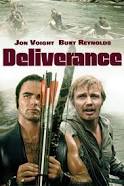
 Simon Jarrett discusses a disturbing 1970s film classic which peddles some very old ‘retardation’ myths.