The national learning disability charity Dimensions is spearheading a campaign – I’m with Sam – to fight back against learning disability and autism hate crime. Thirteen organisations have joined them so far and there has already been some success in working with the Crown Prosecution Service to react more robustly to these crimes. Simon Jarrett reports
My children and I are all disabled… we have been sworn at, threatened by neighbours and we have had them try to hit us with their vehicles”.
This was just one of many depressing testimonies received by the I’m with Sam campaign, led by not-for-profit learning disability organisation Dimensions, as they investigated the extent of learning disability and autism hate crime in England and Wales. Other respondents testified to threats to their lives, being spat at, school bullying and violence, verbal and physical attacks, public ridicule, theft and vandalism against their property and possessions. Many did not feel it worth reporting the crimes against them, or felt too scared to do so. Those who did report often experienced an ineffective response from police, the criminal justice system, local authorities, schools and colleges. Some were even made to feel that what had happened was their own fault.
The campaign has also uncovered incidences of so-called ‘mate-crime’, where manipulative individuals prey on people with learning disabilities by befriending them, and then extorting their money and possessions. The ‘friendships’ often come with an underlying threat of violence, leaving the person trapped in a coercive relationship. In one case more than £2,000 was extorted from a young man by the person he believed to be his best friend, and who had even accompanied him on holiday. He was sold worthless goods at vastly inflated prices, given ‘loans’ at astronomical interest rates and threatened with violence if he did not meet financial demands. When the abuse was discovered, the police lacked the powers to charge the perpetrator, because of the apparently voluntary nature of the transactions. The victim was admitted to hospital with a breakdown.
A Dimensions survey found that 73% of respondents had experienced hate crime, 53% in the past year. Respondents reported that the crimes had made them scared of other people, uncomfortable about leaving the house and had affected their confidence and self-esteem. Many were left with feelings of anger at what had happened to them. Respondents called on authorities to tackle learning disability hate crime head-on. They want changes in the law and for the justice system, police and schools and colleges to give them greater protection.
The Dimensions campaign uses the image of ‘Sam’ to represent all learning disabled or autistic victims of hate crime. “Sam is in many ways just like you, just like your child. But Sam’s learning disability makes him or her a target for verbal, physical and financial abuse.” Having produced evidence of the extent of hate crime through its survey, the campaign is attacking the issue on a broad front. They have brought together a large group of partner organisations to keep up the campaign pressure (Box 1). They have also appealed to the public (including readers of Community Living) to write to their MPs about the campaign and to tell their own stories or those of people they know.
I’m with Sam has set eight campaign objectives (Box 2), which include changes in the law to make online disability hate a crime, steps to make it easier for people with learning disabilities to report hate crime, and collection of separate statistics by the police and others about disability hate incidents. They have met with the Crown Prosecution Service to discuss their new policy for prosecuting crimes against disabled people, which emphasises ‘situational risk’ rather than vulnerability, and commits to seeking more prosecutions and sentence uplifts where hostility to disability is involved.
Dimensions Chief Executive Steve Scown has called on everyone, including politicians, civil servants, mums and dads, teachers, police and care professionals, to play their part in giving the campaign momentum, and to influence where they can. In his words: “Hate crime robs people of their confidence, their independence and, sometimes, their lives.”
Box 1
Strength in numbers – joining Dimensions as partners in the ‘I’m with Sam’ anti-hate crime campaign are 13 organisations:
Beyond Words
Ambitious about Autism
Autism Together
National Forum of People with Learning Disabilities
Choice Support
Learning Disability England
CMG – Care Management Group
Stop Hate UK
National Valuing Families Forum
Inclusion North
Foundation for People with Learning Disabilities
The National Autistic Society
VODG – Voluntary Organisations Disability Group
Box 2
Blueprint: I’m with Sam’s eight objectives to end learning disability hate crime
Separate disability hate statistics into learning disability/autism, and other disabilities
Change the law to make disability hate a crime online
Department of Education to adapt resources to support all schools with positive messages around difference
Manufacturers to incorporate greater learning disability sensitivity into toys and games
Department of Health guidance to help families and staff identify and manage hate crime
Crown Prosecution Service to improve investigation protocols when learning disabled victims involved
Improved Home Office training and resources for police officers and funded self-advocates to provide specialist victim support
Evaluation of effectiveness of new coercive behaviour legislation on people with learning disabilities
Robin Jackson tells the extraordinary story of Hermann Gross, a German Expressionist artist who lived amongst a community of children with learning disabilities and was inspired by them to paint on themes of social renewal, interdependence and the meaning of vulnerability.
Quote: For the founders of Camphill and for Gross, the search for new social forms was never an abstract idea — it was an urgent necessity. As the community gave his work new life, so he offered new life to the community.
At the beginning of World War II Dr Karl Koenig and a group of refugees from Austria and Germany founded the first Camphill community in Scotland. Koenig had developed a vision of a ‘learning community’ where the traditional boundaries between professional disciplines would be dissolved, the spiritual well-being of those living in the community nurtured and respected, creativity, spontaneity and originality encouraged and where ecological sensitivity and responsibility would be exercised.
Koenig was looking at one possible way to generate social renewal at a time of social disintegration and to send a message of hope at a time of widespread despair. Having experienced some of the horrors of a hate-fuelled Nazi regime, Koenig was determined to create a community in which compassion and tolerance were present, for it was compassion and tolerance that bound communities together. It was Koenig’s belief that co-workers in the communities should live and work together with children and adults with special needs in such a way that new social forms might develop: the co-workers would share every aspect of their lives with the children and work without remuneration.
Inspiration
It was to this distinctive community that Hermann Gross – a German Expressionist artist and former pupil of Picasso – came to live and work. Working in this residential setting became a source of inspiration for him. Both for the founders of Camphill and for Gross, the search for new social forms was never an abstract idea — it was an urgent necessity. As the community gave his work new life, so he offered new life to the community.
It had always been one of the aims of the founders of Camphill to foster social art. Gross began a process whereby people were challenged to look at their surroundings in a new way. This stimulated an interest in what was put on the walls of the houses and meeting rooms and in the gardens. Gross made a significant contribution to the community’s understanding of the purpose and value of art, not simply by making his work available to the community but by ensuring that the art-making process itself was accessible and visible and not some precious and exclusive activity. In essence, he was engaged in the demystification of the process – but not of the product.
Gross’s work is unusual insofar as there are relatively few examples of children as principal subjects in either classical or modern art – apart from the iconic representations of the Christ child – yet children feature strongly in his work. Not only does Gross take children as his main subjects but he goes one step further and encourages the viewer to reflect upon the transient nature of childhood and all the vulnerabilities inherent in it. The challenge for the artist is to be able to convey that message without recourse to the cloyingly sentimental images that characterised much of Victorian illustrations depicting childhood.
Gross does not present a form of sentimental art that leads the viewer away from active engagement with the ambiguities and complexities of the real world. Sentimentality in art makes no demands upon us, requires no struggle, involves only a narrow range of feelings, arouses no thoughts or feelings about the real world: it represents a general failure of imagination. Gross was aware that the kind of social renewal that his Camphill colleagues sought could only be achieved by creating a world that was more responsive to the needs of the child. He was engaged in social art, where the medium is being used to convey an ethical message, not simply about how one should care for and protect children but how societies should treat all vulnerable groups.
Sense of community
When Gross was artist-in-residence in Aberdeen, a significant number of children attending the Camphill School were drawn from some of the most socially deprived districts in Glasgow with which Joan Eardley – a distinguished Scottish artist – would have been familiar. Both Eardley and Gross succeeded in persuading the viewer to treat children as serious subjects by portraying them with compassion and without sentimentality. Eardley’s paintings demonstrate that, notwithstanding personal circumstance, the child possesses an inner resilience that transcends that circumstance, however disadvantageous. She was particularly attracted by the friendliness and community spirit in these districts. In different ways both Eardley and Gross were commenting upon the importance of a sense of community. By the time of Eardley’s death in 1963 many of the old tenement districts had been levelled to the ground and residents transferred to soulless high-rise estates. In the process that strong sense of community that had so appealed to Eardley had gone.
Eardley differed from Gross in that she tended to focus almost exclusively on the child, whereas Gross invariably sets the child in the context of a relationship with one or more adults. Whilst Eardley stressed the independent identity of the child, Gross highlighted the importance of inter¬dependence – an essential feature of life in a Camphill community. The life-sharing aspect of Camphill community life is one of its defining features, as this ensures that the principles of dignity and mutual respect can be meaningfully translated into practice. And it is this mutual relationship that provides the cohesive force that binds together the different elements of a community: it is the mortar without which the communal edifice would collapse.
Reference
Robin Jackson (2008) Hermann Gross: art and soul. Edinburgh: Floris Books.
Elinor Harbridge is retiring after a remarkable 30 years as founder, publisher and editor of Community Living Magazine, handing the reins to Simon Jarrett. It has had its ups and downs over those years but it has outlived other magazines and, as she told Seán Kelly, perhaps just surviving these days is a success.
I first met Elinor when I was CEO at the Elfrida Society, an early supporter and sponsor of the magazine. In 2005 it was decided that Elfrida would take on the publishing of Community Living. As part of the process I asked Elinor about contingency plans for producing the magazine if she should become ill. I think I imagined a journalist friend who might step in as editor at short notice. Elinor gave me a stern look which quickly helped me understand that, for her, becoming ill was not on the cards – or perhaps the message was that if she did become ill she would just continue. It was clear that she did not consider this an ordinary job where you could ring in sick – this was a commitment of body and soul. I pictured her with all four limbs encased in plaster like some television comedy casualty, still dictating her editorial to a young reporter with a notebook. Luckily, that never came to pass and she has carried on producing the magazine quarterly for a full three decades.
Elinor lives with her two rescue dogs, Heidi and Kit, in the lovely village of Dunster near the Somerset coast. Along with my wife, Mary, I took up a long-standing invitation to visit her and to hear her story first-hand.
“Who wrote this rubbish?”
The first seeds of Community Living were planted when Elinor was working for Community Care magazine in 1979. The editor asked her to go to Huyton, where there was a home for people with learning difficulties run by a religious order. She wrote an article which, she says, “was about how lovely it was and how happy the people were.” The editor seemed pleased and the story ran. She didn’t get any feedback… except a phone call from David Brandon. A colleague took the call but she could hear him from some distance away. The gist of it was: “Who wrote this rubbish?”
“That was my first introduction to David and it was a wake-up call,” she says.
Elinor felt she would like to do something to address the issues that people with learning difficulties were facing. Then in 1987 the moment was right. She had already started a speech therapy magazine (Speech Therapy In Practice which she later sold) under the house name of Hexagon Publishing. Now she wanted to start a campaigning magazine for people with learning difficulties and she knew who she wanted to be the editor. David Brandon and Elinor met in a very noisy café on Birmingham Station. He had travelled from Preston and Elinor from London. “I asked him if he was interested in editing this and he said, ‘Yes’. It was quite a niche thing at the time because a lot of services were still being run in a very traditional way.” I suggest that it was brave to turn a fierce critic into an ally. “Yes, I suppose you could say that,” she laughs, “but his criticism was justified.”
Community Living magazine launched in April 1987. There was nothing like it and the number of subscribers shot up during the first few years. When David Brandon became busier with other things Elinor became the editor, but he remained involved.
Better design
In 1999 Elinor met Christina Schwabenland, CEO of the Elfrida Society based in Islington. This led to the Elfrida Society giving financial support to the magazine as well as contributing articles. After a couple of years the Elfrida Society took over the publishing of the magazine. An Editorial Advisory Board was established gathering other charities and individuals. An external designer introduced better design and use of colour – superficial changes perhaps but ones that undeniably appealed to an increasingly sophisticated readership. Elinor says: “We got good articles from Elfrida people. I now had an editorial board which was great. I was getting proper support and very useful input from people who really knew what was going on and were doing the sort of things we wanted to publicise in the magazine. It was a very good period.” On the other hand, she was not the sole owner or decision-maker any more.“That was quite a hard thing to learn. So I had that dual feeling about it.”
Meanwhile Andrew Holman had become the editor of Community Living. Elinor says, “Andrew took a leading role in the magazine in the late 1990s and early 2000s. He was a strong supporter of people with learning difficulties. As well as his keen interest in politics he did a great deal to promote the idea of direct payments.” After a couple of years Andrew developed his own company, Inspired Services, and Elinor became editor again, although Andrew continued to write perceptive pieces for the magazine until recently.
Campaigning
As time went by other organisations such as KeyRing, Integrate (Preston & Chorley), Respond, Three Cs, Linkability and UCLAN joined the editorial board and became sponsors of the magazine. Then in 2011 the publishing role was taken over by a specially created charity called CL Initiatives Ltd, chaired by Rosemary Trustam.
Community Living describes itself as a campaigning magazine. Does she feel it has helped change the world? She is wary of claiming that, since change was happening anyway, but says, “We have given people with learning difficulties a voice in the magazine and promoted the whole self-advocacy movement. I think we do that more strongly than others.”
A more recent focus is on social care law which Elinor says Rosemary Trustam has brought to the magazine. Legal expert Belinda Schwehr has been writing articles in every issue and leading seminars. Elinor says, “It is campaigning because she is trying to get people to understand their legal rights and when they can use the law and when they can’t. With our annual seminars it has been an important part of what the magazine has done over the last few years.”
Community Living is also supporting moves to get people out of institutions. “It’s a vital campaign and we are adding our voice to it,” she says.
Underdog
Have people’s lives changed for the better? Elinor refers to the Valuing People survey in the last issue: “It’s fairly clear that some people have benefited but an awful lot have not. Valuing People was like the ultimate postcode lottery in that some authorities got hold of it and took it forward but others didn’t.“ She is worried that some local authorities may be saving money with congregated services. “We might be going back to that because of the way that local authorities are making their cuts.”
I comment that she has spent 30 years rather selflessly promoting the rights of a group of people of which she is not a member. “It’s that English thing of supporting the underdog. It has been a very satisfying job. A magazine gives you a bit of power to influence things. Maybe it’s more a matter of confirming people’s views, developing a partnership with the readers. If the magazine is saying something that people want to do but feel worried about, perhaps the magazine endorsing it gives them a bit more confidence?”
Over the years, the magazine has had its ups and down as well as stiff competition from other publications. It has outlasted Community Connecting and Learning Disability Today magazine. I suggest just surviving is a success. She agrees. “I said to Gill Levy (an editorial adviser) our theme song should be I will survive!
Progressive impact
Elinor tells me she is confident that the magazine will thrive under the new editor Simon Jarrett, saying: “His values are those I have always tried to follow and he has demonstrated his editorial skills as arts correspondent. She also pays tribute to all current (and past) members of the Editorial Board and trustees of the charity. “I would single out Gill Levy who has supported the magazine since day one”.
So perhaps it is appropriate to finish with Gill’s own recent message to Elinor. Her words take us back to the impact that the magazine made on progressive staff in the early days:
“It was absolutely wonderful to receive the very first edition. It included so many of the issues I was struggling with in my new job at RNIB working with staff and carers of adults with learning difficulties and complex needs. The magazine challenged me to think in different ways and really helped me to move from local authority social work with children with learning difficulties to providing a service which sought to provide advocacy and campaign in a variety of settings.”
There it is again, the advocacy word. Autonomy and advocacy are the magazine’s watchwords. Let’s always remember them. Thank goodness and thank you Elinor Harbridge for ensuring that Community Living magazine is still here to make sure we do.
Note: Elinor will be retaining her link with Community Living and continuing as consultant editor. You can stay in touch with her on her website: www.hexagoneditorial.co.uk
David O’Driscoll reflects on how we can help people with learning disabilities cope with bereavement.
There have been enormous changes for people with learning disabilities since one of the country’s first asylums opened in Abbots Langley near Watford, Hertfordshire in 1870. There was a lot of optimism when Leavesden opened its doors and a great belief in such institutions. They were meant to be a ‘happier place’, where people with learning disabilities would be protected from difficult issues, such as death or loss. In my historical research, I am always struck by how painful the admission process was for them and how little attention there was to the person’s feelings. Also what happened on a practical level when someone died? I was told that the ward was shut and the body was disposed of. The deceased often simply disappeared and it was very rare for the patients to be involved in any grief rituals. There was blindness or denial to the impact of this on the patients. It was not until the 1980s and the work of the social researcher Maureen Oswin that loss and bereavement was seriously thought about. It was truly a sad situation.
Vulnerability
Today, are we in a better place? It is a complex picture. We have a growing body of research on loss and learning disability which emphasises people’s vulnerability. We know that many people with learning disabilities have a lifelong history of loss, separation and abandonment. Some of this research into their end of life experience has highlighted how people with learning disabilities die, on average, 16 years before their counterparts without a disability, and more than a third of these deaths are avoidable.
There is concern about the overuse of medication. While I feel that there is a place for anti-depressants in helping a person adjust to their new reality, it seems that it is too easily prescribed at the first signs of difficulty. We also know that people with learning disabilities are more likely to miss out on attending a funeral or other rituals of significant figures in their lives. This is particularly so if they have a severe learning disability. As a result, there have been countless recommendations for services, many of which have guidelines today, hopefully including the right to take part in rituals.
Many services have also developed end of life plans. These are important as the service user’s adjustment can depend on their environment, family or, more often than not, support services. But for me the key element in supporting the bereaved person is developing a relationship to generate dialogue about their experience of loss, giving them opportunities to voice their sadness, anger and/or anxiety. Yet this too can cause anxiety for staff who may fear they are opening a ‘can of worms’.
Research has revealed that support services are not adequately prepared to identify negative reactions to bereavement. How should staff in support services help people with learning disabilities with their grief?
It is important to support their involvement in rituals. If the families are anxious about including them, find out what their concerns are and what the services can do to support them.
Talk to people about their experience. One way is by using a ‘grief stages model’. However, bereavement researchers today see limited value in it, claiming there is no research base and it that it is too simplistic to capture the complexity of the grief process.
There are several versions of this model widely known in health and social care circles. The bereaved person moves through stages: shock and denial, followed by anger, resentment and guilt, then, bargaining, maybe depression and finally acceptance. While there is no ‘one size fits all’ approach, a stages model can be useful to help staff contain their own anxiety whilst discussing with the service user their experiences. It should not be used diagnostically but could help generate conversation.
Practical methods
Current researchers have emphasised the importance of individual meaning for the therapeutic intervention and this framework can help. There are other practical methods such as life story books or the Books Beyond Words series (https://booksbeyondwords.co.uk).
Also key is the relationship with the deceased. We have moved away from the idea of letting go of the deceased as people still live on in our minds and we need to find ways to support and acknowledge this. One way would be for support services to have a bereavement life history of each service user, with experiences of past losses, positive and negative, to help future planning. I have seen a number of examples of the negative effects of poor post bereavement planning on people’s lives. If people need external support Cruse, the bereavement support service (www.cruse.org.uk), can be helpful with more straightforward grief reactions. For more complex reactions referral to a specialist learning disability service is recommended.
Loss and grief are fundamental to human life. Put simply, grief is the price we pay for love, and developing emotional bonds to people, places even possessions. Most of us adapt well to bereavement but it can be a sad place and we all need support at this painful time.
David O’Driscoll is a psychotherapist with Hertfordshire Partnership NHS Foundation Trust.
Simon Jarrett writes: In the summer 2016 issue of Community Living (29:4) Seán Kelly wrote about the increasing difficulties he is facing as a photographer working at events involving people with learning disabilities (Should staff discourage people from having their photos taken?). Staff were finding numerous pretexts, mostly under the general cover of ‘confidentiality’ or ‘consent’, to prevent people having their photographs taken. Is this a genuine concern for privacy and personal rights, or part of a more concerning trend which denies people with learning disabilities the right to a public identity? Does the label of ‘service-user ‘mean that you become a person without a story: someone who lives in society, but is not really seen as belonging to it?
As humans, we all have an identity and a life story, so what does it mean for our humanity when these are denied to us? It seems the problem identified by Seán is not an isolated one. Here Laura Harris and David O’Driscoll talk about the many external obstacles they have faced in supporting people with learning disabilities simply to tell the story of their own lives.
Mencap Cymru’s Hidden Now Heard project has been working for over two years researching and capturing the stories of Wales’s long-stay hospitals (or asylums as they used to be called), the last of which closed in 2006. These hidden histories of former patients with a learning disability, the staff who worked there and their relatives have informed five museum exhibitions across the country with three more scheduled before the end of the project in 2017.
However there is a stark and unavoidable gap in our research and in the voices that shape our understanding of such places; the voices of former patients who called these institutions home.
Fear
It is not for want of trying but time and time again we are met by similar responses from relatives and support staff. There is a strange sense of fear and an absolute desire to ensure the people they support are nothing but happy.
We are often told that a person lacks capacity, will get too upset or doesn’t understand what they are saying. In essence the cycle of denying someone a voice, to be heard and to have his or her experience validated, continues with adults infantilised by this idea of protection.
Not everybody will want to share their memories of course – and many support staff and families we meet are very supportive – but such misconstrued protection results in the continued silencing of this diverse community within our society and ensures their stories will never be heard.
Laura Harris is the project manager of the ‘Hidden Now Heard’ oral history project. You can follow them on Facebook https://www.facebook.com/hiddennowheard/
Opening a can of worms?
David O’Driscoll reflects on the struggles he has faced encouraging people to talk about their lives in NHS institutions.
In 2000 the NHS Trust governing the closure of Harperbury Hospital in Hertfordshire had an imaginative idea. The long-stay hospital for people with learning disabilities was closing, after 70 years. The first patients were admitted in 1928. The idea was to give a secondment to an NHS worker (which was me) to organise various events including a history conference, exhibition and, most of all, a closure event. This would involve oral history accounts with ex-hospital patients and staff, and fireworks.
In its heyday Harperbury had up to a thousand patients. Its catchment area was nearly the whole of North London, east and west. It has a fantastic history. J F Kennedy’s family funded a research project there, The Kennedy-Galton Centre. Because of this link the hospital had some famous visitors, including Jackie Kennedy and Muriel Humphrey, wife of Vice-president Hubert Humphrey. The famous Tottenham Hotspur football club, including their star player Jimmy Greaves, played the patient team in 1969. There were also more difficult moments, including various overcrowding scandals in the 1960s and early 1970s.
Paternalistic
The system governing the lives of the hospital could be described in many ways but I would use the term ‘paternalistic’: most of the hospital patients’ lives were tightly controlled; they were not given freedom or choice; most decisions were made on their behalf.
Much of the research on patient resettlement found that choice was something they particularly valued. In 2000 the literature on this aspect of social history was slim. In particular we were lacking accounts by ex-patients themselves. For this reason I wanted to put them at its centre. I was sure I would get lots of contacts. I put ads in the local paper (I got one reply, a nurse) and contacted various local networks. I waited by the phone, but it never rang. Puzzled, I thought maybe I was going about it the wrong way. I felt that support services would get in touch with their ex-patients, once I explained the project. I contacted many social work teams and colleagues in health. I received little response. It was puzzling as I was always being told that this history was important, as it was ‘hidden’ and that we needed to record it now as many ex-patients would not be around much longer. There was a sense of urgency. I went the direct way. I obtained lists from the hospital’s resettlement team, and contacted the support services, who were cautious and uncertain.
Finally I did get a few responses but it was clear that a number of the support staff felt I was opening a ‘can of worms’, that I would be leaving the support services to deal with the emotional distress I had opened up. They thought someone talking about their institutional experience would not be a good idea and that people were today leading a ‘happier life’ in the community. Why unsettle them? I was told that clearly ex-hospital patients would not at any price want to discuss their experiences. We need to respect this. However, it was also clear that many would value the opportunity to do so and they had not been given the opportunity.
Failing people
Today, 15 years later, are we in a different place with history? In many ways I think we are. The Social History of Learning Disability group based at the Open University has pioneered a historical engagement which has involved people with learning disabilities in their studies. There are also currently a number of large-scale heritage lottery funded oral history projects on long stay-hospitals in Wales and the north of England. There is also an annual two-day conference each year. This year’s theme was ‘Why history?’ It was clear, whilst listening to presentations, that many of the difficulties I had experienced as a history worker back in 2000, were still encountered today.
This got me thinking. Are we failing people today by not talking about their past experiences. There are still many people who have spent a lot of time in an old long-stay hospital. Hertfordshire has a remarkable history and amazing stories yet there is no mention of it in any of its literature. This is not unusual: most NHS trusts do the same. While other services, if they mention history, do so as a public relations exercise to emphasise how progressive they are today.
We know best
Despite much progress in services, is paternalism still dominating today? We know best! The main reason I suspect there is such difficulty with history today is because it is a cause of anxiety – maybe even embarrassment, shame and guilt. We do not like these feelings. They are opening up a can of worms indeed. As George Orwell wrote: “Who controls the past controls the future. Who controls the present controls the past.”
Matthew Eddisford reports on looming threats to the future of supported housing.
Late last year the Government launched its consultation on the future funding of supported housing. Prior to the launch, housing associations were crying out for clarity on these funding arrangements to enable them to plan for the future with some certainty and address unmet demand for supported housing. Has the consultation provided this clarity? Unfortunately, no.
So what are the issues housing associations who wish to provide supported housing now face?
Uncertainty over future rent levels
The Government have confirmed that an ‘LHA + top up’ rate will be applied to all supported housing rents from April 2019. However, there is no indication as to what level of ‘top-up’ will be allowed. We understand that the initial fund will be at a level comparable to current costs – but how this will be applied is unclear. It also fails to take account of the current unmet demand and could turn into a post code lottery, with local authorities who have done little in the preceding years set to lose out further. Without any confidence over the sustainability of rents housing associations are limiting, or even abandoning altogether, future development plans.
Will a ring-fence protect funding?
The Government have assured us that a ring-fence will be in place to protect this pot of money. However, history tells us this will not offer the necessary protection to funding in the long-term – remember Supporting People? Without a ring fence in place there is a genuine fear that the supported housing top-up ‘pot’ will be swallowed up by local social care priorities. What housing associations would perhaps rather see is the introduction of statutory duties around housing, to strengthen the grip on this housing funding, but it is unclear if this has been considered.
Addressing long term need
Property costs money. Adapted and specialist property costs a bit (or in some cases a lot) more money, and so for housing associations property is an investment paid for over the long term. With no guarantee as to the longevity of income, housing associations are again in a Catch 22 – halt development and fail to meet the very objectives of our being, or carry on regardless and jeopardise the business? Housing associations have to consider the risk if the schemes are to fail, ie. the exit strategy. This strategy is not necessarily quite so clear when considering highly bespoke housing. Will this result in the housing needs of the most vulnerable not being met?
Protection of existing tenants
The Government has confirmed that the arrangements will be applied to ALL tenants from April 2019, and so existing tenants will not be protected. Existing tenants could see their entitlements slashed significantly which could see them fail to meet their rental commitments or, in some circumstances, face the prospect of eviction. Housing associations may have some very difficult decisions to make around the ongoing viability of schemes and providing vulnerable individuals with a home. It is not inconceivable that we could see swathes of supported accommodation becoming untenable for associations and/or tenants.
A ‘standard’ model of housing with little regard for the individual
As local authorities will have a finite pot of money to work with (and an uncertain ring fence), the danger is that it will be a race to the bottom in terms of rent levels which inevitably leads to compromises on quality. Are we likely to see the widespread introduction of large scale blocks of self-contained units which provide efficiencies on both the housing and support costs? With cost, and not necessarily outcomes, being the key driver, this is a distinct possibility. A mixed portfolio of housing is crucial to ensure the broad spectrum of choice is being offered.
Where will the capital come from for much needed supported accommodation?
Under the current framework, supported housing is viewed as a sound long term investment. We have seen the market flooded with interest from institutional investors and corporate lenders. However, with uncertainty over long term income from new schemes and the strength of housing providers to meet their debt commitments, capital may be withdrawn.
Where does this leave us? There are more questions than answers to all of these problems as things stand. However, in my optimism I am hoping that the Government will realise that putting existing tenants at risk and causing the abandonment of new supported housing is in absolutely nobody’s best interests, ethically or financially. I also believe that fundamental changes like this will result in innovation and a desire from housing associations to ensure things ‘keep moving’. Demand for housing has arguably never been greater and housing associations need to continue to step up to the mark and provide innovative solutions in the face of these challenges.
Matthew Eddisford is Chief Executive of Care Housing Association
Our legal correspondent Belinda Schwehr unveils the new charity she is establishing – an idea whose time has definitely come.
Community Living’s editor has generously allowed me to use my normal space to publicise my latest venture – a new charity providing legal advice to people stuck in wrangles over social care with their local council or health service Clinical Commissioning Group (CCG).
The charity is going to be called CASCAIDr – the Centre for Adults’ Social Care – Advice, Information and Dispute Resolution.
What’s the problem?
I believe there’s an urgent need for a national organisation providing free legal advice on social care. Existing information and advice resources have been depleted, legal aid has shrunk and Citizens Advice Bureaux don’t cover this area.
In addition, there’s an acknowledged crisis in social care funding, a significantly reduced workforce and a yawning gap between the rhetoric and the reality – with some ugly and unethical pressures being applied behind the scenes.
Most people don’t even realise that they have a legal problem until it’s too late. Others just don’t want to rock the boat, through fear or simple resignation. In difficult times, many people feel their relatives shouldn’t be someone else’s concern. In truth, none of us can predict whether it will be us who ends up needing adult social care. We all need public sector decision-making to be properly governed by the law and sound legal principle.
What will CASCAIDr do?
CASCAIDr’s primary purpose is to provide free, specialist legal advice on adult health and social care rights. The recipients will be people who qualify as ‘in scope’ in respect of disputes about eligibility for funding or the amount of funding for packages of services under statutory duties applicable in England and Wales.
The charity’s objects also include advancing social welfare, public education, relieving financial hardship, promoting citizenship, conflict resolution and shoring up third-sector providers in difficult times.
CASCAIDr’s logo is a floodgate with a deluge of powerful cascading water carrying all before it. I can’t wait to open the floodgates!
Our activities will include triage, steering, analysis, advice and the drafting of what’s called a ‘pre-action protocol letter’. This is a letter that people are obliged to send to local authority and CCG legal advisers if they believe they have a serious legal challenge to bring by way of judicial review, in the Administrative Court.
We won’t play games for their own sake, of course – we are professionals! We will aim to promote compromise and cases being settled on suitable terms but we are committed to helping people enforce their legal rights to decent care packages.
CASCAIDr will focus on a selection of fundamental issues in adult social care law – for example, the cost-capping of homecare, omission to implement advocacy rights, ignoring the Care Act guidance and lack of engagement with why a care plan is even arguably sufficient and defensible.
How are we going to tackle this?
Our unique approach is to use crowdfunding to support legal challenges where a barrister has given a positive opinion on the merits of the case. Public bodies will not be able to ignore this – they will know we are serious. Our hope is to reinvigorate the rule of law within local government, before things get worse. A little legal principle should go a long way with public bodies’ management, staff and elected or Board Members.
CASCAIDr will work in a virtual way, using technology to enable people to:
book calls to an expert
fill out referral forms
obtain assistance from volunteers, if the person’s own attempt at a form is not sufficiently specific.
get advice directly from a public access barrister (for more complex cases that are beyond CASCAIDr’s specialist in-house expertise)
gain access to solicitors who either offer legal aid or are interested in working, perhaps “pro bono”, on useful test cases
raise money for litigation through crowdfunding, via the CrowdJustice website.
How will we cope with the workload?
As founder, I’m going to be bringing 20 years of expertise in adult social care law. I have been a barrister, academic, trainer, writer and commentator. I’m now happily returning to my roots as a legal thinker, with a mission to develop and preserve legal literacy in the sector.
I will provide the first level of triage for the organisation myself, at first. Interested volunteers will be available to help elicit salient facts from people who are struggling (having signed up, online, to undertake this role).
Advisers with skills and familiarity with the legislation will then analyse, advise and prepare draft letters, which will be checked before transmission to any public body. Aspiring advisers can apply online for this role, for which they will be paid a flat rate per task.
For more complex cases, we have identified leading barristers with direct public access rights, who are interested in working for a flat rate per hour (about the same as they would get on legal aid for a judicial review case).
CrowdJustice terms and conditions are highly supportive of CASCAIDr’s ongoing financial viability, because any funds not then used on the litigation end up with the charity. So if the body being challenged ultimately settles the case, it will have funded further challenges through indecision about conceding, earlier on.
Is this all going to be free?
Not quite! CASCAIDr will offer affordable advice to people outside the scope of the free legal advice service.
So we’ll provide advice and support, on a discounted basis, to individuals whose problems are not actually about assessment, eligibility or care planning and cuts, but who are still people who need ‘hand holding’ before they do end up with a legal problem. Alternatively, people may wish to take a rejected complaint to the ombudsman, Parliamentary Commissioner for Administration, Care Quality Commission or through the NHS complaints system. Or they may have problems related to charging, safeguarding or some other aspect of health or social care.
They may benefit from specialist advocacy or help with complaining about something, even though it’s not illegal.
We will also offer discounted legal advice to any organisations in the sector that are not for profit, or charities themselves, such as care and support providers, or advocacy organisations.
We’ll be offering chargeable training in the form of webinars and lectures for universities, charities, providers and advocates.
Where will the money come from?
CASCAIDr will be seeking donations from organisations such as care providers and housing associations and, of course, from members of the public. All donations will attract GiftAid or be tax deductible for corporates, once we have obtained charitable status.
We are also offering Fee Based Memberships to organisations such as law firms who wish to develop health and social care public law expertise, advocates’ organisations and social and healthcare providers. In return for their fee, member organisations will have access to my Care Act webinar series, a case law update twice a year, and three hours of advice per year. If an organisation cannot afford membership, it can offer help to CASCAIDr, instead – for example, access to volunteers, fundraising or simply spreading the word.
We hope providers will make donations, because they are damaged too by any public body’s lack of respect for the end user’s rights. If publicly funded service users and carers are given arbitrarily low packages, or budgets, then the businesses that are commissioned and paid to provide the inputs, receive less than they need, and end up struggling.
We know that businesses won’t want to be seen to pay for legal advice for a service user about how to challenge the pubic body making the decisions, but we think making a donation or paying for a membership is a wholly different thing. I want ‘Collaborating with CASCAIDr, to uphold legal rights’ to be a badge of pride, one day, for health and social care businesses.
Why action is needed now
If something is not done to help people, now, there is a risk that reduction in the money supply will make it impossible for advice organisations to justify funding the acquisition of health and social care legal expertise. It will become uncommercial for them to do so if they are not getting ‘customers’ through their doors. The only effective way of holding the state to account on social care issues is through legal accountability – and that is alarmingly close to disappearing.
CASCAIDr’s launch is likely to be sometime in March, as it depends on Charity Commission registration for maximising initial donations. People will be able to donate by text or by the MyDonate.Com site, which automates the addition of 25% GiftAid, if you are a taxpayer.
I will be emailing and encouraging people to forward my message to as many of their contacts as they feel able to. Social media will be important too. It would be great if people could like, follow or tweet about CASCAIDr on Facebook, Twitter and other platforms.
Finally, whenever possible I’ll be writing up the charity’s success stories to illustrate the good that can come from knowing a bit of Care Act law. In the meantime, we need to stay up to date with what’s happening in the sector. If a council or NHS body near you is doing something that we ought to know about, please email the details to me at: belindaschwehr@cascaidr.com
Read Belinda’s latest blog on http://www.schwehroncare.co.uk/
Extraordinary times call for extraordinary measures – Frank sees Donald Trump’s election bring about an unlikely alliance between wife and neighbour Henry
“If my old Dad, gentleman that he was, were still alive today, he would turn in his grave,” said neighbour Henry, scrambling his idioms. “Grabbing women’s bits?! You don’t have to be a bra-burning women’s libber to know it’s disgusting to be talking about grabbing women’s bits,” he continued, supportively he thought.
Wife, who had just returned from the women’s anti-Trump march, flashed Henry a grim smile and dumped her protest banner in the recycling bin – “Free Melania” on one side, “We shall overcomb” on the other. “You’ve spelt that wrong,” said Henry. “Don’t bother,” I whispered to wife, ushering her into the house, leaving Henry out in the cold.
Wife burst into tears. One pot of tea, a hug and a Tunnock’s tea cake later, she explained in fits and starts, still affected. “Little girls with a banner saying ‘Be nice’. Girl of four giving out little hearts. A happy young woman with learning difficulties, sporting pink hair and a wheelchair covered in ‘Love Trumps Hate’ stickers. Their whole lives ahead of them. What will the world come to now? After everything we’ve done. After everything we’ve won. All undone.”
Sobbed in solidarity
“Perhaps the new leader of the free world is all mouth and no trousers,” I ventured, instantly regretting the half-dressed image. Every hour on the hour for a week, the news contradicted me. Obama Care smashed; the Mexican Wall ordered; Muslims banned. Every day, wife and friend in New York emailed each other news of each fresh attack in what sounded like amplified Morse Code, then hugged each other virtually and sobbed in solidarity across the Atlantic on Skype. America First alright, just like the inaugural speech promised, except if you are a woman, disabled, African American, Muslim, Mexican, poor…
And then there were those images. Winston Churchill’s bust forced to look on while the President signed war-mongering, planet-wrecking, hateful order after executive order. Then May and Trump holding hands like newcomers in a Lonely Hearts club. That last image sucked all the air out of the sitting room and dried wife’s eyes instantly. “WTF! He wouldn’t dare hold Putin’s hand like that,” said wife, disgusted. “What an advert for world leadership! Appeasing sycophant seeks pawing, pusillanimous patriarch for special relationship,” she spat. I nodded vigorously in agreement, understanding little, only that wife was fully armed and back in the saddle.
Neighbour Henry invited himself in from the cold. “Not on my Nelly. Over my dead body. I’ve signed a petition to ban Trump’s state visit,” declared Henry, who had never signed a petition nor protested against the establishment in his life before. He handed wife her placard, the b in ‘We shall overcomb’ crossed out and replaced with an e. “We’ve got to stick together,” he said, brandishing his own freshly painted placard like an old hand. On one side it read ‘Trump stinks’, on the other ‘Free Winston Churchill’. “You’re one in a million Henry,” I said. Delighted, he contradicted me: “I am one in one million, eight hundred and ninety five thousand, one hundred and eighty three to be precise. And counting!”
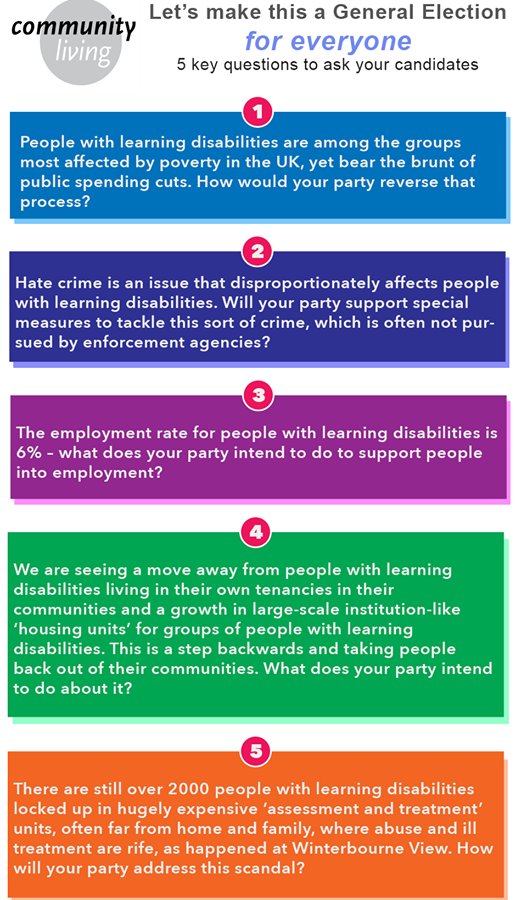
At Community Living it is not for us to take sides in the forthcoming general election, but with all parties we intend to ensure that people with learning disabilities are on the political agenda. We’ve identified five key questions that we would urge all Community Living readers and supporters to ask when they meet canvassers and candidates during the campaign. If you don’t want to take up too much of their time, just pick your favourite! And if you think there are other questions that need to be asked then tell us, via Facebook and Twitter
Recently on a Facebook page a local party chair wrote: ‘I have rarely, if ever, been asked a detailed question about party policy when canvassing’. Let’s see if we can change that, and make politicians think about learning disability.
Here are our suggested five key questions, in no particular order:
People with learning disabilities are among the groups most affected by poverty in the UK, yet are inordinately bearing the brunt of public spending cuts. How would your party reverse that process?
Hate crime is an issue that disproportionately affects people with learning disabilities. Will your party support special measures to tackle this sort of crime, which is often not pursued by enforcement agencies?
The employment rate for people with learning disabilities is 6% – what does your party intend to do to support people into employment?
We are seeing a move away from people with learning disabilities living in their own tenancies in their communities, and a growth in large-scale institution-like ‘housing units’ for groups of people with learning disabilities. This is a step backwards and taking people back out of their communities. What does your party intend to do about it?
There are still over 2000 people with learning disabilities locked up in hugely expensive ‘assessment and treatment’ units, often far from home and family, where abuse and ill treatment are rife, as happened at Winterbourne View. How will your party address this scandal?
There is plenty, I hope, to catch your interest and stir up discussion in our Spring issue.
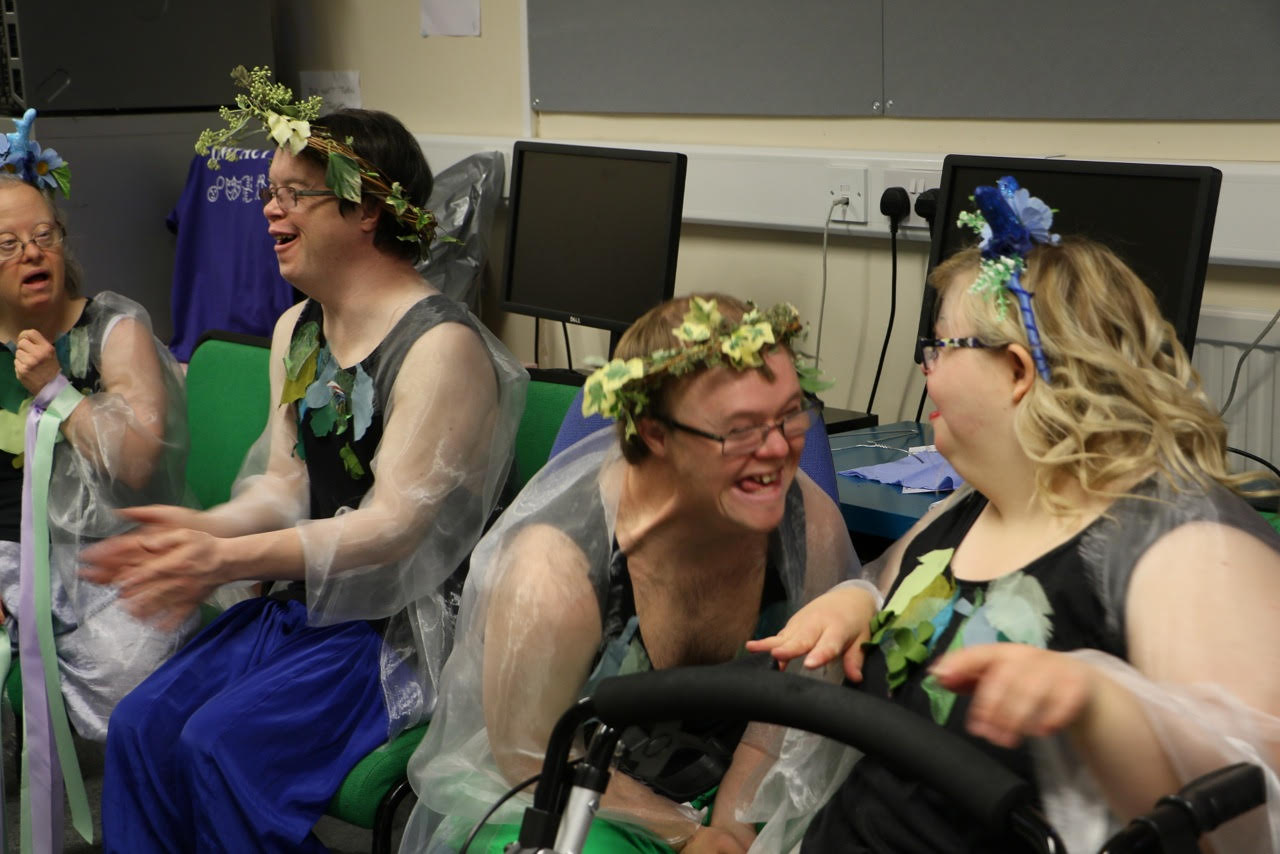
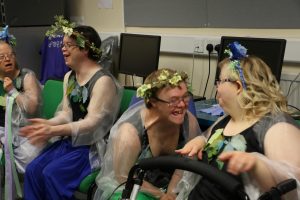
Our eye-catching cover shows a group of young actors getting ready to perform in Impact Theatre’s recent production of Shakespeare’s Midsummer Night’s Dream. Inside, our full-colour photo feature shows the stunning visual beauty of the performance. Thanks to Impact for letting us show off these amazing images.
On the subject of performance, huge congratulations to the amazing Steven Brandon, who has just won best actor in the National Film Awards for his performance in My Feral Heart, a moving film about a young man with Down’s syndrome whose life is turned upside down after the death of his mother. He shrugged off competition from Daniel Radcliffe, Michael Fassbender and Eddie Redmayne to win the award. Our review of My Feral Heart is in this issue.
Back in a less beautiful world we ask some serious questions.
Are people with learning disabilities losing the right to an identity? No photographs except for official ones because of confidentiality, no right to tell your own story because of worries about ‘capacity’ and ‘protection’. We have analysis from across the UK of this unsettling phenomenon.
What about hate crime? And are you aware of ‘mate-crime’? We report on a timely campaign by Dimensions, ‘I’m with Sam’, which seeks to tackle the disturbing trend in physical and verbal violence as well as financial and emotional exploitation, against people with learning disabilities.
And what about a place to live? Recent years have seen a positive rise in the numbers of people who have their own tenancies enabling them to lead independent lives. Is this now at risk from planned government reforms to supported housing? Matthew Eddisford of Care Housing Association reports for us.
On top of this we have a revealing article about grief and learning disability by David O Driscoll, and an interview with our outgoing editor (and founder) Elinor Harbridge, who reflects on her thirty years with the magazine. Plus our theatre, television, film and book reviews, conference reports, benefits updates, legal news and much more.
Enjoy
(and by the way if you’re not a subscriber, we’re a bargain! Just £30 a year for an individual subscription, even less for students, unwaged and other concessions. Just hit the subscribe button on our home page.)
I recently attended a talk by the excellent Joe Plomin, the producer of the Winterbourne View Panorama programme. He listed more than twenty regulatory bodies that had a statutory duty to protect the residents of the institution. Every single one of them failed to detect anything. In the end it was a television documentary team, none of them ‘experts’ in learning disability, healthcare, or protection, who exposed what was going on. Plomin’s real anger about the whole thing, he told us, was that he had to make the programme at all. He predicted, sadly but confidently, that the next such exposure would surely not be far away. On cue, along came Dispatches.
Channel 4’s programme ‘Under lock and key’ showed the British public another miserable catalogue of personal tragedies arising from the ‘care’ of people with learning disabilities. This time it was at St Andrews in Northampton, part of St Andrews Healthcare, a long-standing charity ‘providing NHS Healthcare’ in the field of mental health and learning disability. (1) St Andrews issued a statement refuting the allegations as inaccurate, misleading or taken out of context, but said that because of their duty to uphold the confidentiality of their patients they could elaborate no further. (2) There were calls for an enquiry.
Harrowing and disturbing as they are, I do not intend to recount the individual stories here – these have been more than adequately covered elsewhere. (3, 4, 5) Let us instead step back and take a wider look at the whole picture. This is not the first time, by any means, that we have been here. It is just six years since Panorama filmed undercover at Winterbourne View, a privately operated assessment and treatment centre for people with learning disabilities, and revealed horrific practices of torture and abuse. (6) Six staff were jailed and five given suspended sentences and a report, accepted by the government, recommended that the 3,000 plus learning disabled or mentally ill patients kept in ‘assessment and treatment’ units would be supported back into their communities or at least to smaller units nearer their homes. This commitment remains far from being met, and many still live in places such as St Andrews.
But Winterbourne View was not the first scandalous exposure of shocking institutional ill-treatment of people with learning disabilities. In the last half century there have been scandals at Ely Hospital in Cardiff (1967), St Lawrence and Borocourt hospitals (1981), the Cornwall Partnership NHS Trust (2005), Sutton and Merton Primary Care Trust (2005) and, most recently, at Southern Health Foundation Trust (2015 and ongoing). This is by no means a comprehensive list.
One of the startling things about each of these events is that they are almost never uncovered by the regulatory bodies employed, at state expense, to stop such things happening. Ely was exposed by the News of The World, St Lawrence and Borocourt by an ITV documentary, Silent Minority, Cornwall by the East Cornwall Mencap Society, Southern Healthcare by families, Winterbourne by Panorama, and St Andrews by Dispatches. The only exception was Merton and Sutton, where a new chief executive, untainted by association, demanded an investigation.
A characteristic of each of these events is that an enquiry is initiated, a report published, ‘lessons are learned’, action plans are implemented and then, after a short period, another scandal erupts. As Saskia Baron, a regular contributor to Community Living, has put it, ‘every time, they make headlines, and promises are made to reform the system.’ (3) The abuse, however, goes on.
Note that there is no pattern to the provider of the abuse. Abuse can happen, free at the point of delivery, on the NHS, just as much as it can occur in the private sector. It can come from the not-for-profit sector just as easily as from the state or the free market. The common factor in this disparate series of abusive events is that all the people who populate the institutions have learning disabilities.
What does all of this tell us? Here are two thoughts.
First, at the heart of all of these scandals is the medical profession. They run the hospitals and the trusts, they design and provide the ‘care’ and ‘treatment’ at St Andrews and Winterbourne, they commission the services, they section people into them. Why are people with learning disabilities the objects of medical treatment, simply because they have learning disabilities? They become powerless in the world of medical authority, sectioned, prescribed psychotropic drugs, sometimes spending decades or even their whole lives in secure accommodation at the whim of psychiatrists. And often these medicalised environments, where they should be safe and cared for, are deeply abusive. Who decided that learning disability is a disease that needs medical treatment?
Second, the problem, even in the age of ‘care in the community’, is still too often seen as simply being the wrong sort of institution. Or the wrong type of carer working in the institution. Because the institution, still, is seen as a necessary thing. Because these people are service users, people born not to work and live in families and have social lives in their communities but to be creatures of the institution. If only we could tweak the institution, or improve the staff, or regulate better, then these service users will be using better services, and all will be well. Let’s pause and consider that. Has the institution ever worked for people with learning disabilities? I suggest that it never has, and it never will. The institution and the abuse of people with learning disabilities will always go hand in hand.
If all this – the casual abuse, the lifelong detention, the early deaths, the deprivation of rights and liberties – was happening to any other group in society, thousands would be demonstrating in Trafalgar Square. Yet they don’t. Because this is seen not as a matter of human rights, but as a matter of institutional failure, for those who are born to be users of services, the institutional fodder of a society in which the rest of us can live freely. No enquiry will root out this problem, unless it begins by acknowledging these truths – like the rest of us, people with learning disabilities do not need medical care unless they are ill, and they are not born to live in institutions.
In the scramble for local authorities to manage their budgets, learning disability services have become easy prey to the knife with authorities persuading themselves that cuts to services and changes to ‘models’ are in the ‘best interests’ of service users. The problem is that whilst they may purport to ask people – sadly late in the day – these changes have not been driven by the aggregation of individual assessed needs but by cost savings.
Two North West local authorities: Lancashire, a large county council and Rochdale, a smaller borough council, are examples of what’s happening more widely. They are two of the hardest hit authorities, faced with massive cuts to their budgets.
There has been been a long hard fight for the rights of people with learning disabilities to live nothing more than an ordinary life in their local community. This was, and remains, a core value at the heart of providers in the North West who developed their services driven by these values from the early 1980s onwards. They will not respond to requests from social workers from many miles away to ‘place’ people with them as they are committed to their locality. They are seen as likely targets, as costs are higher supporting people with highly complex learning disabilities in ways that celebrate their differences, varying needs and personal attributes, supporting them to have lives determined by themselves, often in partnership with families.
Both local authorities have taken the recent advice of the Secretary of State for Health when he spoke of the need for ‘imaginative thinking’ and ‘efficiency improvements’ at local level which would not only make savings but actually enhance people’s experiences. Both authorities have new schemes which claim to fit the bill. Goodness – why haven’t we thought of all this before?
Are we expecting ‘ambitious’ outcomes, as Lancashire claimed recently, from a series of three halted ‘frameworks’ for ‘preferred provider’ status? No, not really. People with learning disabilities are just like the rest of us – they want a life, not an outcome. Some are very ambitious; others are not. They or their family advocates want to express who their ‘preferred provider’ is, not the local authority, and they will measure a provider’s success by their degree of satisfaction with them, not by a succession of outcomes assessed as being suitably ambitious by a third party who hardly knows them. The idea is that people will gain competence and therefore reduce their dependency on paid support. Great idea but it’s doubtful this approach will solve the authorities’ budget woes.
What is more worrying about Lancashire’s latest attempt to cut the cost of learning disability support is that the proposed exercise completely cuts out the people who receive the support. It’s simply a procurement exercise. The proposal is that once providers have been accepted onto the ‘framework’ as a ‘preferred provider’ and hence meet the quality standards, then they will take part in ‘mini-competitions’ to compete for the ‘work’ (work meaning someone’s day to day care and support). This applies to every ‘package of care’ – not the person receiving it? They will be judged on the basis of a split of 60% quality and 40% cost without any minimum expected rate below which they will not go. To participate in the mini-competition, providers have already had to demonstrate their quality in order to get on the framework so the contest is evidently, and simply, about the price.
Providers will be able to work in up to five county zones. Hence if a provider works in all ten currently, they will not retain all their current work. Whilst this may not apply to many locally-based providers who operate across two or three districts, or zones, what about those people forced to change their support provider in spite of their satisfaction or even attachment to their current provider? Imagine how this will also feel to other providers forced to take part in mini-competitions to compete for work with people who are not their first choice.
People with learning disabilities do not cope well with change. The relationship between a person with a disability and the provider of their care should not be underestimated; whether that’s a personal assistant or provider. It takes time and the building of trust to feel confident about handing over a loved one to a person, school or care provider. You can read CQC reports, speak to other family members, visit the provider, even interview for a PA and do all of your research but even those of us seemingly in ‘the know’ have to take a leap of faith. Only time and experience actually confirms that your decision is the right one. Success takes a colossal amount of continued joined-up working between the supported person, families, the provider and professionals. The balances are finely tuned. Change any of these and the apple cart is upset. Support that enables development is also based on relationships – not only with the immediate support worker but with the agency and its leadership which is critical to developing and embedding the culture and values of the service and its staff. It is evident that Lancashire County Council has overlooked all this, not least the emotional content and security in personal care. The people themselves feel this most and are of course the most affected by change, particularly change that is out of their control. Research shows that major changes even within our control, such as moving house or changing jobs, are a major cause of stress. How much more stressful would this be?
One way of avoiding these shenanigans would be to take a personal budget but take-up of these by people with learning disabilities has been mixed. Many are unable to instruct a broker so only those who understand the system and articulate families benefit. One family came to our agency after a series of scrapes with employment law. They reported they had had no uplift in fee or any review of their loved one’s care package for many years. They were forced to support their loved one when PAs were absent regardless of their work and young family commitments. In another case, an intelligent, articulate ex-chief executive wrote about why he wouldn’t touch a personal budget for his loved one with the proverbial barge pole.
Currently there has been no consultation with self-advocates or their families in Lancashire on this particular framework. Some of the documentation sent to providers inferred that people supported had already been consulted but it transpired that this had been two years previously on the first framework! This was raised in the web-based and other feedback which appears to have prompted a hastily organised last minute consultation offering the chance to return an easy read questionnaire, mainly just asking if people agreed with what they are doing. One person from a local forum said: “We pay for the service. We should be asked what we want”. Many people supported do contribute quite significantly to the cost of their care. We must hope that the drive for efficiency savings doesn’t override really listening to the people most affected.
Meanwhile, in Greater Manchester, Rochdale are keeping us on our toes. Their approach is equally creative. Needing to save £1.4m they are ‘consulting’ on a re-modelling of support to people with learning disabilities over 55. The suggestion is that these people will give up their shared supported tenancy, as the model of sharing doesn’t work and they would prefer to live alone. The Council would like to be proactive in approaching people in their 50s, as people with learning disabilities do not do well in more mainstream older adult provisions. Agreed. The suggestion is for more residential care, extra support and individual flats. In his article in the Guardian on Friday 14 October 2016 Rob Greig, Chief Executive of NDTi, described this approach as turning back the clock. The theory is that this will cost less but the only way that cost saving could possibly be made is with more shared staffing, ie. if the staffing levels are reduced. It’s hard to see how this can happen and still give people access to the community without restricted outings or by people going out in conspicuous larger groups; in other words, institutions set within our communities.
Both sets of commissioners and those around the country facing the same issues have unenviable positions. Rochdale is a highly deprived borough. The town has received more than its fair share of social scandals. It has not benefitted from the council tax precept; the council tax take is low and the pressures on adult social care are immense. In addition, there are few self-funders for adult social care in deprived areas and the need for social care greater. It is well discussed that the learning disability budget of councils takes a large proportion of any local authority’s budget. There is much talk of the share being disproportionate but because the help needed is usually life-long, we wholeheartedly disagree.
The costs of older adults are not comparable because most have the ability to self-advocate, save for their retirement and can make, for example, advance decisions about their care, or have an established home where they can plan for their twilight years. Care at the latter end of their life will necessarily be less and people also have more chance to decline care even if this is unwise. Such opportunities are almost never available to adults with learning disabilities and it seems unlikely that Rochdale’s plans will enhance people’s lives or achieve the requisite savings.
Sarah Pickup from the Local Government Association argues that she feels that savings have ‘pretty much gone as far as they can in most cases’. ADASS concur, adding that many in need of social care may already not be receiving the care needed, causing distress and, in some cases, additional NHS costs.
The Lancashire Learning Disability Consortium received an independent report from Laing and Buisson*, commissioned following Lancashire’s last, failed, attempt to cut the learning disability hourly rate paid to providers. It shows that to be compliant with employment law, national living wage and the much-debated Whittlestone ruling on sleep-in payments, the requisite quality care comes at a cost higher than that currently paid by both these local authorities. What must not be lost sight of is that appropriate care and its cost must be set by proper assessments of people’s needs. This is not the end of people’s lives – this istheir life.
The second Be Free Festival took place in August. Nearly 300 people with learning disabilities and their supporters had a great time in a huge park in the wilds of Essex. Seán Kelly was there too, taking pictures. “It was a blast!’ he says.
Organised by Paradigm the three days included a host of exciting sports activities in the day time such as archery, rock-climbing and riding on a huge zip-wire. There were also creative activities such as printing your own t-shirts and making ‘protest’ banners. The sun shone every day.
A great new development was that in the evenings there were excellent live DJ sets and live singers and bands. Highlights for me were seeing the soulful singer Lizzie Emeh and the fab group “Too Hot for Candy”. Another highlight was a great acoustic performance from young singer Ije. She performed on the grass with her guitar and serenaded people as they arrived and booked in, a lovely welcome for festival-goers.
A popular stand was ‘Beats Massage’ where you could have a massage in perfect time to your favourite music, and just like any other festival there was festival food available to be bought. Great Caribbean food from the ‘Caribbean Queen’ stall vied with tasty soft-shell crab burgers and other delights, not to mention fresh popcorn and candyfloss.
Why did she start the festivals? I asked Sally Warren, Managing Director of Paradigm. “Because someone with learning disabilities said they love our conferences but there are so many – can’t we do something different?”
Sally says that Be Free is pushing the boundaries both for people who receive support and for staff so that people find new opportunities and new friendships. It’s not just about fun though, each festival has what Sally calls a hidden theme. This year’s theme was to encourage people to think about what are the essential skills staff need to have to offer great support. “Great support doesn’t limit but challenges and pushes back the shackles of the system”, she says. Festival goers were brought together in the main marquee to discuss these issues and finally they voted on the top aspects of great support.
Paradigm will be using the eight essentials voted on to push for ‘Gr8 Support’ and to challenge the bad support we hear about so ofen.
Find out more at http://www.paradigm-uk.org/events-training/be-free Paradigm plan to launch “Gr8Support2day” soon but in the meantime go to twitter and search for #Gr8Support2day
Frustrated at not being able to find a school that offered help to her autistic son with his communication problems, Zoe Thompson set up her own school Bright Futures using an American idea, RDI.
Frustrated at not being able to find a school that offered help to her autistic son with his communication problems, Zoe Thompson set up her own school Bright Futures using an American idea, RDI. Seán Kelly talked to her about her brave initiative.
When Zoe Thompson was looking for a school for her autistic son she could not find one that offered help with his social communication needs. So she started one herself. “As you do”, she says, laughing.
Of course, this is an absurd shortening of the journey which led to the opening a few years ago of Bright Futures School in Oldham and Zoe’s current position there as Head of Development. Perhaps the story really starts further back, 12 years ago when her (then) 5-year old son received a diagnosis of autism. Zoe had been looking at what was provided by the local authority and the medical profession. “But there was nothing on offer that made any sense to me in terms of what I wanted for our lad”, she says.
One night she was awake at 3am doing an internet search. She came across an American initiative called Relationship Development Intervention or RDI (these days Zoe often just refers to it as ‘guiding’) and she went immediately to wake her husband up. “I just thought, that’s it, that is it!”.
Parent-guides
So the family went off to America for Zoe and her husband Dixon to become trained as RDI parent-guides and also for her son to be assessed. She took both her boys and her aunt and uncle to look after them while they were training. Back in England she continued receiving supervision from a consultant in America. The process involved Zoe sending video-tapes of her interactions with her son. Nowadays, of course, guides can upload digital videos onto the RDI platform (online learning and communication system) for much speedier feedback.
What is RDI?
RDI is a social communication intervention for children and young people with autism. It is one of the few which meets the relevant NICE (National Institute for Clinical Excellence) guidelines. Zoe describes it as a personalised and respectful approach, usually to a child with developmental gaps. The aim is to assist that person to “master missed milestones” in their social communication development.
Zoe outlines the key tools as:
The setting of limits and boundaries;
Going slowly and not putting pressure on the child;
Giving them opportunities to step into a role.
It is important that the child has a ‘co-regulatory’ role. She gives an example of a game in which an adult and child are playing by rolling a ball to each other. When the adult first rolls the ball they are in the ‘sender’ role and the child is the ‘receiver’. When the child rolls the ball back they have swapped roles so now the child is the ‘sender’ and the adult the ‘receiver’. There is some freedom in such a game; for example, both of them can roll the ball fast or slow, but there are expectations too, for example, that each will try to make sure the other person can reach the ball.
Zoe describes the game as a metaphor for social communication. A conversation is much the same – both sides must take responsibility for what is happening, take their turns and adjust their roles as needed. In the game, if the ball goes out of reach, one of the players must initiate a ‘repair’ by going off and getting the ball.
An important bit of learning for those supporting children with autism is that a child can be given an opportunity to repair a breakdown in social communication simply by the adult pausing to allow the child time to think about what needs to happen and then the interaction can continue successfully.
An important element of RDI/Guiding is the use of ‘Declarative Communication’. The guide ‘declares’ (ie. describes) how they are feeling about the current situation. There is a great example in one of the video clips on Zoe’s blog (see link below): Jo is reading a book to Lucy and then Lucy turns herself upside down on the sofa. Jo just says, “I can’t read it when you’re upside down”. This feels different to the kind of instructions or demands that might happen in ordinary education. Jo is not instructing or criticising but is simply explaining what is needed if they are going to engage. Shortly afterwards Lucy turns herself the right way up and they can read the book together.
Effective
Zoe tells me that the aim is for the child to learn that sharing and working with others can be really enjoyable and can make them feel more competent. Declarative Communication can also be very effective non-verbally; for example, holding hands out in a welcoming gesture.
All this led to the plan to open Bright Futures School with her son as a pupil. “It seemed to be the only way to get what we wanted for him”, she says.
Bright Futures opened in 2010. The RDI work is integrated not an add-on. Zoe is clear:“If the child hasn’t mastered joint attention (in psychology that is a precursor to the development of speech and other communication milestones) then there is no way you are going to get them to sit down and look at a blackboard”. It seems to me that RDI could be called pre-education skills.
Between them Zoe and her husband had health and local authority experience and met as funding officers at what is now the Big Lottery so they knew about funding applications and business plans. Still it must have been a challenge starting a school? “It was a tumultuous road … with lots of mistakes,” she says. “I would do it better if I did it again but we have now got a thriving school”.
Outstanding
I wonder how open Ofsted were to the school’s approach but it turns out that they weren’t really interested in the RDI element and did not really see it as educational. However, Ofsted do cover Behaviour and Social Development and the school was judged outstanding on that, despite having only been open for about a month at the time of inspection.
To Zoe the social communication side is at least as important as the educational side. She sometimes has to point out to parents that while it would be nice for their child to get a degree it’s no good if they have a meltdown when the gasman comes and asks lots of questions or if they can’t maintain meaningful employment because they can’t work as part of a team. “Ultimately, if you haven’t got friendships and social reciprocity what is your quality of life going to be?”, she says.
There are currently only eight certified RDI/Guiding Consultants in the UK. Prospects for increasing that number are very limited because there is no-one with any remit for promoting the approach. However, RDI/Guiding is intended to be a parent-led intervention and much support is available on-line. The parent is the child’s guide. The consultant is the parent’s guide. At Bright Futures School staff act in the parent/guide role.
Zoe says that to be properly effective the same approach should be used at school and at home. She has been helping parents make the case in their children’s Education, Health and Care [EHC] plans for a funded RDI programme at home. She will soon be going to an SEN tribunal to do the same for her own son. Her message is: “Make sure you get the core autism difficulties listed in the ‘needs’ section of the EHC Plan. If the ‘needs’ are written correctly, then social communication provision should follow. I have challenged our LEA. If I win this tribunal I will be shouting from the rooftops so that other families can benefit”.
A parent who becomes a guide can be supported via Skype. There are parents from all over the world on the RDI platform. There is a cost, though, and RDI is a trade-marked intervention. Zoe has no problem with that. Her view is that, in the absence of other sources of income, why shouldn’t the creators of RDI charge? “You do get people saying that people shouldn’t be making money out of it. Well, if they weren’t making money out of it how are they going to develop it?”
Health and local authorities are often reluctant to fund this approach saying it is not yet a fully tested and accepted model. Zoe accepts that RDI /Guiding has not been extensively peer-reviewed (ie. by other academics) and that relatively little research has been carried out. She says there has been no big research funding from pharmaceutical companies, probably because they see no prospect of big profits. Meanwhile, peer-reviewed research by academics can take 20 years or more so what do you do in the meantime? She says anecdotal evidence is building about the effectiveness of the approach. As an example, the two video clips of Lucy at Bright Futures School show an amazing transformation in one year, far more than one would expect in that timescale. “It depends how you define evidence. For me, I just look at that video of Lucy”, she says. “Isn’t that enough?”
In his early years Zoe’s son had a lot of challenges which her family has been able to work through thanks to RDI. She is involved in the 7 Days of Action campaign and is aware of the world of the Assessment and Treatment Unit (ATU). At one point her local authority was considering a placement in a residential school for her son. Looking back, she can see how this could easily have led to an ATU admission. “It would have been the worst thing possible for him. I always say what I have done is saved my child from an ATU”.
Zoe is keen to point out to me that RDI /Guiding works just as well with children with learning disabilities and that sometimes it is easier to work with a non-verbal child than with one who is verbal. One problem for RDI is that it is still very much ‘under the radar’ and few people in the UK have heard of it. Zoe would like more parents to be aware of it and would love to see it featured at, for example, a National Autistic Society Conference, so more people could find out about it.
Invitation
I say to Zoe that RDI/Guiding seems to be about offering an invitation to join in. “Yes, that is always the way and if they don’t join then you just wait. Or you might say I can see you’re struggling at the moment – I am just going to give you five minutes and we can talk if you want when I come back. What you’re giving them there is space to deal with their emotions. It is important that the child learns to regulate their own emotions because if they can’t regulate themselves, they can’t engage”.
I like the style. It seems the kind of approach one could usefully take with any withdrawn child – or indeed anyone, including me! “Oh, yes,” says Zoe, laughing. “It even works with husbands”.
More information about Bright Futures School: www.brightfuturesschool.co.uk
Zoe’s Blog with the video clips of Lucy: http://notnigellanotjamie.blogspot.co.uk/2016/07/using-guiding-to-help-engagement-and.html
David O’Driscoll thinks we can learn much from taking a cup of tea with a renowned psychoanalyst whose approaches, set out in this accessible new study, could support people with learning disabilities.
Tea with Winnicott
by Brett Kahr (with illustrations by Alison Bechdel)
Published by Karnac Books 2016
ISBN: 9781782203421
Donald Winnicott is not so widely known in intellectual disability circles but in the world of psychotherapy he is a hugely significant figure. He was born in Plymouth in 1896 and died in 1971, working all his life in London. He trained in the field of child mental health and was later to become known as a pediatrician. After becoming interested in the work of Sigmund Freud, he went on to train as a psychoanalyst.
In this account, Kahr imagines conversations with Winnicott over a ‘cup of tea’; in fact, ‘ten cups of tea’. This method gives a clear, easy to read outline of his many theories in the context of mental services of the period. Winnicott was keen to bring psychoanalytic ideas to wider audiences. As Kahr notes: “You always advocated sharing knowledge with the widest possible number of people, and you readily supported the fledging psychotherapy movement in Great Britain whereby many of your (psychoanalytic) colleagues regarded the psychotherapists as a threat”. (p. 32). He did this in a number of ways, from an advice show on BBC Radio to giving talks to the widest range of audiences.
This is one of the many reasons why Winnicott is of value and interest to those in the field of learning disability. In the period he was working, there was little psychological interest in this group; as we know they were socially excluded. The psychological ‘help’ for people in the institution was of limited value, very behavioural-orientated with a punishment and reward approach. The real shame is that outside the institution there was some extraordinary thinking in the field of British psychoanalysis, particularly in the post Second World War period. Here, Winnicott was a key figure.
For example, Winnicott was highly critical of the psychiatric approach to psychosis: “They meet a patient for five minutes… three minutes even …and they know that this person has a broken brain, that one needs ECT, and so forth. There is no curiosity about patients’ history” (p. 75). While ECT is thankfully not an option today, it has been replaced by medication for many of today’s psychiatrists. This lack of curiosity about patients’ history in my experience still stands once they have a learning disability diagnosis.
Winnicott’s main expertise was in the crucial relationship the mother has with the baby. He observed children with their parents with meticulous attention at his two popular clinics – in Paddington and Hackney in London. A key contribution was his thinking on ‘hate’. Winnicott wrote a famous paper on this which focuses on the burdensome, difficult work of supporting people and how this can bring up difficult feelings, sometimes troubling, stronger, negative feelings. Winnicott discusses how we need to contain our hatred, rather then act it out. Winnicott’s most well-known concept was ‘transitional objects’. He noticed parents often gave babies something to cuddle to help them sleep or during their absence. The object is important for soothing, helping sleep and as a defence against anxiety.
However, Winnicott felt there was more meaning in it than just as a calming object. The transitional object is not given up but slowly relegated to the margins; it becomes less important, it has done its job and hopefully at such time the children will have started to develop a sense of self. These objects can reappear in our lives, maybe when we are dealing with loss or when we are stressed. I have been told that emergency services have soft toys in their vehicles, not just for children. In my work supporting people with learning disability with their grief, I often have such an object linked to the deceased person to help the bereaved individual process their loss.
This book is a wonderful introduction to the work of Donald Winnicott, and as a trained psychoanalytic psychotherapist, I found it helpful to have a guide along the way. I have read several such books and this is the one I would choose. I hope this can help communicate some of the developing interest in psychoanalytic understanding to the current generation of learning disability professionals.
David O’Driscoll is Visiting Research Fellow at Hertfordshire Partnership University.
Tea with Winnicott
by Brett Kahr (with illustrations by Alison Bechdel)
Published by Karnac Books 2016
ISBN: 9781782203421
Donald Winnicott is not so widely known in intellectual disability circles but in the world of psychotherapy he is a hugely significant figure. He was born in Plymouth in 1896 and died in 1971, working all his life in London. He trained in the field of child mental health and was later to become known as a pediatrician. After becoming interested in the work of Sigmund Freud, he went on to train as a psychoanalyst.
In this account, Kahr imagines conversations with Winnicott over a ‘cup of tea’; in fact, ‘ten cups of tea’. This method gives a clear, easy to read outline of his many theories in the context of mental services of the period. Winnicott was keen to bring psychoanalytic ideas to wider audiences. As Kahr notes: “You always advocated sharing knowledge with the widest possible number of people, and you readily supported the fledging psychotherapy movement in Great Britain whereby many of your (psychoanalytic) colleagues regarded the psychotherapists as a threat”. (p. 32). He did this in a number of ways, from an advice show on BBC Radio to giving talks to the widest range of audiences.
This is one of the many reasons why Winnicott is of value and interest to those in the field of learning disability. In the period he was working, there was little psychological interest in this group; as we know they were socially excluded. The psychological ‘help’ for people in the institution was of limited value, very behavioural-orientated with a punishment and reward approach. The real shame is that outside the institution there was some extraordinary thinking in the field of British psychoanalysis, particularly in the post Second World War period. Here, Winnicott was a key figure.
For example, Winnicott was highly critical of the psychiatric approach to psychosis: “They meet a patient for five minutes… three minutes even …and they know that this person has a broken brain, that one needs ECT, and so forth. There is no curiosity about patients’ history” (p. 75). While ECT is thankfully not an option today, it has been replaced by medication for many of today’s psychiatrists. This lack of curiosity about patients’ history in my experience still stands once they have a learning disability diagnosis.
Winnicott’s main expertise was in the crucial relationship the mother has with the baby. He observed children with their parents with meticulous attention at his two popular clinics – in Paddington and Hackney in London. A key contribution was his thinking on ‘hate’. Winnicott wrote a famous paper on this which focuses on the burdensome, difficult work of supporting people and how this can bring up difficult feelings, sometimes troubling, stronger, negative feelings. Winnicott discusses how we need to contain our hatred, rather then act it out. Winnicott’s most well-known concept was ‘transitional objects’. He noticed parents often gave babies something to cuddle to help them sleep or during their absence. The object is important for soothing, helping sleep and as a defence against anxiety.
However, Winnicott felt there was more meaning in it than just as a calming object. The transitional object is not given up but slowly relegated to the margins; it becomes less important, it has done its job and hopefully at such time the children will have started to develop a sense of self. These objects can reappear in our lives, maybe when we are dealing with loss or when we are stressed. I have been told that emergency services have soft toys in their vehicles, not just for children. In my work supporting people with learning disability with their grief, I often have such an object linked to the deceased person to help the bereaved individual process their loss.
This book is a wonderful introduction to the work of Donald Winnicott, and as a trained psychoanalytic psychotherapist, I found it helpful to have a guide along the way. I have read several such books and this is the one I would choose. I hope this can help communicate some of the developing interest in psychoanalytic understanding to the current generation of learning disability professionals.
David O’Driscoll is Visiting Research Fellow at Hertfordshire Partnership University.
Belinda Schwehr on some of the legal twists and turns of the legislation governing direct payments
Direct payments are “the Government’s preferred mechanism for personalised care and support… They provide independence, choice and control by enabling people to commission their own care and support in order to meet their eligible needs”.
(Guidance 12.2)
But in practice they cannot be the ‘default’ mechanism because a capacitated request is needed before a council can be relieved of its statutory duty to meet needs. And also because “people must not be forced to take a direct payment against their will, but instead be informed of the choices available to them.” [Guidance 12.5].
How to get the benefits of direct payments
There are two ways to benefit from the statutory concept of a personal budget: the council spending the budget to commission services, or the client or someone else receiving the budget as a direct payment to spend, directly; but there are three main ways to benefit from the direct payment form of a personal budget:
Management options turn on:
a) whether one has capacity to request one, and wants to do the administration in person, engaging providers and buying services or employing/engaging individuals;
b) if one would prefer not to manage in person, whether one has a willing and appropriate nominee to help the service user to manage the payment;
c) whether, if one lacks capacity even to request, there’s a willing and appropriate person to be appointed by the council as an Authorised Person to take the payment in his or her own name, in lieu of the service user.
Other variations, called Individual Service Funds (IFS) by the sector, involve the selection of a service provider to receive some of the budget as fees for care, but then operating also as the DP holder’s agent for a separate payment for further administrative work, such as service commissioning on the client’s behalf; but in reality this is just the DP holder buying two different services from a company or a person.
It may also be called an ISF where the provider is the main contractor, taking the whole budget as fees it can call its own from the very start, but then sub-contracting out some of the services covered by the budget, through discussion with the client or a circle of support, usually family members.
ISFs can also be set up without the person having a direct payment at all, but instead participating along with their relatives and circle, if necessary, in the selection and scoping out of the relevant roles for all concerned parties, by the council. This is simply a participative form of a commissioned personal budget.
A council can refuse a direct payment if they do not wish to provide one, as long as they have legally defensible reasons. But they have to share these to enable a person to address them, if they choose.
The local authority must make direct payments if the conditions set out in the Act and Regulations are met – but since two of the conditions allow for much difference of professional judgement, on the same facts, one would never safely call it ‘a right’.
Apart from the basic question of capacity to request one, and the question of whether the person is a formally prohibited person, there are two obvious aspects of residual control over the ‘right’ to a direct payment. Both are woolly: one is capability to ‘manage’, with whatever help is available, and the second is the question of the appropriateness of paying the money to the user or to their nominee, as a means of meeting the needs.
So it is sensible to accept that the authority has to be generally satisfied with one’s nominee, at the very least, before a person can say they have a right to a direct payment.
What sort of conditions could be lawfully imposed on direct payments about having help, and the helpers?
It is clearly lawfully possible for a council to insist that a person has help, before it will let them have a direct payment; a council has to be satisfied that the person can manage the payment, and if it is not, it can just refuse a direct payment. So making it a condition that someone has help to manage, if there’s some coherent evidence that they may struggle, could not feasibly be controversial.
The council is also able to decline, on the basis that they don’t think that a person’s own preferred nominated helper is up to it, or that giving it to that particular nominated person is not ‘appropriate’.
And councils are not legally obliged to pay for direct payment clients to have any help, let alone any outside help or admin support, even if they think that the person needs it, in order to make managing a DP feasible, and thus encourage take-up.
All the guidance says is: “Local authorities should therefore take all reasonable steps to provide this support to whoever may require it.” In legal terms, if a council doesn’t have to fund this sort of help, applying conditions to offering it is very likely to be lawful.
The council’s paying for direct payment support or brokerage, or grant funding this sort of help, through the council, will clearly mean that the person is encouraged to seek help willingly, and that gives the council certain leverage, because it can then say that it isn’t ‘necessary’ to fund anything else.
Conditions limiting choice of a direct payment support service
Councils tend to accept that it is unlikely to be lawful to demand that the money is spent only on the council’s preferred providers. That would risk challenge as a condition negating choice – the whole point of the direct payment scheme. Saying ‘You must not use any provider who is not approved’ would be unlawful.
Instead, in support of potential safeguarding concerns, there’s a condition that provides for exclusion of named providers but no condition allowing a council to proscribe a provider.
But it may be lawful to insist that a person doing the admin/payroll to help someone manage a direct payment be on an approved list.
There is an extra discretion to permit a person where necessary to pay a close relative to administer the fund. Any such person will already have been nominated by the service user or other holder of the payment, and will have been approved, albeit in a different sense, under the general condition that the council has to be satisfied that payment to a nominee is appropriate.
The 2016 Nottinghamshire case has made it clear that removing accreditation from a popular provider, thereby necessitating a transfer to another, given this council’s policy to require accreditation, is not essentially unlawful. The choice principle and the direction in the Care Act were insufficient to deter the judge from upholding the council’s decision, despite citation of para 10.48 of the Guidance exhorting councils to avoid lists of prescribed providers as not fitting “with the government’s vision of personalised care”.
It isn’t clear whether the judge’s decision was because of the particular circumstances (which were very extreme concerning the organisation’s abuse of the system), or whether the decision was not fundamentally about limiting choice of care and support providers – only the DP management services – whilst the Guidance was more widely directed at ‘real’ providers. Nobody was challenging the policy to require accreditation in the first place, so what the case stands for is unclear.
How can direct payments be operated consistently with safeguarding concerns?
Careful use by a council of a range of conditions provided for in the regulations is clearly prudent; this is all public money. People do mis-spend it, through poor support, ignorance, or worse.
The power to impose conditions is designed to help councils get information out of people about who might be employed or engaged, and to help prevent the use of undesirable agencies or individuals. Providers of financial support services can be stripped of the approval the council requires them to have before they will fund their use; or even specifically named so they cannot be authorised to be used.
Wherever the Authorised Person needs to be DBS’d, by law, the people employed by the Authorised Person also have to be checked.
Some councils insist on DBS checks on nominated helpers and Authorised Persons even where the DP regulations do not demand it, although it is certainly possible to be DBS’d through an umbrella body, where the role involves receiving DP monies, not just providing care or support for a client, under the list of scheduled roles requiring a DBS.
Insisting on a DBS where none is legally needed may be over-cautious, especially in relation to nominees of capacitated persons, and is possibly illegal in the matter of people’s privacy about their pasts; especially as it is specifically provided for, with regard to Authorised Persons who are corporate bodies, unincorporated associations, or people who are not in an intimate relationship with the service user, (or specified close relatives in the same household), nor a friend of the proposed worker.
Another older case makes it clear that it may not be lawfully possible to insist that a person has a particular kind of support to manage, such as a manager for running a payroll, if the purpose is not actually related to the person’s capacity to manage. There, the council’s concern was to ensure that the council could communicate with employees about the risks of taking their children to the household of the client who had a sex offender history; the client used human rights grounds successfully to challenge conditions that the payment go through a third party organisation, and a condition requiring disclosure of his convictions history to the personal assistants.
Rory Sheehan and Angela Hassiotis report on a study of GP records which revealed a worrying number of people with learning disabilities being prescribed antipsychotic medications.
Study title:
Behaviour that challenges and antipsychotic medication use
Aims: The purpose of the study was to investigate the extent of antipsychotic drug use to address ‘behaviour that challenges’ in people with learning disabilities across the UK.
Methods: GP care records for over 33,000 people with learning disabilities from around the UK were looked at to see how many had a diagnosis of mental health problems, how many were recorded as having ‘behaviour that challenges’, and how many had been given antipsychotic medications.
Background
Many people with learning disabilities lead active and fulfilling lives. However, some present with behaviours which may cause harm or stop them doing the things they want to do – this is often known as ‘behaviour that challenges’. It might include aggression, hurting oneself, or causing damage, and it has an impact on the person and those around them. There could be several reasons for this – the person may be unwell and in pain, they might be frustrated because they are not being listened to, or they might not be getting the right support where they live. Of course, these different causes require different responses and support.
Sometimes antipsychotic drugs used to treat serious mental ill health have been given to people with learning disabilities who have ‘behaviour that challenges’ even when they do not have mental health problems, despite little evidence that these drugs are helpful when used for this reason. Antipsychotic medications can cause unwanted side-effects, like movement problems, sleepiness, and weight gain, and people with learning disabilities seem more sensitive to side-effects than other groups of people.
The National Institute for Health and Care Excellence (NICE) has produced guidelines that advise professionals on how best to assess and manage ‘behaviour that challenges’. These guidelines recognise the complexity of such problems and state that a team of professionals should be involved in helping people. A variety of management approaches should be considered and antipsychotic medication should be used only when the situation is likely to increase risk of harm to the person or those around them, or when other strategies have failed.
Findings
Our main findings were:
Just over one in three people with learning disabilities had a GP record of ‘behaviour that challenges’.
A quarter of people with learning disabilities had been given antipsychotic medication.
Most people who were given antipsychotic medication did not have a record of a serious mental health problem that the antipsychotics are designed to treat.
People with ‘behaviour that challenges’ were over twice as likely to be prescribed antipsychotic medication.
Conclusions
More people with learning disabilities than we expected were recorded as having ‘behaviour that challenges’. This highlights the need for health and social care teams to provide a responsive and effective service for this group of people. Because such behaviours can turn into crisis situations, it is important that ways of responding outside working hours are available and easily accessible.
Our findings about antipsychotic medication use seem to confirm the worry that medication is sometimes being used when it might not be necessary and may be causing harm. The study cannot tell us why this is. It could be that antipsychotic medication is helpful for some people who have ‘behaviour that challenges’. Alternatively, it might be that medication is being used because other forms of treatment, like working with a psychologist or behaviour specialist, are not readily available or have not been effective.
It is sign that things are changing that the number of people with learning disabilities prescribed antipsychotic medication has fallen gradually over the past 15 years but there is still room for improvement.
The future
Many people with learning disabilities have been taking antipsychotic drugs for ‘behaviour that challenges’ for a long time, often many years. It is understandable that they might be reluctant to stop this medication and be worried about the effect this will have.
We have looked at the scientific evidence and found it to be of poor quality, which means it is difficult for doctors to advise people. Some people seem to do well when their antipsychotic medication is reduced or stopped, but a roughly equal number of people get worse and may need to restart the medication – we can’t predict who these people will be so there are no easy answers.
It is always important to discuss medication changes with a doctor. Each person must be treated as an individual and there should be a thorough assessment of a person’s health and their past and current difficulties. The views of people with learning disabilities and their relatives or carers must also be taken into account.
To make it easier for doctors and people with learning disabilities to make sure they are getting the right medications at the right time we have planned a programme of work to develop a review tool that will support decision-making about medication and empower people with learning disabilities to be actively involved in their care.
KEY MESSAGES
Antipsychotic medications might be being over-used in people with learning disabilities, especially in people who also have ‘behaviour that challenges’, and some people have been on these drugs for many years.
People with behaviour that challenges need access to a range of treatments, not just medication.
Evidence on the effects of stopping taking these drugs is poor – some people with learning disabilities seem to do well but a roughly equal number of people get worse when they stop taking them.
A review tool is being developed by University College London that will help people with learning disabilities to be involved in decisions about medication.
References
Sheehan, R., Hassiotis A., Walters, K., Osborn, D., Strydom, A., Horsfall, L (2015). Mental illness, challenging behaviour, and psychotropic drug prescribing in people with intellectual disability: UK population based cohort study. BMJ 351:h4326
National Institute for Health and Care Excellence. Challenging behaviour and learning disabilities: prevention and interventions for people with learning disabilities whose behaviour challenges (2015). NICE
Rory Sheehan is an NIHR Research Fellow and Angela Hassiotis is Professor of Psychiatry of Learning Disability at University College London.
Desperate parents spoke up about their experiences following the first 7 days of Action. Rosemary Trustam reports.
This second 7 Days of Action took place from 10 to 17 October and was inspired by a mother’s post who blogged about how her son’s personal hygiene was completely neglected during his time in an Assessment and Treatment Unit (ATU).
After the first 7 Days of Action many people got in touch, desperate to share their stories. Thirty five people took part in the second 7 days. Others felt nervous about speaking out.
Heartbreaking
Those that did told heartbreaking stories. Why their children had been incarcerated, often miles from home, mainly concerned breakdowns of placements, closure of homes, accommodation needs, withdrawal of support or lack of local services. For some, like Stephen Neary, a short-term respite placement due to family illness or for others a request for temporary help, became a long-term placement.
No one had committed a crime, but of the 15 people released, their incarceration varied from 8 months to 4 years; two others had died in the units, 18 remained incarcerated.
Only two people had placements near home and half were 200 miles or more away. What is clear is that there was a lack of any appropriate planning or contingency plans.
Themes from people’s stories
A failure of forward planning
– It is dangerous to ask for support, even when it is dangerous not to. Some parents wished they had never done so in the light of what happened to their offspring – including the deaths of Connor Sparrowhawk and Thomas Rawnsley.
– Lack of understanding of autism
Autism is not ‘curable’. Inappropriate approaches can worsen behaviour. Parents saw their offspring losing skills and abilities. Mental health carers do not, generally, understand autism, which is a neurological condition, not a mental illness. Some of their coping mechanisms were interpreted as mental illness.
– Effects of medication and ‘treatments’
‘Treatments’ like restraint and seclusion can and do adversely affect health. Stories included medications causing huge gains in weight or over-doping and restraint injuries.
– Units are self-contained institutions
As such they run commensurate risks of neglect and abuse. Families who best know their offspring are sidelined, their expertise dismissed, their contributions disdained or blocked, and their visiting arbitrarily cut short or denied.
– Hard to leave
For people with complex difficulties, leaving an ATU is much harder than entering one. Short-term assessment orders or voluntary admissions lead to long-term detentions due to the distress caused.
– Funding falling between health and social care
Once local authorities have got someone into long-term NHS care, they are extremely reluctant to reassume the cost and effort of providing that person’s care in the community.
– Your adult children are not your children any more
If your children have learning disabilities or autism, they may not even be your family members. They belong to the state. One mother was told her son’s data protection rights override her right as his mother to seek a second opinion in his best interests. The odds are weighted – dangerously and disgracefully – against caring families. Parent-blaming is still widespread, as shown in the exchange recorded at 12.56 on day 7 https://whobyf1re.wordpress.com/2015/10/13/lbs-inquest-day-7-session-1/ of Connor’s inquest. Families’ rights to be consulted are easy to ignore or bypass.
Threats
Families inhabit one of two spaces: naïveté or fear. Speaking out about your fears can draw unwelcome official attention. You may even receive threats. Some families had thought about participating in 7 Days, and then decided it was too much of a risk.
So is there any hope? Yes. Families have bravely and generously shared their stories and begun a class action about unlawful detentions to put the duty on the local authority to assess whether the person has needs for care and support, and, if so what those needs are.
The campaign video starts to tell their stories https://www.youtube.com/watch?v=n3hqZ2jkvns&feature=youtu.be
Rosemary Trustam attended the centenary celebration of the work of Elfrida Rathbone at the House of Lords
A hundred years ago Elfrida Rathbone cycled across Camden carrying a rice pudding. She was bringing it to her cookery class to show the girls what a good one should look like.
This picture of Elfrida Rathbone was painted by Alexis Keir, CEO of Elfrida Rathbone Camden, who opened the centenary celebration of the life of this amazing woman at the House of Lords in November.
The event was attended by the staff and the people they support of the London charities which owe their existence to the woman whose centenary they were celebrating. Four charities – Rathbone Society Lambeth, Elfrida Rathbone Camden, Generate and the Elfrida Society – have this connection.
Opportunities
Their work sprang out of the kind of youth and community work that ‘generates opportunities’ for young people. They focused on those with learning disabilities struggling on the margins, often without formal supports, at risk of exploitation and isolation.
The connectivity created by these small local charities not only prevents people getting into trouble through relationships with trusted people, it helps them make their own contributions.
Generate’s original Thursday club run by volunteers became three for different ages and got people into work, funding their first paid staff. Three young people told me about their experiences today. Claudia goes to a club offering acting, this month presenting a drama and song celebrating the centenary. Stuart spends two days working in the charity shop and Nicola works in Generate’s reception.
The event was hosted by Baroness Hollins who spoke of how the work started by Elfrida Rathbone in 1916 has led to the vision, values and achievements we see today, contrary to the view of people with learning disabilities not having much to contribute. She commended the huge range of creative innovative work with people with learning disabilities, children and young people, families and parents with learning disabilities.
Kalid and Lucy from Elfrida Rathbone Camden spoke of the importance of offering a range of educational and creative opportunities irrespective of the extent of anyone’s disability. This inclusiveness and shared connections clearly unlock people’s self-belief as they spoke out with real confidence.
This confidence was evident when Beverley Dawkins, Generate’s current CEO, introduced Leon who had written a rap, one of their centenary songs, and performed it for us.
June and Paul were introduced by Tony Bamforth, CEO of the Elfrida Society in Islington which employs them. They said how wonderful it had been to meet so many ‘Elfrida people’.
Ahead of the game
Jo Clare, who came from an education background and worked at the Elfrida Society, is now CEO of Three Cs. She said: “Elfrida was always ahead of the game. As early as the mid-1980s, they trained literacy tutors like me in computer-assisted learning and people with learning difficulties were already benefiting from IT and audio visual software before most of us had computers. Elfrida was doing personalisation long before it became a word”.
Community Living magazine owes much to Elfrida too when it hosted the magazine from 2006 to 2011, ensuring its continued campaigning voice.
Julian Rathbone who was representing the Rathbone family spoke to me with evident warmth about the family feeling of this day.
For these four London charities the bonus of this centenary has been how it has helped them make space to reconnect and consider how as a network they can support each other whilst retaining their local focus.
In Hungary life in the community for people with learning disabilities remains a distant aim.
Agnes Turnpenny is from Hungary and works with several organisations to promote deinstitutionalisation and community living in her home country. She describes the problems faced in bringing to an end the institutional system inherited from the communist era – problems also facing a number of other east central European countries.
Hungary, in East Central Europe, was part of the former ‘Eastern Bloc’ but has been a member state of the European Union since 2004. It has a population of around 9.5 million people, of which nearly 80,000 – the majority older adults – live in social care institutions. However, at the end of 2013 17,000 people with disabilities – the vast majority with learning disabilities – and 9,000 people with mental health problems lived in institutions. There are approximately 150 institutions for people with learning disabilities with an average size of 130 places. On paper the Government is committed to the closure and replacement of institutions with community-based services but in reality they are investing large sums of money in creating smaller institutions rebranded as ‘supported accommodation’ in the community. Although these will undoubtedly mean a massive improvement in people’s quality of life, especially their material living conditions, the majority will not provide individualised support and real community inclusion, and therefore will ultimately represent a wasted opportunity and resources.
Burden
The origins of the current institutional system go back to the early communist ‘welfare state’ in the 1950s, organised around the ideology of full employment. Everybody – men and women – were expected to work, except people who were considered too ill or too disabled. People with disabilities did not fit in this model and were seen as a burden on their families and on society. Families were encouraged to institutionalise disabled children, and those who decided to look after them at home were faced with strong disapproval from the community and no support of any kind from the state. Children with severe learning disabilities were excluded from public education until 1993, after the regime change.
On the other hand, looking after vulnerable people in institutions was seen as an employment opportunity for large numbers of unskilled (female) labour in rural areas. Institutions were established in nationalised buildings – mansion houses, monasteries, old army or mine barracks – that had in common that they were not fit for human accommodation and were typically found in remote rural areas, often close to the borders with poor infrastructure and transport links. For example, people with learning disabilities from the capital city Budapest were placed in institutions 100-150 miles away, on the border with Austria (very difficult to access by public transport).
The 1970s saw some changes in the provision of residential care for people with learning disabilities, in particular the creation of specialist learning disability institutions for adults and children to replace mixed provision, and a substantial expansion in the number of places. New institutions opened in less remote areas. The first non-residential, community-based services also appeared in the late 1970s – mainly sheltered workshops and day centres – that together with the expansion of maternity benefits offered an alternative to institutionalisation for many families.
New approaches
The ideas of deinstitutionalisation and normalisation first appeared in Hungary in the mid-1980s among professionals and parents who visited or heard about Austrian, Canadian and US services (Lányi-Engelmayer 1982). The first group homes opened in the late 1980s, shortly before the regime change. By that time the erosion of the communist regime reached a point where private initiatives were no longer suppressed and the period was also characterised by an intense search for new approaches and openness to new ideas. Grass-roots parents groups could openly voice concerns over conditions and human rights abuses in institutions (such as restraint and the use of cage beds) and created alternative, community-based services – group homes – based on ‘Western’ models. Some institutions also established group homes, ‘half-way houses’, and even supported living-type arrangements. There seemed to be a real prospect of change.
In 1993 a new law on social care and benefits came into force that represented a major departure from the ‘welfare’ policies of the communist regime in many ways; however it preserved institutions as the only form of residential care for people with disabilities. In the 1990s various international and private donors (the Dutch Government, the Hungarian Soros Foundation) supported the creation of group homes. However, the closure of institutions was not on the agenda: only their modernisation and ‘humanisation’. The group homes that developed were quite large in size (8-14 places) and many of them severely understaffed.
Hungary ratified the UN Convention on the Rights of Persons with Disabilities and its Optional Protocol in 2007. Article 19 (Living independently and being included in the community) makes the unjustified segregation of people with disabilities in congregate settings a violation of human rights. The Government regarded the ratification as “an outstanding achievement”; however, no consideration was given to its policy implications.
Meanwhile, the Hungarian Government had been under pressure for some time to invest money in the infrastructure of institutions because many had deteriorated to a point that they became unsuitable for human accommodation.
In 2006 the European Union permitted the use of the European Regional Development Fund to support investments in social infrastructure in the new member states. This meant that the Government could use EU money to close the institutions and develop the support for people with disabilities to live in the community. Instead, in 2009 they decided to allow the replacement of existing institutions with new ones with up to 50 places on the grounds of the old institution. This met with strong opposition from advocacy and human rights organisations in Hungary and across Europe, and following the intervention of the European Commission the Government had to recall and revise the programme. The new programme permitted the development of institutions with up to 25 places and allowed only the development of new infrastructure in the community.
Real change
Between 2011 and 2016 six institutions – four for people with learning disabilities and two for people with mental health problems – closed and the majority of residents moved to smaller houses in the community (for 8-10 people). Although the programme was far from perfect, it was a step towards real change and an opportunity for learning (Kozma et al 2016). The government put its plans for the future continuation of the programme out for public consultation in 2016. These represented a huge step backwards in the little progress towards community living that has been achieved so far. The plans allow partial closure and campus-style developments on existing sites of institutions, contrary to UN Convention and EU legislation (OSF 2015). This is now being challenged by a coalition of advocacy and human rights organisations, but the prospect of de-institutionalisation seems like an increasingly remote possibility.
References
Lanyi-Engelmayer A, Katona F, Czeizi A, (1982) Current issues in mental retardation in Hungary, Applied Research in Mental Retardation, 4:2, pp. 123-138
Kozma, A., Petri, G., Balogh, A. & Birtha, M. (2016). The role of EU funding in deinstitutionalisation in Hungary and the experiences so far. Budapest: Hungarian Civil Liberties Union. Available: http://tasz.hu/files/tasz/imce/zarotanulmany_tasz_a4_preview_4.pdf (English summary starts on p. 10)
Open Society Foundations (2015). Community, not confinement. The Role of the European Union in Promoting and Protecting the Right of People with Disabilities to Live in the Community. New York: Open Society Foundations. Available: https://www.opensocietyfoundations.org/sites/default/files/community-not-confinement-20151014.pdf
Agnes Turnpenny is a researcher at the Tizard Centre, University of Kent.
In October, the Department of Health announced that funding for the National Forum of People with Learning Disabilities, and the National Valuing Families Forum is likely to be withdrawn. There was no explanation for this decision to pull the plug on the national voice for England’s people with learning disabilities, and families, in government.
The two Forums were set up following Valuing People, the 2001 White Paper which proclaimed Rights, Independence, Choice and Inclusion as its principles. The Forums were a bold attempt to bring the voices of people with learning disabilities into government. Elected representatives meet regularly, to share what is happening to people with learning disabilities and families in their regions, and to work out how to respond to developments in government. The Forums have membership of the Government’s Learning Disability Board, bringing their voices into direct contact with the Government. But after March 2017, this will cease.
Rather than pull funding altogether, I would argue for a review of the Forums, with a view to build on the work they have done over almost 15 years. It was a brave experiment. They were far from perfect, but surely that is an argument to reflect and learn, not to abandon. We could learn, too, from Wales and Scotland, both of which have national coordinating bodies for self advocacy, funded at arms length by government.
So what now? If the Forums go, the last Valuing People flame is extinguished in England. And it is hard to see what will replace it.
When it was launched there was cross-party support for the Valuing People White Paper (DoH, 2001) which set out a new strategy for learning disability for the 21st century to improve the lives of people with learning disabilities.
Valuing People said: “People with learning disabilities are amongst the most vulnerable and socially excluded in our society. Very few have jobs, live in their own homes or have choice over who cares for them. This needs to change: people with learning
disabilities must no longer be marginalised or excluded. Valuing People sets out how the Government will provide new opportunities for children and adults with learning disabilities and their families to live full and independent lives as part of their communities.”
Using the Valuing People categories a team from Paradigm asked self advocates, advocates, families, commissioners, support providers, health/social care workers, and policy makers what has changed over the last 15 years.
Report by Sue Livett and Sally Warren of Paradigm.
In our survey we were struck by the many statements and stories shared. People talked about their direct experience, some of it positive, often due to individuals in key positions, like head teachers, and good new models of support. However, nearly every positive comment was qualified with a ‘but’… and for families the story is overwhelmingly one of fear, stress and uncertainty due to battles they’ve had, and expect to continue, in the future.
A patchy picture has emerged – some glimmers of hope, some changes in culture – against a backdrop of huge pressure on the system. People talked of links to hostile stereotypes which support the Government’s austerity policies, resulting in support and services being reduced, removed or under threat.
The results
The graph below illustrates what we found. We offered a sliding scale of 0 (no change), 3 (making good progress), to 6 (big improvements, we’ve cracked it!). We would hope after 15 years the responses would be clustered around making good progress (the spotty purple bar).
The league table
Between 40 – 50% of people felt that the areas of Control, Housing, Fulfilment and Partnerships are making good progress and heading towards big improvements. The areas where people felt least change has been made are Employment and Transition.
Some strong themes emerged throughout the survey:-
People with complex needs and people with autism experience difficulties in being part of local communities, getting information, support and joined up approaches from places many of us use, including schools and the NHS.
“More needs to be done in terms of making community spaces fully accessible for all. Fully accessible hoist- assisted toilets (or lack of) is a good example.”
People are still ending up in segregated settings such as prisons, residential settings and ATUs. Despite reports such as ‘Death by Indifference’ (Mencap 2012) there appears to be a lack of understanding of the health needs of people with learning disabilities:-
“There is still a tendency to assume that symptoms are caused by someone’s learning disabilities…and miss other conditions, also to not offer treatment because the client would not be able to cope due to their learning disabilities, rather than seeking support from the appropriate health services to support them to have treatment”.
Theory and practice need to meet: some aspects of reform have been experienced as positive, eg, the Education, Health and Care Plan (EHCP) process and Special Educational Needs Disability(SEND) reforms, as they introduced a framework that enables a focus on delivering outcomes and preparing children for adulthood. Some NHS initiatives are welcome but there is a need for ongoing investment and promotion. The majority of responses on Education Health and Care Plans and Person Centred Plans said they were insufficiently used to make action happen. People commented on the need for greater joined up working between education, health and social care.
Comments included:
“Roles like acute liaison officers in hospitals are helping people with their ‘journeys’ through hospital and improving their experiences. Paid annual health checks have helped to highlight people with learning disabilities on doctors’ registers, as well as igniting a better monitoring of care.” (Advocate)
“Have seen creation of acute liaison nurses in hospitals and doctors’ surgeries, automatic booking of double appointments and use of hospital passports and health action plans”.
“The primary care learning disability liaison/screening nurses have been a huge step in the right direction”.
“Yellow health books and annual health checks are good”.
“GP surgeries are clueless – they are unable to deal with people with complex needs, are frightened of them and have no training in providing a proper healthcare service for them”.
There are enormous pressures on families and carers, financially and emotionally.
“Things are much harder for carers. I am 65 and still looking after my 22 year old daughter… carers’ supporters are now not able to offer carers free coffee and we have to buy our own – how’s that for being valued?”
Families talked about being frightened of the future, dreading their children moving into adulthood and losing services.
“I am in constant fear of having a reduction in services”.
“Talking with families, they find it as hard now as they always have … If you are able to cope you are left to it… they may not be able to cope but the alternatives aren’t suitable so the family just keep quiet and put up with the minimal support or limited respite”.
Examples were given of considerable delays across social care services and lack of opportunities for people to spend time away from their families in community settings.
We’re still not giving people information despite the 2014 Care Act’s requirements. People referred to some good examples where advocacy had worked and of carers support services working hard for them – but others talked about struggling to access advocacy and support.
As noted above, families and social workers talked about the lack of planning for adulthood. Families were dreading this challenge and experienced a culture shock moving from children’s to adult services, with different funding and eligibility for support.
“It’s like dropping off a cliff.”
A number of people commented on power and control still sitting with local authorities. This suggests little progress with personal budgets – they were rarely mentioned.
“Individual budgets can add to family responsibilities… partly due to benefit cuts and reductions in professional support and services”.
“I am often infuriated by the lack of support available for the individual and their family during transition.” (Social worker)
“… the support for carers has gradually decreased despite the implementation of the Care Act. Carers are assessed in their own right now but it has not improved the quality or type of support given to them. If anything it has increased the amount of signposting to services that either are unaffordable or have huge waiting lists.” (Carer)
“We have been totally let down. Because our son has high/complex needs we were told, as he was turning 18, that things would be in place as he was ‘flagged’ up. The exact opposite was true and we could never have imagined how stressful the next two years would be. The lack of support, information and lack of people with experience who could help us was frightening.”
There were many comments about housing. Again, some examples were given about successes:
“My daughter moved into her own shared ownership home eight years ago and has never looked back…”
But most of the feedback expressed frustration on lack of information, advice and access to housing.
“Housing information is really complicated to understand”.
“We feel palmed off… we want to be able to talk face to face about important issues like housing but we are often told to use the phone or computer”.
“We had a nightmare! It took six and a half years to get our son housed. We had to climb to the highest people in charge at the county council – the people who write the glossy brochures and compile the statistics – to be told all their rhetoric was ‘aspirational’ and they were not able to provide or deliver housing other than residential care. We had to do it for ourselves.” (Family carer)
People talked about real challenges in navigating systems. There was some support for contract monitoring with a hope that this would bring improvements but there was little evidence of this happening.
“Perhaps we have made simple things complicated”.
Austerity is being felt, with examples of cuts to support, across agencies, such as legal aid, the courts, college funding, short breaks. People talked about planning models being used more but as a paper exercise rather than in real life.
“Powers have to be constantly reminded about the person at the centre.” (Relative and social worker)
“We provide employment coaching and support in partnership with job centre+ but funding has been cut, putting additional pressure on people to move swiftly into work… the Government is putting in additional barriers to people preparing for and gaining paid employment. Government support and funding is not readily available”.
People talked about cost considerations overriding quality.
“Providers have been squeezed to the bone and are falling like flies. In Cornwall legal challenges from providers are pending. Contracts have been given back as they can’t provide the service for the reduced contract. One provider gave 14 days notice of eviction to 12 people with learning disabilities”.
“Quality doesn’t come into it – it’s all down to cost, like Ebay but for the lowest bidder”.
“With the budget cuts, quality is less of a driving force. If you can provide the cheapest service you win the business. I was told in a professional meeting that it is 70/30 cost v quality”.
Hate crime was referred to, sometimes linked to people spending more time in their communities and being ‘visible’. Being able to go out and meet people and go to ordinary places is restricted.
“There is still a sense that people want something for nothing and shouldn’t need support to care for their family rather than recognising that most people only ask for help when they are desperate or in a crisis”.
“Social media seems primarily to blame – or at least to fan the flames. There is definitely a lot of anxiety now about community safety which I did not see or feel when my son was younger”.
“A lot of clients are still isolated and unable to go out at night. They need more social activities and opportunities in the community, support with travel training, befrienders, and support to get to activities”.
“I have to comment on the inexorable rise of hate crime. We have experienced it – a fire which would have had dire consequences if we had not installed telecare and a surveillance system.”
“I once took my daughter to a local employment event – first it wasn’t accessible, second the majority of employers did not understand that my daughter might want to work. It was a very depressing experience”.
There were many comments about people feeling isolated and that people with learning disabilities should be at the centre of initiatives to be part of their communities, eg. by developing and being involved in social enterprises.
“The community resource should be promoted to the wider public rather than to marginalised groups, so that barriers to inclusion are broken down. When people with learning disabilities are co-ordinating and working at the resource, customer and community members from disadvantaged and marginalised groups feel more comfortable and welcomed giving them opportunies to make friends and contribute to their community”.
Our conclusion is that progress has stalled. We have heard about some areas where improvements have been made but we need to see these continue and become much more widespread so they become the norm, the standard which people with learning disabilities and their families should expect. There is a danger that as the aims of Valuing People become more distant, they are dismissed and crowded out by other agendas. We must not let this happen.
What next?
We must push the bar higher and address these challenges. We are sending the results of our survey to Penny Mordaunt, the Minister of State for Disabled People and other ministers – we want to know what plans and commitment the Government has to make real progress. We invite readers to contact their MP to show them what life is like for thousands of people.
References
Valuing People, DoH 2001
Death by Indifference, Mencap 2012
If you would like fuller details of the survey e-mail Sally Warren at
Paul Williams recounts the story of Jérôme Lejeune, a pioneer in the understanding of the genetic causes of Down’s syndrome, who also fought for an improvement in the lives of the people themselves.
Jérôme Lejeune was born in France in 1926. He trained as a doctor and began work in a clinic specialising in people with learning difficulties and their families. He carried out a study of twins with Down’s syndrome and became convinced that the cause of the syndrome was genetic. Each cell of the human body contains a nucleus within which genetic material is collected into strands called ‘chromosomes’. When cells are dividing, the strands separate and can be studied under a microscope and photographed. Only in the 1950s was it discovered that humans have 46 chromosomes in each cell. These can be arranged in pairs and numbered according to size. Pair number one is the largest, pair 22 is the smallest, and the remaining two chromosomes are labelled XX or XY and determine gender.
On learning of the discovery of the 46 human chromosomes, Lejeune decided to develop ways of studying the chromosomes of people with Down’s syndrome. In 1959 he published his results showing that people with the syndrome have an extra chromosome – three at place number 21 instead of two. He coined the alternative name for the syndrome – ‘Trisomy 21’.
Screening
Lejeune carried out this work believing that the discovery could lead to better ways of supporting people through teaching and diet. He became the first Professor of Genetics in France, and he specialised in giving advice to families with a member with Down’s syndrome. He is said to have been able to recall the names and history of 5,000 people with Down’s syndrome. However, he was horrified when other doctors and researchers started to use his discovery to develop screening before birth and making available abortion as a means of prevention. He began to campaign against this, and founded an organisation to support pregnant women who did not wish to be screened or to have an abortion – ‘Secours aux Futures Mères’ (‘Help for Future Mothers’).
In 1972 in a speech in New York, Lejeune denounced as ‘an Institute of Death’ the American National Institute of Health, which was advocating adoption of pre-natal screening for Down’s syndrome in order to offer abortion. The consequences for him back in France were severe. His name was dropped from a shortlist for the Nobel Prize for his work in genetics and the funding for his research on stimulation and diet was withdrawn. Fortunately, his work did continue to be funded by sympathetic organisations, including the Society for the Protection of Unborn Children in Britain. There is now a Jérôme Lejeune Institute in Paris continuing to carry out research and give advice on stimulation, therapy and diet for people with Down’s syndrome, and an international Jérôme Lejeune Foundation raises funds and gives support for this work.
Lejeune died in 1994. His funeral in Notre Dame Cathedral was attended by many people with Down’s syndrome and their families who expressed great gratitude for his work. His daughter Clara has written a biography of him with the title Life is a Blessing.
Further reading
Clara Lejeune (2000) Life is a Blessing: a Biography of Jérôme Lejeune. San Francisco: Ignatius Press.
Michael Baron reads John Williams’s compelling story about life with his autistic son – and then gets to meet the author for lunch.
My Son’s Not Rainman
by John Williams
Published by Michael O’Mara Books 2016 ISBN 978-1-78243-388-0
Today I had lunch with a debut author, stand-up comedian, blogger, and parent of a young son with cerebral palsy and autism. John Williams, who lives in Lewisham, has just published My Son’s Not Rainman. Not four weeks from publication date, this unsentimental, easy to read, funny and sad memoir about John and, as he calls him, The Boy, is in its second reprinting and translation rights have been sold to Russia and France. If you read The Guardian, you may have seen their story – Have you heard the one about the comedian and his autistic son? (2016). It featured John telling some of his adventures in, one might say, the disability business.
“Why ‘The Boy’?” I asked John over a glass of wine at Dulwich’s Café Rouge. “I feared my son might want to read the book and may be still too young to understand the trials and tribulations of his parents, now divorced but working together to do the best for our kid”, he replies. “But The Boy knows the book is out there, he’s seen it and approved the cover. No, that’s not him, looking blond and beautiful, but it might be the sort of child whose unnerving tantrums in a bus queue or a department store would incite a passer-by to ask the question… ‘Why?’ “
Williams has been asking that question for 15 years. And he makes a good fist of answering it when, in one of his blogs reproduced in the book (every one worth reading), he writes, with disarming honesty… “I can’t quite explain it but in some ways it feels we’re living our lives on a different time trajectory to everyone else… The Boy will get there eventually – he’s just following a different path”.
And in another blog he writes: “The Boy will forever dance to a different beat”. That path, from birth to the 13th birthday, is charted in a way that is unique and necessary, and different, from so many accounts of growing up with a, let’s face it, handicapped child in the family. Only here John, with his belief in the intrinsic value of life, tells of its joys and heartbreaks. As he said to me: “I’m just Dad and there is no better job in the world.” That must be one reason why his other day, or rather evening, job, is as a stand-up comedian. It was difficult, he is the first to admit, to write a script for a comedy but nevertheless he did, for a successful hour at the 2013 Edinburgh Fringe.
I, too, am a parent of a son with autism, and never thought parenting might be a bit of a laugh. But this parent on his own gives all of that and more. He recounts, not only his own breakdown – when he spent two years, with various labels and diagnoses, in three mental hospitals and his transformative time as a care worker – but also The Boy’s progress through their challenging but happy times together. One of the outings is to Legoland: “Great for playing ‘Spot The Person On The Autistic Spectrum’. The place is filled with them.“ he says.
Eventually, there are the schools, the struggles with the education system and, finally, like the best of fairytales, the special school where ‘Mr Teacher’ telephones: “Things are going all right. He’s having a brilliant day. No hitting, no biting, he’s stayed in class all day. I’m really proud of him.”
John is now proud to be off all the pills that were a legacy of the hospital years. He is a successful comedian; he has developed a thick skin; he can joke about autism; he is very aware of the condition’s infinite complexity; he is a caring, loving, confident parent; and now he is a writer. As the cover announces – ‘One man, one autistic boy, a million adventures.’ I am unsurprised at news of a second printing. Life may be at times, to quote from the book, “a shitty game without winners… a frightening, horrible, angry, impenetrable fog“, but My Son’s Not Rainman is, in its inimitable way, a triumph of a memoir.
Reference
Have you heard the one about the comedian and his autistic son?Guardian Family Supplement, 10 Sept 2016
You can buy My Son’s Not Rainman from Village Books (Dulwich Village) at £7.99 , the net profits going to a not-for-profit group aiming to provide in south-west London a café/hub for welcoming young people with autism and their families and carers: people like John and The Boy. Dulwich@village-books.co.uk


 The national learning disability charity Dimensions is spearheading a campaign – I’m with Sam – to fight back against learning disability and autism hate crime. Thirteen organisations have joined them so far and there has already been some success in working with the Crown Prosecution Service to react more robustly to these crimes. Simon Jarrett reports