
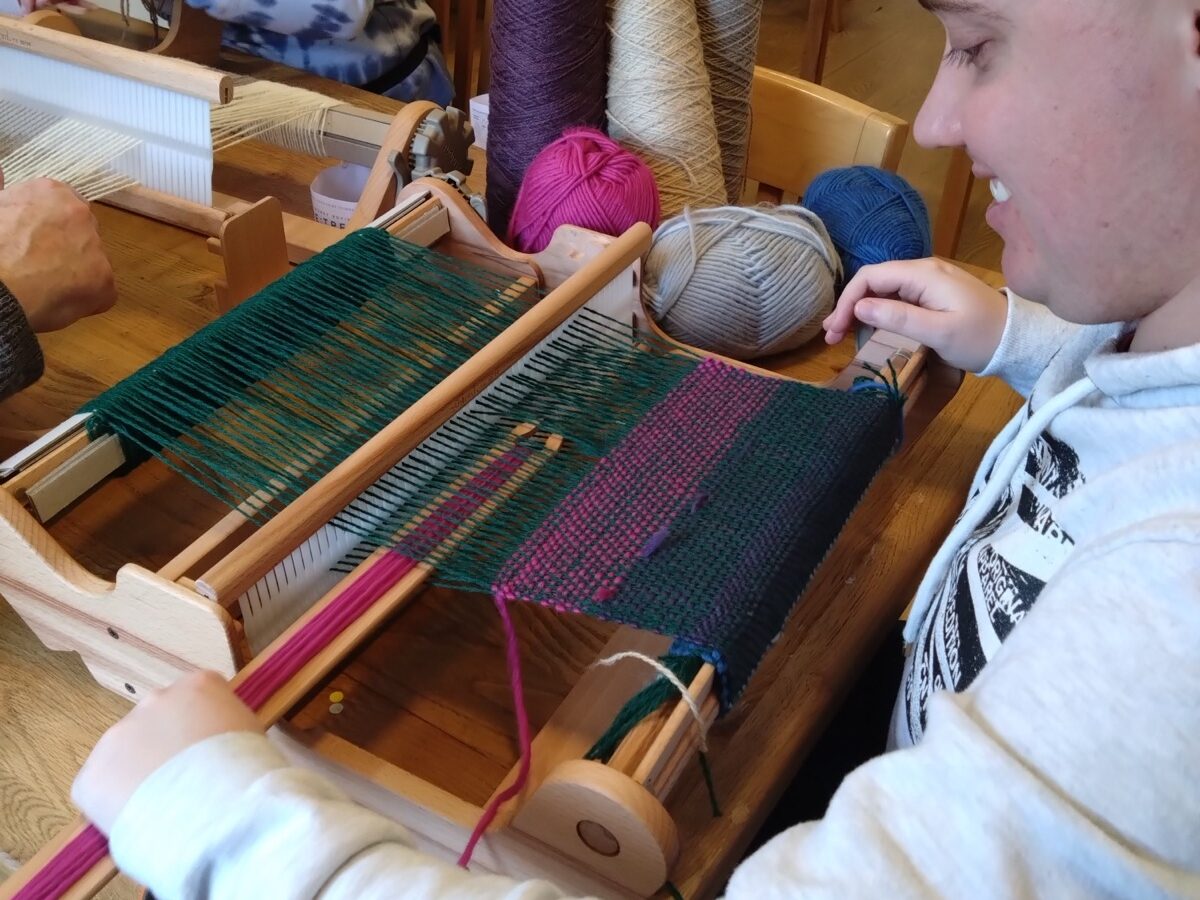
“I can get quite anxious, but being in a room with everyone weaving was very relaxing and therapeutic for me. I absolutely loved it.”
These are the words of one co-facilitator, who happens to have a learning disability, with whom I collaborated on an accessible weaving workshop in Somerset.
Having visited weaving studios in Scotland, Finland and Japan where learning disabled people have become masters of the craft, I have observed learning disabled weavers across continents who have become experts, creating their own beautiful work, completely unaided.
This inspired me to run my own handweaving workshops for people with learning disabilities in supported living homes and community venues in the Midsomer Norton and Shepton Mallet areas of Somerset.
Since 2024, I have run 15 weaving workshops involving 16 people with learning disabilities. These were funded initially by a Willson grant then by the Elmgrant Trust, plus by charging a small fee to community workshop participants.
Four of my original participants went on to co-facilitate community weaving workshops with me as paid employment.
While the paid work impact so far has been on a small scale, the project has many benefits for learning disabled people, the community and our environment, so I am now looking at grants to develop it.
What happens at workshops
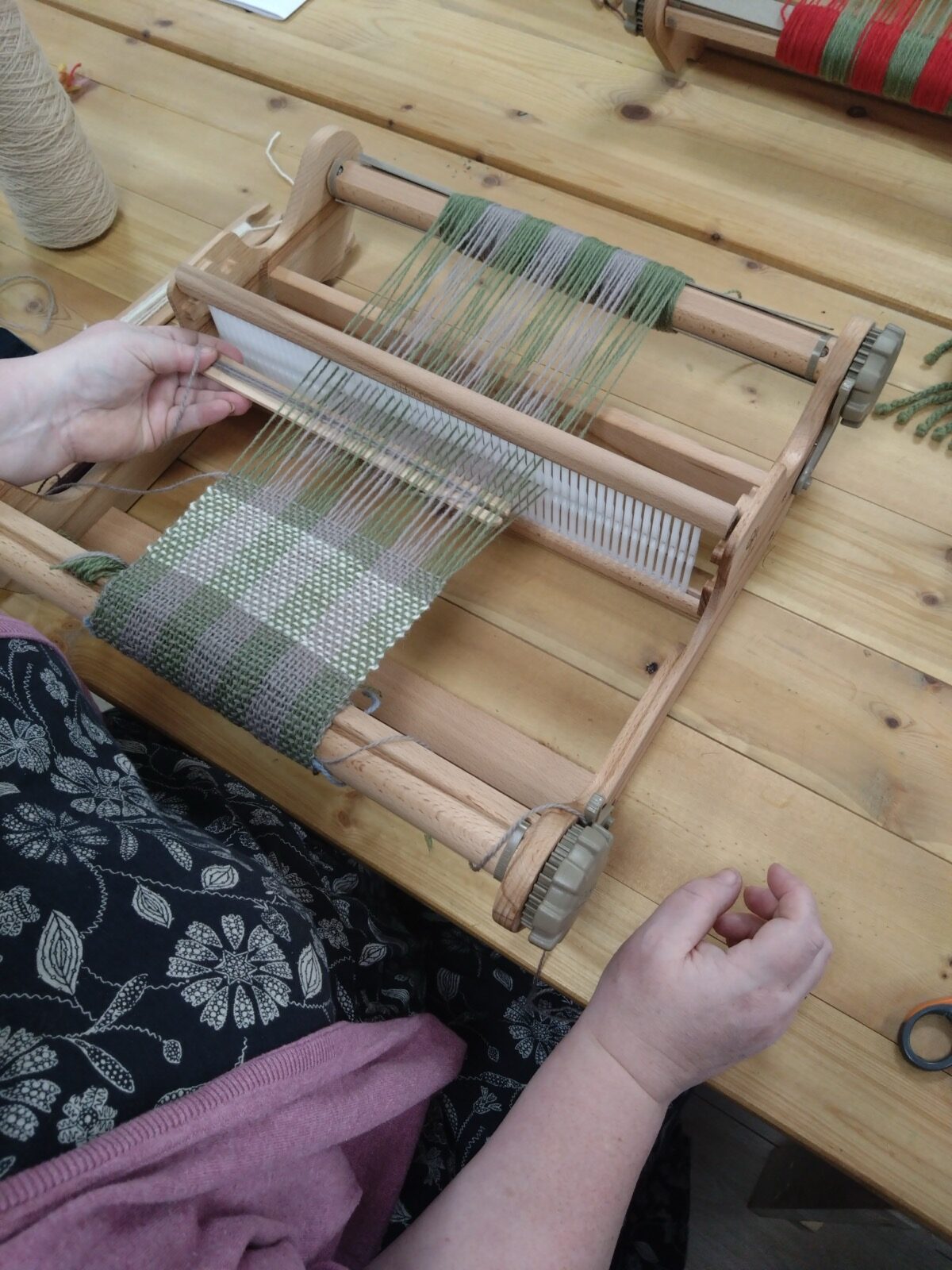
Each two-hour workshop involves up to six participants who learn how to weave on a rigid heddle loom (a small, rectangular portable wooden loom) using British wool.
I tend to demonstrate how to start using the loom, then the co-facilitator encourages people to choose the yarn colours that they would like to work with, showing them how to wind this onto their shuttle (the stick you hold to pass weft thread between the warp threads to weave your cloth).
While people are quietly getting on with their weaving, the co-facilitators help by winding wool onto cones for future workshops. At the end of the workshop, the co-facilitators help to untie the work from the looms.
As a member of the South West England Fibreshed, I am part of a global movement to bring clothing and textile growth and production back to local areas. So part of my work is to spark discussion about the impact of the textile industry and working with British wool among learning disabled people.
Art and craft have huge potential for self-expression for everyone in society and are especially transformative for those with communication difficulties.
Handweaving also offers opportunities for independence. I have seen people with profound and multiple learning disabilities gain huge satisfaction from working at the loom and creating cloth relatively independently, even though they may require a high level of support in other aspects of their lives.
Unwinding the work from the loom and revealing the finished piece of weaving elicits real joy.
A challenging aspect is finding enough funding to support upskilling the co-facilitators and run the workshops, particularly as handweaving is a time-intensive craft. Additionally, potential participants often lack the support to get out to try something different.
The most rewarding aspect is being part of enabling people to be seen in positions where they can share knowledge and others can learn from them. This is fundamental to helping to change societal perceptions.
Creating work opportunities is so important; fewer than one in 20 adults with learning disabilities in England are in paid work. I would love to develop the project so more individuals could learn how to weave and co-facilitate workshops.
It would be great to engage with farmers who need an outlet for their sheep wool. I envisage an inclusive hub for wool craft, enabling a team of learning disabled people to become educators and creators of sustainable, regenerative textile products.