
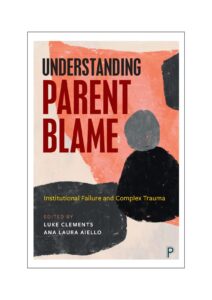
Understanding Parent Blame:
Institutional Failure and Complex Trauma
Luke Clements and Ana Laura Aiello, editors
Policy Press, 2025
Blame the parents. It’s a common reaction to any failure in children’s behaviour or to their safety, yet so many issues – from education and economic to social care and mental health – arise from the failure of the state to provide adequate support to children and their families.
As parents, we know that “parenting and blame” are fellow travellers: we are accustomed to blame ourselves, and our children – for good measure – are wont to blame us too. This is part and parcel of family life and is not the focus of this work.
Blame by default
What has driven every contributor to this book is their deep concern for what happens when state institutions develop policies and foster practices that, by default, blame parents too.
This book challenges the incremental normalisation of behaviours of this kind. It seeks to identify how such practices have developed and to convey the devastating impact that they have on families.
In the context of this book, parent blame arises in situations where there is a failure by a public body to provide a level of support that a responsive state should provide for a child (and/or their family) and the default organisational response of the public body is to blame the child’s parents for this failure.
Parent blame is not a new phenomenon, but media references to “parent blame” appear to be increasing significantly – essentially as a term used by parents to describe their encounters with social welfare agencies.
The phenomenon occurs in relation to a spectrum of support failures by public bodies: in terms of failing to provide adequate social care support for disabled children; in terms of failing to provide appropriate education for children who are “not fine” in their school; in terms of the organisational responses of healthcare providers, where parents consider a diagnosis or treatment plan inappropriate; in situations where there is a failure to provide adequate measures to protect a child from abuse in public settings – and in many other contexts.
This edited collection brings together academics, practitioners and activists along with contributions from parents and young people who have experienced the trauma of being caught up in the process of blame. In addition, there are contributions from key researchers as well as practitioners/activists who have written on this issue.
All the chapters are either written by family members who have experienced the direct consequences of parent blame or by authors who work closely with such families and seek to ensure that their voices are heard in everything that they publish.
The book explores the nature and causes of parent blame and interrogates its prevalence, impact and potential pathways for reform.
Research suggests that in the last two decades, there has been a significant increase in conflict between families and social welfare institutions. These conflicts often involve practitioners directly blaming parents for their child’s difficulties – accusations that cause significant distress/trauma to families.
Harm disregarded
Many of the book’s contributions seek to analyse the reasons for this increasing conflict and to better understand why the resulting |harm experienced by families is, so often, disregarded.
This book is, therefore, of particular relevance to public policy debates concerning families: their support needs, their precarity and the increasing extent to which states are intervening in their private and family lives.
This is an edited extract