
Ivan Alexeivich was born in 1666 to Alexei, tsar of all Russia, and his then wife, Tsarina Maria Miloslavskaya. He was the youngest of the couple’s five sons and their 12th child; his mother died shortly after giving birth to the 13th.
Ivan was widely reported to have some form of learning disability, with accompanying physical problems.
The exact nature and cause of these is unclear, with some claiming he had a form of Down syndrome and others that he carried the long-term effects of a childhood illness.
This was not an issue while his brothers were alive and likely to accede to the throne before him, but two of his brothers died in infancy, and his eldest brother and heir apparent died suddenly aged just 15 years.
After the death of Tsar Alexei, Ivan suddenly found himself next in line to the throne after his brilliant but physically frail brother, Tsar Fyodor III.
Family rivalry
Before he died, Alexei had remarried. This union, with Natalya Naryshkina of the Naryshkin family, produced a son: the future Peter the Great.
Following her brother Fyodor III’s early death without heirs in 1682, Sofia was anxious to thwart the Naryshkin ambition that Peter be chosen as tsar instead of her surviving brother Ivan.
Ivan was older than Peter by some five years so first in line, but his disabilities cast doubt on his elevation.
Essentially, both boys stood at the heart of a power struggle taking place between the families of the two one-time tsarinas, the Miloslavskys and the Naryshkins.
Rumours swirled that both Fyodor and Ivan had been murdered by the Naryshkins to clear the way for Peter. Outraged, the Streltsy – an elite corps of musketeers – marched on the palace and demanded to see Ivan in what became known as the (extremely bloody) Moscow Uprising.
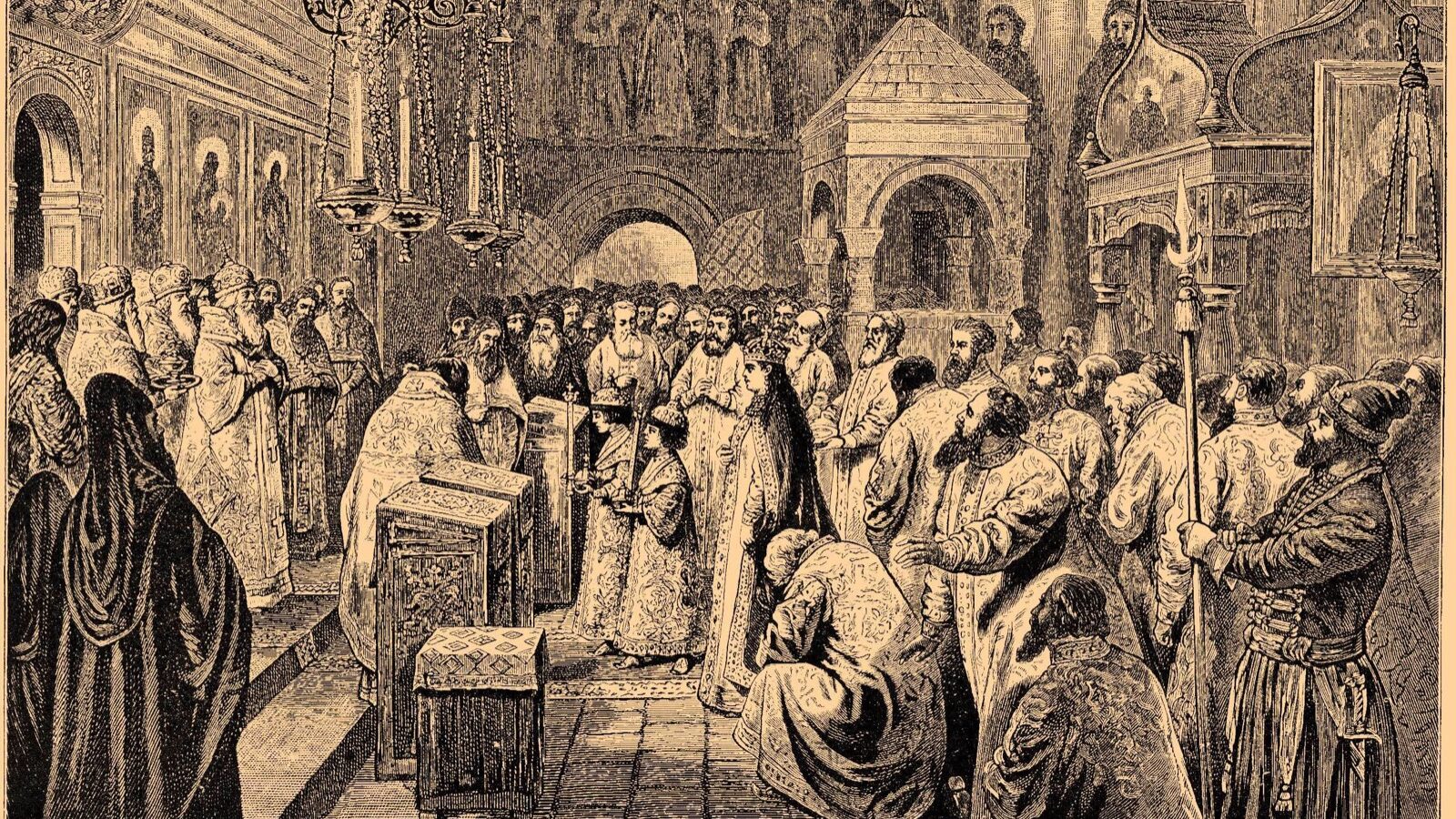
The resulting compromise was that Ivan and Peter would co-rule as joint tsars Ivan V and Peter I, thus placating both families. As both were minors, Sofia would act as regent until they came of age.
Despite Sofia’s best efforts to defend the status of Ivan as senior tsar, Peter was the dominant personality, bursting with ideas and energy. Ivan, meanwhile, was uninterested in wielding power and increasingly sidelined at court.
Although Peter reportedly exhibited various tics that belied his epilepsy, he was remarkably tall and perceived as strong and healthy.
In contrast, by the time Ivan was 17, he “babbled when he spoke”, was half blind and his eyes flickered and darted in a way that allegedly unsettled visitors so much that he was forced to wear a green taffeta blindfold in their presence.
An absence of heirs and his benign presence at court meant Ivan was no threat to the dynamic and ambitious Peter, which ensured his survival
Sofia’s best hope to secure her family’s legacy was for Ivan to produce an heir, so she arranged for him to marry. His tranquil and solid marriage to Praskovia Saltykova resulted in five daughters – although these were possibly via her lover.
The lack of sons meant Ivan and his family did not imperil Peter’s power. In fact, this absence of heirs alongside Ivan’s benign presence at court meant he personally was no threat to the dynamic and ambitious Peter, which ensured his survival.
Parties versus praying
While Peter was busy travelling around the country waging war and having riotous parties, Ivan stayed in Moscow, fasting and praying, and working through the court administration and rituals Peter could not stomach.
Sofia was eventually outmanoeuvred, and forced to see out her days in the isolated luxury of Novodevichy Convent.
Meanwhile, Ivan, described by foreign ambassadors as “senile, paralytic and almost blind”, contentedly performed his duties at court until 1696, when he died at the age of 29. He left three surviving daughters and his steadfast wife.
Peter immediately returned to Moscow to give his late half-brother and co-ruler a grand traditional funeral, his way now clear to becoming the autocratic first emperor of all Russia. n
Further reading
Montefiore S. The Romanovs 1613-1918. London: Weidenfeld & Nicolson; 2016
Flantzer S. Ivan V, Tsar of all Russia. Unofficial Royalty. 2018.