
My book considers the ways in which the lives of people with a learning disability are closely interconnected with the lives of those around them.
The 14 chapters feature individuals’ experiences in Australia, France, Ireland, Italy, Malta, Spain, the UK and the US. The stories focus on the interactions between people with and without disabilities.
Decisions by deficit
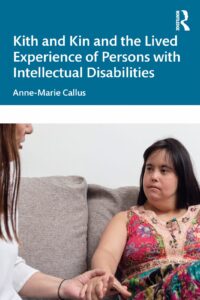
Kith and Kin and the Lived Experience
of Persons with Intellectual Disabilities
Anne-Marie Callus
Routledge, 2026
Josephine’s experience in mainstream schools, for example, has been mixed. Her classmates laugh at her inclination to take off her socks and this, alongside the educators’ problematic solution of making her keep them on, are a painful reminder that her attending a mainstream school does not mean that she is fully accepted. Josephine has to conform to standards.
In Giovanni’s case, his excitement about going to the carnival with his brother Giacomo is superseded by the latter’s life-defining decision to proclaim his status as Giovanni’s sibling to the world – with a YouTube video – confronting prejudice.
Eve’s family too encounter this prejudice when a sympathy card, not a congratulations card, is sent to her father after her birth.
These misconceptions exist even within services that are supposed to nurture, such as the home that Lucien ended up in where he is medicated to keep him calm.
His parents moved him into a home because his behaviour was becoming very difficult for them to manage. It was especially difficult for his mother as his full-time carer yet she is the one who was most reluctant for him to leave home.
Prejudice is experienced in a different manner by Shea, who is assumed not to have the capacity to vote by decision-makers. They have never met her but have deeply ingrained misconceptions; they think that they can sit in judgement over the supposed incapacities of people who have a learning disability.
For high-school teacher Marc, the tight control he maintains over his students with learning disabilities not only translates into lost opportunities for developing practical self-determination skills but also reinforces the perception they cannot make decisions for themselves.
Marc controls the students’ money on their trip to Paris, not allowing them to buy anything he does not want them to have such as sweets. Non-disabled students on the same trip have more freedom.
Marc’s decision is as unappealing as the experience of another participant who was told by a bartender he would not serve her alcohol.
These decisions are based entirely on a deficit model of disability.
Good connections
In contrast, there are positive stories of interaction.
For Leon, his mainstream school’s caretaker’s simple invitation to help carry boxes unwittingly provides a lesson to his teachers about the need to connect with him on his own terms.
The support for Noli to enter the labour market, for example, has enabled her to earn money and work towards her dream of living independently and providing a necessary service. She works on a market stall selling fruit and vegetables; her job is to pack bags of oranges, apples and potatoes for customers.
Likewise, Lauren’s successful acting career has become a launchpad for her to be more actively involved in the film industry and to campaign for disability rights.
For all the people who feature in this book, their relationships with others are characterised by a mixture of affirmative, neutral and negative encounters.