
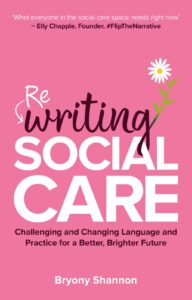
Rewriting Social Care:
Challenging and Changing Language and Practice
for a Better, Brighter Future
Bryony Shannon
Jessica Kingsley Publishers, 2025
The search for the perfect “label” has spanned both decades and continents. There have been numerous surveys and much debate about the “preferred terms for labelling individuals”. “What do we call ‘them’?”
But we don’t need to add new labels; we need to remove them. And we can only do that by radically rewriting social care.
Like sorting offices and baggage-handling systems, we rely on labels – precisely because we operate a similar system of screening, sorting, prioritising and processing. We use labels to decide on eligibility, determine pathways and prescribe services.
Keeping a distance
We use labels to distance ourselves from the reality of people’s lives, to help us justify the way we “deal with” people like parcels and suitcases. And we use labels to blame, to shield us from the reality of our collective failures.
Too often, we apply labels because we’re too far removed – physically, emotionally, usually both – from people in the context of their families and their communities and their whole lives.
“Because that’s what we’re talking about. People. Relationships. Families. Normal stuff. Any other label distances and sets up a ‘different from the rest of us’ dynamic that is not useful” – a quote from parent advocate and campaigner Mark Neary from 10 years ago.
Who’s giving?
Our dominant approach to welfare is the “professional gift model”, where “the taxpayer gives money to the government, the government gives money to the professional who turns that money into services that are offered to the needy person as a gift – that is, something that cannot be defined, shaped or controlled by the individual”, to use the 2010 words of author and director of Citizen Network Simon Duffy. The “gift” of services. A “package” of care.
But what if we flip this narrative, drop the labels and focus instead on people’s gifts and potential? On seeing and valuing who people are and want to be. What people can do, could be, want to do next. And on giving our own gifts of time, compassion, dignity, respect, honesty, humility, humanity.
Applying a label is easy. Recognising and nurturing gifts and potential requires a whole different way of thinking and working, where conversations are led by people seeking support and based around what matters most to them. Where our role is listening – with no assumptions – and understanding, building trust, making connections, joining the dots. Where our aim is for people to flourish, not just survive. Where support is a springboard, not a safety net.
This moves us beyond focusing on basic physiological and safety needs – the bottom tiers of Maslow’s hierarchy (a motivational theory in psychology comprising a five-tier model of human needs) – to recognising, valuing and focusing on the importance of belonging, esteem and self-actualisation.
Applying a label is easy. Recognising and nurturing people’s gifts and potential requires a whole different way of thinking
It moves us from focusing only on what “professionals” give to starting with what people, families and communities have, and investing our time and resources in nurturing, developing and connecting what is present and abundant.
For example, in Stirling, an 87-year-old man with dementia was reading a book to a 93-year-old neighbour because she can’t see the words anymore. There’s no “service” that could replicate the relationship, connection and care created here. Everyone has something to give to their neighbour – an observation by community worker Hannah Ellis Gray in 2023.
Labels are for parcels. Jars. Suitcases. Not people.
This is an edited extract