
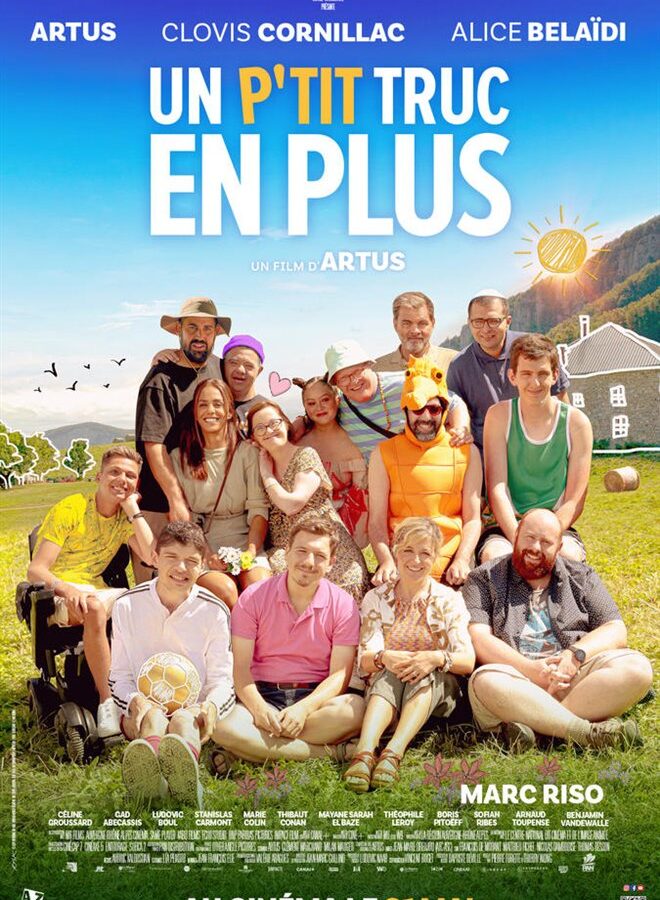
This film tells the story of a father-and-son criminal pair who, after a jewellery heist, evade police by joining a coachload of people with learning disabilities bound for their annual jaunt to a holiday camp. The son is mistaken for a learning disabled person, Sylvain, for whom the group are waiting.
The thieves decide to pass themselves off as Sylvain and his educator Orpi, named after a pharmacy they glimpse through the coach window.
All the learning disabled characters are played by learning disabled actors except Sylvain, who is played by French comedian Artus, the film’s writer and director.
In France, this low-budget production was a surprise smash hit, attracting 11 million cinema viewers. It has not yet been released outside the Francosphere.
At its core, this is a classic crime comedy where tough people from the criminal world disguise themselves among an unlikely group – think Jack Lemon and Tony Curtis in Some Like it Hot or Whoopi Goldberg in Sister Act.
Inevitably, they eventually find redemption under the influence of the good people who now surround them and a heartwarming feelgood end ensues.
Make no mistake, this is a well-made film that at times can be extremely funny.
The characters include a foul-mouthed young guy with Down syndrome who shouts industrial-strength insults, a serious-minded autistic man who lectures everyone on the niceties of the French constitution and a confident young woman who falls in love with men and then brutally dispatches them.
Is this them expressing themselves and challenging norms or are they feeding into stereotypes of happy-go-lucky people not to be taken seriously?
One of the coach party works out immediately that Sylvain is not learning disabled, teaches him how to do a better job and blackmails him in return for keeping his secret.
Jokes at whose expense?
All good, but the film also has some problematic elements.
Portraying people pretending to be learning disabled is risky, dredging up memories of Lars Van Trier’s awful 1998 film The Idiots in which a group of intellectuals “challenge bourgeois norms”, as the film’s blurb explains, by pretending to be learning disabled. Ha ha.
It’s nowhere near as bad as that but, when the man with Down syndrome shows Sylvain how to let his tongue loll out convincingly, well – yes, he’s in charge but at whose expense is this joke?
The group career around a supermarket singing, chanting and pushing each other in trolleys, shocking the public. Are they just expressing themselves and challenging social norms or feeding into stereotypes of happy-go-lucky people who aren’t to be taken seriously? They all go to bed early in mixed dormitories, while the staff sit outside drinking and talking.
One character is Jewish. His primary function seems to be as the butt of two gags; in one, someone makes a playdough wind turbine unintentionally shaped like a swastika and innocently wants to show it to him. Such jokes can work, even if they are sailing close to the wind, but he needed a greater role and a more developed character for it to be acceptable.
A further controversy is that the learning-disabled actors were paid but on a one-off, contract basis.
The other stars were entitled to a slice of the profits which were, unexpectedly, enormous. This could be justified if those paid a fee played minor parts but several of them were undoubtedly in starring roles.
So where does this leave us? Is it great that millions watched a mainstream film with learning disabled protagonists acting brilliantly? Did they see and absorb that stereotypes were being challenged? I hope so on both counts.
But I fear that other stereotypes were being reinforced, on and off screen. And this is P’tit Truc’s little extra problem.