


Page 27 - CL winter 2023 for web
P. 27
home life


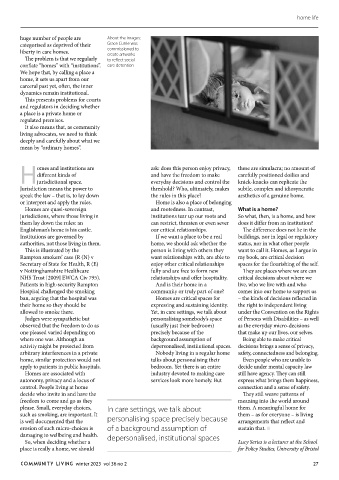
        huge number of people are      About the images:
        categorised as deprived of their   Grace Currie was
        liberty in care homes.         commissioned to
                                       create artworks
          The problem is that we regularly   to reflect social
        conflate “homes” with “institutions”.   care detention
        We hope that, by calling a place a
        home, it sets us apart from our
        carceral past yet, often, the inner
        dynamics remain institutional.
          This presents problems for courts
        and regulators in deciding whether
        a place is a private home or
        regulated premises.
          It also means that, as community
        living advocates, we need to think
        deeply and carefully about what we
        mean by “ordinary homes”.


              omes and institutions are               ask: does this person enjoy privacy,   these are simulacra; no amount of
              different kinds of                      and have the freedom to make   carefully positioned doilies and
        Hjurisdictional space.                        everyday decisions and control the   knick-knacks can replicate the
        Jurisdiction means the power to               threshold? Who, ultimately, makes   subtle, complex and idiosyncratic
        speak the law – that is, to lay down          the rules in this place?       aesthetics of a genuine home.
        or interpret and apply the rules.               Home is also a place of belonging
          Homes are quasi-sovereign                   and rootedness. In contrast,   What is a home?
        jurisdictions, where those living in          institutions tear up our roots and   So what, then, is a home, and how
        them lay down the rules: an                   can restrict, threaten or even sever   does it differ from an institution?
        Englishman’s home is his castle.              our critical relationships.     The difference does not lie in the
        Institutions are governed by                    If we want a place to be a real   buildings, nor in legal or regulatory
        authorities, not those living in them.        home, we should ask whether the   status, nor in what other people
          This is illustrated by the                  person is living with others they   want to call it. Homes, as I argue in
        Rampton smokers’ case (R (N) v                want relationships with, are able to   my book, are critical decision
        Secretary of State for Health, R (E)          enjoy other critical relationships   spaces for the flourishing of the self.
        v Nottinghamshire Healthcare                  fully and are free to form new   They are places where we are can
        NHS Trust [2009] EWCA Civ 795).               relationships and offer hospitality.   critical decisions about where we
        Patients in high-security Rampton               And is their home in a       live, who we live with and who
        Hospital challenged the smoking               community or truly part of one?  comes into our home to support us
        ban, arguing that the hospital was              Homes are critical spaces for   – the kinds of decisions reflected in
        their home so they should be                  expressing and sustaining identity.   the right to independent living
        allowed to smoke there.                       Yet, in care settings, we talk about   under the Convention on the Rights
          Judges were sympathetic but                 personalising somebody’s space   of Persons with Disabilities – as well
        observed that the freedom to do as            (usually just their bedroom)   as the everyday micro-decisions
        one pleased varied depending on               precisely because of the       that make up our lives, our selves.
        where one was. Although an                    background assumption of        Being able to make critical
        activity might be protected from              depersonalised, institutional spaces.  decisions brings a sense of privacy,
        arbitrary interferences in a private            Nobody living in a regular home   safety, connectedness and belonging.
        home, similar protection would not            talks about personalising their   Even people who are unable to
        apply to patients in public hospitals.        bedroom. Yet there is an entire   decide under mental capacity law
          Homes are associated with                   industry devoted to making care   still have agency. They can still
        autonomy, privacy and a locus of              services look more homely. But   express what brings them happiness,
        control. People living at home                                               connection and a sense of safety.
        decide who invite in and have the                                             They still weave patterns of
        freedom to come and go as they                                               meaning into the world around
        please. Small, everyday choices,   In care settings, we talk about           them. A meaningful home for
        such as smoking, are important. It                                           them – as for everyone – is living
        is well documented that the    personalising space precisely because         arrangements that reflect and
        erosion of such micro-choices is   of a background assumption of             sustain that. n
        damaging to wellbeing and health.   depersonalised, institutional spaces
          So, when deciding whether a                                                Lucy Series is a lecturer at the School
        place is really a home, we should                                            for Policy Studies, University of Bristol

        Community Living  winter 2023  vol 36 no 2                                                             27

