


Page 30 - CL winter 2023 for web
P. 30
history


        Humanity in fiction                                                          where he has faced cruelty
                                                                                     and violence.
                                                                                      London pushes the narrative that
                                                                                     Tom is happier and safer inside the
                                                                                     institution, which is brought home
                                                                                     to him whether fleeing from a brutal
        A short story by Jack London’, written from the perspective of an            adoptive family or returning from an
        institution resident who describes his thoughts, feelings and                abortive attempt to find a gold mine.
                                                                                      Literature professor Don Graham
        dreams, was hailed as groundbreaking, says Susanna Shapland                  suggested that the Endicotts, a
                                                                                     lightly fictionalised version of Jack
                                                                                     and Charmain London encountered
                                                                                     by Tom, were included in the tale
                                                                                     “to represent the unfeeling attitude
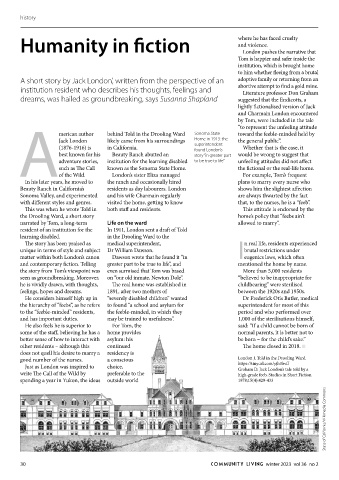
                      merican author   behind Told in the Drooling Ward   Sonoma State   toward the feeble-minded held by
                      Jack London      likely came from his surroundings   Home in 1913: the   the general public”.
                      (1876-1916) is   in California.                superintendent   Whether that is the case, it
                                                                     found London’s
                      best known for his   Beauty Ranch abutted an   story “in greater part   would be wrong to suggest that
                      adventure stories,   institution for the learning disabled   to be true to life”  unfeeling attitudes did not affect
                      such as The Call   known as the Sonoma State Home.             the fictional or the real-life home.
        Aof the Wild.                   London’s sister Eliza managed                 For example, Tom’s frequent
          In his later years, he moved to   the ranch and occasionally hired         plans to marry every nurse who
        Beauty Ranch in California’s   residents as day labourers. London            shows him the slightest affection
        Sonoma Valley, and experimented   and his wife Charmain regularly            are always thwarted by the fact
        with different styles and genres.   visited the home, getting to know        that, to the nurses, he is a “feeb”.
          This was when he wrote Told in   both staff and residents.                  This attitude is endorsed by the
        the Drooling Ward, a short story                                             home’s policy that “feebs ain’t
        narrated by Tom, a long-term   Life on the ward                              allowed to marry”.
        resident of an institution for the   In 1911, London sent a draft of Told
        learning disabled.             in the Drooling Ward to the
          The story has been praised as   medical superintendent,                      n real life, residents experienced
        unique in terms of style and subject  Dr William Dawson.                       brutal restrictions under
        matter within both London’s canon   Dawson wrote that he found it “in        Ieugenics laws, which often
        and contemporary fiction. Telling   greater part to be true to life”, and    mentioned the home by name.
        the story from Tom’s viewpoint was   even surmised that Tom was based         More than 5,000 residents
        seen as groundbreaking. Moreover,   on “our old inmate, Newton Dole”.        “believed to be inappropriate for
        he is vividly drawn, with thoughts,   The real home was established in       childbearing” were sterilised
        feelings, hopes and dreams.    1891, after two mothers of                    between the 1920s and 1950s.
          He considers himself high up in   “severely disabled children” wanted       Dr Frederick Otis Butler, medical
        the hierarchy of “feebs”, as he refers   to found “a school and asylum for   superintendent for most of this
        to the “feeble-minded” residents,   the feeble-minded, in which they         period and who performed over
        and has important duties.      may be trained to usefulness”.                1,000 of the sterilisations himself,
          He also feels he is superior to   For Tom, the                             said: “If a child cannot be born of
        some of the staff, believing he has a   home provides                        normal parents, it is better not to
        better sense of how to interact with   asylum: his                           be born – for the child’s sake.”
        other residents – although this   continued                                   The home closed in 2018. n
        does not quell his desire to marry a   residency is
        good number of the nurses.     a conscious                                   London J. Told in the Drooling Ward.
          Just as London was inspired to   choice,                                   https://tinyurl.com/yjh3bvff
                                                                                     Graham D. Jack London’s tale told by a
        write The Call of the Wild by   preferable to the                            high-grade feeb. Studies in Short Fiction.
        spending a year in Yukon, the ideas  outside world                           1978;15(4):429-433
                                                                                                                   State of California/Wikimedia Commons


        30                                                                 Community Living  winter 2023  vol 36  no 2

