


Page 26 - CL winter 2023 for web
P. 26
home life


        The true meaning of home


        Many people living in the community are often, in reality, housed            or normal lives in homes in the
        in mini institutions. We need to think carefully about what we               community, elevating autonomy,
                                                                                     independence, person-centred care
        mean by an ordinary home, says Lucy Series                                   and choice and control.
                                                                                      The problem is that many people
                                                                                     living in care homes, supported
                                                                                     living or private homes do not
                                                                                     enjoy the autonomy, independence,
                      fter my son was                                                person-centred care, choice and
                      born two years                                                 control the pioneers of community
                      ago, I had to stay                                             living aspired to.
                      in hospital for a                                               Some do – and we need to hold
                      while. Despite                                                 on to this, because realising this for
                      fantastic care on                                              everyone should be the central aim
        Athe delivery ward,                                                          of social care.
        the postnatal wards were grim,                                                The dismaying reality is that
        particularly during Covid.                                                   many community settings are, in
          Us mothers were ruled by an                                                effect, mini institutions.
        institutional clock that dictated                                             Some living arrangements are so
        when we slept (rarely), woke up                                              restrictive that, following the a
        (early), got pain relief medication                                          supreme court decision in 2014
        (not until the trolley came around)                                          case ( P v Cheshire West & Chester
        and when we should be up and                                                 Council; P & Q v Surrey County
        about, regardless of pain.                                                   Council [2014] UKSC 19), the
          Some midwives and auxiliaries                                              residents are legally categorised as
        were kind, but others approached                                             being deprived of their liberty.
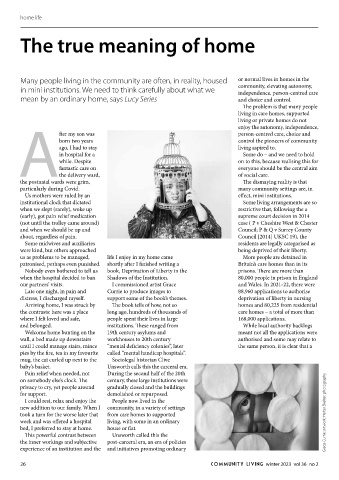
        us as problems to be managed,   life I enjoy in my home came                  More people are detained in
        patronised, perhaps even punished.  shortly after I finished writing a       Britain’s care homes than in its
          Nobody even bothered to tell us   book, Deprivation of Liberty in the      prisons. There are more than
        when the hospital decided to ban   Shadows of the Institution.               80,000 people in prison in England
        our partners’ visits.           I commissioned artist Grace                  and Wales. In 2021-22, there were
          Late one night, in pain and   Currie to produce images to                  88,960 applications to authorise
        distress, I discharged myself.   support some of the book’s themes.          deprivation of liberty in nursing
          Arriving home, I was struck by   The book tells of how, not so             homes and 80,225 from residential
        the contrasts: here was a place   long ago, hundreds of thousands of         care homes – a total of more than
        where I felt loved and safe,   people spent their lives in large             168,000 applications.
        and belonged.                  institutions. These ranged from                While local authority backlogs
          Welcome home bunting on the   19th century asylums and                     meant not all the applications were
        wall, a bed made up downstairs   workhouses to 20th century                  authorised and some may relate to
        until I could manage stairs, mince   “mental deficiency colonies”, later     the same person, it is clear that a
        pies by the fire, tea in my favourite   called “mental handicap hospitals”.
        mug, the cat curled up next to the   Sociolegal historian Clive
        baby’s basket.                 Unsworth calls this the carceral era.
          Pain relief when needed, not    During the second half of the 20th
        on somebody else’s clock. The   century, these large institutions were
        privacy to cry, yet people around   gradually closed and the buildings
        for support.                   demolished or repurposed.
          I could rest, relax and enjoy the   People now lived in the
        new addition to our family. When I  community, in a variety of settings
        took a turn for the worse later that   from care homes to supported                                        Grace Currie: artwork; Helter Skelter: photography
        week and was offered a hospital   living, with some in an ordinary
        bed, I preferred to stay at home.   house or flat.
          This powerful contrast between   Unsworth called this the
        the inner workings and subjective   post-carceral era, an era of policies
        experience of an institution and the  and initiatives promoting ordinary

        26                                                                 Community Living  winter 2023  vol 36  no 2

