


Page 19 - Community Living Magazine 34-3
P. 19
in conversation

       was inspired by Sylvia Pankhurst and                                     the National Council for Independent
       joined other feminists calling for equality                              Living. She was the founding chair of the
       for women.                                                               Social Care Institute for Excellence and, in
        “I was actually fighting for equal rights                               2001, she was made a dame commander
       for women and equal pay before I ever                                    of the British Empire. She was a
       became involved in fighting for disabled                                 commissioner of the Disability Rights
       people’s rights,” she says.                                              Commission and, in 2007, was appointed
                                                                                a crossbench peer in the House of Lords.
       Employer ignorance                                                         She was surprised at the peerage
       Leaving Sussex with a first in her master’s                              because of her history of vociferous
       degree, she assumed employment would                                     campaigning, not to mention the
       not be a problem. She applied for about                                  occasional lawbreaking.
       90 jobs. All the replies said “sorry we                                    Of those earlier days, she says: “I had to
       don’t employ disabled people” or “sorry                                  go and get angry somewhere. I had to find
       we couldn’t cater for your needs”. “Not                                  out who I was. I had to understand the
       that they knew my needs of course,” she                                  true nature of social oppression as it
       says. “I began to realise that there was                                 affects disabled people.” A friend told her
       something radically wrong.”                                              that her experience was exactly the
        Then, she secured a job with a well-                                    reason the House of Lords needed her.
       known, well-funded national disability                                     The House of Lords may seem an
       charity. Almost unbelievably, they sacked   “I started my life absolutely hating disabled   unlikely place for a campaigner but it is
       her three months later because her   people and hating me. And now I absolutely   clear Campbell genuinely has an impact.
       disability prevented her from operating a   love disabled people. And I totally love me”  “I am there to revise and influence
       manual typewriter.                                                       legislation,” she says, “I have always
        Then, in 1981, a woman who was       Campbell became the chair of the   abided by the rules of the house because
       setting up the British Council of Disabled   BCODP as the disability movement was   they are there for a reason. I do very little
       People (BCODP) invited Campbell to its   achieving a serious public profile.   campaigning – I just use persuasion and
       second meeting. She did not really want                                  argument and hope that other people are
       to join a disability group, saying: “I have   Apology for exclusion      influenced by it.”
       spent half my life trying to get away from   Years later in 2016, I was at the launch of   Campbell’s most recent work is seeking
       segregation, not to rejoin it.”     Learning Disability England and heard   to amend the Domestic Abuse Bill to
        The woman explained that the council   Campbell give a speech in which she   include disabled people who are abused
       had been set up to challenge that very   apologised to people with learning   by their carers.
       exclusion, and also suggested that   disabilities that they had been excluded
       Campbell should examine her prejudices   from the early disability movement.   Archaic rules
       about disabled people and herself. “She   She says now: “I think it was very   The House of Lords has changed a little
       said if you deny disabled people, then you   important to apologise. It took me a while   just because she is there. When she asked
       are denying yourself. You should be proud   to recognise that we were being exclusive.  if a personal assistant (PA) could sit with
       of who you are.”                    We were far too academic. We weren’t   her in the chamber, she was told: “Oh no,
        Reluctantly, Campbell went to the   accessible enough. We all spoke middle-  that’s a 1725 rule that must never be
       meeting. The main event was Mike Oliver   class, well-educated language.   broken. No commoner goes on the floor
       speaking about the social model of    “And we weren’t very kind to each other.  of the House of Lords except for
       disability. It was, says Campbell, an   We had spent years fighting each other in   doorkeepers and staff.”
       extraordinary lecture.              private as we worked out our personal and   Campbell says that it took 18 months
        “I could feel the little hairs on the back   collective identities. I think when we came   before it was accepted that the whole
       of my neck going up and I tingled all over.   up with the slogan ‘Nothing about us   place was not going to crumble because
       Suddenly, everything fell into place. It was   without us’, as an organisation we had to   she had brought her PA into the chamber.
       a semi-religious experience because I left   abide by that or we would become what   However, some members still
       that room a different person than I went   we had been oppressed by.”    complained that the PA had brought in a
       in. From that day onwards, I became a   Campbell’s further career is on the   little green chair to sit on. The chair was
       freedom fighter for disabled people.”   public record. She co-founded and chaired  re-covered in red (to match the benches)
                                                                                and everyone was happy. She laughs:
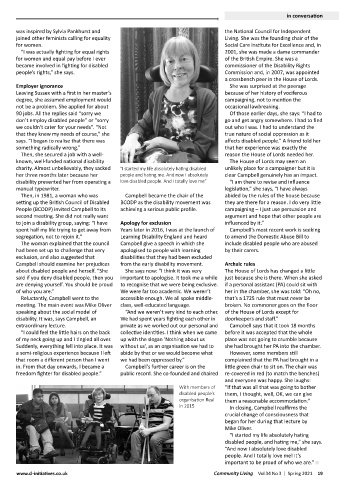
                                                                With members of   “If that was all that was going to bother
                                                                disabled people’s   them, I thought, well, OK, we can give
                                                                organisation Real   them a reasonable accommodation.”
                                                                in 2015           In closing, Campbell reaffirms the
                                                                                crucial change of consciousness that
                                                                                began for her during that lecture by
                                                                                Mike Oliver.
                                                                                  “I started my life absolutely hating
                                                                                disabled people, and hating me,” she says.
                                                                                “And now I absolutely love disabled
                                                                                people. And I totally love me! It’s
                                                                                important to be proud of who we are.” n
       www.cl-initiatives.co.uk                                             Community Living  Vol 34 No 3  |  Spring 2021  19

