


Page 22 - Community Living Magazine 34-3
P. 22
community safety
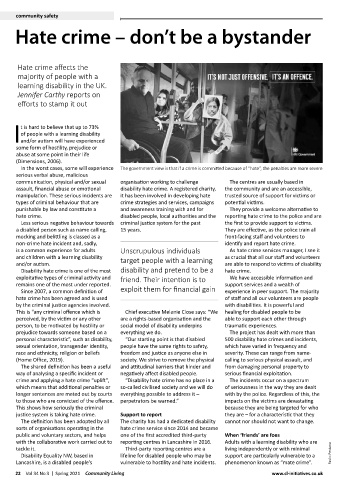
      Hate crime – don’t be a bystander


       Hate crime affects the
       majority of people with a
       learning disability in the UK.
       Jennifer Carthy reports on
       efforts to stamp it out


        t is hard to believe that up to 73%
        of people with a learning disability
      Iand/or autism will have experienced
       some form of hostility, prejudice or
       abuse at some point in their life
       (Dimensions, 2006).
        In the worst cases, some will experience   The government view is that if a crime is committed because of “hate”, the penalties are more severe
       serious verbal abuse, malicious
       communication, physical and/or sexual   organisation working to challenge   The centres are usually based in
       assault, financial abuse or emotional   disability hate crime. A registered charity,   the community and are an accessible,
       manipulation. These serious incidents are   it has been involved in developing hate   trusted source of support for victims or
       types of criminal behaviour that are   crime strategies and services, campaigns   potential victims.
       punishable by law and constitute a   and awareness training with and for   They provide a welcome alternative to
       hate crime.                         disabled people, local authorities and the   reporting hate crime to the police and are
        Less serious negative behaviour towards  criminal justice system for the past   the first to provide support to victims.
       a disabled person such as name calling,   15 years.                      They are effective, as the police train all
       mocking and belittling is classed as a                                   front-facing staff and volunteers to
       non-crime hate incident and, sadly,                                      identify and report hate crime.
       is a common experience for adults    Unscrupulous individuals              As hate crime services manager, I see it
       and children with a learning disability   target people with a learning   as crucial that all our staff and volunteers
       and/or autism.                                                           are able to respond to victims of disability
        Disability hate crime is one of the most   disability and pretend to be a   hate crime.
       exploitative types of criminal activity and   friend. Their intention is to   We have accessible information and
       remains one of the most under reported.                                  support services and a wealth of
        Since 2007, a common definition of   exploit them for financial gain    experience in peer support. The majority
       hate crime has been agreed and is used                                   of staff and all our volunteers are people
       by the criminal justice agencies involved.                               with disabilities. It is powerful and
       This is “any criminal offence which is   Chief executive Melanie Close says: “We  healing for disabled people to be
       perceived, by the victim or any other   are a rights-based organisation and the   able to support each other through
       person, to be motivated by hostility or   social model of disability underpins   traumatic experiences.
       prejudice towards someone based on a   everything we do.                   The project has dealt with more than
       personal characteristic”, such as disability,   “Our starting point is that disabled   500 disability hate crimes and incidents,
       sexual orientation, transgender identity,   people have the same rights to safety,   which have varied in frequency and
       race and ethnicity, religion or beliefs   freedom and justice as anyone else in   severity. These can range from name-
       (Home Office, 2019).                society. We strive to remove the physical   calling to serious physical assault, and
        The shared definition has been a useful   and attitudinal barriers that hinder and   from damaging personal property to
       way of analysing a specific incident or   negatively affect disabled people.   serious financial exploitation.
       crime and applying a hate crime “uplift”,   “Disability hate crime has no place in a   The incidents occur on a spectrum
       which means that additional penalties or   so-called civilised society and we will do   of seriousness in the way they are dealt
       longer sentences are meted out by courts   everything possible to address it –   with by the police. Regardless of this, the
       to those who are convicted of the offence.  perpetrators be warned.”     impacts on the victims are devastating
       This shows how seriously the criminal                                    because they are being targeted for who
       justice system is taking hate crime.   Support to report                 they are – for a characteristic that they
        The definition has been adopted by all   The charity has had a dedicated disability   cannot nor should not want to change.
       sorts of organisations operating in the   hate crime service since 2014 and became
       public and voluntary sectors, and helps   one of the first accredited third-party   When ‘friends’ are foes
       with the collaborative work carried out to   reporting centres in Lancashire in 2016.   Adults with a learning disability who are
       tackle it.                            Third-party reporting centres are a   living independently or with minimal
        Disability Equality NW, based in   lifeline for disabled people who may be   support are particularly vulnerable to a   Paulo Pestana
       Lancashire, is a disabled people’s   vulnerable to hostility and hate incidents.   phenomenon known as “mate crime”.

      22  Vol 34 No 3  |  Spring 2021  Community Living                                         www.cl-initiatives.co.uk

