


Page 16 - Community Living Magazine 34-3
P. 16
coronavirus

                                                                                two washrooms. The asylum also had its
                                                                                own cemetery.
                                                                                  Overcrowding was an issue from the
                                                                                start. As early as 1871, barely a year after
                                                                                the hospital opened, there were 1,638
                                                                                patients and, in 1914, more than 2,000.
                                                                                Because of staff shortages during the
                                                                                First World War and the need to billet
                                                                                troops at the asylum, some patients
                                                                                were discharged.
                                                                                  What Monica Diplock, who wrote the
                                                                                1990 history of the hospital that is the
                                                                                source of this information, did not
      When epidemics bring                                                      mention was that the population of the
                                                                                hospital declined for other reasons during
                                                                                the war, with extraordinarily high death
      too many deaths                                                           rates from causes including the Spanish

                                                                                flu and other infectious diseases.
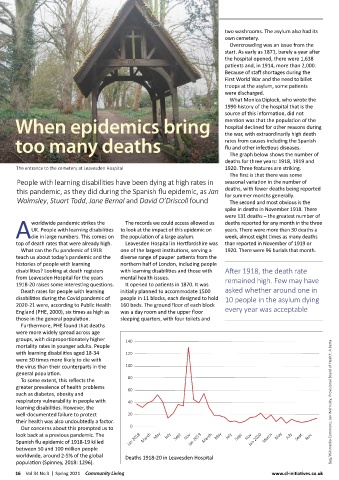
                                                                                  The graph below shows the number of
                                                                                deaths for three years: 1918, 1919 and
       The entrance to the cemetery at Leavesden Hospital                       1920. Three features are striking.
                                                                                  The first is that there was some
       People with learning disabilities have been dying at high rates in       seasonal variation in the number of
       this pandemic, as they did during the Spanish flu epidemic, as Jan       deaths, with fewer deaths being reported
                                                                                for summer months generally.
       Walmsley, Stuart Todd, Jane Bernal and David O’Driscoll found              The second and most obvious is the
                                                                                spike in deaths in November 1918. There
                                                                                were 131 deaths – the greatest number of
            worldwide pandemic strikes the   The records we could access allowed us   deaths reported for any month in the three
            UK. People with learning disabilities  to look at the impact of this epidemic on   years. There were more than 30 deaths a
       A die in large numbers. This comes on  the population of a large asylum.  week, almost eight times as many deaths
       top of death rates that were already high.   Leavesden Hospital in Hertfordshire was   than reported in November of 1919 or
        What can the flu pandemic of 1918   one of the largest institutions, serving a   1920. There were 96 burials that month.
       teach us about today’s pandemic and the   diverse range of pauper patients from the
       histories of people with learning   northern half of London, including people
       disabilities? Looking at death registers   with learning disabilities and those with   After 1918, the death rate
       from Leavesden Hospital for the years   mental health issues.            remained high. Few may have
       1918-20 raises some interesting questions.  It opened to patients in 1870. It was
        Death rates for people with learning   initially planned to accommodate 1500   asked whether around one in
       disabilities during the Covid pandemic of   people in 11 blocks, each designed to hold   10 people in the asylum dying
       2020-21 were, according to Public Health   160 beds. The ground floor of each block
       England (PHE, 2000), six times as high as   was a day room and the upper floor   every year was acceptable
       those in the general population.    sleeping quarters, with four toilets and
        Furthermore, PHE found that deaths
       were more widely spread across age
       groups, with disproportionately higher   140
       mortality rates in younger adults. People
       with learning disabilities aged 18-34    120
       were 30 times more likely to die with
       the virus than their counterparts in the   100
       general population.
        To some extent, this reflects the     80
       greater prevalence of health problems   60
       such as diabetes, obesity and
       respiratory vulnerability in people with   40                                                                 Bazj/Wikimedia Commons; Jan Walmsley; Provisional Board of Health, Alberta
       learning disabilities. However, the
       well-documented failure to protect     20
       their health was also undoubtedly a factor.
        Our concerns about this prompted us to   0
       look back at a previous pandemic. The       March  May  July  Sept  Nov  March  May  July  Sept  Nov  March  May  July  Sept  Nov
       Spanish flu epidemic of 1918-19 killed   Jan 2018            Jan 2019             Jan 2020
       between 50 and 100 million people
       worldwide, around 2-5% of the global   Deaths 1918-20 in Leavesden Hospital
       population (Spinney, 2018: 1296).

      16  Vol 34 No 3  |  Spring 2021  Community Living                                         www.cl-initiatives.co.uk

