


Page 17 - Community Living Magazine 32 - 4
P. 17
living a life

       We decided to use mobile interviews with                                                      My own place.
       all participants – they were equally           1          Otis Robinson’s                    Great spot next
       productive with highly articulate people.                      journey                        to the market
        We gave people cameras; they  took    I was born in
       their own photographs or we took them   1956 at 24 Ocean
       on their behalf. The subjects included   View, Kingston,
       places they had lived, schools,         Jamaica  1              5
       playgrounds, friends’ and neighbours’    I came to to                             6
       homes, and learning disability services.  join my mum and
        We planned the interviews once we       dad in 1965
       had enough information about key places                                                               6
       in a person’s life. Familiar buildings and                                       2
       places provided context to support                                                           2001 – present
                                                                                                    Branbury Court
       remembering. Sharing such detailed local              2
       knowledge would not have been possible   1965 Coleman House,             4
                                                                                                     I shared a flat
       in a traditional, static interview. As we did   Auriga Mews   3                            here with my friends.
                                                                               I remember Sunday
       more interviews, people became more     off the high street             dinners, holidays and   We had very nice
       confident in taking charge by giving    We lived here during              making friends      neighbours
       directions, pointing out and leading   the 1970s. I remember
       researchers to places of interest and    going to Carnival
       indicating what they wanted to
       photograph. Eight people suggested new
       places to visit and photograph.
        Benito Bianchi said: “Go this way, yeah,
       go down there … my gardening scheme
       and my old house.”                                  3                              4                    5
        Smith took a researcher by hand, led us      First floor flat,           1980-1987           1987-2001
       across the road and into a park. We stood     Churchill Walk             Arnold House      Greenfield Gardens
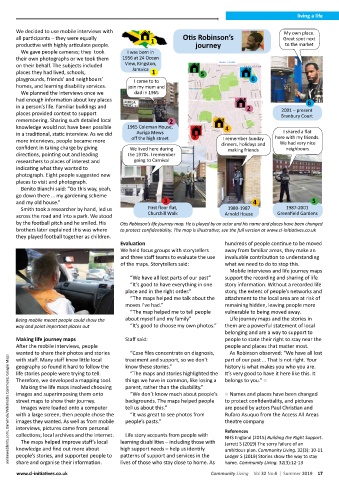
       by the football pitch and he smiled. His   Otis Robinson’s life journey map. He is played by an actor and his name and places have been changed
       brothers later explained this was where   to protect confidentiality. The map is illustrative; see the full version at www.cl-initiatives.co.uk
       they played football together as children.
                                           Evaluation                           hundreds of people continue to be moved
                                           We held focus groups with storytellers   away from familiar areas, they make an
                                           and three staff teams to evaluate the use   invaluable contribution to understanding
                                           of the maps. Storytellers said:      what we need to do to stop this.
                                                                                  Mobile interviews and life journey maps
                                               “We have all lost parts of our past”  support the recording and sharing of life
                                               “It’s good to have everything in one   story information. Without a recorded life
                                             place and in the right order.”     story, the extent of people’s networks and
                                               “The maps helped me talk about the   attachment to the local area are at risk of
                                             moves I’ve had.”                   remaining hidden, leaving people more
                                               “The map helped me to tell people   vulnerable to being moved away.
       Being mobile meant people could show the   about myself and my family”     Life journey maps and the stories in
       way and point important places out      “It’s good to choose my own photos.”   them are a powerful statement of local
                                                                                belonging and are a way to support to
       Making life journey maps              Staff said:                        people to state their right to stay near the
       After the mobile interviews, people                                      people and places that matter most.
       wanted to share their photos and stories   “Case files concentrate on diagnosis,   As Robinson observed: “We have all lost
    onlinewebfonts.com; Darwinek/Wikimedia Commons; Google Maps
       with staff. Many staff knew little local   treatment and support, so we don’t   part of our past … That is not right. Your
       geography so found it hard to follow the   know these stories.”          history is what makes you who you are.
       life stories people were trying to tell.   “The maps and stories highlighted the  It’s very good to have it here like this. It
       Therefore, we developed a mapping tool.   things we have in common, like losing a   belongs to you.” n
        Making the life maps involved choosing   parent, rather than the disability.”
       images and superimposing them onto      “We don’t know much about people’s   ● Names and places have been changed
       street maps to show their journey.    backgrounds. The maps helped people   to protect confidentiality, and pictures
        Images were loaded onto a computer   tell us about this.”               are posed by actors Paul Christian and
       with a large screen, then people chose the   “It was great to see photos from   Rufaro Asuquo from the Access All Areas
       images they wanted. As well as from mobile   people’s pasts.”            theatre company
       interviews, pictures came from personal                                  References
       collections, local archives and the internet.  Life story accounts from people with   NHS England (2015) Building the Right Support.
        The maps helped improve staff’s local   learning disabilities – including those with   Jarrett S (2019) The sorry failure of an
       knowledge and find out more about   high support needs – help us identify   ambitious plan. Community Living. 32(3): 10-11
       people’s stories, and supported people to   patterns of support and services in the   Ledger S (2019) Stories show the way to stay
       share and organise their information.  lives of those who stay close to home. As   home. Community Living. 32(3):12-13

       www.cl-initiatives.co.uk                                            Community Living  Vol 32 No 4  |  Summer 2019  17

