


Page 22 - Community Living Magazine 32 - 4
P. 22
inclusion
       Achieving citizenship and inclusion


       We often talk about ‘inclusion’ and ‘citizenship’ but what do they mean in practice, how are
       they related to each other and how can they be achieved? Tim Stainton reflects on his
       experiences as a father and in his professional life in Canada to find some answers


              y son, who lives with a learning   relatively equal footing with others, then   Leydet (2017) sees citizenship as
              disability, likes to play a game   the system, even one as developed as   composed of three main dimensions: legal
      Mwhen we are driving. The game       ours, seems to fall short of fully   status, defined by civil, political and social
       involves reading the letters off licence   recognizing his citizenship.  rights; citizens actively participating in a
       plates and finding words that match                                      society’s political institutions; and
       the letter.                         Distinct and connected               citizenship in a political community that
        With great enthusiasm, he will shout   So what do these two stories of our life   furnishes a distinct source of identity.
       out his name for one letter, the dog’s   tell us? I use them to illustrate the   While all are relevant, we are mainly
       name for another but, when we come to   necessity and distinctiveness of the two   concerned with the first dimension
       F, he often becomes quieter and more   concepts with regards to: our aspirations   here – legal status.
       introspective. He will quietly say “friends”.   for a world where everyone’s citizenship is   It is this legal status as citizens that has
        He is an extremely likeable, engaging   valued and recognised; and the idea of   been denied to people with learning
       young man, loved by all who get to know   inclusion, a world where everyone feels a   disabilities based on the view that they
       him, greeted at school by students as he   part of something, connected to a   lacked the capacity for full citizenship.
       races from the car to the classroom, and   community and loved and cared for   Recently, however, arguments have been
       very involved in school and outside   by others.                         made against this view on a number of
       activities, mostly designed specifically for                             grounds (Leydet, 2017).
       people with disabilities.                                                  The notion that citizenship stems solely
        But on weekends or holidays, when not  “                                from an individual’s capacity and autonomy
                                                  The idea of a citizenship
       involved in organised pursuits or out with                               has been challenged. It is argued that a
       the family or support workers, he sits   based on people having          person’s autonomy is in fact “relational”
       alone playing Wii or watching YouTube.   a type or degree of reason      (about their connections with other
       Nobody drops by to hang out. Nobody     is no longer universally         people) and that, similarly, capacity is a
       calls to see if he wants to do whatever                                  function not of a person’s independence
       teens do when not formally occupied.            accepted                 but of their interdependence. Others have
        In short, while certainly part of his                           ”       argued that we do not need the concept of
       community, well liked and well supported,                                moral capacity at all, as it is neither helpful
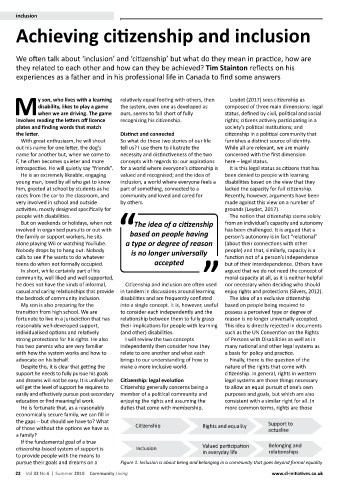
       he does not have the kinds of informal,   Citizenship and inclusion are often used   nor necessary when deciding who should
       casual and caring relationships that provide   in tandem in discussions around learning   enjoy rights and protections (Silvers, 2012).
       the bedrock of community inclusion.   disabilities and are frequently conflated   The idea of an exclusive citizenship
        My son is also preparing for the   into a single concept. It is, however, useful  based on people being required to
       transition from high school. We are   to consider each independently and the   possess a perceived type or degree of
       fortunate to live in a jurisdiction that has   relationship between them to fully grasp   reason is no longer universally accepted.
       reasonably well-developed support,   their implications for people with learning   This idea is directly rejected in documents
       individualised options and relatively   (and other) disabilities.        such as the UN Convention on the Rights
       strong protections for his rights. He also   I will review the two concepts   of Persons with Disabilities as well as in
       has two parents who are very familiar   independently then consider how they   many national and other legal systems as
       with how the system works and how to   relate to one another and what each   a basis for policy and practice.
       advocate on his behalf.             brings to our understanding of how to   Finally, there is the question of the
        Despite this, it is clear that getting the   make a more inclusive world.  nature of the rights that come with
       support he needs to fully pursue his goals                               citizenship. In general, rights in western
       and dreams will not be easy. It is unlikely he   Citizenship: legal evolution   legal systems are those things necessary
       will get the level of support he requires to   Citizenship generally concerns being a   to allow an equal pursuit of one’s own
       easily and effectively pursue post-secondary   member of a political community and   purposes and goals, but which are also
       education or find meaningful work.   enjoying the rights and assuming the   consistent with a similar right for all. In
        He is fortunate that, as a reasonably   duties that come with membership.   more common terms, rights are those
       economically secure family, we can fill in
       the gaps – but should we have to? What                                                  Support to
       of those without the options we have as   Citizenship            Rights and equality    actualise
       a family?
        If the fundamental goal of a true
       citizenship-based system of support is    Inclusion              Valued participation   Belonging and
                                                                                               relationships
                                                                        in everyday life
       to provide people with the means to
       pursue their goals and dreams on a   Figure 1. Inclusion is about being and belonging in a community that goes beyond formal equality
      22  Vol 32 No 4  |  Summer 2019  Community Living                                         www.cl-initiatives.co.uk

