


Page 16 - Community Living Magazine 32 - 4
P. 16
living a life
                                           We were here: sharing


                                           stories of local support


                                           People are telling their stories through mobile interviews and
                                           life journey maps. These stories can help them remain in their
                                           communities, say Sue Ledger and Lindy Shufflebotham


               e are the experts on how      Consultation with self-advocates, families,
               things worked – it was us who   health and social care practitioners,
      Wwere here.”                         commissioners and service providers made
        So said Otis Robinson, one of nine   us ask: how did some people remain local?
       people with learning disabilities who told   This gave rise to Sue Ledger’s Staying
       stories of how they were supported to   Local PhD Research project. This aimed to
       stay in their communities.          find out what enabled people to remain in
        The Staying Local research project drew   their communities through listening to
       on unexplored life stories to better   those who had made it happen.
       understand what supported people to
       remain local. Taking the lead from life   Why recover and record life stories?
       storytellers, the project developed mobile   Sharing stories from our past is a good
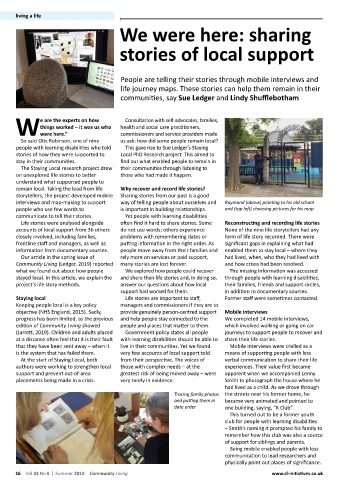
       interviews and map-making to support   way of telling people about ourselves and   Raymond (above) pointing to his old school
       people who use few words to         is important in building relationships.   and (top left) choosing pictures for his map
       communicate to tell their stories.    Yet people with learning disabilities
        Life stories were analysed alongside   often find it hard to share stories. Some   Reconstructing and recording life stories
       accounts of local support from 36 others   do not use words; others experience   None of the nine life storytellers had any
       closely involved, including families,   problems with remembering dates or   form of life story recorded. There were
       frontline staff and managers, as well as   putting information in the right order. As   significant gaps in explaining what had
       information from documentary sources.  people move away from their families and   enabled them to stay local – where they
        Our article in the spring issue of   rely more on services or paid support,   had lived, when, who they had lived with
       Community Living (Ledger, 2019) reported   many stories are lost forever.   and how crises had been resolved.
       what we found out about how people    We explored how people could recover   The missing information was accessed
       stayed local. In this article, we explain the   and share their life stories and, in doing so,   through people with learning disabilities,
       project’s life story methods.       answer our questions about how local   their families, friends and support circles,
                                           support had worked for them.         in addition to documentary sources.
       Staying local                         Life stories are important to staff,   Former staff were sometimes contacted.
       Keeping people local is a key policy   managers and commissioners if they are to
       objective (NHS England, 2015). Sadly,   provide genuinely person-centred support   Mobile interviews
       progress has been limited, as the previous   and help people stay connected to the   We completed 14 mobile interviews,
       edition of Community Living showed   people and places that matter to them.   which involved walking or going on car
       (Jarrett, 2019). Children and adults placed   Government policy states all people   journeys to support people to recover and
       at a distance often feel that it is their fault   with learning disabilities should be able to   share their life stories.
       that they have been sent away – when it   live in their communities. Yet we found   Mobile interviews were trialled as a
       is the system that has failed them.   very few accounts of local support told   means of supporting people with less
        At the start of Staying Local, both   from their perspective. The voices of   verbal communication to share their life
       authors were working to strengthen local   those with complex needs – at the   experiences. Their value first became
       support and prevent out-of-area     greatest risk of being moved away – were   apparent when we accompanied Lenny
       placements being made in a crisis.   very rarely in evidence.            Smith to photograph the house where he
                                                                                had lived as a child. As we drove through
                                                              Tracing family photos   the streets near his former home, he
                                                              and putting them in   became very animated and pointed to
                                                              date order        one building, saying, “K Club”.
                                                                                  This turned out to be a former youth
                                                                                club for people with learning disabilities
                                                                                – Smith’s naming it prompted his family to
                                                                                remember how this club was also a source
                                                                                of support for siblings and parents.
                                                                                  Being mobile enabled people with less
                                                                                communication to lead researchers and
                                                                                physically point out places of significance.

      16  Vol 32 No 4  |  Summer 2019  Community Living                                         www.cl-initiatives.co.uk

