


Page 25 - Community Living Magazine 35-1
P. 25
oral history

        Nevertheless, it limited people’s lives. It
       was a big employer in the village of
       Starcross – a village within a village you
       could say, but a place apart.
        The philanthropy of the past had created
       the institution to provide a purpose in life
       but, in reality, “purpose” had dwindled to
       patients sitting on the boundary wall,
       looking out on a world denied them. They
       had no personal possessions, and no
       choice over the food put in front of them
       or the activities they could take part in.
        For some, as the interviews reveal,
       institutional life had advantages: shielding
       them from an unkind or difficult world; a
       routine; friends close at hand; and even
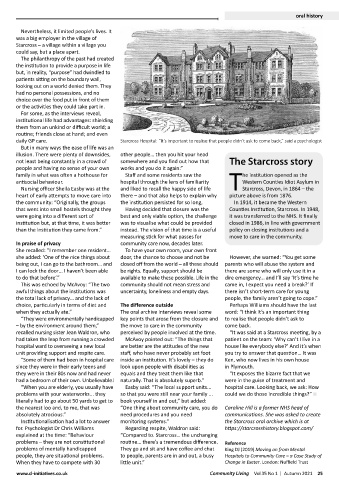
       daily GP care.                      Starcross Hospital: “It’s important to realise that people didn’t ask to come back,” said a psychologist
        But in many ways the ease of life was an
       illusion. There were plenty of downsides,   other people… then you hit your head
       not least being constantly in a crowd of   somewhere and you find out how that   The Starcross story
       people and having no sense of your own   works and you do it again.”
       family in what was often a hothouse for   Staff and some residents saw the     he institution opened as the
       antisocial behaviour.               hospital through the lens of familiarity   Western Counties Idiot Asylum in
        Nursing officer Sheila Easby was at the   and liked to recall the happy side of life  TStarcross, Devon, in 1864 – the
       heart of early attempts to move care into   there – and that also helps to explain why   picture above is from 1876.
       the community: “Originally, the groups   the institution persisted for so long,  In 1914, it became the Western
       that went into small hostels thought they   Having decided that closure was the   Counties Institution, Starcross. In 1948,
       were going into a different sort of   best and only viable option, the challenge   it was transferred to the NHS. It finally
       institution but, at that time, it was better   was to visualise what could be provided   closed in 1986, in line with government
       than the institution they came from.”  instead. The vision of that time is a useful   policy on closing institutions and a
                                           measuring stick for what passes for    move to care in the community.
       In praise of privacy                community care now, decades later.
       She recalled: “I remember one resident…   To have your own room, your own front
       she added: ‘One of the nice things about   door, the chance to choose and not be   However, she warned: “You get some
       being out, I can go to the bathroom… and   closed off from the world – all these should  parents who will abuse the system and
       I can lock the door… I haven’t been able   be rights. Equally, support should be   there are some who will only use it in a
       to do that before’.”                available to make these possible. Life in the  dire emergency... and I’ll say ‘It’s time he
        This was echoed by McAvoy: “The two   community should not mean stress and   came in, I expect you need a break?’ If
       awful things about the institutions was   uncertainty, loneliness and empty days.  there isn’t short-term care for young
       the total lack of privacy… and the lack of                               people, the family aren’t going to cope.”
       choice, particularly in terms of diet and   The difference outside         Perhaps Williams should have the last
       when they actually ate.”            The oral archive interviews reveal some   word: “I think it’s an important thing
        “They were environmentally handicapped   key points that arose from the closure and  to realise that people didn’t ask to
       – by the environment around them,”   the move to care in the community   come back.
       recalled nursing sister Jean Waldron, who   perceived by people involved at the time.  “It was said at a Starcross meeting, by a
       had taken the leap from running a crowded   McAvoy pointed out: “The things that   patient on the team: ‘Why can’t I live in a
       hospital ward to overseeing a new local   are better are the attitudes of the new   house like everybody else?’ And it’s when
       unit providing support and respite care.   staff, who have never probably set foot   you try to answer that question… It was
        “Some of them had been in hospital care   inside an institution. It’s lovely – they do   Ken, who now lives in his own house
       since they were in their early teens and   look upon people with disabilities as   in Plymouth.
       they were in their 80s now and had never   equals and they treat them like that   “It exposes the bizarre fact that we
       had a bedroom of their own. Unbelievable!   naturally. That is absolutely superb.”  were in the guise of treatment and
        “When you are elderly, you usually have   Easby said: “The local support units...    hospital care. Looking back, we ask: How
       problems with your waterworks... they   so that you were still near your family ...   could we do those incredible things?” n
       literally had to go about 50 yards to get to   book yourself in and out,” but added:
       the nearest loo and, to me, that was   “One thing about community care, you do   Caroline Hill is a former NHS head of
       absolutely atrocious.”              need procedures and you need         communications. She was asked to create
        Institutionalisation had a lot to answer   monitoring systems.”         the Starcross oral archive which is at
       for. Psychologist Dr Chris Williams   Regarding respite, Waldron said:   https://starcrosshistory.blogspot.com/
       explained at the time: “Behaviour   “Compared to. Starcross… the unchanging
       problems – they are not constitutional   routine… there’s a tremendous difference.   Reference
       problems of mentally handicapped    They go and sit and have coffee and chat   King DJ (2019) Moving on from Mental
       people, they are situational problems.   to people, parents are in and out, a busy   Hospitals to Community Care – a Case Study of
       When they have to compete with 30   little unit.”                        Change in Exeter. London: Nuffield Trust

       www.cl-initiatives.co.uk                                            Community Living  Vol 35 No 1  |  Autumn 2021  25

