


Page 30 - Community Living Magazine 35-1
P. 30
history
      Brave New World: satire or blueprint?


       Aldous Huxley’s disturbing novel included human ‘defectives’             over by other, more “vigorous” nations
       specially created to do menial work. Was he attacking the idea           who had got their eugenic policies in order.
                                                                                  Much as the differing fictional visions of
       or somewhat sympathetic to it? asks Susanna Shapland                     Huxley and Wells had shown, there was

                                                                                remarkably little agreement over the
            ldous Huxley’s satirical novel Brave                                practical application of eugenics despite
            New World was published in 1932.                                    widespread faith in its efficacy. Eugenicists
       AIts primary target was American                                         disagreed over how best to arrest the birth
       culture, which he feared was in the                                      rate of “undesirables”, with ideas ranging
       ascendant, especially with what he saw as                                from birth control to the “lethal chamber”.
       its impersonal production lines, unthinking                                Opinion coalesced around sterilisation of
       consumption and homogeneous, low-                                        the unfit, voluntary to begin with but, it was
       brow culture that discouraged                                            hoped, leading to compulsory measures, as
       individualism and freedom of thought.                                    had been seen across America and Europe.
        Consequently, the citizens of his Brave                                   There was also confusion over who the
       New World are not born but engineered                                    unfit actually were – but all agreed they
       in a laboratory, then conditioned to fulfil                              included the “mentally deficient”. This
       various predestined roles.                                               vague term had been enshrined in law, with
        It was also Huxley’s riposte to the                                     people categorised as “idiots”, “imbeciles”,
       optimistic futuristic visions of authors such                            “feeble-minded” and “moral defectives” by
       as HG Wells, particularly Wells’ novel Men                               the 1913 Mental Deficiency Act.
       Like Gods (1923), which featured a utopia                                  Backed by the increasingly influential
       consisting solely of eugenically engineered                              Eugenics Society, Labour MP Major
       elites. Huxley thought this society                                      Archibald Church attempted to introduce a
       impractical as there would be no one willing                             voluntary sterilisation bill targeting “mental
       to do physical and dirty work.                                           defectives” into parliament in 1931.
        The eugenically engineered society he                                     His colleague Dr Hyacinth Morgan spoke
       devised includes an elite, designated                                    against it, denouncing it as “anti-working
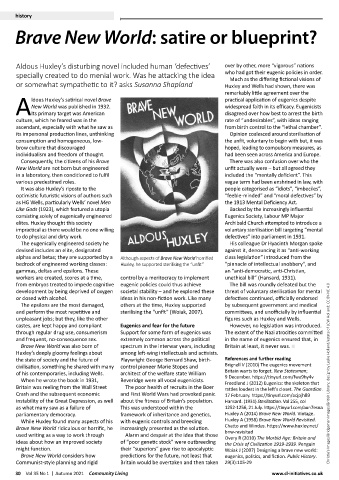
       alphas and betas; they are supported by a   Although aspects of Brave New World horrified   class legislation” introduced from the
       bedrock of engineered working classes:   Huxley, he supported sterilising the “unfit”  “pinnacle of intellectual snobbery”, and
       gammas, deltas and epsilons. These                                       an “anti-democratic, anti-Christian,
       workers are created, scores at a time,   control by a meritocracy to implement   unethical bill” (Hansard, 1931).
       from embryos treated to impede cognitive  eugenic policies could thus achieve   The bill was roundly defeated but the
       development by being deprived of oxygen   societal stability – and he explored these   threat of voluntary sterilisation for mental
       or dosed with alcohol.              ideas in his non-fiction work. Like many   defectives continued, officially endorsed
        The epsilons are the most damaged,   others at the time, Huxley supported   by subsequent government and medical
       and perform the most repetitive and   sterilising the “unfit” (Woiak, 2007).  committees, and unofficially by influential
       unpleasant jobs; but they, like the other                                figures such as Huxley and Wells.
       castes, are kept happy and compliant   Eugenics and fear for the future    However, no legislation was introduced.
       through regular drug use, consumerism   Support for some form of eugenics was   The extent of the Nazi atrocities committed
       and frequent, no-consequence sex.   extremely common across the political   in the name of eugenics ensured that, in
        Brave New World was also born of   spectrum in the interwar years, including   Britain at least, it never was. n
       Huxley’s deeply gloomy feelings about    among left-wing intellectuals and activists.
       the state of society and the future of   Playwright George Bernard Shaw, birth-  References and further reading
       civilisation, something he shared with many  control pioneer Marie Stopes and   Brignell V (2010) The eugenics movement
       of his contemporaries, including Wells.  architect of the welfare state William   Britain wants to forget. New Statesman;  Christie’s Images/Bridgeman Images/British Library; design by Leslie Holland/estate of LCW Holland; CC BY-NC 4.0
                                                                                9 December. https://tinyurl.com/fwa9hy4v
        When he wrote the book in 1931,    Beveridge were all vocal eugenicists.   Freedland J (2012) Eugenics: the skeleton that
       Britain was reeling from the Wall Street   The poor health of recruits in the Boer   rattles loudest in the left’s closet. The Guardian.
       Crash and the subsequent economic   and First World Wars had provoked panic   17 February. https://tinyurl.com/acjpjh89
       instability of the Great Depression, as well   about the fitness of Britain’s population.   Hansard. (1931) Sterilization. Vol 255, col
       as what many saw as a failure of    This was understood within the       1252-1256, 21 July. https://tinyurl.com/aun7esna
       parliamentary democracy.            framework of inheritance and genetics,   Huxley A (2014) Brave New World. Vintage.
        While Huxley found many aspects of his   with eugenic controls and breeding   Huxley A (1958) Brave New World Revisited.
       Brave New World ridiculous or horrific, he   increasingly presented as the solution.   Chatto and Windus. https://www.huxley.net/
       used writing as a way to work through   Alarm and despair at the idea that those   bnw-revisited
                                                                                Overy R (2010) The Morbid Age: Britain and
       ideas about how an improved society   of “poor genetic stock” were outbreeding   the Crisis of Civilization 1919-1939. Penguin
       might function.                     their “superiors” gave rise to apocalyptic   Woiak J (2007) Designing a brave new world:
        Brave New World considers how      predictions for the future, not least that   eugenics, politics, and fiction. Public History.
       Communist-style planning and rigid   Britain would be overtaken and then taken   29(3):105-29

      30  Vol 35 No 1  |  Autumn 2021  Community Living                                         www.cl-initiatives.co.uk

