


Page 24 - Community Living Magazine 35-1
P. 24
oral history
       When the past speaks back


       An archive of residents and staff discussing the closure of a              Reading what the interviewees said, it is
       longstanding ‘mental handicap’ hospital should cause us to               possible to appreciate that staff did their
                                                                                best within the very limiting confines of
       reflect on trends in care provision now, writes Caroline Hill            an institution.
                                                                                  Updating the buildings drained
                                                                                resources while doing nothing to alter the
          ockdown was an opportunity to revive   King, who later headed health services   fact that this was a life apart from the rest
          a long-neglected oral archive from the   in New Zealand, has contributed a   of society for those who lived there.
      Llate 1980s, and bring to light the   commentary to the now-published       Meanwhile, by the 1980s, the majority
       first-hand testimony of an asylum’s former   archive extracts.           of people with learning disabilities or
       residents and staff.                  He writes: “Institutions like Starcross   special needs were living with their
        It also seems very timely, as      Hospital harmed human life and must   families or trying to fend for themselves.
       contributors to Community Living have   never be repeated.”                What the contributors said about the
       been lamenting the regressive steps they   His is a voice that should resonate   pride staff took in their work, the
       have seen back towards institutional   loudly. He questions how it took so long   institutionalisation of those who lived and
       “care”. The lessons of the past should not   to end institutional care.  worked there and the perceived
       be forgotten.                         The idea to close the hospital had come   inadequacies of the early efforts to move
        When the purpose of the Royal Western   from within not above, yet even those   patients into the community all help to
       Counties Institution, Starcross Hospital, a   with a vision for better care and the   explain why the status quo endured for
       former “idiot asylum” in Devon, started to   determination to succeed were   so long.
       be seriously questioned, it had existed for   emotionally torn, as the archive reveals.
       more than a century. Hundreds of people   Speaking soon after the closure, nursing   Caution over independence
       had lived out their lives there in a   officer Viv McAvoy, who was heading a   There was also a deeply ingrained belief
       separate, regimented world.         new local support service, recalled: “In   that the patients could not learn or adapt.
        What followed was the first closure    some ways I felt quite sad and, again, I felt  Medical superintendent Dr David Prentice
       of a large “mental handicap” hospital in   quite glad. The whole thing is a conflict of   explained: “We were always bedevilled by
       favour of a range of new community    emotions and still is.”            this feeling of permanence that there was
       care services.                        The interview extracts also shine a light   no way out for them ever standing on
        Health authority manager David King   on the circumstances that led to people   their own feet.”
       asked for an oral archive to be created   being admitted and then living out their   However, staff discovered otherwise.
       before the memories of Starcross Hospital   lives at Starcross Hospital. In many cases,   As King put it: “Although hospital care
       faded. Staff and residents were     staff lived out their working lives there too  was supposed to be beneficial, release
       interviewed and what they said was   – even their own holidays were spent with  from hospital has been as good as a cure
       recorded and transcribed.           the people in their care.            for so many who were thought to be
        King went on to head the national    Nursing tutor Tom Bush said: “People   beyond hope.”
       Mental Health Task Force and wrote a   said they would never close it – it has   The testimony in the interviews
       book on how the transition to community   been a wonderful place. But I think they   suggests that Starcross might not have
       care was achieved (King, 1991). He   were very much living with a dream… an   been necessarily representative of
       foresaw a day – correctly, it now appears   old idea… old memories… If you talk to the  large asylums in general and, perhaps,
       – when the realities of institutions might   new staff coming in, the youngsters would   suffered from fewer of their most
       be forgotten.                       say: ‘Oh, it’s too big, it’s so impersonal’.”  regrettable traits.


         Read the stories from the Starcross archive


             he doors of Starcross Hospital   All had lived or worked at Starcross
             closed in 1986. Fast forward 34   Hospital and had agreed to share their
         Tyears to a document box, opened   thoughts and memories at the time of its
         in the first lockdown of the pandemic.  closure. The archive contains colourful
          As I read through the contents, the   memories stretching back to the 1930s of
         voices of nearly 40 people, talking   life in and around the imposing Victorian
         decades previously, come back to life    building and how the closure came about.
         – I could hear some of these voices    Residents and staff have at last been
         in my head as I had recorded many    honoured in a compilation of interview
         of the interviews and listened to a   highlights I have edited. Starcross
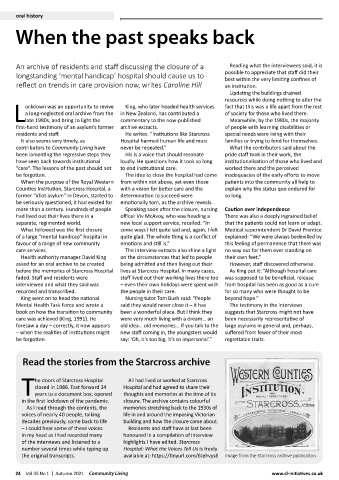
         number several times while typing up   Hospital: What the Voices Tell Us is freely
         the original transcripts.          available at: https://tinyurl.com/6tehvys6  Image from the Starcross archive publication


      24  Vol 35 No 1  |  Autumn 2021  Community Living                                         www.cl-initiatives.co.uk

