


Page 9 - Community Living Magazine 34-3
P. 9
legal: charging policies

       guarantee) that may be taken into
       account in charges for everyone or for
       severely disabled people.
        The judge highlighted that paragraph
       8.47 of the Care Act guidance said councils
       “should” consider this approach. There
       has to be a very good reason for departing
       from guidance, and the exhortation had
       been entirely overlooked, it seems.
        He was sympathetic to the difficult
       position facing the council, but quoted
       from caselaw: “Saving public expenditure
       can be a legitimate aim but will not of
       itself provide justification for differential
       treatment unless there is, in the case in
       hand, a reasonable relationship of
       proportionality between the aim sought
       to be achieved, and the means chosen to
       pursue it (i.e. the measure under challenge).
        “The objectives identified are not
       sufficiently important to justify
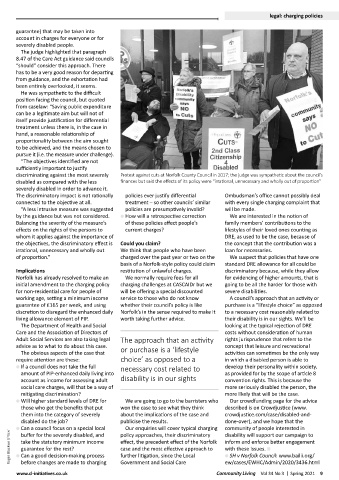
       discriminating against the most severely   Protest against cuts at Norfolk County Council in 2017; the judge was sympathetic about the council’s
       disabled as compared with the less   finances but said the effects of its policy were “irrational, unnecessary and wholly out of proportion”
       severely disabled in order to advance it.
       The discriminatory impact is not rationally   policies ever justify differential   Ombudsman’s office cannot possibly deal
       connected to the objective at all.    treatment – so other councils’ similar   with every single charging complaint that
        “A less intrusive measure was suggested   policies are presumptively invalid?   will be made.
       by the guidance but was not considered.   l  How will a retrospective correction    We are interested in the notion of
       Balancing the severity of the measure’s   of these policies affect people’s    family members’ contributions to the
       effects on the rights of the persons to   current charges?               lifestyles of their loved ones counting as
       whom it applies against the importance of                                DRE, as used to be the case, because of
       the objectives, the discriminatory effect is   Could you claim?          the concept that the contribution was a
       irrational, unnecessary and wholly out   We think that people who have been   loan for necessaries.
       of proportion.”                     charged over the past year or two on the   We suspect that policies that have one
                                           basis of a Norfolk-style policy could claim   standard DRE allowance for all could be
       Implications                        restitution of unlawful charges.     discriminatory because, while they allow
       Norfolk has already resolved to make an   We normally require fees for all   for evidencing of higher amounts, that is
       initial amendment to the charging policy   charging challenges at CASCAIDr but we   going to be all the harder for those with
       for non-residential care for people of   will be offering a special discounted   severe disabilities.
       working age, setting a minimum income   service to those who do not know   A council’s approach that an activity or
       guarantee of £165 per week, and using   whether their council’s policy is like   purchase is a “lifestyle choice” as opposed
       discretion to disregard the enhanced daily   Norfolk’s in the sense required to make it   to a necessary cost reasonably related to
       living allowance element of PIP.    worth taking further advice.         their disability is in our sights. We’ll be
        The Department of Health and Social                                     looking at the typical rejection of DRE
       Care and the Association of Directors of                                 costs without consideration of human
       Adult Social Services are also taking legal   The approach that an activity   rights jurisprudence that refers to the
       advice as to what to do about this case.  or purchase is a ‘lifestyle    concept that leisure and recreational
        The obvious aspects of the case that                                    activities can sometimes be the only way
       require attention are these:        choice’ as opposed to a              in which a disabled person is able to
       l  If a council does not take the full   necessary cost related to       develop their personality within society,
        amount of PIP-enhanced daily living into                                as provided for by the scope of article 8
        account as income for assessing adult   disability is in our sights     convention rights. This is because the
        social care charges, will that be a way of                              more seriously disabled the person, the
        mitigating discrimination?                                              more likely that will be the case.
       l  Will higher standard levels of DRE for   We are going to go to the barristers who   Our crowdfunding page for the advice
        those who get the benefits that put   won the case to see what they think   described is on Crowdjustice (www.
        them into the category of severely   about the implications of the case and   crowdjustice.com/case/disabled-and-
        disabled do the job?               publicise the results.               done-over), and we hope that the
                                             Our enquiries will cover typical charging
       l  Can a council focus on a special local   policy approaches, their discriminatory   community of people interested in
    Roger Blackwell/Flickr  l  Can a good decision-making process   effect, the precedent effect of the Norfolk   inform and enforce better engagement
        buffer for the severely disabled, and
                                                                                disability will support our campaign to
        take the statutory minimum income
                                           case and the most effective approach to
        guarantee for the rest?
                                                                                with these issues. n
                                                                                l SH v Norfolk Council: www.bailii.org/
                                           further litigation, since the Local
                                                                                ew/cases/EWHC/Admin/2020/3436.html
        before changes are made to charging
       www.cl-initiatives.co.uk            Government and Social Care        Community Living  Vol 34 No 3  |  Spring 2021  9

