


Page 8 - Community Living Magazine 34-3
P. 8
legal: charging policies
      Tackling unfair charging policies


       Although it is notoriously hard to challenge policies on financial         The council also argued that people
       tests, a judicial review has found against a council regarding how       subject to the charging policy earning
                                                                                income from employment were not in an
       it assessed a person with severe disabilities, says Belinda Schwehr      analogous position to severely disabled
                                                                                individuals such as SH and were treated
                                                                                differently because they varied in other
           he use by local authorities of   disproportionately, with no objective   ways. The judge disagreed.
           “affordability” as a principle in   justification for the differential treatment.   The council argued that, as SH’s higher
       Tfinancial assessment and charging    SH’s income from benefits was      level of needs would result in higher
       policies is misleading and disingenuous.   “property”, which put her interest in that   disability-related expenses (DREs) and
        Appeals processes are wholly a matter   income into the category of an article 1   these would be disregarded when her
       of preference in each council. Most local   first protocol right under the European   charges were assessed, then this flexibility
       authority officers are ill equipped to bring   Convention on Human Rights (protection   was the equivalent to the disregard of
       public law expertise to bear upon   of property).                        earnings for those able to work.
       challenges to financial assessment    The council argued that “severely    The judge identified that the definition
       outcomes that can have such a stultifying   disabled” was not a sufficiently specific   of DREs under the charging policy was
       effect on people’s lives or even their   status to qualify for protection from   “not at all coterminous with the higher
       willingness to accept services.     discrimination under article 14.     rate of PIP” and, furthermore, that DRE
                                             However, the judge concluded that this   was “harder to prove and claim than the
       Discrimination against severe disability  status could be defined precisely in terms   blanket disregard of outside earnings for
       In SH v Norfolk Council, the council’s   of eligibility for ESA support and PIP in the   those able to get them”.
       charging policy was found to have   enhanced daily living category. He added   Consequently, he took the view:
       discriminated against severely disabled   that it would be best if, for charging   “Neither the evidence nor the charging
       people contrary to article 14 (protection   purposes, it was compulsory to compare   policy suggests to me that the DRE regime
       from discrimination) of the Human Rights   the result with that for less disabled   reduces to any significant extent, let alone
       Act, in taking the whole of a person’s   people to see if there was an unjustified   eliminates, what would otherwise be
       income above the minimum income     difference in treatment.             differential treatment.”
       guarantee into account when calculating                                    The test of objective justification for
       charges for social care.                                                 different treatment involves
        SH, the young woman with Down      The council’s position was that      considerations as to whether, first, the
       syndrome pursuing the challenge, was in   because the policy was the     difference is “a proportionate means of
       receipt of both employment support                                       achieving a legitimate aim” and, second,
       allowance (ESA) in the higher level support  same for everyone, there was   the justification for the adverse effect of
       group category and personal independence   no difference in treatment.    the rules is “manifestly without
       payment (PIP) in the enhanced daily living                               reasonable foundation”.
       and enhanced mobility category.     This was quickly dismissed             The council’s evidence focused on
        She also had a package of care including                                austerity and demonstrated a conscientious
       day services, overnight respite and some                                 process of consultation and phased
       community support, via a direct payment   The discrimination was that the   introduction of a less favourable charging
       under the Care Act.                 proportion of earnings that she and other   policy that included measures intended to
        Her lawyers used the idea of       severely disabled people with high care   mitigate the impact on those affected.
       discrimination in the context of another   needs and significant barriers to work had   However, the judge identified that these
       human right. They said her status and the   to pay under the charging policy was   mitigation strategies were primarily
       way that Norfolk’s charging policy treated   greater than the proportion of earnings   focused on supporting access to
                              her impacted   that people who were disabled but not   employment for affected individuals, a
                              on her life   severely so were required to pay.   mitigation that was not available to SH.
                                             Less disabled people will have lower   The council’s consultation and
                                           levels of assessable benefit (they will not be   consideration process had not identified
                                           paid daily living PIP at the enhanced rate)   or discussed the differential impact
                                           and may have earnings from employment   between severely disabled individuals
                                           or self-employment that will be entirely   unable to access employment and others
                                           disregarded from their assessments.   affected by the charging policy.
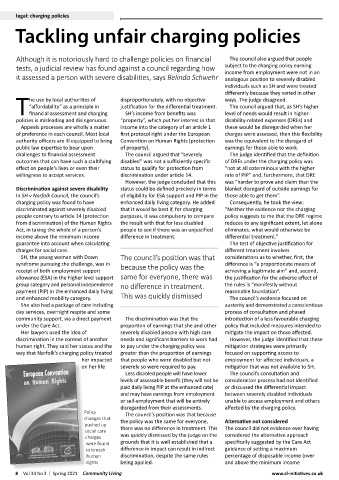
                               Policy        The council’s position was that because
                               changes that   the policy was the same for everyone,   Alternative not considered
                               pushed up
                               social care   there was no difference in treatment. This   The council did not evidence ever having
                               charges     was quickly dismissed by the judge on the   considered the alternative approach
                               were found   grounds that it is well established that a   specifically suggested by the Care Act
                               to breach   difference in impact can result in indirect   guidance of setting a maximum
                               human       discrimination, despite the same rules   percentage of disposable income (over
                               rights      being applied.                       and above the minimum income
      8  Vol 34 No 3  |  Spring 2021  Community Living                                          www.cl-initiatives.co.uk

