


Page 30 - Community Living Magazine 34-2
P. 30
history
       Payback time arrives at long last


       Men with learning disabilities were exploited for decades while          immediately declared uninhabitable by
       working in an Iowa slaughterhouse. Only now are they starting            the state fire marshal.
                                                                                  The men themselves were in physically
       to get justice. Susanna Shapland tells their story                       poor health, with malformed hands from

                                                                                their gruesome, repetitive work, dental
                                                                                woes, uncut toenails that curved back into
        n the early 1970s, Texas ranchers                                       their feet and long fingernails stained with
        TH Johnson and Kenneth Henry set up a                                   turkey blood. They were taken to a nearby
      Iwork programme. It took young men with                                   motel, assigned social workers and
       learning disabilities from Texas “institutions                           eventually put in the hands of Exceptional
       for the developmentally disabled” and                                    Persons Inc, a non-profit body that
       trained them to process turkeys.                                         supports people with disabilities, who
        Groups of these men were then sent                                      would help them start afresh.
       around the country to work in various
       turkey-processing plants on behalf of                                    Profound injustice
       Johnson’s and Henry’s company, Henry’s                                   Robert Canino from the Dallas office of
       Turkey Service (HTS).                                                    the Equal Employment Opportunity
        In 1974, about a dozen of the men were                                  Commission took on the case. The jury
       taken by truck from Goldthwaite, Texas, to                               were so moved by the profound injustice
       live in an old schoolhouse in Atalissa, Iowa.                            and the emotional harm they felt the men
       They would be joined by around 20 others.                                had suffered that they awarded them
        Every morning at 3am, the men rose to                                   $7.5 million each, a total of $240 million.
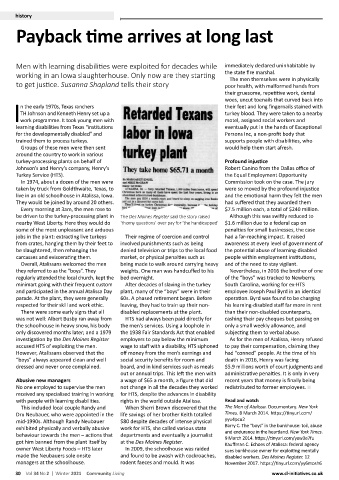
       be driven to the turkey-processing plant in   The Des Moines Register said the story raised   Although this was swiftly reduced to
       nearby West Liberty. Here they would do   ‘thorny questions’ over pay for ‘the handicapped’  $1.6 million due to a federal cap on
       some of the most unpleasant and arduous                                  penalties for small businesses, the case
       jobs in the plant: extracting live turkeys   Their regime of coercion and control   had a far-reaching impact. It raised
       from crates, hanging them by their feet to   involved punishments such as being   awareness at every level of government of
       be slaughtered, then rehanging the   denied television or trips to the local food   the potential abuse of learning-disabled
       carcasses and eviscerating them.    market, or physical penalties such as   people within employment institutions,
        Overall, Atalissans welcomed the men   being made to walk around carrying heavy  and of the need to stay vigilant.
       they referred to as the “boys”. They   weights. One man was handcuffed to his   Nevertheless, in 2016 the brother of one
       regularly attended the local church, kept the  bed overnight.            of the “boys” was tracked to Newberry,
       minimart going with their frequent custom   After decades of slaving in the turkey   South Carolina, working for ex-HTS
       and participated in the annual Atalissa Day   plant, many of the “boys” were in their   employee Joseph Paul Byrd in an identical
       parade. At the plant, they were generally   60s. A phased retirement began. Before   operation. Byrd was found to be charging
       respected for their skill and work ethic.   leaving, they had to train up their non-  his learning-disabled staff far more in rent
        There were some early signs that all   disabled replacements at the plant.   than their non-disabled counterparts,
       was not well: Albert Busby ran away from   HTS had always been paid directly for   cashing their pay cheques but passing on
       the schoolhouse in heavy snow, his body   the men’s services. Using a loophole in   only a small weekly allowance, and
       only discovered months later; and a 1979   the 1938 Fair Standards Act that enabled   subjecting them to verbal abuse.
       investigation by the Des Moines Register   employers to pay below the minimum   As for the men of Atalissa, Henry refused
       accused HTS of exploiting the men.   wage to staff with a disability, HTS siphoned  to pay their compensation, claiming they
       However, Atalissans observed that the   off money from the men’s earnings and   had “conned” people. At the time of his
       “boys” always appeared clean and well   social security benefits for room and   death in 2016, Henry was facing
       dressed and never once complained.   board, and in kind services such as meals   $5.9 millions worth of court judgments and
                                           out or annual trips. This left the men with   administrative penalties. It is only in very
       Abusive new managers                a wage of $65 a month, a figure that did   recent years that money is finally being
       No one employed to supervise the men   not change in all the decades they worked   redistributed to former employees. n
       received any specialised training in working  for HTS, despite the advances in disability
       with people with learning disabilities.   rights in the world outside Atalissa.   Read and watch
        This included local couple Randy and   When Sherri Brown discovered that the   The Men of Atalissa. Documentary. New York
       Dru Neubauer, who were appointed in the  life savings of her brother Keith totalled   Times. 8 March 2014. https://tinyurl.com/
       mid-1990s. Although Randy Neubauer   $80 despite decades of intense physical   yyu4pcu2
       exhibited physically and verbally abusive   work for HTS, she called various state   Barry C. The “boys” in the bunkhouse: toil, abuse
                                                                                and endurance in the heartland. New York Times.
       behaviour towards the men – actions that   departments and eventually a journalist   9 March 2014. https://tinyurl.com/yaw3e7fu
       got him banned from the plant itself by   at the Des Moines Register.    Kauffman C. Echoes of Atalissa: federal agency
       owner West Liberty Foods – HTS later   In 2009, the schoolhouse was raided   sues bunkhouse owner for exploiting mentally
       made the Neubauers sole onsite      and found to be awash with cockroaches,   disabled workers. Des Moines Register. 12
       managers at the schoolhouse.        rodent faeces and mould. It was      November 2017. https://tinyurl.com/yy6mosh6

      30  Vol 34 No 2  |  Winter 2021  Community Living                                         www.cl-initiatives.co.uk

