


Page 29 - Community Living Magazine 34-2
P. 29
arts: access to performance
How to open your arts venue to all
Changes in attitude and working with people who find it hard were made to the show; the volume was
to attend performances can improve access to the arts. Trish reduced, pyrotechnics and loud bangs
were removed and the house lights stayed
Hodson describes how it can be done partially on throughout. It was a great day
and we had fantastic audience feedback.
These things take time to plan and
he arts venues with the best access venue would not be a safe space or might implement. Unfortunately, time seems
for their deaf and disabled visitors be too overwhelming. rarer than gold sometimes and twice as
Tare those that consider access in its We invited people to look around the valuable, and is the best excuse in the
broadest possible sense, in my auditorium and public spaces to get a feel world for not doing something.
experience. At all costs, they avoid doing for them. At spaced-out intervals, we tried “Improving access” is often added to
things in a particular way just because to replicate how it would feel during a live someone’s main job or taken on by a
“that’s how we’ve always done it”. show by turning off the house lights and volunteer who may be passionate but not
They have rooted access in customer playing music through the PA system, which have the power to change anything.
service, embedded it in staff training, indicated how loud a show could be and Those who do it best make time for
and recognise it is not something how the space changed in the dark. access. Being patient and looking again at
affecting only wheelchair users. For one family, whose son has how we do things is essential if venues are
During my 20-plus years as complex learning disabilities, it to be welcoming environments for some
an access officer in a 2,000- changed their lives completely. visitors with learning disabilities.
seat theatre, I was fortunate Although an avid music lover, he When I deliver accessibility training, I
to witness many changes and had never attended a live event emphasise there are many simple ways to
improvements in accessibility. because of anxiety about doing make improvements: identify chill-out
There were changes through this. After the familiarisation event, spaces; create a visual story that shows
technology and, more importantly they gave it a try and have been to many, what to expect when visiting the venue;
perhaps, changes in attitude. many shows since. use symbols to represent things such as
We started to look beyond ramps and Afterwards, we promoted the fact the box office or toilets; provide sensory
stairs and think about which of our other that disabled people could come and kits with ear defenders; and offer fidget
visitors were disabled by the way we visit us at any time to ensure we toys to help reduce anxiety.
provided services and ran our facilities. were accessible. Relaxed performances, the Sunflower
In the early days, the phrase “hidden One regular customer and her assistant lanyard scheme (used to signify a hidden
impairments” was not known and we did would visit the empty auditorium a week disability) and quiet hours (when noise and
not know how to improve theatre-going before a performance. They would sit in the visual stimuli are as low as possible) are
for people who had learning disabilities or seats they would be using until everything becoming more common, or at least
those on the autistic spectrum. felt relaxed. When they came for the show awareness of them is improving.
and it was loud and busy, some of that Increasingly, “relaxed buildings” are being
Attendance anxiety calm, safe feeling would remain. talked about, thanks to excellent work by
In 2013, after learning more about the Jess Thom, co-founder of Touretteshero.
high levels of anxiety some individuals felt First relaxed performance The idea that we must conform and
when attending or even thinking about In 2014, we held our first relaxed behave in certain ways to be welcome
seeing a performance, I decided to run a performance of a pantomime. somewhere is, thankfully, falling out of
familiarisation event. Frontline staff had awareness training fashion in some quarters.
This was specifically for people who had and we made small changes, including After Covid-19, please let’s not go back to
a learning disability or a sensory and turning off background music and using “normal”. Normal was exclusionary, elitist
communication condition who feared the symbols to make signs clearer. Changes and, worst of all, ableist. Normal was a den
of inequity. I don’t want a new normal but
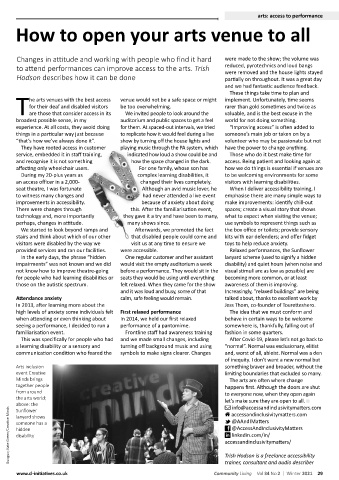
Arts inclusion something braver and broader, without the
event Creative limiting boundaries that excluded so many.
Minds brings The arts are often where change
together people happens first. Although the doors are shut
from around to everyone now, when they open again
the arts world;
above: the let’s make sure they are open to all. n
info@accessandinclusivitymatters.com
Guoguo; Kate Green/Creative Minds someone has a t @AAndIMatters
Sunflower
accessandinclusivitymatters.com
lanyard shows
f @AccessAndInclusivityMatters
hidden
l linkedin.com/in/
disability
accessandinclusivitymatters/
Trish Hodson is a freelance accessibility
trainer, consultant and audio describer
www.cl-initiatives.co.uk Community Living Vol 34 No 2 | Winter 2021 29

