


Page 28 - Community Living Magazine 34-2
P. 28
arts: inclusion
       Life after lockdown


       Creative people with learning disabilities face an uncertain
       future, professionally and personally, writes Tracey Harding.
       They must not fall behind when the arts open up again


           ovid-19 and the lockdowns that   with eight stops, each lasting 5-10
           have followed nationally and    minutes (www.accessallareastheatre.org/
      Cinternationally have caused         stillhere). Audience members could use
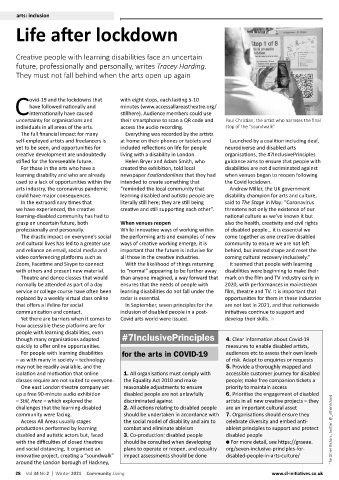
       uncertainty for organisations and   their smartphone to scan a QR code and   Paul Christian, the artist who narrates the final
       individuals in all areas of the arts.   access the audio recording.      stop of the “soundwalk”
        The full financial impact for many   Everything was recorded by the artists
       self-employed artists and freelancers is   at home on their phones or tablets and   Launched by a coalition including deaf,
       yet to be seen, and opportunities for   included reflections on life for people   neurodiverse and disabled arts
       creative development are undoubtedly   living with a disability in London.   organisations, the #7InclusivePrinciples
       stifled for the foreseeable future.   Helen Bryer and Adam Smith, who    guidance aims to ensure that people with
        For those in the arts who have a   created the exhibition, told local   disabilities are not discriminated against
       learning disability and who are already   newspaper Eastlondonlines that they had   when venues began to reopen following
       used to a lack of opportunities within the   intended to create something that   the Covid lockdown.
       arts industry, the coronavirus pandemic   “reminded the local community that   Andrew Miller, the UK government
       could have major consequences.      learning disabled and autistic people are   disability champion for arts and culture,
        In the extraordinary times that    literally still here; they are still being   said to The Stage in May: “Coronavirus
       we have experienced, the creative   creative and still supporting each other”.   threatens not only the existence of our
       learning-disabled community has had to                                   national culture as we’ve known it but
       grasp an uncertain future, both     When venues reopen                   also the health, creativity and civil rights
       professionally and personally.      While innovative ways of working within   of disabled people… it is essential we
        The drastic impact on everyone’s social   the performing arts and examples of new   come together as one creative disabled
       and cultural lives has led to a greater use   ways of creative working emerge, it is   community to ensure we are not left
       and reliance on email, social media and   important that the future is inclusive for   behind, but instead shape and reset the
       video conferencing platforms such as   all those in the creative industries.   coming cultural recovery inclusively.”
       Zoom, Facetime and Skype to connect   With the likelihood of things returning   It seemed that people with learning
       with others and present new material.   to “normal” appearing to be further away   disabilities were beginning to make their
        Theatre and dance classes that would   than anyone imagined, a way forward that  mark on the film and TV industry early in
       normally be attended as part of a day   ensures that the needs of people with   2020, with performances in mainstream
       service or college course have often been   learning disabilities do not fall under the   film, theatre and TV. It is important that
       replaced by a weekly virtual class online   radar is essential.          opportunities for them in these industries
       that offers a lifeline for social     In September, seven principles for the   are not lost in 2021, and that nationwide
       communication and contact.          inclusion of disabled people in a post-  initiatives continue to support and
        Yet there are barriers when it comes to   Covid arts world were issued.   develop their skills. n
       how accessible these platforms are for
       people with learning disabilities, even
       though many organisations adapted    #7InclusivePrinciples               4. Clear information about Covid-19
       quickly to offer online opportunities.                                   measures to enable disabled artists,
        For people with learning disabilities    for the arts in COVID-19       audiences etc to assess their own levels
       – as with many in society – technology                                   of risk. Adapt to enquiries or requests
       may not be readily available, and the                                    5. Provide a thoroughly mapped and
       isolation and motivation that online   1. All organisations must comply with   accessible customer journey for disabled
       classes require are not suited to everyone.   the Equality Act 2010 and make   people; make free companion tickets a
        One east London theatre company set   reasonable adjustments to ensure   priority to maintain access
       up a free 90-minute audio exhibition   disabled people are not unlawfully    6. Prioritise the engagement of disabled
       – Still, Here – which explored the   discriminated against               artists in all new creative projects – they
       challenges that the learning-disabled   2. All actions relating to disabled people   are an important cultural asset
       community were facing.               should be undertaken in accordance with  7. Organisations should ensure they
        Access All Areas usually stages     the social model of disability and aim to   celebrate diversity and embed anti-
       productions performed by learning    combat and eliminate ableism        ableist principles to support and protect  The Other Richard, twitter: @_otherrichard
       disabled and autistic actors but, faced   3. Co-production: disabled people   disabled people
       with the difficulties of closed theatres    should be consulted when developing   ● For more detail, see https://graeae.
       and social distancing, it organised an   plans to operate or reopen, and equality   org/seven-inclusive-principles-for-
       innovative project, creating a “soundwalk”   impact assessments should be done  disabled-people-in-arts-culture/
       around the London borough of Hackney,

      28  Vol 34 No 2  |  Winter 2021  Community Living                                         www.cl-initiatives.co.uk

