


Page 17 - Community Living Magazine 34-2
P. 17
in conversation

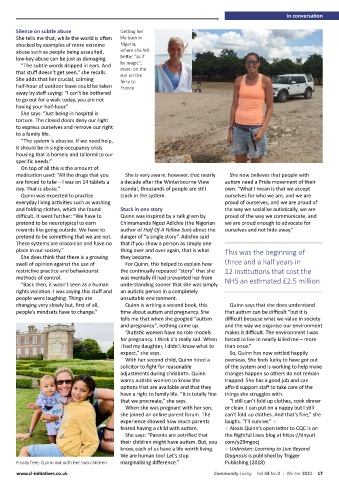
       Silence on subtle abuse             Getting her
       She tells me that, while the world is often   life back in
       shocked by examples of more extreme   Nigeria,
       abuse such as people being assaulted,   where she felt
       low-key abuse can be just as damaging.   better “as if
        “The subtle words dripped in ears. And   by magic”;
       that stuff doesn’t get seen,” she recalls.   inset: on the
                                           run on the
       She adds that her crucial, calming   ferry to
       half-hour of outdoor leave could be taken   France
       away by staff saying: “I can’t be bothered
       to go out for a walk today, you are not
       having your half-hour.”
        She says: “Just being in hospital is
       torture. The closed doors deny our right
       to express ourselves and remove our right
       to a family life.
        “The system is abusive. If we need help,
       it should be in single-occupancy crisis
       housing that is homely and tailored to our
       specific needs.”
        On top of all this is the amount of
       medication used: “All the drugs that you   She is very aware, however, that nearly   She now believes that people with
       are forced to take – I was on 14 tablets a   a decade after the Winterbourne View   autism need a Pride movement of their
       day. That is abuse.”                scandal, thousands of people are still   own: “What I mean is that we accept
        Quinn was expected to practise     stuck in the system.                 ourselves for who we are, and we are
       everyday living activities such as washing                               proud of ourselves, and we are proud of
       and folding clothes, which she found   Stuck in one story                the way we socialise autistically, we are
       difficult. It went further: “We have to   Quinn was inspired by a talk given by   proud of the way we communicate, and
       pretend to be neurotypical to earn   Chimamanda Ngozi Adichie (the Nigerian   we are proud enough to advocate for
       rewards like going outside. We have to   author of Half Of A Yellow Sun) about the   ourselves and not hide away.”
       pretend to be something that we are not.   danger of “a single story”. Adichie said
       These systems are draconian and have no   that if you show a person as simply one
       place in our society.”              thing over and over again, that is what   This was the beginning of
        She does think that there is a growing   they become.
       swell of opinion against the use of   For Quinn, this helped to explain how   three and a half years in
       restrictive practice and behaviourist   the continually repeated “story” that she   12 institutions that cost the
       methods of control.                 was mentally ill had prevented her from   NHS an estimated £2.5 million
        “Back then, it wasn’t seen as a human   understanding sooner that she was simply
       rights violation. I was saying this stuff and   an autistic person in a completely
       people were laughing. Things are    unsuitable environment.
       changing very slowly but, first of all,   Quinn is writing a second book, this   Quinn says that she does understand
       people’s mindsets have to change.”   time about autism and pregnancy. She   that autism can be difficult “but it is
                                           tells me that when she googled “autism   difficult because what we value in society
                                           and pregnancy”, nothing came up.     and the way we organise our environment
                                             “Autistic women have no role models   makes it difficult. The environment I was
                                           for pregnancy. I think it’s really sad. When   forced to live in nearly killed me – more
                                           I had my daughter, I didn’t know what to   than once.”
                                           expect,” she says.                     So, Quinn has now settled happily
                                             With her second child, Quinn hired a   overseas. She feels lucky to have got out
                                           solicitor to fight for reasonable    of the system and is working to help make
                                           adjustments during childbirth. Quinn   changes happen so others do not remain
                                           wants autistic women to know the     trapped. She has a good job and can
                                           options that are available and that they   afford support staff to take care of the
                                           have a right to family life. “It is totally fine   things she struggles with.
                                           that we procreate,” she says.          “I still can’t fold up clothes, cook dinner
                                             When she was pregnant with her son,   or clean. I can put on a nappy but I still
                                           she joined an online parent forum. The   can’t fold up clothes. And that’s fine,” she
                                           experience showed how much parents   laughs. “I’ll survive.” n
                                           feared having a child with autism.   ● Alexis Quinn’s open letter to CQC is on
                                             She says: “Parents are petrified that   the Rightful Lives blog at https://tinyurl.
                                           their children might have autism. But, you   com/y29mgocj
                                           know, each of us have a life worth living.   ● Unbroken: Learning to Live Beyond
                                           We are human too! Let’s stop         Diagnosis is published by Trigger
       Finally free: Quinn out with her two children  marginalising difference.”   Publishing (2018)
       www.cl-initiatives.co.uk                                             Community Living  Vol 34 No 2  |  Winter 2021  17

