


Page 13 - Community Living Magazine 33 - 3
P. 13
opinion

       The trouble with rights in reality


       Fundamental human rights have been protected globally for                  Today, questions around the full
       more than 70 years. So why, asks Simon Jarrett, are the rights           personhood of people with learning
                                                                                disabilities persist. Here in the UK, however
       of people with learning disabilities proving so problematic?             much it is claimed that rights apply to all,
                                                                                enduring practices such as incarceration in
                                                                                assessment and treatment centres with
           he purpose of rights is to protect   usefulness of documents such as the 1948  little or no legal recourse, denial of the
           and to empower people – to      United Nations’ Universal Declaration of   right to family life, education and work,
       Tprotect them from harm, such as    Human Rights and the 1975 Declaration of  inferior levels of health treatment, and
       violence or starvation, and to empower   the Rights of Disabled Persons.  abuse even within community-based
       them to live good lives through freedom    Unless such rights are enforceable,   services demonstrate that universal rights
       and opportunity.                    with an effective method for enforcement,  frameworks can be of little value if people
        There are therefore rights that confer   argues Geuss, they are only an expression   are perceived as lacking full personhood.
       “freedom from” and those that provide   of what we regard as desirable, a good   This is exemplified in the name of
       “freedom to”. Freedom from rights tend   idea that we would like to see happen.   the movement campaigning to release
       to protect individuals while freedom to   Worse, he suggests, such declarations   people locked up in “specialist”
       rights tend to be enabling, according                                    institutions – #HumanToo.
       liberties to people that can carry risks.                                  The often unconsciously held belief that
        The fact that these two forms of rights   “  While rights are           people with learning disabilities are not
       can be contradictory – to achieve personal                               fully human derives in part from our
       realisation, a person may sometimes have   necessary, they are           notion of mental capacity. If we argue that
       to shed some of their protective rights to   not sufficient to guarantee   a person does not fully belong because
       employ their right to take risks – is at the   inclusion, protection     they lack the ability to reason, or read or
       heart of the struggle many people with                                   write, or live independently, we are
       learning disabilities experience in exercising   and equality            assigning them to a lower level of
       their rights to live the lives they wish to live.                ”       personhood than the rest of society.
        However, as several contributors to this                                  Rather than society adapting to
       issue eloquently attest, other factors   can be positively harmful, creating an   whatever characteristics particular humans
       underlie the difficulties experienced by   illusion of a world in which rights are   might have, we construct a society that
       people with learning disabilities   respected. For the most powerless and   excludes and withholds rights from people
       concerning their rights.            isolated, the world is no such thing but, for  who lack certain “essential” capacities.
        For Simon Duffy (page 10), human rights  those of us who are more powerful and   None of this is to say that rights have no
       are not in themselves enough; they   connected, the illusion of rights for all is   place in the lives of people with learning
       require inclusive communities to enable   psychologically attractive and comforting.   disabilities. Indeed, they are essential in
       full and equal citizenship. Sally Warren                                 modern societies where, without them,
       and Jo Giles (pages 22-23) talk about the   Who counts as a person?      the risks of discrimination and abuse are
       dissipation of rights in certain cultures and  Where rights apply to “all people”, the   extremely high.
       environments to the point where people   question of what constitutes a “person” is   However, rights must be enforceable
       struggle to retain them. Clare Palmer and   paramount. The French Revolution’s 1789   and relate to real lives rather than be
       Virginia Bovell (opposite page) attest to   Declaration of the Rights of Man did not   illusory ideas about people and the world
       the difficulties of applying a universal set   include women. America’s Declaration of   in which they live.
       of rights (particularly freedom to rights) to  Independence in 1776 declared the   Moreover, it is important to remember
       people with the most profound disabilities.  equality of all “men” but this did not   that, while rights are necessary, they are
        Political theorist Raymond Geuss (2001)   include black slaves. In both cases, women  not sufficient to guarantee inclusion,
       has questioned the effectiveness and   and slaves were not seen as fully human.   protection and equality.
                                                                                  To reshape society, there must also be a
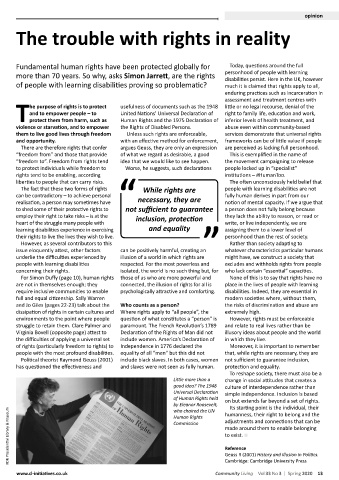
                                                              Little more than a   change in social attitudes that creates a
                                                              good idea? The 1948   culture of interdependence rather than
                                                              Universal Declaration   simple independence. Inclusion is based
                                                              of Human Rights held   on but extends far beyond a set of rights.
                                                              by Eleanor Roosevelt,   humanness, their right to belong and the
                                                                                  Its starting point is the individual, their
    FDR Presidential Library & Museum                         Commission        adjustments and connections that can be
                                                              who chaired the UN
                                                              Human Rights
                                                                                made around them to enable belonging
                                                                                to exist. n

                                                                                Reference
                                                                                Geuss R (2001) History and Illusion in Politics.
                                                                                Cambridge: Cambridge University Press

       www.cl-initiatives.co.uk                                              Community Living  Vol 33 No 3  |  Spring 2020  13

