


Page 12 - Community Living Magazine 33 - 3
P. 12
opinion

       How inclusive is the learning disability community?


       Could self-advocates do more to include people with profound
       and multiple learning disabilities and be more realistic about
       what they can achieve? ask Clare Palmer and Virginia Bovell


           he self-advocacy movement, with   too often been seen as an obstacle to
           its aims of promoting           independence rather than a critical cog in
       Tindependence and choice, inclusion  the wheel of belonging.”
       and better opportunities for people with
       learning disabilities, is hugely valuable.   Greeted with suspicion
        We applaud its achievements        There is a long history of family advocacy
       wholeheartedly. However, major      that has led to progressive developments.
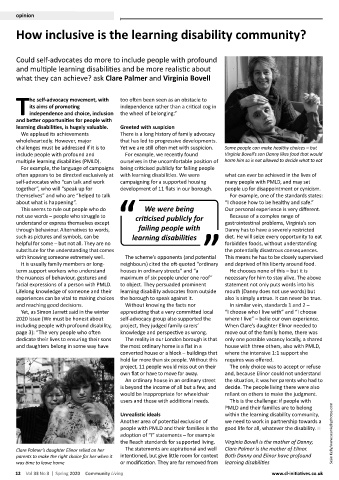
       challenges must be addressed if it is to   Yet we are still often met with suspicion.   Some people can make healthy choices – but
       include people with profound and      For example, we recently found     Virginia Bovell’s son Danny likes food that would
       multiple learning disabilities (PMLD).  ourselves in the uncomfortable position of   harm him so is not allowed to decide what to eat
        For example, the language of campaigns  being criticised publicly for failing people
       often appears to be directed exclusively at  with learning disabilities. We were   what can ever be achieved in the lives of
       self-advocates who “can talk and work   campaigning for a supported housing   many people with PMLD, and may set
       together”, who will “speak up for   development of 11 flats in our borough.   people up for disappointment or cynicism.
       themselves” and who are “helped to talk                                    For example, one of the standards states:
       about what is happening”.                                                “I choose how to be healthy and safe.”
        This seems to rule out people who do   “    We were being               Our personal experience is very different.
       not use words – people who struggle to    criticised publicly for          Because of a complex range of
       understand or express themselves except                                  gastrointestinal problems, Virginia’s son
       through behaviour. Alternatives to words,   failing people with          Danny has to have a severely restricted
       such as pictures and symbols, can be       learning disabilities       “  diet. He will seize every opportunity to eat
       helpful for some – but not all. They are no                              forbidden foods, without understanding
       substitute for the understanding that comes                              the potentially disastrous consequences.
       with knowing someone extremely well.   The scheme’s opponents (and potential   This means he has to be closely supervised
        It is usually family members or long-  neighbours) cited the oft-quoted “ordinary   and deprived of his liberty around food.
       term support workers who understand   houses in ordinary streets” and “a   He chooses none of this – but it is
       the nuances of behaviour, gestures and   maximum of six people under one roof”   necessary for him to stay alive. The above
       facial expressions of a person with PMLD.   to object. They persuaded prominent   statement not only puts words into his
       Lifelong knowledge of someone and their   learning disability advocates from outside   mouth (Danny does not use words) but
       experiences can be vital to making choices  the borough to speak against it.   also is simply untrue. It can never be true.
       and reaching good decisions.          Without knowing the facts nor        In similar vein, standards 1 and 2 –
        Yet, as Simon Jarrett said in the winter   appreciating that a very committed local   “I choose who I live with” and “I choose
       2020 issue (We must be honest about   self-advocacy group also supported the   where I live” – belie our own experience.
       including people with profound disability,   project, they judged family carers’   When Clare’s daughter Elinor needed to
       page 3): “The very people who often   knowledge and perspective as wrong.   move out of the family home, there was
       dedicate their lives to ensuring their sons   The reality in our London borough is that   only one possible vacancy locally, a shared
       and daughters belong in some way have   the most ordinary home is a flat in a   house with three others, also with PMLD,
                                           converted house or a block – buildings that   where the intensive 1:1 support she
                                           hold far more than six people. Without this   requires was offered.
                                           project, 11 people would miss out on their   The only choice was to accept or refuse
                                           own flat or have to move far away.   and, because Elinor could not understand
                                             An ordinary house in an ordinary street   the situation, it was her parents who had to
                                           is beyond the income of all but a few, and   decide. The people living there were also
                                           would be inappropriate for wheelchair   reliant on others to make the judgment.
                                           users and those with additional needs.  This is the challenge: if people with
                                                                                PMLD and their families are to belong
                                           Unrealistic ideals                   within the learning disability community,
                                           Another area of potential exclusion of   we need to work in partnership towards a
                                           people with PMLD and their families is the   good life for all, whatever the disability. n
                                           adoption of “I” statements – for example                                   Seán Kelly/www.seankellyphotos.com
                                           the Reach standards for supported living.   Virginia Bovell is the mother of Danny;
       Clare Palmer’s daughter Elinor relied on her   The statements are aspirational and well   Clare Palmer is the mother of Elinor.
       parents to make the right choice for her when it   intentioned, but give little room for context   Both Danny and Elinor have profound
       was time to leave home              or modification. They are far removed from   learning disabilities
      12  Vol 33 No 3  |  Spring 2020  Community Living                                         www.cl-initiatives.co.uk

