


Page 30 - Community Living Magazine 35-3
P. 30
history
      Absconding as an act of resistance


       Escaping from hospital was dismissed by the authorities as the           perpetrators of any agency and refused to
       behaviour of ‘vicious’ or ‘discontented’ individuals but it was a        accept that absconding could be inspired
                                                                                by any genuine grievance.
       feat of defiance, explains Susanna Shapland                                In reality, absconding was an act of

                                                                                wilful resistance by individual patients for
           he “unauthorised absence of a                                        whom life in the institution – whether
           patient from a hospital”, known as                                   temporarily or on a more permanent basis
       Tabsconding, has long been a                                             – was intolerable.
       regular feature in the annual reports of                                   In the 1981 documentary film Silent
       long-stay institutions.                                                  Minority, patients at Borocourt Hospital in
        Historically, official records tended to                                Reading, kept unstimulated in a bare
       downplay absconding as very rare and the                                 outside compound for hours on end,
       act of only the most troublesome and                                     attempted to dig their way out. The
       difficult patients.                                                      narrator acknowledged the act by drily
        At the same time, escape attempts were                                  noting “one or two still fight the system”.
       portrayed by the authorities as genuine                                    O’Driscoll and Walmsley found similar
       causes for concern. Absconding patients                                  examples of attempted escape as a means
       were said to be at significant risk of harm,                             of “fighting the system”.
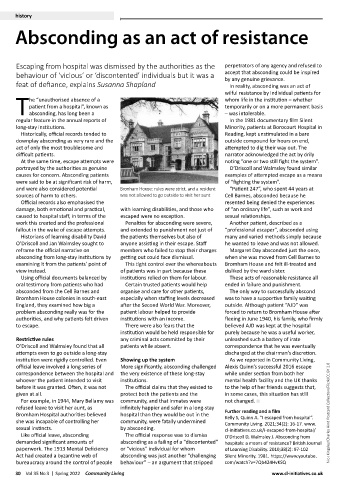
       and were also considered potential   Bronham House: rules were strict, and a resident   “Patient 247”, who spent 44 years at
       sources of harm to others.          was not allowed to go outside to visit her aunt  Cell Barnes, absconded because he
        Official records also emphasised the                                    resented being denied the experiences
       damage, both emotional and practical,   with learning disabilities, and those who   of “an ordinary life”, such as work and
       caused to hospital staff, in terms of the   escaped were no exception.   sexual relationships.
       work this created and the professional   Penalties for absconding were severe,   Another patient, described as a
       fallout in the wake of escape attempts.  and extended to punishment not just of   “professional escaper”, absconded using
        Historians of learning disability David   the patients themselves but also of   many and varied methods simply because
       O’Driscoll and Jan Walmsley sought to   anyone assisting in their escape. Staff   he wanted to leave and was not allowed.
       reframe the official narrative on   members who failed to stop their charges   Margaret Day absconded just the once,
       absconding from long-stay institutions by   getting out could face dismissal.  when she was moved from Cell Barnes to
       examining it from the patients’ point of   This tight control over the whereabouts   Bromham House and felt ill-treated and
       view instead.                       of patients was in part because these   disliked by the ward sister.
        Using official documents balanced by   institutions relied on them for labour.   These acts of reasonable resistance all
       oral testimony from patients who had   Certain trusted patients would help   ended in failure and punishment.
       absconded from the Cell Barnes and   organise and care for other patients,   The only way to successfully abscond
       Bromham House colonies in south-east   especially when staffing levels decreased   was to have a supportive family waiting
       England, they examined how big a    after the Second World War. Moreover,   outside. Although patient “AJD” was
       problem absconding really was for the   patient labour helped to provide   forced to return to Bromham House after
       authorities, and why patients felt driven   institutions with an income.   fleeing in June 1940, his family, who firmly
       to escape.                            There were also fears that the     believed AJD was kept at the hospital
                                           institution would be held responsible for   purely because he was a useful worker,
       Restrictive rules                   any criminal acts committed by their   unleashed such a battery of irate
       O’Driscoll and Walmsley found that all   patients while absent.          correspondence that he was eventually
       attempts even to go outside a long-stay                                  discharged at the chairman’s discretion.
       institution were rigidly controlled. Even   Showing up the system          As we reported in Community Living,
       official leave involved a long series of   More significantly, absconding challenged   Alexis Quinn’s successful 2016 escape
       correspondence between the hospital and  the very existence of these long-stay   while under section from both her
       whoever the patient intended to visit   institutions.                    mental health facility and the UK thanks
       before it was granted. Often, it was not   The official claims that they existed to   to the help of her friends suggests that,
       given at all.                       protect both the patients and the    in some cases, this situation has still
        For example, in 1944, Mary Bellamy was  community, and that inmates were   not changed. n
       refused leave to visit her aunt, as   infinitely happier and safer in a long-stay   Further reading and a film
       Bromham Hospital authorities believed   hospital than they would be out in the   Kelly S, Quinn A. “I escaped from hospital”.   Nick Kingsley/Charles Hind Postcard Collection/Flicrk/CC BY 2.0
       she was incapable of controlling her   community, were fatally undermined   Community Living. 2021;34(2): 16-17. www.
       sexual instincts.                   by absconding.                       cl-initiatives.co.uk/i-escaped-from-hospital/
        Like official leave, absconding      The official response was to dismiss   O’Driscoll D, Walmsley J. Absconding from
       demanded significant amounts of     absconding as a failing of a “discontented”   hospitals: a means of resistance? British Journal
       paperwork. The 1913 Mental Deficiency   or “vicious” individual for whom   of Learning Disability. 2010;38(2): 97-102
       Act had created a byzantine web of   absconding was just another “challenging   Silent Minority. 1981. https://www.youtube.
       bureaucracy around the control of people   behaviour” – an argument that stripped   com/watch?v=7Qb424HvKSQ

      30  Vol 35 No 3  |  Spring 2022  Community Living                                         www.cl-initiatives.co.uk

