


Page 28 - Community Living Magazine 35-3
P. 28
shared lives then and now

       Finding Grace Eyre – a pioneer of shared lives


       Young people discovered the value of history through the story           generations lacked control over their lives,
       of Grace Eyre, who set up a society that organised homes in the          including choice of how and where they
                                                                                lived, showed how much had changed
       community, report Nathaniel Lawford and Jackie Reeve                     – and that more change was needed.
                                                                                  One participant said the project
                                                                                materials “will be such a great resource to
           he Grace Eyre Foundation, founded                                    support people’s understanding about
           in 1913 as the Guardianship Society,                                 where people with learning disabilities
       Twas unique for its time.                                                came from and where we’re heading in the
        In response to widespread                                               future and what we can do to change that”.
       institutionalisation following the 1913                                    Talking about Grace Eyre’s life was a
       Mental Deficiency Act, its founder, Grace                                prompt for these discussions, particularly
       Eyre Woodhead (1864-1936) pioneered a                                    where her own words were used to reflect
       model of community based                                                 on her work and the times she lived in.
       “guardianship”, providing homes for                                        When talking about past limits on
       adults and children with learning                                        opportunities, many participants related
       disabilities in Brighton and rural Sussex.                               these directly to their own experience.
        This gradually evolved into a shared lives                                From several life stories we recorded, it
       service – the oldest and longest running in                              became clear that a priority had been to
       the country. Shared lives involves paid                                  find people work to help them to be
       carers sharing their homes and lives with                                useful and economically productive. The
       people who need support to enable them                                   Guardianship Society would negotiate
       to lead an independent life.                                             jobs with local employers and people
        The foundation received funding from                                    would be sent there to work – with very
       the Heritage Lottery Fund in 2019 to                                     little choice over this.
       enable people with learning disabilities to                                In the early years, that might have meant
       explore their own history, share their life                              young women going into service and young
       stories, learn heritage skills and help to                               men being placed on Guardianship-owned
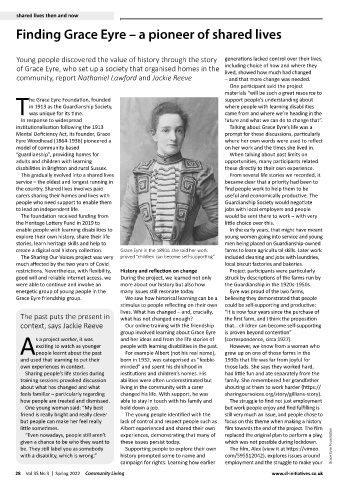
       create a digital oral history collection.  Grace Eyre in the 1890s: she said her work   farms to learn agricultural skills. Later work
        The Sharing Our Voices project was very   proved “children can become self-supporting”  included cleaning and jobs with laundries,
       much affected by the two years of Covid                                  local biscuit factories and bakeries.
       restrictions. Nevertheless, with flexibility,   History and reflection on change  Project participants were particularly
       good will and reliable internet access, we   During the project, we learned not only   struck by descriptions of the farms run by
       were able to continue and involve an   more about our history but also how   the Guardianship in the 1920s-1950s.
       energetic group of young people in the   many issues still resonate today.   Eyre was proud of the two farms,
       Grace Eyre friendship group.          We saw how historical learning can be a   believing they demonstrated that people
                                           stimulus to people reflecting on their own   could be self-supporting and productive:
                                           lives. What has changed – and, crucially,   “It is now four years since the purchase of
        The past puts the present in       what has not changed enough?         the first farm, and I think the proposition
        context, says Jackie Reeve           Our online training with the friendship   that… children can become self-supporting
                                           group involved learning about Grace Eyre   is proven beyond contention”
              s a project worker, it was   and her ideas and from the life stories of   (correspondence, circa 1927).
              exciting to watch as younger   people with learning disabilities in the past.  However, we know from a woman who
        Apeople learnt about the past        For example Albert (not his real name),   grew up on one of those farms in the
        and used that learning to put their   born in 1932, was categorised as “feeble-  1930s that life was far from joyful for
        own experiences in context.        minded” and spent his childhood in   those lads. She says they worked hard,
          Sharing people’s life stories during   institutions and children’s homes. His   had little fun and ate separately from the
        training sessions provoked discussion   abilities were often underestimated but   family. She remembered her grandfather
        about what has changed and what    living in the community with a carer   shouting at them to work harder (https://
        feels familiar – particularly regarding   changed his life. With support, he was   sharingourvoices.org/story/gillians-story).
        how people are treated and dismissed.   able to stay in touch with his family and   The struggle to find not just employment
          One young woman said: “My best   hold down a job.                     but work people enjoy and find fulfilling is
        friend is really bright and really clever   The young people identified with the   still very much an issue, and people chose to
        but people can make her feel really   lack of control and respect people such as   focus on this theme when making a history
        little sometimes.                  Albert experienced and shared their own   film towards the end of the project. The film
          “Even nowadays, people still aren’t   experiences, demonstrating that many of   replaced the original plan to perform a play,
        given a chance to be who they want to   these issues persist today.     which was not possible during lockdown.
        be. They still label you as somebody   Supporting people to explore their own   The film, Alex (view it at https://vimeo.  Grace Eyre Foundation
        with a disability, which is wrong.”  history prompted some to name and   com/595512042), explores issues around
                                           campaign for rights. Learning how earlier   employment and the struggle to make your

      28  Vol 35 No 3  |  Spring 2022  Community Living                                         www.cl-initiatives.co.uk

