


Page 13 - Community Living Magazine 35-1
P. 13
safeguarding

       things would become possible and, I   expected to answer it as it applied   with equal exchange of cards, invitations
       believe, would be welcomed by the great   to yourself.                   and presents.
       majority of both staff and those supported.  A concept of “life sharing” was   Each person supported is helped to
        Supporting people with learning    prevalent in organisations such as L’Arche   keep a record, for example photographs
       disabilities is long-term work. Many staff   and Camphill, deriving from their positive   and an address book with contact details,
       work with the same individuals for many   founding philosophies (Williams and   which includes not only their own friends
       years – in some cases a lifetime. This offers   Evans, 2013).            and family but also staff who they are
       many opportunities for close friendship.   This concept prevails where the pressure   close to and their family and friends.
        I know of several instances where   to “professionalise” can be resisted. As
       people without a family have been taken   L’Arche (2021a) noted: “People with
       home by one of their supporters, for   learning disabilities have much to teach us   People without a family have
       example at Christmas, over many years,   and contribute to the world. During the   been taken home by staff, for
       to stay overnight and be part of family   last 50 years, we have learnt that one of
       celebrations, but the supporters have   the best ways to enable this is by creating…  example to stay at Christmas,
       been told it is now “unprofessional” and   a culture of shared lives between people   but supporters have been told
       cannot happen. There is a great sense of   with and without learning disabilities.”
       loss on both sides.                   There is mutual benefit in such    this is now ‘unprofessional’
                                           relationships: “I got to know the three
       Tyranny versus equality safeguarding  guys quite well over the course of the
       Before the advent of the tyranny and risk   year, and it changed my life in ways that I   Staff and people they support are
       avoidance within current notions of   had never expected. I was constantly   encouraged to be each other’s friends on
       safeguarding, evidence showed fostering   amazed at how much I was growing   social media. If they leave, staff are
       equality and genuine friendship between   through these friendships.     encouraged to keep in touch and be
       staff and those they support is beneficial   “I had thought I was coming to this   willing to continue friendship with the
       and greatly needed.                 programme to do a good thing and help   person they have supported, through
        The British Institute of Learning   people but actually it was me who was   visits, communications and in other ways.
       Disabilities in 1989 published a study of   being cared for. I learned that I can   If staff wish to consider fostering or an
       relationships between social workers and   experience meaningful, mutual friendship   adult placement, who better to do this for
       people with learning disabilities. In many   with people who… are different from   than someone they already know well?
       cases, there was true friendship and   myself” (L’Arche, 2021b).           Only in this way can the devastating
       sharing to the great benefit of everyone.   A study of a Camphill community   abuse of imposed loneliness, isolation and
        It reported: “The social worker’s task   involving life-sharing between people   friendlessness be tackled seriously. I
       was characterised by informality. It took   with learning disabilities and the   believe that experience of this is common
       place within long-term relationships.   extended families of their supporters   among people with learning disabilities
       Many people had their social worker’s   came to this conclusion: “Living in   and they are particularly vulnerable to it
       home address and telephone number.   extended families in a long-term social   and concerned about it.
       Many social workers described themselves   relationship with co-workers/assistants   I also believe that being a true friend to
       as friends of the people with whom they   enables both groups to become familiar   someone and sharing your life with them
       worked. Some service users shared this   with each other’s pattern of    is a much stronger safeguard against more
       view and came to see their social workers   communication: an essential step if a   direct abuse than rules and so-called
       as their friends too” (Atkinson, 1989).  person with a learning disability is to   “professional standards” (Williams, 2019).
        More than 40 years ago, Values Into   learn of the world and express choices   Unfortunately, this issue has been
       Action held what were called participation   about what they want to do in it.   exacerbated further by the Covid
       workshops to foster equal relationships   “It also helps generate a sense of   restrictions. Now is the time to reconsider
       between staff and those they supported.   community in which they feel part of a   what we are doing. n
       A whole weekend event was structured   readily available, supportive and
       around equal sharing. Rooms, facilities   dependable social structure.” (Randell   References
                                                                                Atkinson D (1989) Someone to Turn to: the
       and activities were shared and, if you   and Cumella, 2009).             Role of Front-line Staff. BILD Publications
       asked a question of a person, you were                                   L’Arche (2021a) What We Do. https://www.
                                           A hug, a family, a different approach  larche.org.uk/what-wedo
                                           This is what I would like to see. On arrival   L’Arche (2021b) Meaningful and Mutual
                                           to support a person, staff give them a hug.
                                                                                Relationships. https://tinyurl.com/rxamst5j
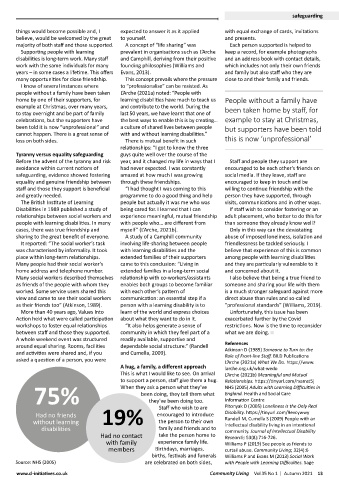
             75%                           When they ask a person what they’ve   NHS (2005) Adults with Learning Difficulties in
                                                                                England. Health and Social Care
                                                   been doing, they tell them what
                                                                                Information Centre
                                                     they’ve been doing too.
                                                         Staff who wish to are
                                                                                Disability. https://tinyurl.com/9evcywwy
              Had no friends         19%                encouraged to introduce   Pitonyak D (2005) Loneliness is the Only Real
             without learning                            the person to their own   Randell M, Cumella S (2009) People with an
                                                                                intellectual disability living in an intentional
                disabilities                             family and friends and to   community. Journal of Intellectual Disability
                                    Had no contact       take the person home to   Research; 53(8):716-726.
                                      with family        experience family life.   Williams P (2019) See people as friends to
                                       members          Birthdays, marriages,   curtail abuse. Community Living; 32(4):6
                                                      births, festivals and funerals   Williams P and Evans M (2013) Social Work
       Source: NHS (2005)                           are celebrated on both sides,   with People with Learning Difficulties. Sage
       www.cl-initiatives.co.uk                                            Community Living  Vol 35 No 1  |  Autumn 2021  13

