


Page 12 - Community Living Magazine 35-1
P. 12
safeguarding


                                                                                   The cold


                                                                            comfort of


                                                                    safeguarding


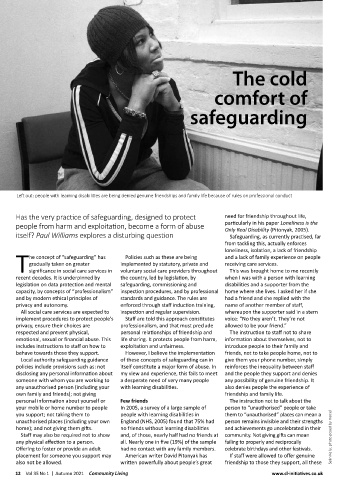
       Left out: people with learning disabilities are being denied genuine friendships and family life because of rules on professional conduct


       Has the very practice of safeguarding, designed to protect               need for friendship throughout life,
       people from harm and exploitation, become a form of abuse                particularly in his paper Loneliness is the
                                                                                Only Real Disability (Pitonyak, 2005).
       itself? Paul Williams explores a disturbing question                       Safeguarding, as currently practised, far
                                                                                from tackling this, actually enforces
                                                                                loneliness, isolation, a lack of friendship
           he concept of “safeguarding” has   Policies such as these are being   and a lack of family experience on people
           gradually taken on greater      implemented by statutory, private and   receiving care services.
       Tsignificance in social care services in   voluntary social care providers throughout   This was brought home to me recently
       recent decades. It is underpinned by   the country, led by legislation, by   when I was with a person with learning
       legislation on data protection and mental   safeguarding, commissioning and   disabilities and a supporter from the
       capacity, by concepts of “professionalism”   inspection procedures, and by professional  home where she lives. I asked her if she
       and by modern ethical principles of   standards and guidance. The rules are   had a friend and she replied with the
       privacy and autonomy.               enforced through staff induction training,   name of another member of staff,
        All social care services are expected to   inspection and regular supervision.   whereupon the supporter said in a stern
       implement procedures to protect people’s   Staff are told this approach constitutes   voice: “No they aren’t. They’re not
       privacy, ensure their choices are   professionalism, and that must preclude   allowed to be your friend.”
       respected and prevent physical,     personal relationships of friendship and   The instruction to staff not to share
       emotional, sexual or financial abuse. This   life sharing. It protects people from harm,   information about themselves, not to
       includes instructions to staff on how to   exploitation and unfairness.   introduce people to their family and
       behave towards those they support.    However, I believe the implementation   friends, not to take people home, not to
        Local authority safeguarding guidance   of these concepts of safeguarding can in   give them your phone number, simply
       policies include provisions such as: not   itself constitute a major form of abuse. In   reinforces the inequality between staff
       disclosing any personal information about   my view and experience, this fails to meet   and the people they support and denies
       someone with whom you are working to   a desperate need of very many people   any possibility of genuine friendship. It
       any unauthorised person (including your   with learning disabilities.    also denies people the experience of
       own family and friends); not giving                                      friendship and family life.
       personal information about yourself or   Few friends                       The instruction not to talk about the
       your mobile or home number to people   In 2005, a survey of a large sample of   person to “unauthorised” people or take
       you support; not taking them to     people with learning disabilities in   them to “unauthorised” places can mean a
       unauthorised places (including your own   England (NHS, 2005) found that 75% had   person remains invisible and their strengths
       home); and not giving them gifts.   no friends without learning disabilities   and achievements go uncelebrated in their
        Staff may also be required not to show   and, of those, nearly half had no friends at  community. Not giving gifts can mean
       any physical affection to a person.   all. Nearly one in five (19%) of the sample   failing to properly and reciprocally   Seán Kelly; photo posed by model
       Offering to foster or provide an adult   had no contact with any family members.   celebrate birthdays and other festivals.
       placement for someone you support may   American writer David Pitonyak has   If staff were allowed to offer genuine
       also not be allowed.                written powerfully about people’s great   friendship to those they support, all these

      12  Vol 35 No 1  |  Autumn 2021  Community Living                                         www.cl-initiatives.co.uk

