


Page 30 - Community Living Magazine 34-1
P. 30
history
       From sidelined to expert storytellers


       The history of learning disability was long neglected, with              is both fruitful and important. People
       firsthand accounts of those affected missing. Susanna Shapland           bring their own experiences to stand
                                                                                alongside the historical documentary
       describes the movement that changed this                                 evidence, often from official sources such

                                                                                as councils and institutions and, in so
                                                                                doing, challenge and disrupt these
          or decades, the history of learning                                   accepted narratives, revealing something
          disability was not given the                                          far more nuanced and complex.
      Frecognition it deserved. It was                                            Their stories also serve as a corrective
       subsumed into related topics such as the                                 to excessive claims of progress that were
       history of eugenics or of mental health,                                 particularly prominent with the closing of
       and historians tended to rely solely on                                  the long-stay institutions, reminding
       documentary evidence to write histories                                  historians and policy-makers alike that,
       of policies or institutions.                                             while much has changed, much has stayed
        Those with experience of living with a                                  the same and things still need to change.
       learning disability were sidelined and                                     In this way, people with learning
       silenced or, at best, portrayed as merely                                disabilities and historians are working
       victims of an uncaring or cruel system.                                  cooperatively as historian activists,
        This reflected how those with learning                                  coming together to tell their stories and
       disabilities were perceived – as people who                              influence policy. The lives of people with
       were unable to articulate their experiences                              learning disabilities as told by them are,
       or to understand them, and who needed                                    quite rightly, central to these works, and
       to be spoken for rather than listened to.                                historians have learnt how to adapt their
        This began to change in the 1970s with                                  practices to accommodate these experts
       the burgeoning disability rights movement.                               so their stories are properly told.
       Speaking Up events gave people with                                        The next step, as seen by people such
       learning disabilities the chance to speak                                as Atkinson and Walmsley, is to include
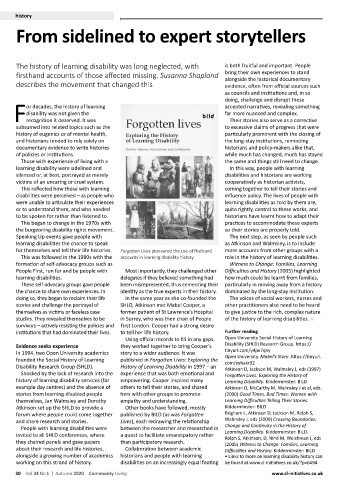
       for themselves and tell their life histories.   Forgotten Lives pioneered the use of firsthand   more accounts from other groups with a
        This was followed in the 1980s with the   accounts in learning disability history  role in the history of learning disabilities.
       formation of self-advocacy groups such as                                  Witness to Change: Families, Learning
       People First, run for and by people with   Most importantly, they challenged other   Difficulties and History (2005) highlighted
       learning disabilities.              delegates if they believed something had   how much could be learnt from families,
        These self-advocacy groups gave people   been misrepresented, thus cementing their  particularly in moving away from a history
       the chance to share own experiences. In   identity as the true experts in their history.   dominated by the long-stay institution.
       doing so, they began to reclaim their life   In the same year as she co-founded the   The voices of social workers, nurses and
       stories and challenge the portrayal of   SHLD, Atkinson met Mabel Cooper, a   other practitioners also need to be heard
       themselves as victims or faceless case   former patient of St Lawrence’s Hospital   to give justice to the rich, complex nature
       studies. They revealed themselves to be   in Surrey, who was then chair of People   of the history of learning disabilities. n
       survivors – actively resisting the policies and  First London. Cooper had a strong desire
       institutions that had dominated their lives.   to tell her life history.   Further reading
                                             Using official records to fill in any gaps,   Open University Social History of Learning
       Evidence seeks experience           they worked together to bring Cooper’s   Disability (SHLD) Research Group. https://
       In 1994, two Open University academics   story to a wider audience. It was   tinyurl.com/y4jw7qny
                                                                                Open University. Mabel’s Story. https://tinyurl.
       founded the Social History of Learning   published in Forgotten Lives: Exploring the   com/yyhakr32
       Disability Research Group (SHLD).   History of Learning Disability in 1997 – an   Atkinson D, Jackson M, Walmsley J, eds (1997)
        Shocked by the lack of research into the   experience that was both emotional and   Forgotten Lives: Exploring the History of
       history of learning disability services (for   empowering. Cooper inspired many   Learning Disability. Kidderminster: BILD
       example day centres) and the absence of   others to tell their stories, and shared   Atkinson D, McCarthy M, Walmsley J et al, eds.
       stories from learning-disabled people   hers with other groups to promote   (2000) Good Times, Bad Times: Women with
       themselves, Jan Walmsley and Dorothy   empathy and understanding.        Learning Difficulties Telling Their Stories.
       Atkinson set up the SHLD to provide a   Other books have followed, mostly   Kidderminster: BILD
       forum where people could come together   published by BILD (as was Forgotten   Brigham L, Atkinson D, Jackson M, Rolph S,
       and share research and stories.     Lives), each redrawing the relationship   Walmsley J, eds (2000) Crossing Boundaries:
        People with learning disabilities were   between the researcher and researched in   Change and Continuity in the History of
       invited to all SHLD conferences, where   a quest to facilitate emancipatory rather   Learning Disability. Kidderminster: BILD.
                                                                                Rolph S, Atkinson, D, Nind M, Welshman J, eds
       they chaired panels and gave papers   than participatory research.       (2005) Witness to Change: Families, Learning
       about their research and life histories,   Collaboration between academic   Difficulties and History. Kidderminster: BILD
       alongside a growing number of academics   historians and people with learning   • Links to more on learning disability history can
       working on this strand of history.   disabilities on an increasingly equal footing   be found at www.cl-initiatives.co.uk/?p=6494

      30  Vol 34 No 1  |  Autumn 2020  Community Living                                         www.cl-initiatives.co.uk

