


Page 23 - Community Living Magazine 32-3
P. 23
policy in practice

       Paved with good intentions


       A raft of recent laws and regulations to protect people have turned out to be harmful to those
       with learning disabilities, isolating them from friends and communities, creating restrictions
       and incurring vast expense in community care, says Paul Williams


           here are many ways in which laws                                     death of a person with no family, despite
           can disadvantage people with                                         them having many friends and contacts
       Tlearning disabilities.                                                  who could have been a comfort.
        I will start with a relatively minor                                      When data protection law is combined
       example. In the past, some people with                                   with the Mental Capacity Act, it can result
       learning disabilities were able to pass the                              in a paid advocate, who does not know
       driving test (Duffen, 2003). Then, in 1996,                              the person, being brought in to help with
       a theory test was introduced, which made                                 decisions instead of close friends and
       driving an intellectual as well as a practical                           carers who know the person well.
       activity, largely preventing anyone with                                   Following the Care Standards Act
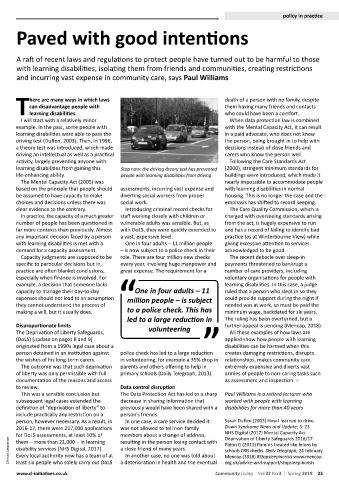
       learning disabilities from gaining this   Stop now: the driving theory test has prevented   (2000), stringent minimum standards for
       life-enhancing ability.             people with learning disabilities from driving  buildings were introduced, which made it
        The Mental Capacity Act (2005) was                                      nearly impossible to accommodate people
       based on the principle that people should   assessments, incurring vast expense and   with learning disabilities in normal
       be assumed to have capacity to make   diverting social workers from proper   housing. This is no longer the case and the
       choices and decisions unless there was   social work.                    emphasis has shifted to record keeping.
       clear evidence to the contrary.       Introducing criminal record checks for   The Care Quality Commission, which is
        In practice, the capacity of a much greater   staff working closely with children or   charged with overseeing standards arising
       number of people has been questioned in   vulnerable adults was sensible. But, as   from the act, is hugely expensive to run
       far more contexts than previously. Almost   with DoLS, they were quickly extended to   and has a record of failing to identify bad
       any important decision faced by a person   a vast, expensive level.      practice (as at Winterbourne view) while
       with learning disabilities is met with a   One in four adults – 11 million people   giving excessive attention to services
       demand for a capacity assessment.   – is now subject to a police check in their   acknowledged to be good.
        Capacity judgments are supposed to be   role. There are four million new checks   The recent debacle over sleep-in
       specific to particular decisions but in,   every year, involving huge manpower and   payments threatened to bankrupt a
       practice are often blanket conclusions,   great expense. The requirement for a   number of care providers, including
       they cannot understand the process of  “                                 learning disabilities. In this case, a judge
       especially when finance is involved. For
                                                                                voluntary organisations for people with
       example, a decision that someone lacks
                                                 One in four adults – 11
                                                                                ruled that a person who slept in so they
       capacity to manage their day-to-day
                                                                                could provide support during the night if
       expenses should not lead to an assumption
                                              million people – is subject
       making a will, but it usually does.    to a police check. This has       needed was at work, so must be paid the
                                                                                minimum wage, backdated for six years.
                                                                                The ruling has been overturned, but a
       Disproportionate limits                led to a large reduction in       further appeal is pending (Mencap, 2018).
                                                     volunteering
       The Deprivation of Liberty Safeguards,                                     All these examples of how laws are
       (DoLS) (update on pages 8 and 9)    police check has led to a large reduction  ”  applied show how people with learning
       originated from a 1990s legal case about a                               disabilities can be harmed when this
       person detained in an institution against                                creates damaging restrictions, disrupts
       the wishes of his long-term carers.   in volunteering, for example a 35% drop in  relationships, makes community care
        The outcome was that such deprivation   parents and others offering to help in   extremely expensive and diverts vast
       of liberty was only permissible with full   primary schools (Daily Telegraph, 2013).  armies of people to non-caring tasks such
       documentation of the reasons and access                                  as assessment and inspection. n
       to review.                          Data control disruption
        This was a sensible conclusion but   The Data Protection Act has led to a sharp   Paul Williams is a retired lecturer who
       subsequent legal cases extended the   decrease in sharing information that   worked with people with learning
       definition of “deprivation of liberty” to   previously would have been shared with a   disabilities for more than 40 years
       include practically any restriction on a   person’s friends.
       person, however necessary. As a result, in   In one case, a care service decided it   Sarah Duffen (2003) How I learned to drive.
       2016-17, there were 217,000 applications   was not allowed to tell non-family   Down Syndrome News and Update; 3: 23
       for DoLS assessments, at least 10% of   members about a change of address,   NHS Digital (2017) Mental Capacity Act
                                                                                Deprivation of Liberty Safeguards 2016/17.
    Christy Lawrance  disability services (NHS Digital, 2017).   a close friend of many years.   Paton G (2013) Parents treated like felons by
                                           resulting in the person losing contact with
       them – more than 21,000 – in learning
                                                                                schools CRB checks. Daily Telegraph; 24 February
       Every local authority now has a team of at
                                             In another case, no one was told about
                                                                                Mencap (2018) #Stopsleepincrisis.www.mencap.
                                           a deterioration in health and the eventual
       least six people who solely carry out DoLS
                                                                                org.uk/advice-and-support/stopsleepincrisis
       www.cl-initiatives.co.uk                                              Community Living  Vol 32 No 3  |  Spring 2019  23

