


Page 30 - Community Living Magazine 34-4
P. 30
history
       ‘Idiocy’ in early modern England


       Is it true that so-called ‘idiots’ were abused and hidden away           highly localised and had the family firmly
       before the asylum came to their rescue? What sort of lives did           at its centre.
                                                                                  The immediate family was expected to
       they really lead? Susanna Shapland investigates                          care for their idiot relative, with the parish

                                                                                stepping in to provide relief if they were
              uch of what is commonly                                           driven into poverty or if there were no
              understood about the lives of                                     family members alive or capable of
      Mpeople with learning disabilities                                        looking after the individual in question.
       in early modern England (circa 1500-1800)                                  In the latter situation, the parish could
       is skewed by preconceptions about                                        pay for the idiot to lodge for a period of
       that period.                                                             time with a “nurse” or keeper, usually in
        There is the romantic vision that                                       the same parish but occasionally nearby.
       confused and conflated those who were                                    The courts could enforce their judgment if
       commonly referred to as “idiots”                                         an appointed guardian proved reluctant
       with “lunatics”.                                                         to provide the agreed care or support.
        Popularised in the 19th century by the                                    This shows that, although parochial
       poet William Wordsworth and others, this                                 support was highly localised and could be
       view focused on the idea of figures such                                 somewhat rudimentary, there was a
       as the village idiot and Tom o’Bedlam.                                   system in place to support idiots in their
        Believed to be embraced by their                                        communities and this was an accepted
       pre-industrial societies, these characters                               part of parish life.
       were seen as being financially kept by                                     Showing there was an idiot in the
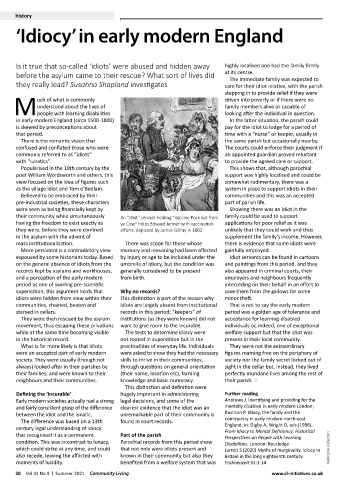
       their community while simultaneously   An “idiot” servant holding “Vaccine Pock hot from   family could be used to support
       having the freedom to exist exactly as   ye Cow” helps Edward Jenner with vaccination   applications for poor relief as it was
       they were, before they were confined    efforts, depicted by James Gillray in 1802  unlikely that they could work and thus
       in the asylum with the advent of                                         supplement the family’s income. However,
       mass institutionalisation.            There was scope for those whose    there is evidence that some idiots were
        More persistent is a contradictory view   memory and reasoning had been affected   gainfully employed.
       espoused by some historians today. Based   by injury or age to be included under the   Idiot servants can be found in cartoons
       on the general absence of idiots from the   umbrella of idiocy, but the condition was   and paintings from this period, and they
       records kept by asylums and workhouses,   generally considered to be present   also appeared in criminal courts, their
       and a perception of the early modern   from birth.                       employers and neighbours frequently
       period as one of swirling pre-scientific                                 interceding on their behalf in an effort to
       superstition, this argument holds that   Why no records?                 save them from the gallows for some
       idiots were hidden from view within their   This distinction is part of the reason why   minor theft.
       communities, chained, beaten and    idiots are largely absent from institutional   That is not to say the early modern
       starved in cellars.                 records in this period; “keepers” of   period was a golden age of tolerance and
        They were then rescued by the asylum   institutions (as they were known) did not   acceptance for learning-disabled
       movement, thus escaping these privations  want to give room to the incurable.  individuals or, indeed, one of exceptional
       while at the same time becoming visible   The tests to determine idiocy were    welfare support but that the idiot was
       in the historical record.           not rooted in superstition but in the   present in their local community.
        What is far more likely is that idiots   practicalities of everyday life. Individuals   They were not the extraordinary
       were an accepted part of early modern   were asked to show they had the necessary  figures roaming free on the periphery of
       society. They were usually (though not   skills to thrive in their communities,   society nor the family secret locked out of
       always) looked after in their parishes by   through questions on general orientation   sight in the cellar but, instead, they lived
       their families, and were known to their   (their name, location etc), farming   perfectly mundane lives among the rest of
       neighbours and their communities.   knowledge and basic numeracy.        their parish. n
                                             This distinction and definition were
       Defining the ‘incurable’            hugely important in administering    Further reading
       Early modern societies actually had a strong  legal decisions, and some of the    Andrews J. Identifying and providing for the
       and fairly consistent grasp of the difference   clearest evidence that the idiot was an   mentally disabled in early modern London;
       between the idiot and the lunatic.   unremarkable part of their community is   Rushton P. Idiocy, the family and the
        The difference was based on a 13th   found in court records.            community in early modern north-east
       century legal understanding of idiocy                                    England; in: Digby A, Wright D, eds (1996).
                                                                                From Idiocy to Mental Deficiency: Historical
       that recognised it as a permanent   Part of the parish                   Perspectives on People with Learning
       condition. This was in contrast to lunacy,   Parochial records from this period show   Disabilities. London: Routledge
       which could strike at any time, and could   that not only were idiots present and   Jarrett S (2020) Myths of marginality. Idiocy in   Wellcome Collection
       also recede, leaving the afflicted with   known in their community but also they   Britain in the long eighteenth century.
       moments of lucidity.                benefited from a welfare system that was   Frühneuzeit 31:1-14

      30  Vol 34 No 4  |  Summer 2021  Community Living                                         www.cl-initiatives.co.uk

